

Urban transportation networks depend on robust rail systems to maintain safety, efficiency, and public trust. In large metropolitan areas such as Los Angeles, millions of commuters rely daily on smooth, uninterrupted service. The integrity of rail infrastructure is central to this reliability.
To maintain the highest safety standards, EMA Industries recently completed a large-scale ultrasonic rail testing project for the Los Angeles Metro, covering more than 200 miles of track. The initiative demonstrates EMA’s technical leadership in non-destructive testing (NDT) and its commitment to long-term infrastructure sustainability.
Project Overview
The Los Angeles Metro Ultrasonic Rail Testing Project was commissioned to ensure the continued operational safety of one of the busiest urban rail systems in the United States. The project scope involved a comprehensive ultrasonic examination of all Metro lines, defect analysis, quality assurance verification, and detailed reporting.
Services Delivered:
- Ultrasonic testing (UT) of rail tracks
- Data recording and defect analysis
- Quality assurance and safety verification
- Comprehensive documentation and reporting
The project was designed not only to identify existing issues but also to predict potential risk areas within the network. Through advanced ultrasonic inspection methods, EMA Industries provided Metro engineers with accurate data to guide future maintenance and replacement programs.
The Need for Ultrasonic Rail Testing

Rail failures, though rare, can have catastrophic consequences. Internal flaws such as transverse fissures, inclusions, and vertical split heads often develop beneath the surface, where they cannot be detected through visual inspection. Over time, heavy loading and cyclic stress amplify these defects, threatening the track’s structural integrity.
Ultrasonic testing (UT) addresses this risk through sound-wave propagation technology. By transmitting high-frequency ultrasonic pulses into the rail material, inspectors can identify internal discontinuities based on the reflected wave patterns. The technique provides real-time insight into the health of the rail, allowing preventive maintenance long before visible deterioration occurs.
For an extensive system like Los Angeles Metro, where trains operate across hundreds of miles each day, such predictive diagnostics are essential. EMA Industries’ implementation of ultrasonic inspection technology helped the Metro maintain its proactive safety management strategy while reducing long-term maintenance costs.
Scope of Work

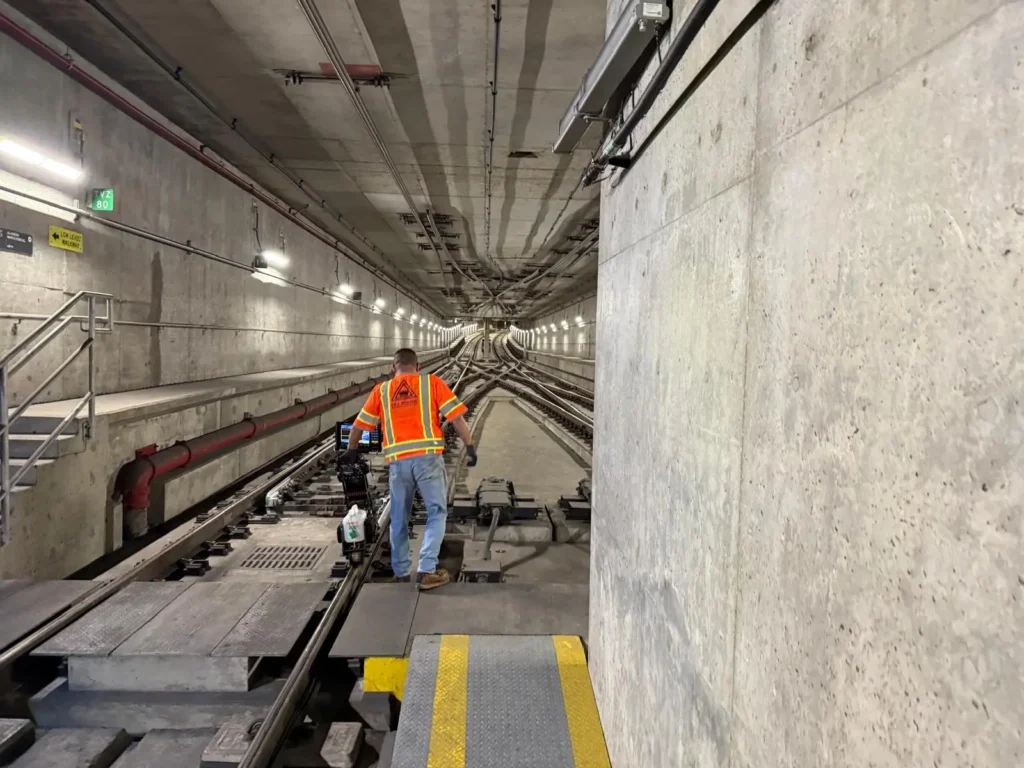
The project covered more than 200 miles of rail lines spanning the entire Los Angeles Metro system. EMA’s field teams performed comprehensive ultrasonic examinations under strict operational constraints, ensuring that all work was conducted safely and without service interruptions.
1. Ultrasonic Examination of Rails
EMA deployed specialized UT equipment designed to detect internal flaws, including transverse defects, inclusions, and cracks, within the rail head and web. Multi-channel sensors captured both longitudinal and transverse wave data, providing a full cross-sectional analysis of each inspected rail segment.
All collected signals were processed through digital acquisition systems capable of recording high-resolution waveforms for later evaluation. Each indication was classified according to defect type, depth, and location, allowing engineers to prioritize maintenance interventions based on risk level.
2. Defect Evaluation and Reporting
Data integrity was a primary focus throughout the project. EMA engineers utilized advanced software for waveform analysis, signal filtering, and defect characterization. Each identified anomaly was documented with corresponding GPS coordinates and photographic verification where applicable.
The results were compiled into detailed condition reports, enabling Metro’s asset management teams to incorporate findings directly into their existing maintenance management systems. This data-driven approach supports transparent decision-making and long-term trend analysis for infrastructure health monitoring.
3. Safety and Quality Assurance
All testing activities adhered to stringent quality assurance and safety protocols, consistent with industry standards such as AREMA, ASTM E164, and EN ISO 16810 for ultrasonic testing. Equipment calibration was verified daily to ensure data accuracy.
EMA also conducted internal quality audits throughout the project to verify procedural compliance and traceability. These audits helped ensure that every stage, from data collection to reporting, met or exceeded the client’s operational safety requirements.
4. Technical Support and Consultation
Beyond field testing, EMA provided expert consultation to the Los Angeles Metro engineering division. This included maintenance recommendations, inspection scheduling advice, and training support for in-house staff. Such collaboration ensures that the Metro’s maintenance teams are equipped with the knowledge and data necessary for continued system reliability.
Non-Destructive Testing Technology
EMA Industries applied non-destructive testing (NDT) techniques that rely on high-precision ultrasonic transducers and automated scanning systems. Unlike destructive methods that require material removal or sampling, ultrasonic inspection preserves the integrity of the rail while revealing sub-surface defects invisible to the naked eye.
The equipment used combined contact and non-contact sensors, allowing efficient scanning even on curved or welded track segments. Modern signal interpretation algorithms enhanced sensitivity and reduced false positives, producing reliable diagnostic data.
The testing system also featured onboard digital storage and GPS integration, enabling seamless mapping of defect locations along the rail corridor. This integration is particularly valuable for large-scale networks like Los Angeles Metro, where maintenance crews depend on spatial accuracy to schedule repairs without disrupting service.
Overcoming Operational Challenges
Executing ultrasonic testing on a live metropolitan rail network presents logistical and safety challenges. EMA Industries’ teams coordinated closely with Los Angeles Metro operations staff to develop inspection schedules that minimized impact on daily service.
Testing was often performed during off-peak hours or overnight windows, allowing field crews to access track sections safely. The project required careful synchronization between field technicians, dispatch operators, and Metro maintenance divisions.
Weather, vibration, and electrical noise can also interfere with ultrasonic readings. EMA mitigated these variables through real-time signal calibration, environmental monitoring, and redundant data collection protocols. The company’s experience in managing complex urban rail environments ensured that all inspections were executed precisely and safely.
Ensuring Safety and Reliability
Safety is the core objective of every EMA project. For the Los Angeles Metro initiative, multiple safety assurance layers were built into both planning and execution.
All personnel were trained in rail-specific safety procedures, including lockout-tagout systems, right-of-way protocols, and communication standards. Prior to fieldwork, EMA conducted risk assessments to identify hazards associated with rail access, equipment movement, and electrical interference.
The company also implemented real-time monitoring of field operations. Supervisors tracked inspection progress and safety compliance through a centralized control system, ensuring that every technician adhered to the defined safety framework.
By maintaining strict procedural discipline, EMA achieved zero incidents throughout the duration of the project, a reflection of both its safety culture and technical rigor.
Data-Driven Insights and Maintenance Optimization
The project’s outcome extended beyond defect detection. The extensive dataset generated by EMA’s ultrasonic testing provides Los Angeles Metro with a predictive model for rail maintenance.
Using the defect database, engineers can now forecast deterioration patterns, prioritize high-risk segments, and allocate resources efficiently. This data-driven maintenance strategy helps reduce unexpected failures, extend rail lifespan, and optimize maintenance budgets.
EMA’s reports included actionable recommendations for corrective maintenance, re-inspection intervals, and long-term asset management strategies. The analytical framework supports the Metro’s goal of transitioning from reactive to predictive infrastructure management.
Environmental and Economic Benefits
Preventing rail failure not only enhances public safety but also offers environmental and economic benefits. Early detection of defects reduces the need for emergency repairs, minimizing energy consumption, material waste, and service disruptions.
Moreover, ultrasonic testing enables rail operators to plan maintenance during low-demand periods, avoiding costly unplanned downtime. This approach contributes to sustainable infrastructure management by maximizing asset utility and reducing the overall carbon footprint associated with replacement and reconstruction activities.
EMA Industries’ Expertise and Commitment
Founded on principles of precision, reliability, and innovation, EMA Industries has built a strong reputation across the rail sector for its non-destructive testing and inspection services. The company’s multidisciplinary team of engineers and field specialists brings extensive experience in ultrasonic testing, magnetic particle inspection, and eddy current testing.
EMA’s work on the Los Angeles Metro project reinforces its standing as a trusted partner in rail safety. The successful completion of this large-scale initiative highlights the company’s capacity to manage complex projects across diverse environments, from metropolitan transit systems to freight and heavy-haul networks.
This achievement reflects EMA’s continuous investment in cutting-edge inspection technology and its unwavering focus on infrastructure resilience.
Future Outlook
As urban transit networks expand and train frequencies increase, the demand for continuous condition monitoring will rise. EMA Industries is already exploring new solutions such as automated ultrasonic inspection vehicles, AI-assisted defect recognition, and remote data analytics platforms to further enhance testing efficiency and accuracy.
By integrating these technologies, future inspections can be conducted faster and more frequently, enabling real-time rail health assessment. EMA’s forward-looking approach positions it as a leader in the digital transformation of rail maintenance.
Contribution to Regional Transportation Safety
The successful completion of the Los Angeles Metro ultrasonic testing project delivers immediate and long-term value to the region. For daily commuters, it translates to safer, smoother rides. For Metro management, it provides confidence in the reliability of the network.
By identifying potential failure points before they pose a risk, EMA’s testing contributes directly to public safety and service continuity. The initiative also supports California’s broader infrastructure modernization efforts by demonstrating the effectiveness of preventive inspection programs.
Comprehensive Reporting and Documentation
Documentation is critical in infrastructure testing. EMA produced a series of comprehensive reports detailing every aspect of the inspection process. Each report included:
- Equipment calibration logs
- Test parameters and configuration data
- Signal analysis charts and defect classifications
- Location-specific maintenance recommendations
This structured documentation allows the Los Angeles Metro to maintain a permanent record of rail condition over time. It also facilitates regulatory compliance with state and federal safety oversight bodies.
Reinforcing the Culture of Quality
Throughout the project, EMA Industries maintained a culture of quality assurance rooted in continuous improvement. The company’s internal review teams conducted performance audits to identify potential refinements in testing methodology and reporting efficiency.
All findings were incorporated into EMA’s quality management system (QMS), which aligns with ISO 9001 principles. This systematic approach ensures that every project, regardless of scale, meets consistent standards of technical accuracy and client satisfaction.
Collaboration and Coordination
A project of this scope required extensive coordination among multiple stakeholders. EMA worked closely with Los Angeles Metro’s engineering, operations, and maintenance divisions to align project timelines and deliverables.
Pre-project workshops were held to establish communication protocols and define key performance indicators (KPIs). Regular progress meetings ensured transparency and allowed for dynamic problem-solving as field conditions evolved.
The result was a seamless partnership characterized by shared objectives: safety, reliability, and efficiency.
Conclusion
The Los Angeles Metro Ultrasonic Rail Testing Project marks a significant milestone in EMA Industries’ ongoing mission to advance rail safety through technology and expertise. By inspecting more than 200 miles of track using state-of-the-art ultrasonic testing methods, EMA helped ensure that one of the nation’s busiest transit systems remains safe and dependable.
Through precision engineering, rigorous data analysis, and unwavering commitment to quality, EMA Industries has set a new benchmark for infrastructure testing and maintenance. The project exemplifies how collaboration between public transit authorities and private engineering specialists can deliver tangible improvements in safety and sustainability.
As Los Angeles continues to invest in its rail network, EMA’s work serves as both a foundation and a model for future infrastructure resilience, proving that with the right technology and expertise, safety truly stays on track.
Key Points
- EMA Industries completed ultrasonic testing on over 200 miles of Los Angeles Metro track to ensure safety and reliability.
- Ultrasonic testing (UT) detects internal rail flaws such as cracks and inclusions that are invisible to the naked eye.
- The project involved non-destructive testing (NDT) methods, preserving rail integrity while identifying hidden structural weaknesses.
- Comprehensive data recording and defect analysis allowed Los Angeles Metro to prioritize maintenance and plan future inspections.
- Strict safety and quality assurance protocols were followed in line with AREMA, ASTM, and ISO standards.
- Testing occurred without disrupting commuter services, with inspections scheduled during off-peak or overnight hours.
- Advanced equipment with GPS and digital data systems provided accurate mapping of defects across the rail network.
- The project produced predictive maintenance insights, helping Metro reduce failures and extend rail lifespan.
- EMA delivered detailed documentation and technical consultation, supporting long-term infrastructure management and regulatory compliance.
- The initiative reinforces EMA’s leadership in rail safety technology, setting a new standard for preventive inspection in urban transit systems.
FAQs
What is ultrasonic rail testing?
Ultrasonic rail testing is a non-destructive method that uses high-frequency sound waves to detect internal rail defects such as cracks, inclusions, and discontinuities that cannot be seen during visual inspections.
Why is ultrasonic testing important for rail safety?
It helps identify potential rail failures before they occur, reducing the risk of derailments and extending the lifespan of rail infrastructure.
Did the testing disrupt daily Metro operations?
No. EMA Industries coordinated inspections during off-peak and overnight hours to complete testing without interrupting daily commuter services.
What safety standards did EMA follow during the project?
All procedures adhered to AREMA, ASTM, and ISO standards for ultrasonic testing, ensuring high accuracy and full regulatory compliance.
How does this project benefit Los Angeles Metro passengers?
By identifying internal defects early, the project enhances rail safety, reduces service disruptions, and ensures smoother, more reliable rides for passengers.
