

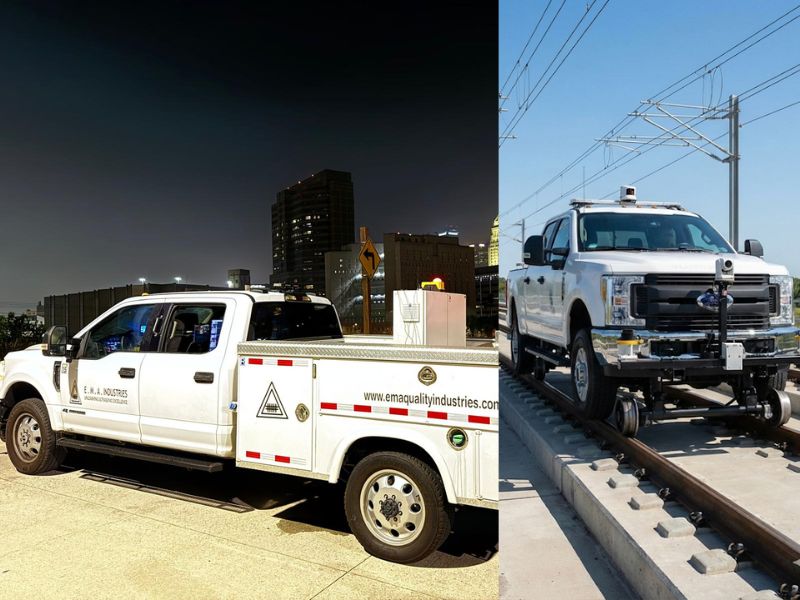
networks depend on precise, reliable inspection to keep trains moving safely, and the Hi-Rail Track Inspector has become one of the most important tools for that job.
This dual-mode vehicle can shift from road to rail within minutes, allowing teams to reach sections of track that traditional inspection trains may miss. Its ability to move quickly, collect data, and identify faults early has made it a key asset for modern railway maintenance.
This article explains how a Hi-Rail inspection vehicle works, the systems it uses, and why ultrasonic testing plays such a major role in finding hidden defects. It also covers the strengths and limits of hi-rail inspection, the best situations to use these vehicles, and the newest trends shaping the future of rail maintenance.
How a Hi-Rail Inspection Vehicle Works
A Hi-Rail Track Inspector is designed to switch from road travel to rail operation in a matter of minutes. This conversion allows crews to reach inspection sites far more quickly than traditional rail-only vehicles.
The process begins when the operator positions the vehicle over the track and activates the hydraulic system. The rail wheels lower smoothly and lock securely into place. Once engaged, the vehicle rolls along the rails while its tyres provide propulsion. This simple mechanism enables fast access to remote sections, branch lines, and sidings where larger inspection trains may struggle to operate.
This adaptability is crucial for modern rail operations, and the reasons become even clearer as we explore the vehicle’s internal components next.
Main Components: Rail Wheels, Sensors, Onboard Systems
A Hi-Rail inspection vehicle relies on several specialised components working together to achieve accurate and efficient inspection results.
Its key parts often include:
- Rail wheels for guided and stable rail movement
- Sensor suites for detecting faults and measuring track conditions
- Onboard computers to process inspection data in real time
- Communication units for transferring data securely to maintenance teams
These components allow the vehicle to carry out multiple inspection tasks simultaneously. Rail wheels provide stability, sensors gather technical measurements, and onboard systems ensure that data is recorded with precision. This combination reduces inspection time and strengthens the reliability of the entire operation.
But the real advantage of this setup becomes even more evident when considering the benefits of highway-rail vehicle inspection.
Advantages of Highway-Rail Vehicle Inspection
A highway-rail inspection approach offers several benefits for day-to-day rail maintenance. Crews can drive the vehicle on public roads, access the nearest track entry point, and begin inspection with minimal delay.
This mobility reduces travel time, lowers logistical costs, and limits the need for track closures.
Key advantages include:
- Faster response to urgent inspection needs
- Easy access to remote or low-traffic rail segments
- Ability to carry multiple inspection tools on a single platform
- Reduced disruption to rail operations
These strengths make the highway-rail method ideal for both routine assessments and targeted follow-ups. And this practicality leads directly into the technologies that power these inspections.
Rail Inspection Systems Used on Hi-Rail Vehicles
Every railway track inspection system inside a Hi-Rail Track Inspector is designed to gather detailed information about the condition of the rail. These systems combine several tools, structural monitors, surface scanners, and location trackers, to create a complete view of track health.
This integrated approach allows teams to detect early-stage defects, monitor long-term wear patterns, and plan timely maintenance before faults escalate. But structural measurements alone are not enough, which is why geometry tools play a major role…
Track Geometry Measurement Tools
Track geometry affects safety, ride comfort, and long-term rail stability. Hi-Rail inspection vehicles use specialised sensors to record the exact condition of the track as they travel.
Typical measurement systems include:
- Track gauge sensors
- Cant and cross-level measurement units
- Alignment and curvature monitors
- Inertial sensors for irregularity detection
By collecting this data regularly, maintenance teams can spot gradual distortions and track wear that may not be visible during manual inspection. These detailed readings help engineers identify where intervention is needed, before the issue affects train operations.
Imaging, Laser, GPS, and Data Logging Systems
To support the geometry tools, Hi-Rail inspection vehicles use advanced imaging and mapping technologies.
These systems often include:
- High-resolution cameras for capturing rail surface defects
- Laser scanners for mapping rail profiles with millimetre accuracy
- GPS tracking for logging the exact position of each reading
- Data-logging systems for storing and analysing long-term inspection records
Together, these tools ensure that every crack, dip, or alignment shift is captured precisely across long stretches of track. This rich data creates a clear picture of overall network health, setting the stage for even deeper analysis when ultrasonic and other non-destructive technologies come into play next.
Hi-Rail Ultrasonic Inspection and Other Non-Destructive Tests
A Hi-Rail Track Inspector becomes even more effective when fitted with ultrasonic inspection tools, which send high-frequency sound waves through the rail. These waves travel through the metal and reflect back to the sensors, creating a clear picture of the rail’s internal condition. Because ultrasonic signals penetrate deeply, they can reveal flaws that surface-level tools cannot detect.
This depth makes ultrasonic testing one of the most reliable non-destructive methods for identifying hidden structural problems.
As you will see, the real value of this technology becomes more apparent when looking at the specific defects it can uncover.
Detecting Internal Cracks, Weld Issues, and Bolt-Hole Defects
Ultrasonic systems on a Hi-Rail inspection vehicle are built to detect internal irregularities that threaten track integrity. They identify problems such as:
- Internal cracks not visible on the surface
- Weld defects that weaken joints
- Bolt-hole cracking around fishplates
- Horizontal and vertical splits in the rail head
- Fatigue issues caused by repeated loads
Because these defects often start beneath the surface, early detection is essential. Ultrasonic testing allows maintenance teams to identify the exact location and depth of each flaw, enabling fast and targeted repair. But ultrasonic testing is not effective in every situation, which raises an important question.
When Ultrasonic Inspection Is Most Effective
Ultrasonic inspection works best under certain conditions. Clean rail surfaces, moderate speeds, and stable contact between the sensor and rail allow the system to produce accurate signals. It is especially effective during:
- Routine inspection rounds on secondary lines
- Follow-up checks after detecting geometry irregularities
- Maintenance planning before heavy seasonal traffic
- Inspections in areas prone to internal cracking
Crews often combine ultrasonic systems with imaging and geometry tools to build a complete, multi-layered view of the rail. This combination strengthens decision-making but even advanced technology has limits, which leads us into the next section.
Best Use Cases for Hi-Rail Track Inspectors
A Hi-Rail Track Inspector delivers the greatest value when it is used in situations where flexibility, quick access, and cost-efficient inspection matter most. These vehicles fill the operational gap between manual surveys and large inspection trains, making them ideal for targeted assessments and routine monitoring.
This section explores the environments where they perform best and how they support wider inspection strategies across a rail network.
Secondary Lines, Remote Areas, and Low-Traffic Routes
Hi-rail inspection vehicles thrive in areas where access is limited or where full-sized inspection trains are impractical. Their road-to-rail capability allows them to reach challenging locations quickly, ensuring that even lightly used sections receive proper monitoring.
They are particularly valuable on:
- Secondary and regional lines where traffic is low
- Remote areas with limited rail infrastructure
- Industrial sidings and branch lines with short distances
- Low-traffic routes where heavy inspection trains are unnecessary
In these environments, the ease of deployment and reduced need for track closures make hi-rail vehicles far more efficient than traditional solutions. This accessibility becomes even more important when considering how they support ongoing maintenance.
Routine Checks, Early-Stage Defect Spotting, and Follow-Up Scans
Hi-rail vehicles are ideal for regular inspection runs that keep track assets in good condition. Their mobility allows crews to perform frequent checks without disrupting train schedules. These vehicles excel at:
- Routine monitoring to track wear and alignment changes
- Early-stage detection of faults before they escalate
- Follow-up scans after geometry or ultrasonic irregularities
- Seasonal inspections before periods of heavy traffic
Because they can carry multiple sensors, geometry tools, imaging systems, and even ultrasonic equipment, they help maintenance teams verify defects quickly and plan targeted repairs. However, their true strength emerges when they operate as part of a larger inspection strategy.
Integrating Hi-Rail Vehicles with Broader Inspection Programmes
A Hi-Rail Track Inspector delivers the best results when used alongside traditional inspection trains and fixed monitoring equipment. Each tool serves a different purpose, and combining them provides a complete picture of network health.
Hi-rail vehicles support broader programmes by:
- Filling gaps between high-speed inspection train runs
- Providing detailed checks in specific problem areas
- Verifying defects detected by automated systems
- Offering rapid deployment during emergency response
By integrating hi-rail vehicles into a wider maintenance plan, rail operators can increase inspection frequency, reduce downtime, and maintain safer, more reliable infrastructure. This combined approach ensures that every section of the network, large or small, receives the attention it needs.
Conclusion
A Hi-Rail Track Inspector plays a central role in keeping today’s rail networks safe, efficient, and well-maintained. Its ability to operate on both roads and rails allows inspection teams to reach locations that larger inspection trains cannot access quickly, making it an essential tool for routine monitoring and targeted assessments.
With advanced systems such as track geometry sensors, imaging tools, GPS mapping, and ultrasonic testing, these vehicles deliver precise insights into both surface and internal rail conditions.
While they cannot replace the capacity or speed of heavy inspection trains, hi-rail vehicles provide flexibility, rapid deployment, and cost-effective coverage of large or remote areas.
Their strengths make them especially valuable on secondary lines, low-traffic routes, and locations where early detection of defects is critical. When integrated into a broader inspection programme, they help rail operators maintain high safety standards, reduce repair costs, and extend the lifespan of vital infrastructure.
As rail networks continue to modernise, the role of dual-mode inspection vehicles will only grow. Hi-rail technology, combined with advanced sensors and data-driven maintenance strategies, is shaping a more reliable and responsive future for railway inspection.
Key Points
- A Hi-Rail Track Inspector is a dual-mode vehicle that operates on both roads and rails, enabling fast access to inspection sites.
- Road-to-rail conversion uses hydraulic rail wheels that lower and lock into position, allowing the vehicle to run smoothly on tracks.
- Key components include rail wheels, sensor units, onboard computers, and communication systems that work together for accurate inspections.
- Highway-rail vehicle inspection offers flexible deployment, reduced disruption to rail operations, and easy access to remote or low-traffic lines.
- Hi-rail vehicles use a range of systems such as track geometry sensors, imaging tools, GPS, and laser equipment to monitor track conditions.
- Ultrasonic inspection sends sound waves through the rail to detect internal defects that surface tools cannot identify.
- Ultrasonic systems can reveal hidden issues such as internal cracks, weld flaws, fatigue damage, and bolt-hole defects.
- Ultrasonic testing works best when rails are clean, speeds are controlled, and stable contact is maintained between the sensor and rail.
- Hi-rail vehicles are ideal for secondary lines, remote areas, routine inspections, early defect detection, and follow-up scans after irregularities.
- When integrated into broader inspection programmes alongside heavy inspection trains, hi-rail vehicles improve network safety, cut costs, and support long-term maintenance planning.
FAQs
How do hi‑rail inspection results integrate into broader rail maintenance programmes?
Data collected by hi‑rail inspection vehicles, geometry measurements, flaw detection, defect location mapping (with GPS), can feed into larger maintenance plans. They help in early detection, ongoing monitoring, follow-up inspections, and targeted repairs, complementing inspections done by heavy trains or manual surveys.
Can a hi‑rail vehicle handle long-distance inspection routes or high-speed inspection?
Yes, some hi‑rail inspection vehicles are capable of covering extended distances per day, and with suitable ultrasonic or sensor systems may inspect long stretches efficiently. However, their inspection speed and load limitations may make them less ideal than specialised heavy inspection trains on major mainlines.
How often should hi‑rail vehicles themselves be inspected for safety before use?
Hi‑rail vehicles must undergo regular equipment inspections, checking rail guidance gear, wheel wear, brakes, lights/alarms, and other critical systems. Safety inspections are often required annually (or per regulatory interval) to ensure safe operation.
Are there limitations to using hi‑rail inspection vehicles?
Yes. Because hi‑rail vehicles are lighter and slower than full inspection trains, some load‑dependent measurements may be less accurate. Also, their lower speed and simpler setup may limit coverage and detection capacity compared to heavy inspection trains.
