

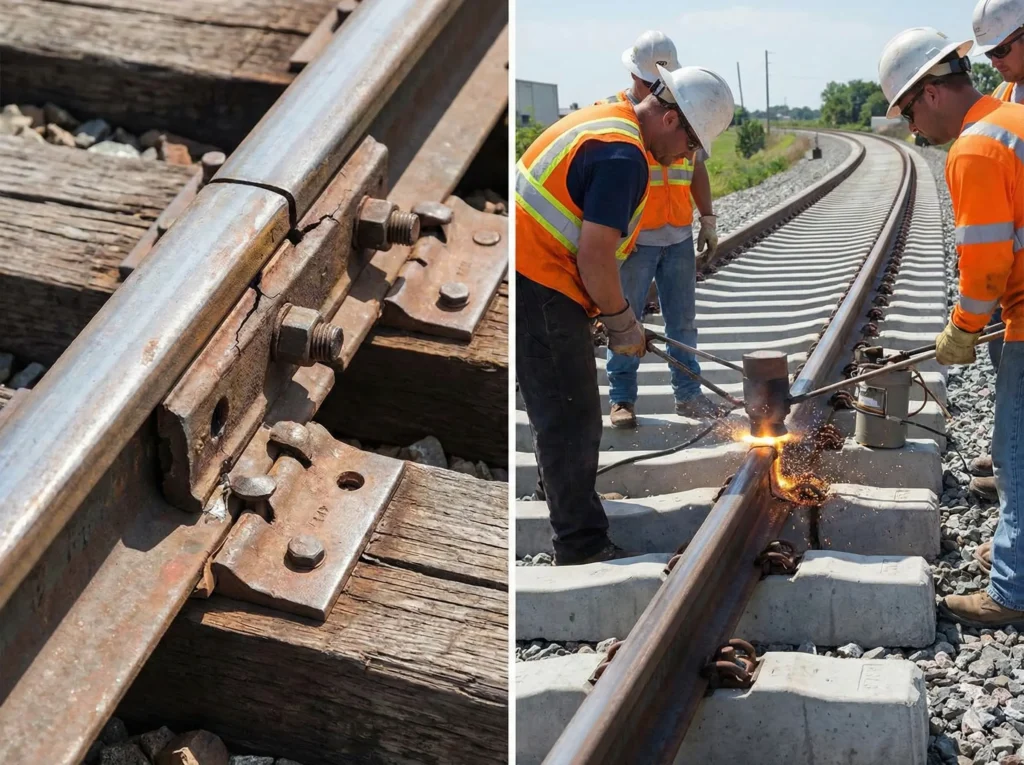
Rail Joints may look like simple connections in a railway track, but they play a critical role in keeping trains moving safely and smoothly. These joints absorb stress, allow rail expansion, and help maintain proper alignment under constant loads.
This article explains what Rail Joints are, why they are used, and the main types found in modern rail systems. It also covers common problems, safety impacts, and practical solutions used to reduce failures and improve track performance.
What Are Rail Joints
Rail Joints are the connection points where two separate rail sections are joined together to form a continuous railway track. They allow individual rail lengths to work as a single system while carrying heavy train loads over long distances.
In traditional rail networks, rails were produced in shorter sections, making Rail Joints essential. Even with modern track systems, these joints are still required in many locations where movement, access, or flexibility is needed.
How Rail Joints Work
Rail Joints hold rail ends firmly in place while allowing limited movement caused by temperature changes and passing trains. This balance between strength and flexibility is critical for track performance.
A standard rail joint assembly usually includes:
- Fishplates fitted on either side of the rail
- Bolts and nuts to clamp the rail ends together
- Small gaps to allow rail expansion and contraction
When trains pass over Rail Joints, wheels apply repeated impact forces at the joint location. Over time, this makes joints more vulnerable than welded sections, which is why their design and installation must be precise.
This natural weakness raises an important question. If Rail Joints demand so much attention, why are they still used across rail tracks today?
Why Rail Joints Are Used in Rail Tracks
Rail Joints play a practical role in keeping rail tracks safe, flexible, and maintainable under constant stress. They are not used by choice alone, but out of necessity, especially where rail movement, repairs, and structural limits must be managed. Understanding why Rail Joints are used helps explain their continued presence in both older and modern rail systems.
Managing Rail Movement and Stress
Rail Joints are used because steel rails expand in heat and contract in cold conditions. Without joints, this movement would create internal stress, leading to buckling or fractures. Joints help absorb this movement and protect the track structure.
This function is especially important in areas with large temperature variations, where rail expansion control is critical for safety.
Supporting Maintenance and Track Access
Rail Joints make inspection, repair, and replacement tasks easier. They allow engineers to work on specific rail sections without disturbing long stretches of track.
Rail Joints are commonly used to:
- Replace damaged or worn rail sections
- Install switches, crossings, and special track equipment
- Adjust track alignment during maintenance
Use in Special Track Locations
In certain locations, continuous welded rail is not practical. Rail Joints are therefore used on bridges, near level crossings, and at transition zones where track movement must be controlled.
While Rail Joints provide flexibility and access, they also introduce impact loads that increase wear and maintenance needs. This trade-off explains why joint-related issues remain a major concern for rail engineers.
Those issues lead directly to common Rail Joint problems, which become more visible as traffic increases and components age.
Main Types of Rail Joints
Rail Joints come in different forms, each designed to suit specific track conditions and operational needs. The type of joint used depends on factors such as traffic load, speed, location, and maintenance access. Choosing the right joint type helps reduce stress, wear, and long-term track damage.
Fishplate Joints
Fishplate joints are the most common and traditional type of Rail Joints. They use metal plates fixed to both sides of the rail ends to hold them in alignment.
These joints are widely used because they are simple to install and repair. However, they are more prone to wear due to repeated wheel impacts, especially on busy rail lines.
Insulated Rail Joints
Insulated Rail Joints are designed to electrically separate sections of track. They are mainly used in signalling systems to detect train presence accurately.
These joints include insulating materials between rail ends and joint components. While essential for safety systems, they require careful installation and regular inspection due to their sensitivity to damage.
Expansion Joints
Expansion joints allow greater rail movement caused by temperature changes. They are commonly installed on bridges and long steel structures where rail expansion is more pronounced.
By allowing controlled movement, expansion Rail Joints help prevent rail buckling and structural stress. However, they are more complex than standard joints and need precise maintenance.
Compromise Joints
Compromise joints connect rails of different sizes or profiles. They are used when upgrading track sections or joining new rails to older ones.
Although effective, these Rail Joints can create uneven load distribution, making them more vulnerable to wear if not properly maintained.
As each joint type solves a specific problem, it also introduces its own challenges. Those challenges become clear when looking at the problems Rail Joints develop over time.
Common Problems in Rail Joints
Rail Joints are among the most stressed parts of a rail track. Continuous wheel impacts, vibration, and environmental exposure make them more likely to fail than welded rail sections. Many rail maintenance issues can be traced back to joint locations.
Joint Wear and Metal Fatigue
Repeated train loads cause wear at the rail ends and joint components. Over time, this leads to metal fatigue, cracks, and deformation.
Common signs include:
- Flattened rail ends
- Loose bolts and fishplates
- Visible cracks near the joint
Loosening of Fastenings
Vibration from passing trains can loosen bolts and nuts holding Rail Joints together. Once loosened, the joint loses alignment, increasing impact forces and accelerating damage.
If not corrected early, this problem can lead to severe track defects.
Noise and Vibration Issues
Rail Joints often produce noticeable noise and vibration as train wheels pass over them. This affects passenger comfort and can cause complaints in residential areas near rail lines.
Excessive vibration also increases stress on sleepers and ballast.
Electrical and Insulation Failures
In insulated Rail Joints, damage to insulating materials can disrupt signalling systems. This may result in false track occupancy readings or signal failures, posing serious safety risks.
These common problems explain why Rail Joints demand frequent inspection and maintenance. The next step is understanding how rail engineers detect and manage these issues before they affect safety.
Effects of Rail Joint Problems on Track Safety
Rail Joint defects have a direct impact on track safety and train performance. Because Rail Joints are natural weak points, even small faults can grow quickly under repeated loads. If left unaddressed, these issues increase the risk of service disruptions and accidents.
Increased Risk of Track Failure
Damaged Rail Joints can cause misalignment between rail sections. This affects wheel guidance and raises the risk of derailment, especially at higher speeds or on curves.
Common safety concerns include:
- Cracked rail ends at joint locations
- Vertical or horizontal misalignment
- Sudden joint failure under load
Reduced Ride Quality and Control
Faulty Rail Joints create uneven track surfaces. This leads to excessive vibration, noise, and impact forces as trains pass over the joint. Poor ride quality reduces braking efficiency and increases stress on rolling stock components.
Over time, these forces also weaken sleepers, fastenings, and ballast, spreading the safety risk beyond the joint itself.
Disruption to Signalling and Operations
In insulated Rail Joints, failures can interfere with track circuits used for train detection. Incorrect signals may cause unnecessary stops or restrict train movements, reducing overall network safety and efficiency.
These risks highlight why joint-related defects are treated as high priority. Preventing them depends heavily on effective inspection and maintenance practices.
Inspection and Maintenance of Rail Joints
Regular inspection and maintenance are essential to control wear and prevent Rail Joint failures. Since joints deteriorate faster than welded rail, they require closer monitoring throughout their service life.
Visual and Routine Inspections
Track inspectors regularly check Rail Joints for visible signs of damage. These inspections focus on alignment, component condition, and fastening security.
Key checks include:
- Condition of fishplates and bolts
- Presence of cracks or deformation
- Correct rail end gaps
Mechanical Testing and Monitoring
Advanced inspection methods are used to detect internal defects that are not visible on the surface. These techniques help identify early-stage fatigue before failure occurs.
Common methods include ultrasonic testing and track geometry measurements.
Preventive Maintenance Actions
Maintenance teams tighten fastenings, replace worn components, and restore proper alignment as part of routine work. In high-impact areas, Rail Joints may be upgraded or replaced with welded rail where possible.
Effective maintenance reduces failure risk, extends component life, and improves overall track safety. These efforts also support the wider move towards modern solutions that aim to minimise joint-related problems altogether.
Modern Solutions and Alternatives to Rail Joints
Rail networks continue to reduce their dependence on traditional Rail Joints due to high maintenance demands and safety concerns. Modern track design focuses on minimising joint locations while improving strength, ride quality, and long-term reliability. These solutions aim to address the weaknesses that Rail Joints naturally introduce.
Continuous Welded Rail (CWR)
Continuous Welded Rail is the most widely used alternative to conventional Rail Joints. Individual rail sections are welded together to form long, uninterrupted lengths of track.
CWR significantly reduces impact forces, noise, and vibration. With fewer joints, there are fewer weak points, leading to improved safety and lower maintenance costs. However, CWR requires careful stress management and precise installation.
Improved Joint Design and Materials
Where Rail Joints cannot be eliminated, modern designs focus on improving durability. High-strength steel, better bolt systems, and reinforced fishplates help joints withstand higher loads and longer service life.
These improvements reduce loosening, fatigue, and deformation, especially on high-traffic routes.
Advanced Insulated Joint Systems
Modern insulated Rail Joints use stronger insulating materials and improved bonding techniques. These designs offer better electrical performance while resisting mechanical damage.
They are commonly used in high-speed and heavily signalled sections where reliability is critical.
Smart Monitoring and Predictive Maintenance
Technology now plays a key role in managing Rail Joints. Sensors and track monitoring systems detect vibration, movement, and early signs of failure.
Benefits of smart monitoring include:
- Early fault detection
- Reduced unplanned maintenance
- Improved safety and asset life
While modern solutions reduce the number of Rail Joints in use, they do not remove the need for them entirely. The focus has shifted from widespread use to strategic placement, supported by better design and monitoring to keep rail tracks safe and efficient.
Conclusion
Rail Joints may seem like small components of a railway track, but their impact on safety, maintenance, and performance is significant. From traditional fishplate joints to modern insulated and expansion joints, each type serves a purpose while presenting its own challenges.
Common problems such as wear, loosening, vibration, and electrical faults highlight why these connections demand regular inspection and careful maintenance.
Modern solutions, including Continuous Welded Rail, improved joint designs, advanced insulated systems, and smart monitoring technologies, are helping rail networks reduce reliance on traditional joints while improving safety and efficiency.
By understanding the types, problems, and solutions associated with Rail Joints, engineers and operators can maintain reliable, safe, and long-lasting tracks that support today’s high-speed and heavy-traffic railway systems.
Key Points
- Rail Joints are connection points between two rail sections, allowing rails to function as a continuous track.
- They absorb stress from train loads, temperature changes, and vibration while enabling maintenance access.
- Typical joints include fishplates, bolts and nuts, and small expansion gaps to allow rail movement.
- Main types include fishplate joints, insulated joints, expansion joints, and compromise joints.
- Rail Joints often face wear, metal fatigue, loosening fastenings, noise, vibration, and electrical/insulation failures.
- Faulty Rail Joints can lead to misalignment, derailments, reduced ride quality, and signalling issues.
- Regular visual checks, mechanical testing, and monitoring are essential to detect joint defects early.
- Preventive actions include tightening fastenings, replacing worn components, restoring alignment, and sometimes upgrading to welded rail.
- Continuous Welded Rail (CWR) reduces the number of joints, impact forces, and maintenance requirements.
- Smart monitoring, improved joint materials, and advanced insulated joints enhance durability, safety, and performance.
FAQs
What modern solutions reduce problems associated with Rail Joints?
Continuous Welded Rail (CWR) reduces the number of joints, lowering impact loads and maintenance. Improved joint designs, advanced insulated joints, and smart monitoring systems also enhance durability and performance.
Can Rail Joints be completely eliminated from a rail network?
While many joints are replaced by welded rail in modern networks, some Rail Joints remain necessary at bridges, crossings, and other special locations where flexibility or access is needed.
What is the purpose of expansion Rail Joints?
Expansion Rail Joints allow rails to expand and contract with temperature changes without causing excessive stress, helping prevent track buckling and maintaining alignment.
What role do fishplates play in Rail Joints?
Fishplates (joint bars) connect rail ends and help transmit forces while maintaining alignment. They are common in mechanical joints and contribute to joint stability when correctly installed.
