
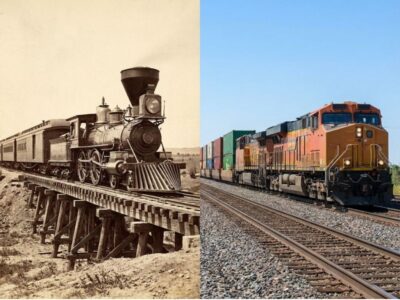
The history of railroads in America is a story of innovation, expansion, and transformation. From the first horse-drawn tracks to the transcontinental railroad and today’s modern freight networks, railroads have shaped the nation’s economy, culture, and daily life.
If you’ve ever wondered how trains helped build America or why they remain important today, this guide for 2026 will take you through the key moments, milestones, and impacts of American railroads. So, read on to discover the journey of railroads and how they changed the country forever.
Early Transportation Before Railroads
Before the rise of railroads, transportation in America was slow, expensive, and often unreliable. Moving people and goods across long distances was a major challenge in the early years of the country.
Roads, Rivers, and Canals
In the 1700s and early 1800s, most travel took place on dirt roads, rivers, and canals:
- Roads: Early American roads were rough and poorly maintained. Many were simply dirt paths that turned muddy in rain and dusty in dry weather. Travel by horse, wagon, or stagecoach was slow and uncomfortable. Long journeys could take weeks.
- Rivers: Rivers were one of the most important transportation routes. Flatboats and steamboats carried crops, timber, and other goods along major rivers like the Mississippi and Ohio. Water travel was cheaper than road travel, but it depended on natural routes and weather conditions.
- Canals: In the early 1800s, canals became popular. The Erie Canal, completed in 1825, connected the Great Lakes to the Hudson River. It reduced shipping costs and helped New York grow into a major trade center. However, canals were expensive to build and could only operate in certain seasons.
Limits of Early Transportation
Despite these options, early transportation had serious limits, such as:
- Travel was very slow.
- Moving goods over land cost a lot of money.
- Roads became unusable during bad weather.
- Rivers did not connect every part of the country.
- Canals froze in winter and required constant maintenance.
Because of these problems, farmers and businesses struggled to send products to distant markets. Many communities remained isolated.
Why a Faster System Was Needed
As the United States expanded westward and its population grew, the need for a better transportation system became clear.
The key requirements included:
- Farmers wanted quicker ways to ship crops.
- Businesses needed reliable routes to sell goods across states.
- The government wanted stronger connections between regions.
A faster and more dependable system would help unite the country, boost trade, and support economic growth. This growing demand set the stage for the development of railroads and marked the beginning of a new chapter in the history of railroads in America.
The Beginning of Railroads in America (Before 1830)
The history of railroads in America began before large steam trains crossed the country. In the early 1800s, the idea of moving goods on iron tracks was still new. At first, rail systems were small, simple, and powered by horses. But these early efforts laid the foundation for the national railroad network that would later transform the country.
The Idea of a Railroad: Colonel John Stevens and His 1812 Proposal
One of the first Americans to promote railroads was Colonel John Stevens of New Jersey. In 1812, he presented a detailed proposal to the U.S. government. He believed railroads could become a faster and more reliable transportation system than canals.
At the time, many leaders favored canals because they were already proven in Europe and America. Stevens argued that railroads would be cheaper to maintain, operate year-round, and move goods more quickly. Although his proposal was not accepted, his ideas played an important role in the early history of railroads in America.
Horse-Drawn Cars and the First Track Experiments
Before steam engines were widely used, early rail systems relied on horses. Wooden or iron rails were laid on the ground, and horse-drawn cars carried coal, stone, and other heavy materials.
These early tracks reduced friction, allowing horses to pull heavier loads than they could on regular roads. Small industrial railways appeared near mines and quarries. While limited in size and speed, these systems showed that rail transport could work in the United States.
The Granite Railway of Massachusetts (1826): The First Chartered Railroad
In 1826, the Granite Railway was built in Massachusetts. It is considered the first chartered railroad in the United States. The railway was created to carry granite from a quarry in Quincy to the Neponset River, where it could be loaded onto boats.
Though short in distance, the Granite Railway proved that railroads could operate successfully as a business. It marked an important early step in the development of rail transport in America.
John Stevens’ Steam Locomotive Test in Hoboken, New Jersey
Colonel John Stevens continued to experiment with steam power. In 1825, he built a small circular track on his property in Hoboken, New Jersey. There, he tested one of the first steam locomotives in the country.
While this locomotive was not used for commercial service, it demonstrated that steam engines could move along tracks without animal power. This experiment helped move the United States closer to adopting steam-powered railroads.
These early developments before 1830 set the stage for rapid growth in the following decades. The ideas, experiments, and small rail lines of this period formed the foundation for the larger expansion that would soon define the history of railroads in America.
The First Real Railroads Take Shape (1827–1840)
Between 1827 and 1840, railroads in America moved from small experiments to working transportation systems. During this period, the first major rail companies were formed, steam power became more common, and railroads began competing with canals and wagon roads. This was a turning point in the history of railroads in America.
The Baltimore and Ohio Railroad: America’s First Major Railroad
The Baltimore and Ohio Railroad (B&O) was chartered in 1827. It is considered America’s first major railroad built for public use. The goal was to connect the port of Baltimore to western markets, especially the Ohio River region.
Construction began in 1828. At first, the railroad used horse-drawn cars. But engineers quickly began testing steam locomotives. In 1830, the B&O tested the famous locomotive Tom Thumb, built by Peter Cooper. Though small, it showed that steam power could compete with horses.
The B&O became a model for future railroads. It proved that rail transport could connect cities, support trade, and operate as a large business.
The South Carolina Canal and Railroad Company and the First Steam-Powered Passenger Train (Christmas Day, 1830)
Another early leader was the South Carolina Canal and Railroad Company. On December 25, 1830, it operated what is often recognized as the first regular steam-powered passenger train service in the United States.
The locomotive, called the Best Friend of Charleston, carried passengers along a six-mile stretch of track. This marked an important moment in American transportation history. For the first time, people could travel by steam-powered train rather than by horse or boat.
This event helped build public confidence in railroads and showed that steam trains could carry both goods and passengers.
Early Growth: Mohawk and Hudson, and Other Pioneer Lines
The success of early railroads encouraged more companies to build tracks. The Mohawk and Hudson Railroad, chartered in 1826 and opened in 1831, connected Albany and Schenectady in New York. It offered a faster route than the Erie Canal between those two cities.
Other short rail lines soon appeared in states like Pennsylvania, Massachusetts, and Virginia. Most early railroads connected cities to rivers or canals, improving trade and travel.
By the late 1830s, hundreds of miles of track had been built across the country. Railroads were no longer just experiments. Instead, they were becoming part of daily life.
How Railroads Began Replacing Canals and Wagon Roads
As railroads expanded, they began to replace older transportation systems.
Unlike canals, railroads could operate year-round and did not freeze in winter. Unlike wagon roads, they were faster, smoother, and could carry heavier loads. Trains also followed direct routes rather than winding river paths.
Businesses quickly saw the benefits. Farmers could send crops to market faster. Manufacturers could receive raw materials more easily. Cities connected by rail began to grow.
By 1840, it was clear that railroads would play a central role in the future of transportation. This period marked the real beginning of large-scale railroad growth and set the stage for rapid expansion across the United States.
Rapid Expansion Across the Country (1840–1860)
Between 1840 and 1860, railroads grew faster than anyone had expected. What started as short regional lines quickly became a national network. This period marked one of the most important phases in the history of railroads in America, as rail transport spread across the East, Midwest, and parts of the South.
The Railroad Boom of the 1840s and 1850s
During the 1840s and 1850s, investors poured money into railroad construction. States supported projects, and private companies competed to build new lines. Towns wanted rail connections because they knew it would bring trade and growth.
Railroads began linking major cities such as New York, Philadelphia, Boston, and Chicago. At the same time, tracks pushed westward into farming regions, opening new markets for crops and goods.
This rapid building period is often called the railroad boom.
Over 9,000 Miles of Track by 1850 and 30,000 Miles by 1860
The numbers show how quickly railroads expanded:
- By 1850, the United States had over 9,000 miles of track.
- By 1860, that number had grown to about 30,000 miles.
Most of this growth took place in the Northeast and Midwest, where industry and agriculture were expanding. Railroads connected farms to cities and cities to ports, creating a stronger national economy.
For the first time, goods could move across large distances in days instead of weeks.
Mergers and the Rise of Larger Railroad Companies
As more tracks were built, small railroad companies began merging. Larger companies could manage longer routes, reduce costs, and compete more effectively.
These mergers helped create stronger and more organized rail systems. Instead of short, disconnected lines, companies started operating continuous routes between major regions. This shift improved efficiency and reliability.
The rise of larger railroad companies also increased their economic power, which would later lead to debates about regulation.
The Illinois Central Railroad and the Role of Federal Land Grants
One major development during this period was the use of federal land grants to support railroad construction.
In 1850, Congress granted public land to help fund the Illinois Central Railroad. The company could sell portions of this land to raise money for building tracks. In return, the railroad would promote settlement and economic growth along its route.
This model became important for later railroad expansion, especially in the West. It showed how the federal government could support infrastructure while encouraging development.
Standardization of Locomotives and Early Cooperation Between Companies
As railroads expanded, companies began working toward standard practices. Locomotives became more powerful and reliable. Builders improved track quality and bridge design.
Rail companies also started coordinating schedules and sharing connections to allow smoother travel between regions. Although track gauges (the width between rails) were not yet fully standardized, early cooperation made long-distance travel easier than before.
By 1860, railroads had become the backbone of American transportation. The rapid growth during these two decades prepared the country for even larger changes during and after the Civil War, shaping the next stage in the history of railroads in America.
Railroads and the Civil War (1861–1865)
The Civil War showed how important railroads had become in American life. For the first time in history, a major war relied heavily on rail transportation. Both the Union (North) and the Confederacy (South) used railroads to move troops, weapons, food, and supplies. This period proved that railroads were not only economic tools but also military assets in the history of railroads in America.
How Both the North and South Used Railroads for Troops and Supplies
Railroads allowed armies to move faster than ever before. Instead of marching long distances on foot, soldiers could travel by train. Supplies such as ammunition, uniforms, food, and medical equipment were also transported by rail.
The Union and the Confederacy both depended on rail lines to support their armies. Rail hubs became strategic targets. Destroying tracks, bridges, and train depots became a common military tactic to weaken the enemy.
Railroads helped armies react quickly to threats and reinforce battle areas when needed.
The North’s Railroad Advantage and Its Role in Winning the War
The North had a major advantage in railroad infrastructure. Before the war began, most of the country’s rail lines were located in the Northern states. The Union also had more factories to produce locomotives, rails, and equipment.
The North had:
- More miles of track
- Stronger industrial support
- Better access to replacement parts
This advantage allowed Union forces to move troops and supplies more efficiently than the Confederacy. Over time, this transportation strength played a key role in the Union’s victory.
Railroad Gauge Problems That Caused Logistical Headaches
One major problem during the Civil War was the lack of standard track gauge. Different railroad companies used different widths between rails. This meant trains could not always move smoothly from one line to another.
When supplies reached a break in gauge, they had to be unloaded and reloaded onto different trains. This caused delays and confusion, especially during urgent military operations.
These problems later encouraged efforts to standardize track gauge across the country.
The Battle of Bull Run and Other Examples of Railroads Changing Battle Outcomes
The First Battle of Bull Run in 1861 showed how railroads could directly affect a battle’s outcome. Confederate forces used trains to quickly move reinforcements to the battlefield. This helped them secure a victory and surprised Union troops.
Throughout the war, railroads were used to transport soldiers to critical locations at short notice. Control of rail lines often meant control of supply routes, which could determine the success or failure of military campaigns.
The Civil War proved that railroads were essential to modern warfare. It also highlighted the need for better coordination and standard systems. By the end of the war, railroads had firmly established themselves as a central part of national power, shaping the next phase in the history of railroads in America.
The Transcontinental Railroad (1862–1869)
The building of the transcontinental railroad was one of the most important events in the history of railroads in America. For the first time, the eastern and western parts of the country would be connected by a single rail line. This project changed transportation, trade, and daily life across the United States.
President Lincoln Signs the Pacific Railway Act (1862)
In 1862, during the Civil War, President Abraham Lincoln signed the Pacific Railway Act into law. This act authorized the construction of a railroad and telegraph line from the Missouri River to the Pacific Ocean.
The law provided government support in two main ways:
- Loans to railroad companies
- Large land grants along the rail route
The goal was to unite the country, support westward expansion, and strengthen economic growth.
Union Pacific Building from the East, Central Pacific from the West
Two companies were chosen to build the railroad:
- Union Pacific started building westward from Omaha, Nebraska.
- Central Pacific started building eastward from Sacramento, California.
The companies raced to lay as much track as possible because government payments were based on the number of miles completed. Workers faced harsh conditions, including extreme weather, difficult terrain, and limited supplies.
The Central Pacific had to cross the Sierra Nevada mountains, while the Union Pacific crossed wide plains and faced conflicts in some western territories.
The Workforce: Chinese and Irish Immigrant Laborers
Much of the hard labor was done by immigrant workers.
The Central Pacific hired thousands of Chinese laborers, who worked in dangerous mountain conditions. They blasted tunnels through rock, laid tracks, and endured long hours for low pay.
The Union Pacific relied heavily on Irish immigrants, many of whom were former Civil War soldiers. They worked across the Great Plains under tough conditions.
These workers played a major role in completing the railroad, yet their contributions were often overlooked for many years.
The Golden Spike at Promontory Point, Utah – May 10, 1869
On May 10, 1869, the two rail lines met at Promontory Point, Utah. A ceremonial golden spike was driven into the final tie, marking the completion of the first transcontinental railroad.
This moment symbolized the connection of the nation from coast to coast. Travel that once took months by wagon or ship could now be completed in about a week by train.
How the Transcontinental Railroad Changed Everyday American Life
The transcontinental railroad transformed life in the United States.
- Travel became faster and more affordable.
- Farmers and businesses gained access to national markets.
- Western territories saw rapid settlement and growth.
- Goods from the East reached the West more easily, and vice versa.
The railroad also had serious consequences. It increased pressure on Native American lands and changed the economy of many regions.
Even with its challenges, the completion of the transcontinental railroad marked a major turning point. It strengthened national unity and reshaped transportation, making it one of the defining chapters in the history of railroads in America.
The Golden Age of American Railroads (1870–1916)
Between 1870 and 1916, railroads reached their peak power and influence. During this period, the rail network expanded across nearly every region of the country. Railroads shaped business, politics, and daily life. This era is often called the Golden Age in the history of railroads in America.
Massive Track Expansion: 45,000 Miles Growing to Over 254,000 Miles by 1916
After the Civil War, railroad construction increased at a rapid pace.
- Around 1870, the United States had about 45,000 miles of track.
- By 1916, the total had grown to more than 254,000 miles.
Rail lines connected farms, mining towns, factories, and ports. Nearly every major city had rail access. The system became the backbone of the national economy.
Railroads made it possible to move raw materials to factories and finished goods to markets across the country.
Rise of Powerful Railroad Corporations and Industrial Tycoons
As railroads expanded, large corporations gained control over vast networks of track. Business leaders such as Cornelius Vanderbilt and Jay Gould became well-known figures.
These railroad companies held great economic power. They controlled shipping rates, influenced local economies, and shaped competition between regions.
The growth of these corporations helped build modern business systems, but it also raised concerns about fairness and monopoly power.
The Panic of 1873 and the Panic of 1893: Boom and Bust Cycles
Railroad expansion required huge investments. Many companies borrowed large amounts of money to build new lines. When profits did not meet expectations, financial problems followed.
- The Panic of 1873 began after major railroad companies failed. It triggered a national economic depression.
- The Panic of 1893 also involved railroad bankruptcies. Once again, overbuilding and heavy debt caused financial collapse.
These boom and bust cycles showed both the strength and the risks of rapid railroad growth.
The Granger Movement and Growing Public Anger Over Railroad Monopolies
Farmers in the Midwest became angry about high shipping rates. Many believed railroads were charging unfair prices and favoring large businesses.
The Granger movement formed to push for lower rates and stronger state laws to regulate railroads. Several states passed laws to control railroad pricing.
Although some early laws were challenged in court, the movement helped bring national attention to the issue of railroad regulation.
The Interstate Commerce Commission (1887) and Early Federal Regulation
In response to public pressure, Congress passed the Interstate Commerce Act in 1887. This law created the Interstate Commerce Commission (ICC).
The ICC became the first federal regulatory agency. Its purpose was to ensure that railroad rates were reasonable and that companies treated customers fairly.
While the ICC had limited power at first, it marked an important step in government oversight of large corporations.
The Hepburn Act (1906) and Its Long-Term Effects on Railroads
In 1906, Congress passed the Hepburn Act, which strengthened the authority of the Interstate Commerce Commission.
The law allowed the ICC to set maximum railroad rates and review company financial records. This gave the federal government greater control over railroad operations.
Over time, stronger regulation reduced the unchecked power of railroad corporations. While it helped protect consumers, it also limited the profits and flexibility of railroad companies.
By 1916, American railroads had reached their largest size and influence. They shaped the country’s economy and helped create a national market. At the same time, public concerns about fairness and regulation changed how railroads operated. This balance between growth and control defined the Golden Age in the history of railroads in America.
Railroads in World War I and Government Control (1917–1920)
World War I marked another major turning point in the history of railroads in America. As the United States entered the war in 1917, railroads became critical to the national war effort. The federal government took direct control of the rail system to ensure smooth and efficient operations.
President Wilson Takes Control of the Railroads During the War
In December 1917, President Woodrow Wilson placed the nation’s railroads under federal control. The system was managed by the United States Railroad Administration (USRA).
The goal was to reduce congestion, improve coordination, and prioritize military needs. Before government control, railroad companies often competed rather than cooperated. This caused delays and inefficiencies.
Under the USRA, railroads were operated as a single national system. Equipment was shared, routes were reorganized, and passenger services were reduced to give priority to war shipments.
How Railroads Moved Troops and Freight on a Massive Scale
During the war, railroads carried:
- Millions of soldiers to training camps and ports
- Weapons and ammunition
- Food, fuel, and raw materials
- Medical supplies
Rail transport was the fastest and most reliable way to move large numbers of troops across long distances. Without the rail network, the United States would have struggled to support its forces in Europe.
The war showed once again how important railroads were to national strength and logistics.
The Damage Done to Railroad Finances Under Government Operation
Although federal control improved coordination, it created financial problems.
The government kept shipping rates low to control costs during the war. At the same time, railroads experienced heavy wear and tear due to increased use. Maintenance was often delayed, and equipment aged quickly.
When the war ended, many railroads were left with:
- Outdated equipment
- Deferred repairs
- Financial strain
Companies argued that government control had weakened their financial position.
Return of the Railroads to Private Hands After the War
In 1920, railroads were returned to private ownership under the Transportation Act of 1920. The law aimed to restore profitability while maintaining some level of federal oversight.
The Interstate Commerce Commission was given more authority to regulate rates and oversee financial stability. The goal was to prevent future collapse while allowing companies to operate independently.
The period of government control was short, but it showed that railroads were essential to national security. It also changed the relationship between the federal government and the rail industry, shaping the next stage in the history of railroads in America.
Decline Between the Wars and the Rise of Competitors (1920s–1930s)
After World War I, American railroads faced new challenges. For decades, trains had been the dominant form of transportation for people and goods. But in the 1920s and 1930s, railroads faced growing competition from automobiles, trucks, and improved highways. At the same time, the Great Depression caused financial stress that made survival difficult for many companies.
The Rise of Automobiles, Trucks, and Highways as Competition
The 1920s saw a boom in automobile ownership. Cars became more affordable thanks to mass production techniques like those introduced by Henry Ford. Families and businesses began relying on cars and trucks for travel and shipping.
- Trucks offered flexible delivery directly to homes and businesses.
- Highways allowed faster travel than some older rail lines.
- Cars made short-distance train travel less necessary.
This new competition forced railroads to rethink their services and routes. Many smaller passenger lines saw a sharp decline in ridership as cars and buses took over local transportation.
The Great Depression’s Impact on Railroad Revenue and Jobs
The stock market crash of 1929 and the Great Depression that followed hit railroads hard. Fewer goods were being shipped, and passenger numbers dropped. Railroads experienced:
- Significant drops in revenue
- Widespread layoffs of railroad workers
- Bankruptcy for some smaller or heavily indebted lines
The economic crisis made it clear that railroads could no longer rely solely on their historical dominance for survival.
Railroads Fighting to Stay Profitable Against New Transportation Options
Railroads tried to compete with automobiles and trucks by modernizing services:
- Faster passenger trains like the streamliners were introduced
- Freight services were reorganized to improve efficiency
- Some railroads focused on long-distance shipments where trucks could not compete
Despite these efforts, the industry continued to decline relative to the growing popularity of road transportation. The period between the wars marked the beginning of a long-term shift in transportation habits in America, signaling that railroads would face ongoing challenges in the decades ahead.
Railroads in World War II: Their Greatest Hour (1941–1945)
World War II was the high point for American railroads. With the nation fully mobilized for war, railroads became the backbone of military transportation and logistics. Unlike the interwar years, railroads were essential for moving millions of troops, equipment, and supplies quickly and efficiently across the country.
Reactivation of Wartime Controls After Pearl Harbor
After the attack on Pearl Harbor in December 1941, the U.S. government again took steps to coordinate the nation’s transportation system. The War Shipping Administration and other federal agencies worked closely with railroad companies to prioritize military shipments.
Railroads were directed to move essential war materials, allocate track space, and schedule trains to maximize efficiency. Passenger service was reduced in some areas to give priority to troop movements.
Carrying 97% of All Military Personnel Within the United States
During the war, railroads carried nearly 97% of all military personnel traveling within the United States. Soldiers were transported from training camps to ports for deployment overseas, as well as between bases across the country.
This enormous movement of troops demonstrated the unmatched capacity of railroads. No other transportation system could handle the scale and speed required for the war effort.
Record-Breaking Passenger and Freight Volumes During the War Years
Railroads also transported unprecedented amounts of freight:
- Weapons, ammunition, and vehicles
- Raw materials like steel, coal, and oil
- Food and medical supplies
Passenger trains were crowded with soldiers, factory workers, and civilians traveling for war-related purposes. Rail companies set records for both freight tonnage and passenger numbers. Maintenance crews worked around the clock to keep trains running on schedule.
Why World War II Marked the Peak of American Railroad Use
World War II represented the peak of railroad use in the United States. Trains were faster, more reliable, and carried more goods and people than ever before. The war temporarily reversed the decline that had started in the 1920s and 1930s.
After the war, new transportation options like automobiles, trucks, and airplanes would gradually take over. But during 1941–1945, railroads proved they were the most critical part of the nation’s transportation network, shaping both the war effort and the history of railroads in America.
The Long Decline of Passenger Rail (1950s–1970s)
After World War II, American railroads faced a new reality. The war had shown the strength of trains, but in peacetime, other forms of transportation began to dominate. From the 1950s through the 1970s, passenger rail in the United States went into a long decline, reshaping the industry and leading to government intervention to preserve essential services.
The Rise of Interstate Highways and Commercial Air Travel
The 1950s brought two major competitors to passenger rail: interstate highways and commercial airlines.
- The Federal-Aid Highway Act of 1956 funded a vast network of interstate highways, making long-distance car travel faster and more convenient.
- Airlines expanded rapidly, offering quicker travel across long distances than trains could manage.
These options gave travelers more freedom and speed, reducing demand for traditional passenger rail services.
Falling Passenger Numbers and Railroad Bankruptcies
As cars and planes became more popular, passenger rail ridership fell sharply. Many rail companies struggled to maintain their passenger lines, which were often unprofitable compared to freight operations.
Declining revenue led to:
- Service reductions and route closures.
- Layoffs of railroad employees.
- Financial instability and bankruptcies for several major railroads.
The decline signaled a shift in America’s transportation priorities from rail to road and air.
The Penn Central Bankruptcy of 1970: The Biggest in U.S. History at the Time
The problems culminated in the Penn Central Railroad bankruptcy of 1970. Formed from the merger of the Pennsylvania Railroad and the New York Central Railroad, Penn Central faced poor management, declining passenger traffic, and heavy debt.
Its collapse was the largest corporate bankruptcy in U.S. history at the time and highlighted the urgent need for federal action to preserve passenger rail service.
The Creation of Amtrak in 1971 to Save Intercity Passenger Service
In response, the federal government created Amtrak in 1971.
- Amtrak took over most intercity passenger rail service from private companies.
- The goal was to maintain essential routes while relieving railroads of unprofitable passenger operations.
- Freight rail remained in private hands, while Amtrak focused on long-distance travel for passengers.
Amtrak preserved a national passenger rail system, though it marked the end of private companies’ dominance in the passenger rail industry.
By the 1970s, passenger rail had largely shifted from a private business model to a federally supported service, reflecting the broader changes in American transportation preferences and the continuing history of railroads in America.
Deregulation and the Comeback of Freight Rail (1980–2000)
After decades of decline, American railroads began a major comeback in the 1980s, but this time focused on freight rather than passenger service. Deregulation, technological improvements, and industry consolidation transformed railroads into a more efficient and profitable system.
The Staggers Rail Act of 1980 and What It Changed
The Staggers Rail Act, passed in 1980, dramatically reshaped the railroad industry. It allowed railroads to:
- Set their own shipping rates without strict government approval.
- Enter or exit markets more easily.
- Negotiate contracts directly with customers.
Before the Act, federal regulation had limited flexibility, causing financial strain and inefficiency. Staggers gave railroads the freedom to compete more effectively and improve profitability.
How Deregulation Sparked Competition and Investment
Following deregulation, railroads could focus on customer needs and long-term efficiency. Companies invested in:
- Upgraded tracks and bridges.
- Modern locomotives and freight cars.
- Improved scheduling and logistics systems.
Competition among railroads encouraged better service, lower rates, and innovation. Many lines that had been unprofitable before became financially viable again.
Consolidation into Major Class I Railroads
The industry also saw consolidation. Many smaller or struggling railroads merged into larger companies, known as Class I railroads.
- Consolidation reduced redundant lines.
- Increased operational efficiency.
- Created a smaller number of powerful freight networks covering the entire country.
By the late 20th century, six major Class I railroads dominated freight transportation, including companies like Union Pacific, CSX, and Norfolk Southern.
The Shift Toward Freight and Intermodal Shipping
Railroads increasingly focused on freight rather than passengers. One major development was intermodal shipping, which combines rail, truck, and sometimes ship transport. Containers and trailers could move seamlessly between modes, reducing costs and transit time.
This shift made railroads an essential part of the modern logistics system. By the 1990s, freight rail was profitable again and positioned to compete with trucks and other forms of transportation.
The period from 1980 to 2000 marked a renaissance for American railroads, but it was centered on efficiency, freight, and innovation rather than the passenger rail dominance of earlier eras.
American Railroads Today
Railroads remain an essential part of the United States transportation system, even though passenger rail has declined compared to its historic peak. Today, freight rail dominates the industry, supporting the economy, creating jobs, and evolving with modern technology and environmental concerns.
The Role of Freight Rail in the Modern Economy
Freight rail is vital for moving goods across the country. Railroads transport:
- Raw materials like coal, steel, and lumber.
- Agricultural products such as grain and livestock.
- Manufactured goods and consumer products.
- Intermodal containers connecting ships, trucks, and trains.
By handling large volumes efficiently, freight rail reduces highway congestion, lowers transportation costs, and helps American businesses compete globally.
Billions in Private Investment and Infrastructure Improvements
Modern railroads have invested billions of dollars in infrastructure to improve efficiency and safety. Key improvements include:
- Replacing old tracks and bridges.
- Modernizing locomotives and freight cars.
- Upgrading signaling and communication systems.
These investments allow railroads to carry heavier loads at higher speeds while maintaining reliability and reducing delays.
Environmental Efforts and the Move Toward Cleaner Fuel
Railroads are increasingly recognized for their environmental benefits. Moving freight by train is far more fuel-efficient than trucks, reducing greenhouse gas emissions.
Many companies are adopting:
- Cleaner diesel engines.
- Energy-efficient locomotives.
- Technologies to monitor and reduce emissions.
Railroads are positioning themselves as a sustainable transportation option in a world focused on reducing environmental impact.
Amtrak and the Ongoing Debate Over Passenger Rail in America
While freight dominates, passenger rail continues through Amtrak, which operates long-distance and regional routes. Challenges include:
- Funding and subsidies for unprofitable routes.
- Competition from cars and airplanes.
- Maintaining aging infrastructure.
Public debate continues over whether expanded passenger rail service is worth federal investment. Proponents argue it reduces traffic, connects cities, and is environmentally friendly. Critics question its cost-effectiveness compared to other transportation options.
Today, American railroads are a modern, efficient, and primarily freight-focused system. They continue to evolve with technology, infrastructure improvements, and environmental considerations, maintaining an important role in the nation’s economy and daily life.
The Impact of Railroads on America
Railroads shaped the United States in ways far beyond transportation. From the 19th century to today, they influenced the economy, population patterns, culture, and the nation’s overall development.
Economic Growth
Railroads were critical to the growth of the American economy. They:
- Connected farms, factories, and ports, creating national markets.
- Enabled faster, cheaper shipping of goods and raw materials.
- Supported industries like steel, coal, and manufacturing.
- Encouraged investment and job creation.
By linking regions and facilitating trade, railroads helped transform the U.S. into a modern industrial economy.
Population Movement
Railroads also reshaped where people lived. They:
- Made westward expansion faster and more accessible.
- Encouraged the growth of towns and cities along rail lines.
- Allowed workers to commute more easily in urban areas.
Millions of Americans moved to new regions, leading to a more connected and mobile population.
Cultural Changes
The spread of railroads influenced daily life and culture. They:
- Made travel more common, connecting families and communities.
- Allowed the spread of ideas, newspapers, and cultural trends.
- Supported tourism and leisure travel.
Railroads helped create a sense of national unity by making distant parts of the country more accessible.
Lasting Legacy
The legacy of railroads in America is enduring. They:
- Paved the way for modern transportation networks.
- Established standards in business, logistics, and infrastructure.
- Left historical landmarks, museums, and preserved lines.
- Continue to influence freight and passenger transport today.
Railroads were more than a mode of transportation, they were a driving force in shaping the nation’s economy, population, and culture, leaving a lasting imprint on American history.
Conclusion
The history of railroads in America is a story of innovation, growth, and transformation. From humble horse-drawn tracks to the completion of the transcontinental railroad, and through periods of boom, war, decline, and resurgence, railroads have played a central role in shaping the nation. They fueled economic growth, connected people and communities, and changed the way Americans lived, worked, and traveled.
Today, while freight rail dominates and passenger service faces ongoing challenges, the legacy of railroads remains strong, reflecting their lasting impact on the country’s economy, culture, and infrastructure. Thus, being aware of this history helps us appreciate how railroads not only built America but continue to drive its progress into the modern era.
Resources:
- https://guides.loc.gov/railroads
- https://www.loc.gov/collections/railroad-maps-1828-to-1900/articles-and-essays/history-of-railroads-and-maps/the-beginnings-of-american-railroads-and-mapping/
- https://www.nps.gov/articles/railroad.htm
- https://www.neh.gov/explore/railroads-and-the-making-modern-america
Key Takeaways
- Early transportation in America (through roads, rivers, and canals) was slow, costly, and unreliable, creating the need for faster systems.
- Colonel John Stevens and early experiments with horse-drawn and steam-powered railways laid the foundation for American railroads.
- The Baltimore & Ohio Railroad (1827) and the South Carolina Canal & Railroad Company (1830) marked the beginning of commercial rail service.
- By 1860, the U.S. had over 30,000 miles of track, with railroads connecting cities, farms, and ports, surpassing canals and wagon roads.
- Railroads were crucial during the Civil War, giving the Union a logistical advantage and demonstrating the strategic value of rail transport.
- The Transcontinental Railroad (1869) united the country coast-to-coast, transforming trade, travel, and westward expansion.
- The Golden Age (1870–1916) saw massive growth, powerful railroad corporations, and early federal regulation to address monopolies.
- Railroads played a critical role in both World Wars, moving troops and supplies efficiently and reaching peak usage during WWII.
- Passenger rail declined in the mid-20th century due to automobiles, highways, and airlines, leading to the creation of Amtrak in 1971.
- Freight rail rebounded after deregulation in 1980, modernizing the industry, supporting the economy, and continuing to influence American transportation today.
FAQs
Who built the American railroads?
Private companies like the Baltimore and Ohio, Union Pacific, and Central Pacific built most railroads, often led by tycoons known as “robber barons” such as Collis P. Huntington, Leland Stanford, and James J. Hill. Labor came from Irish and Chinese immigrants, facing harsh conditions.
Who invented the steam locomotive in America?
While the steam locomotive was invented in England in 1797, the first American-built one was the “Tom Thumb” by Peter Cooper in 1829 for the B&O Railroad. Colonel John Stevens tested an early prototype in 1826.
What marked the peak of American railroads?
Railroad mileage peaked around 1916 at about 254,000 miles before World War I nationalization under the USRA in 1917-1920. Post-war competition from cars and trucks initiated decline.