
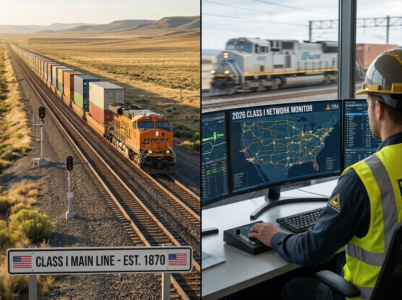
Class I railroads are the backbone of freight transportation in the United States, moving millions of tons of goods across the country every year. From connecting ports to factories, farms, and energy hubs, these railroads play a crucial role in the economy, trade, and daily life.
In this article, we’ll explore what Class I railroads are, trace their history, and explain why they continue to matter in 2026. Keep reading to discover how these massive rail networks impact the U.S. economy, supply chains, and the future of transportation.
What Are Class I Railroads?
Class I railroads are the largest freight rail companies in the United States based on annual operating revenue. They operate long-distance networks across multiple states and play a central role in moving bulk goods, containers, vehicles, and raw materials across North America.
These railroads form the backbone of the national freight system and connect ports, factories, farms, energy hubs, and major cities. And this classification system is regulated by the Surface Transportation Board (STB).
Surface Transportation Board (STB) Revenue Requirements
The STB sets revenue thresholds and adjusts them over time to account for inflation. As of 2024, a railroad must generate at least $1.074 billion in annual operating revenue to qualify as a Class I railroad.
If a railroad’s revenue falls below that level, it is classified as either Class II or Class III.
How the Classification System Works (Class I, II, and III)
The system has three categories:
- Class I – Large railroads with revenue above $1.074 billion.
- Class II (Regional Railroads) – Medium-sized railroads operating regionally with lower revenue levels.
- Class III (Short Line Railroads) – Small railroads that typically serve local customers and connect to larger networks.
The classification is based strictly on revenue, not track length or number of employees.
Current Class I Railroads in 2026
As of 2026, the following railroads meet Class I revenue standards in North America:
- BNSF Railway
- Union Pacific Railroad
- CSX Transportation
- Norfolk Southern Railway
- Canadian National Railway (CN)
- Canadian Pacific Kansas City (CPKC)
- Amtrak (passenger railroad)
Most of these are freight railroads. Amtrak qualifies based on revenue but primarily operates passenger services.
How Class I Railroads Differ from Other Railroads
Class I railroads operate nationwide or cross-border networks, while smaller railroads focus on regional or local routes.
Class II (Regional Railroads)
Regional railroads operate within specific areas of the country. They typically connect short line railroads to Class I networks and move freight over medium distances.
Class III (Short Line Railroads)
Short line railroads operate smaller routes, often serving rural areas, ports, industrial zones, and local manufacturers. They provide first-mile and last-mile connections to larger rail networks.
Key Operational Differences
Here are the main differences:
- Network Size: Class I railroads operate thousands of route miles across multiple states or countries.
- Revenue Scale: Class I railroads generate billions in annual revenue.
- Freight Volume: They move significantly larger freight volumes than regional or short line railroads.
- Geographic Reach: Class I railroads often operate across U.S., Canadian, and Mexican borders.
- Investment Capacity: They invest billions annually in infrastructure, safety, and technology upgrades.
Together, Class I, II, and III railroads create an interconnected rail system that supports the entire U.S. supply chain.
History of Class I Railroads
The history of Class I railroads reflects the growth, decline, and consolidation of the American railroad industry. From the early 1800s to today, railroads have shaped the country’s economy, trade routes, and industrial expansion.
Early Beginnings (1800s–1911)
Railroads began expanding rapidly in the early 19th century, supporting westward expansion and industrial growth.
The first common-carrier railroad in the United States was the Baltimore and Ohio Railroad (B&O), chartered in 1827. It marked the start of large-scale rail transportation in the country.
By the late 1800s:
- Railroads connected the East Coast to the Midwest and West.
- Thousands of miles of track were laid across the country.
- Rail became the main method for moving freight and passengers.
By the early 1900s, more than 140 major railroad systems operated in the United States. However, there was no formal classification system yet.
Classification System Established (1911)
In 1911, the former federal regulator, the Interstate Commerce Commission (ICC), created a revenue-based system to classify railroads.
At that time:
- A railroad needed at least $1 million in annual revenue to qualify as a Class I railroad.
- By 1925, there were 174 Class I railroads operating in the U.S.
The classification helped regulators monitor financial performance and industry structure more clearly.
Mid-20th Century Changes (1950s–1970s)
After World War II, the railroad industry began facing serious challenges:
- Increased competition from trucking and highways
- Growth in air travel
- Declining passenger rail demand
By 1956, the number of Class I railroads had dropped to 113.
One of the most significant failures was the bankruptcy of the Penn Central Transportation Company in 1970, which became one of the largest corporate bankruptcies in U.S. history at the time.
To stabilize the industry:
- The federal government created Amtrak in 1971 to take over most passenger rail services.
- In 1976, Conrail was formed to rescue several bankrupt freight railroads in the Northeast and Midwest.
The Staggers Rail Act of 1980
A major turning point came with the passage of the Staggers Rail Act of 1980.
This law reduced federal regulation and allowed railroads to:
- Set their own freight rates more freely
- Negotiate contracts directly with customers
- Abandon unprofitable routes
The result was improved financial health, higher productivity, and renewed investment across the industry.
Modern Era Consolidation (1990s–2020s)
From the 1990s onward, mergers reshaped the railroad industry and reduced the number of Class I railroads.
Major mergers included:
- Burlington Northern Railroad + Atchison, Topeka and Santa Fe Railway (1995–1996) → Formation of BNSF Railway.
- Union Pacific Railroad + Southern Pacific Transportation Company (1996).
- Split of Conrail assets between CSX Transportation and Norfolk Southern Railway (1999).
- Merger of Canadian Pacific Railway and Kansas City Southern (2023) forming Canadian Pacific Kansas City (CPKC).
These mergers created today’s smaller group of large, financially strong rail systems.
Where the Industry Stands Today
From more than 170 Class I railroads in the 1920s to just a handful today, the industry has gone through more than a century of change.
Consolidation, deregulation, and private investment have shaped the modern Class I railroad system. In 2026, these railroads operate vast networks across the United States and North America, carrying a large share of the nation’s freight and playing a key role in economic stability.
How Class I Railroads Operate Today
In 2026, Class I railroads operate large, integrated freight networks that move goods across the United States, Canada, and Mexico. They manage long-distance routes, major freight corridors, intermodal terminals, and rail yards.
These companies handle millions of railcars each year and coordinate with ports, trucking companies, warehouses, and manufacturers to keep supply chains moving.
Network Coverage
Class I railroads operate thousands of route miles across multiple states and international borders.
- Western networks are dominated by BNSF Railway and Union Pacific Railroad, covering large areas of the western and central United States.
- Eastern operations are led by CSX Transportation and Norfolk Southern Railway, serving the Midwest, Southeast, and East Coast.
- Cross-border routes connect the U.S. with Canada and Mexico through Canadian National Railway and Canadian Pacific Kansas City.
These railroads link major ports, industrial centers, agricultural regions, and energy-producing areas.
What They Transport
Class I railroads move a wide range of freight, including:
- Intermodal containers (goods transferred between ships, trucks, and trains)
- Bulk commodities such as coal, grain, fertilizers, and chemicals
- Automobiles and auto parts
- Agricultural products
- Energy resources, including petroleum products and natural gas liquids
- Construction materials and industrial goods
Intermodal freight has grown significantly in recent years due to e-commerce and global trade.
Infrastructure and Investment
Unlike highways, which are publicly funded, Class I railroads maintain and invest in their own infrastructure.
They own and operate:
- Rail tracks
- Bridges and tunnels
- Rail yards and terminals
- Signal systems and dispatch centers
On average, Class I railroads invest tens of billions of dollars annually in maintenance, expansion, safety systems, and new technology.
Investments focus on:
- Track upgrades and capacity expansion
- Positive Train Control (PTC) safety systems
- Fuel-efficient locomotives
- Automation and data-driven operations
This private investment model reduces the burden on taxpayers while supporting national freight capacity.
Operations and Efficiency
Class I railroads use advanced logistics systems to manage freight flows efficiently. They operate:
- Unit trains for bulk commodities
- Scheduled intermodal services
- Hub-and-spoke yard systems
- Precision scheduled railroading (PSR) models to improve asset utilization
Their large-scale operations allow them to move heavy freight long distances at lower fuel cost per ton compared to trucks.
In 2026, Class I railroads remain central to North America’s freight transportation system, combining large physical networks with modern logistics technology to support economic activity.
Why Class I Railroads Matter in 2026
In 2026, Class I railroads remain one of the most important parts of the U.S. freight transportation system. They move large volumes of goods across long distances, connect domestic industries to global markets, and support hundreds of thousands of jobs.
Their role goes beyond simply transporting freight. They influence economic growth, trade stability, energy supply, infrastructure development, and environmental performance across North America.
The following are some of the key reasons that showcase the importance of having Class I railroads in 2026:
1. Drive Economic Growth
Class I railroads generate major economic value each year. Key stats include:
- They contribute more than $233 billion in total economic output.
- They support over 749,000 jobs across the broader U.S. economy.
- Railroad employees earn high wages, with average total compensation around $149,000, including benefits.
These jobs include engineers, conductors, maintenance workers, logistics specialists, and technology professionals. In addition, many indirect jobs depend on freight rail, including manufacturing, agriculture, mining, warehousing, and port operations.
Rail service is especially important for heavy industries such as steel, chemicals, energy, and agriculture. Without reliable rail transportation, production costs would increase and supply chains would slow down.
2. Support National and Global Supply Chains
Railroads are deeply connected to international trade. Here in the USA, about 38% of rail traffic is tied to global trade. Infact they move more than 543 million tons of trade-related freight annually.
Class I railroads connect:
- Seaports to inland markets
- Manufacturing plants to distribution centers
- Farms to export terminals
- Energy producers to refineries and utilities
Cross-border rail networks operated by companies like Canadian National Railway and Canadian Pacific Kansas City strengthen trade links between the U.S., Canada, and Mexico. Furthermore, intermodal freight has grown steadily as businesses rely on rail to move shipping containers from ports to warehouses efficiently. This makes rail an essential link between ocean shipping and trucking.
In times of global supply chain disruption, railroads help maintain stability by moving large volumes efficiently and reliably.
3. Reduce Emissions and Improve Fuel Efficiency
Rail transport is one of the most fuel-efficient land transportation methods available today. Freight railroads can move one ton of freight more than 470 miles on a single gallon of fuel, making rail significantly more efficient for long-distance shipping.
On average, rail transport is about four times more fuel-efficient than trucking, which helps reduce overall fuel consumption, operating costs, and greenhouse gas emissions.
This results in:
- Lower greenhouse gas emissions
- Reduced highway congestion
- Lower fuel consumption per ton-mile
If freight currently carried by rail were shifted to trucks, it would require more than 21 million additional long-haul truck trips annually. That would increase road congestion, infrastructure wear, and emissions.
As companies focus more on sustainability in 2026, rail plays a key role in helping businesses reduce their carbon footprint.
4. Strengthen Infrastructure Without Taxpayer Funding
Class I railroads operate under a private ownership model. Unlike highways, which are funded by taxpayers, freight railroads:
- Own their track infrastructure
- Maintain bridges and tunnels
- Invest in rail yards and terminals
- Fund signal and safety systems
On average, Class I railroads reinvest about 19% of their annual revenue into infrastructure and capacity improvements, totaling around $26.8 billion per year.
This investment:
- Expands freight capacity
- Improves safety systems
- Supports economic development
- Reduces strain on public infrastructure budgets
Their self-funded model allows long-term planning and consistent modernization of the network.
Without freight rail, it is estimated that 21+ million additional trucks would be needed on U.S. highways each year, increasing congestion, road wear, and emissions.
5. Support for Manufacturing and Reshoring
In 2026, there is growing focus on reshoring and near-shoring manufacturing to North America. Class I railroads support this shift by:
- Providing reliable long-distance freight capacity.
- Connecting industrial parks to ports and borders.
- Supporting just-in-time supply chains
Large manufacturing operations depend on predictable, high-volume freight service. Rail helps keep production costs competitive.
6. National Freight Stability
Class I railroads move roughly 40% of long-distance freight ton-miles in the United States. This makes them a central part of the national freight system.
If rail service slows or faces disruption, it can affect:
- Retail supply chains
- Energy delivery
- Agricultural exports
- Industrial production
Because of their scale and efficiency, railroads provide a stable and cost-effective alternative to road transport for heavy freight.
Current Industry Outlook for 2026
Looking ahead, the industry faces both opportunities and challenges:
- Limited growth expectations due to economic uncertainty.
- Focus on safety, service reliability, and operational efficiency.
- Continued discussion around possible consolidation, including reports of a proposed Union Pacific Railroad–Norfolk Southern Railway merger.
- Manufacturing slowdowns affecting freight volumes.
Despite these challenges, Class I railroads remain essential to the U.S. economy. Their ability to move heavy freight efficiently, invest privately in infrastructure, and support trade and industry ensures they will continue to play a major role in 2026 and beyond.
Challenges Facing Class I Railroads
Even as Class I railroads remain critical to the U.S. economy, they face several ongoing challenges in 2026 that affect operations, growth, and profitability. Some of them are as follows:
- Compete with Trucks and Other Transportation Modes: Class I railroads face competition from the trucking industry, which can offer faster delivery for shorter distances. Air cargo and shipping alternatives also impact certain freight types, forcing railroads to continuously improve efficiency and service.
- Navigate Economic Uncertainty: Fluctuations in manufacturing, energy production, and global trade volumes can directly affect freight demand. Economic slowdowns, changing commodity prices, or trade disruptions can reduce revenue and strain operations.
- Meet Regulatory Requirements: Railroads must comply with federal regulations set by the Surface Transportation Board and safety standards enforced by the Federal Railroad Administration. Compliance adds operational complexity and costs, particularly for infrastructure and safety upgrades.
- Maintain and Upgrade Infrastructure: Class I railroads are responsible for maintaining thousands of miles of track, bridges, tunnels, and terminals. Aging infrastructure requires continuous investment, and failure to upgrade can lead to service delays, safety risks, and higher long-term costs.
- Adapt to Technology and Innovation: Implementing modern technologies such as Positive Train Control (PTC), automation, and data-driven logistics requires capital, training, and cultural adaptation. Railroads must balance innovation with operational reliability and workforce readiness.
- Manage Workforce and Labor Challenges: Finding skilled engineers, conductors, and maintenance crews is critical. Labor shortages, retirements, and contract negotiations can affect service quality and operational continuity.
These challenges highlight the complexity of operating Class I railroads today. Success depends on balancing investment, efficiency, regulatory compliance, and workforce management while maintaining reliable service across North America.
The Future of Class I Railroads
Class I railroads are evolving to meet the demands of 2026 and beyond. With changes in technology, trade patterns, and sustainability priorities, their future will be shaped by innovation, efficiency, and strategic growth.
The following are some of the key areas where Class I railroads will focus their efforts to stay competitive and meet future demands:
- Embrace Technology and Innovation: Railroads are increasingly using digital systems, automation, and data analytics to improve operations. Technologies such as Positive Train Control (PTC), predictive maintenance, and advanced logistics software help railroads move freight more safely and efficiently.
- Support Reshoring and Nearshoring Efforts: As companies bring manufacturing closer to North America, Class I railroads play a critical role in connecting new factories, suppliers, and ports. Efficient rail service helps reduce supply chain bottlenecks and supports regional economic growth.
- Lead Sustainability Initiatives: Railroads are focusing on reducing carbon emissions, improving fuel efficiency, and promoting greener freight solutions. Rail transport is already more fuel-efficient than trucks, and ongoing investments aim to further lower environmental impact.
- Explore Strategic Mergers and Consolidation: The industry may continue to consolidate to improve efficiency and expand network coverage. Mergers like Canadian Pacific Kansas City demonstrate how combining networks can enhance service and competitiveness.
- Adapt to Changing Industry Demands: Class I railroads must remain flexible to respond to economic fluctuations, trade shifts, and customer needs. Investments in workforce development, infrastructure, and technology are essential to sustain growth and maintain reliability.
The future of Class I railroads will be defined by how effectively they combine technology, sustainability, and strategic planning to meet the demands of a rapidly changing freight and supply chain environment.
Conclusion
Class I railroads have been, and continue to be, a cornerstone of the U.S. transportation system. From their early beginnings in the 1800s to today’s modern, consolidated networks, they have shaped trade, industry, and the economy. In 2026, these railroads remain essential for moving vast amounts of freight efficiently, supporting hundreds of thousands of jobs, and enabling global trade.
Despite challenges such as competition from trucks, economic fluctuations, regulatory requirements, and the need for continuous infrastructure investment, Class I railroads continue to adapt. By embracing technology, supporting reshoring efforts, leading sustainability initiatives, and exploring strategic growth opportunities, they are positioning themselves for a strong and resilient future.
Ultimately, Class I railroads are more than just a mode of transport. They are a vital part of the economic and industrial backbone of North America. Their continued evolution will shape how goods move, how industries grow, and how the U.S. maintains its position in a global economy.
Resources:
- https://www.stb.gov/reports-data/economic-data/
- https://www.stb.gov/reports-data/uniform-rail-costing-system/
- https://www.stb.gov/resources/major-railroad-mergers/timeline/
- FRA Safety Data
- https://www.aar.org/wp-content/uploads/2025/02/AAR-PE-Economic-Impact-Report-2025-FINAL.pdf
- https://www.aar.org/wp-content/uploads/2018/05/AAR-Overview-Americas-Freight-Railroads.pdf
Key Takeaways
- Class I railroads are the largest freight railroads in the U.S., defined by annual operating revenue above $1.074 billion (2024 threshold).
- They operate long-distance networks across multiple states and countries, connecting ports, factories, farms, and energy hubs.
- The classification system includes Class I, II, and III railroads, with Class I handling the largest volumes and highest revenue.
- Historical growth included over 170 Class I railroads, but consolidation, mergers, and regulatory changes reduced their number to a handful today.
- The Staggers Rail Act of 1980 transformed the industry, allowing deregulation, improved efficiency, and financial stability.
- Class I railroads transport a wide range of goods, including intermodal containers, bulk commodities, automobiles, agricultural products, and energy resources.
- They invest billions annually in infrastructure and technology, including track upgrades, safety systems, and automation, reducing the burden on public funds.
- Railroads support economic growth and jobs, contributing over $233 billion in economic output and supporting more than 749,000 jobs across the U.S.
- Rail transport is environmentally efficient, moving one ton of freight 470+ miles per gallon of fuel and reducing highway congestion and greenhouse gas emissions.
- The future of Class I railroads focuses on technology, sustainability, and strategic growth, including mergers, reshoring support, and adapting to changing supply chain demands.
FAQs
How Many Class I Railroads Are There?
As of 2026, there are seven Class I railroads: four U.S.-owned freight carriers (BNSF, CSX, Norfolk Southern, Union Pacific), two Canadian-owned with U.S. trackage (Canadian National, Canadian Pacific Kansas City), and Amtrak (passenger).
Who Regulates Class I Railroads?
The STB governs economic aspects like mergers and rates, while the Federal Railroad Administration (FRA) enforces safety standards for tracks, equipment, and operations.
How Have Class I Numbers Changed?
Historically over 100, mergers reduced them from 13 in 2001 to seven today through consolidations like BNSF and CPKC formations.