

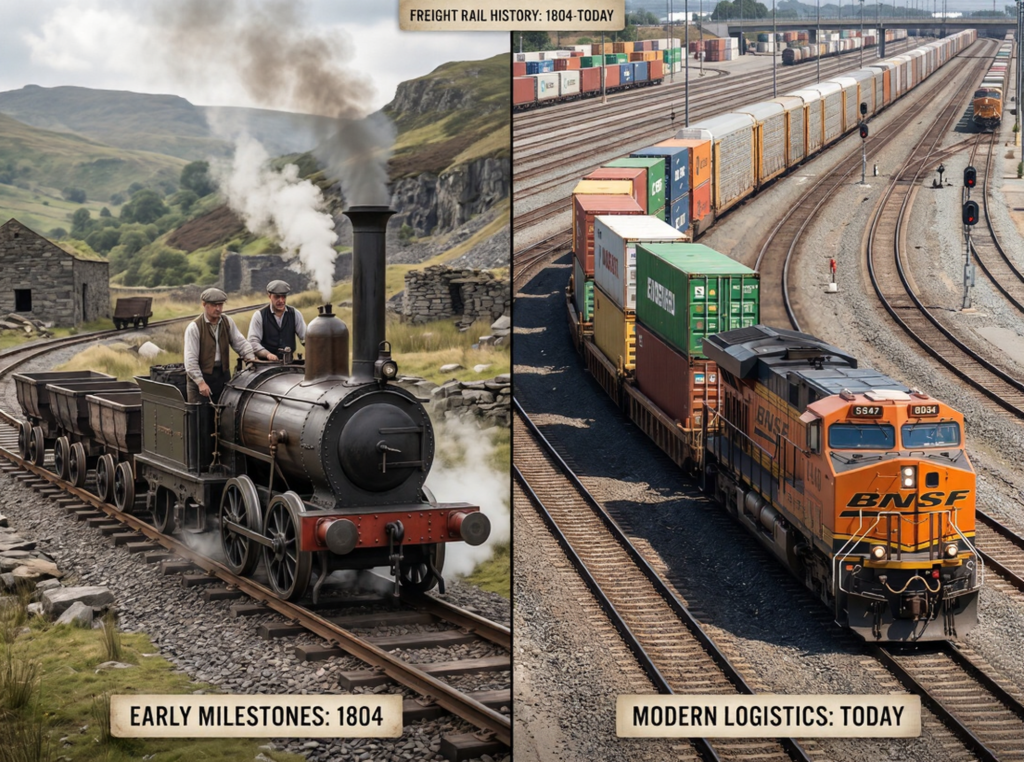
Freight rail history reflects one of the most transformative journeys in industrial and economic development. From a single experimental locomotive to vast interconnected networks, freight rail history shows how innovation reshaped global trade. Even today, freight rail history continues to influence how goods move efficiently across continents.
Over more than two centuries, rail freight has carried raw materials, agricultural goods, and industrial products at an unmatched scale. It reduced transportation costs, expanded markets, and supported industrial revolutions across nations. Entire economies evolved alongside railway expansion.
This article explores the key milestones that shaped freight rail, beginning with its earliest invention and progressing through its golden age.
Who Built the First Steam-Powered Train in 1804?
The first steam-powered train was built by Richard Trevithick in 1804. His invention marked the true beginning of freight rail history and introduced a new era of mechanized transport.
The Penydarren Locomotive: Where It All Began
Richard Trevithick’s Penydarren locomotive made its historic journey in South Wales. On February 21, 1804, it carried 10 tons of iron, five wagons, and approximately 70 passengers over a distance of nearly 9 miles.
This achievement demonstrated that steam engines could move heavy loads on rails. It laid the foundation for future freight transport systems.
However, the early system had serious limitations. The iron rails were too weak and often broke under the locomotive’s weight. Many investors and engineers doubted the long-term viability of steam-powered railways.
Despite skepticism, Trevithick’s invention sparked interest among engineers and industrialists. It proved that machines could replace animal power for hauling goods.
Freight rail history begins with this bold experiment. It introduced a concept that would later revolutionize global logistics.
Yet, at this stage, railways were far from practical for large-scale use. The technology needed refinement. Infrastructure needed improvement.
One invention had proven the idea, but how did it evolve into a reliable system that industries could depend on? The next phase reveals the turning point.
The Birth of Commercial Freight Rail (1820s–1850s)
The 1820s marked the transition from experimental railways to commercial freight systems. This period played a critical role in shaping freight rail history.
The Baltimore & Ohio Railroad, established in 1830, became the first commercial freight railroad in the United States. It demonstrated that rail transport could operate as a profitable business.
At the same time, the United Kingdom rapidly expanded its railway network. Industrial centers connected with ports, mines, and factories.
Railroads quickly proved more efficient than canals and horse-drawn transport. They offered faster delivery times and consistent schedules.
How Early Railroads Transformed Trade
Early freight railroads revolutionized trade by creating reliable transportation systems across regions.
Key commodities transported during this period included:
- Coal for fueling factories and steam engines
- Iron for construction and manufacturing
- Grain to supply growing urban populations
- Timber for infrastructure and housing
Railroads linked production centers with markets. Farmers could sell crops beyond local regions. Factories could receive raw materials faster.
By 1850, the United States had laid more than 9,000 miles of railroad track. The United Kingdom also developed dense rail networks that supported industrial expansion.
Freight rail history during this period highlights how transportation drives economic growth. Railways reduced costs and improved efficiency.
A study from the mid-19th century showed that rail transport reduced freight costs by nearly 50% compared to traditional methods. This cost advantage encouraged rapid adoption.
Railroads also created jobs. Thousands of workers participated in track laying, locomotive manufacturing, and operations.
Cities began to grow along railway lines. Trade hubs emerged where goods could be transferred and distributed.
Transcontinental Railroad and the Expansion Era (1860s–1890s)
The completion of the First Transcontinental Railroad in 1869 marked a major milestone in freight rail history. It connected the eastern United States with the Pacific Coast for the first time.
Before this achievement, transporting goods across the country took months. Ships had to travel around South America, or wagons had to cross dangerous terrain.
After the railroad, goods could travel coast to coast in less than two weeks.
What the Transcontinental Railroad Meant for Freight
The transcontinental railroad transformed freight movement across the nation.
| Factor | Before Railroad | After Railroad |
| Travel Time | 4–6 months | 7–10 days |
| Freight Cost | Extremely high | Significantly lower |
| Risk Level | High (weather, theft) | Reduced significantly |
| Market Reach | Limited | Nationwide |
Freight rail history during this period shows how infrastructure can reshape economies. Railroads enabled industries to expand into new territories.
Agricultural products from the Midwest reached eastern markets quickly. Raw materials from the West supported industrial growth in the East.
However, building the railroad was not easy. Thousands of workers, including Chinese and Irish immigrants, faced harsh working conditions.
Engineering challenges included mountains, deserts, and extreme weather. Political decisions influenced funding and land allocation.
A historical remark from the era stated: “Railroads are the arteries of a growing nation.”
Railways unified distant regions and encouraged westward expansion. Towns developed along railway routes, creating new economic centers.
Freight rail history in this era demonstrates how transportation can influence national development.
Yet, as railroads expanded rapidly, competition increased. Companies sought better technologies and more efficient systems.
When Was the Golden Age of Railroads?
The golden age of railroads occurred between the 1880s and the 1920s. During this time, freight rail history reached its peak in both expansion and operational efficiency.
By 1916, the United States had approximately 254,000 miles of railroad track. Railroads dominated freight transportation across the country.
What Defined the Golden Age of Freight Rail
Several key innovations defined this era and improved freight operations:
- Standardized track gauges allowed trains to travel across networks seamlessly
- Steel rails replaced iron, increasing strength and durability
- Refrigerator cars enabled long-distance transportation of perishable goods
- Advanced signaling systems improved safety and scheduling
- Increased competition between rail companies improved service quality
Freight volumes reached unprecedented levels. Railroads transported coal, steel, agricultural products, and manufactured goods across vast distances.
Freight rail history during this period highlights the importance of technological innovation. Rail companies invested heavily in infrastructure and equipment.
Chicago emerged as a major rail hub, connecting eastern and western networks. Other cities also developed as key distribution centers.
Railroads introduced scheduled freight services. Businesses relied on predictable delivery times for planning production and supply chains.
Statistical data from the early 20th century shows that railroads handled more than 70% of inland freight transportation in the United States.
This dominance made railways essential to economic stability and growth.
However, even at its peak, signs of change began to appear. New transportation technologies were emerging, and they would soon challenge the dominance of railroads.
Decline, Regulation, and the Railroad Crisis (1920s–1970s)
The period between the 1920s and 1970s marked one of the most challenging phases in freight rail history. After decades of dominance, railroads began to lose their competitive edge.
The rise of automobiles and trucking changed the transportation landscape. Trucks offered flexible routes and door-to-door delivery. Highways expanded rapidly, supported by government funding.
Freight rail history during this time shows a steady decline in market share. Railroads struggled to compete with faster and more adaptable road transport.
At the same time, heavy government regulation limited the industry’s ability to adapt. The Interstate Commerce Commission (ICC) controlled pricing, routes, and services. Rail companies could not easily adjust rates or discontinue unprofitable lines.
How Government Regulation Shaped Freight Rail
Government policies had a significant impact on railroad operations during this period.
Key regulatory challenges included:
- Strict rate controls that limited pricing flexibility
- Requirements to maintain unprofitable routes
- Lengthy approval processes for operational changes
These restrictions reduced profitability and slowed innovation. Railroads found it difficult to compete with trucking companies that operated with fewer constraints.
By the mid-20th century, several major railroads faced financial difficulties. The situation worsened with declining freight volumes.
One of the most notable events was the collapse of the Penn Central Railroad in 1970. It became the largest corporate bankruptcy in U.S. history at the time.
Freight rail history during this era reflects how external pressures and internal limitations can weaken even the strongest industries.
Statistical data shows that railroads’ share of freight transportation dropped significantly during these decades. By the 1970s, trucking had captured a large portion of short-distance freight.
However, this crisis forced the industry to reconsider its structure. Change was no longer optional.
What Are the Six Major Freight Railroads?
The modern era of freight rail history began with deregulation, particularly after the Staggers Rail Act of 1980. This law allowed railroads to set competitive rates and improve efficiency.
As a result, the industry consolidated into a smaller number of large, efficient companies.
The Six Class I Freight Railroads Today
Today, six major Class I railroads dominate freight transportation in North America:
- BNSF Railway: One of the largest freight rail networks in the United States, known for extensive coverage in the western regions
- Union Pacific: Operates a vast network connecting the West Coast to the Midwest and Gulf Coast
- CSX Transportation: Serves the eastern United States with a focus on industrial and agricultural freight
- Norfolk Southern: Covers key southeastern and eastern corridors
- Canadian National (CN): Connects Canada with the United States, linking major ports and inland markets
- Canadian Pacific Kansas City (CPKC): A transnational network connecting Canada, the U.S., and Mexico
Freight rail history in the modern era highlights how consolidation improved efficiency. These companies invested in infrastructure, technology, and operational improvements.
Deregulation allowed railroads to focus on profitable routes and services. It also encouraged competition and innovation.
By the late 20th century, freight rail began to recover. Productivity increased, and costs decreased.
But how did these powerful companies reshape freight transportation and drive innovation? The answer lies in the technological revolution that followed.
Modernization and the Technology Revolution (1980s–2000s)
The period after deregulation marked a turning point in freight rail history. Railroads embraced new technologies and operational strategies to improve efficiency.
One of the most important developments was intermodal transportation. This system allowed containers to move seamlessly between ships, trucks, and trains.
Intermodal Freight: A Game-Changer in Transportation
Intermodal freight transformed how goods moved across long distances. Standardized containers made loading and unloading faster and more efficient.
Key advantages of intermodal freight included:
- Reduced handling of goods, minimizing damage
- Faster transfers between transport modes
- Lower transportation costs over long distances
By the 1990s, intermodal traffic had grown significantly. Railroads began to focus heavily on containerized freight.
Freight rail history during this period shows a shift toward efficiency and integration. Railroads became a key part of global supply chains.
Technology also played a crucial role. Rail companies introduced GPS tracking, computerized scheduling systems, and automated signaling.
Precision railroading improved operational efficiency. Trains ran on tighter schedules, reducing delays and fuel consumption.
Statistical data shows that rail productivity nearly doubled between 1980 and 2000. Railroads moved more freight with fewer resources.
Freight rail history in this era highlights how innovation can revive an industry.
Freight Rail History in the Modern Era (2000s–Today)
In the 21st century, freight rail continues to play a vital role in global transportation. Freight rail history has evolved into a story of sustainability, efficiency, and large-scale logistics.
Railroads now move billions of tons of freight each year. In the United States alone, freight rail transports approximately 1.6 billion tons annually.
Rail remains one of the most efficient ways to move heavy goods over long distances. It supports industries such as agriculture, energy, manufacturing, and retail.
Why Freight Rail Still Matters Today
Freight rail continues to offer several key advantages:
- High fuel efficiency compared to trucks
- Lower greenhouse gas emissions
- Ability to move large volumes of goods
- Reduced congestion on highways
According to industry data, trains can move one ton of freight more than 470 miles on a single gallon of fuel. This makes rail one of the most environmentally friendly transportation options.
Freight rail history today reflects a growing focus on sustainability. Rail companies invest in cleaner technologies and energy-efficient systems.
Economic contributions are also significant. Freight rail supports millions of jobs and contributes billions to national economies.
An industry expert once noted: “Freight rail remains the backbone of industrial logistics.”
Railroads also play a crucial role in reducing supply chain disruptions. Their reliability supports consistent delivery of goods across regions.
Freight rail history in the modern era shows how the industry continues to adapt and remain relevant.
Final Thoughts
Freight rail history represents a remarkable journey of innovation, resilience, and transformation over more than two centuries. From the early days of steam-powered locomotives to today’s advanced and efficient rail networks, freight rail history highlights how transportation has shaped global trade and industrial growth. Each phase introduced new technologies, overcame challenges, and redefined how goods move across regions.
The evolution of freight rail was not always smooth. Periods of decline and heavy regulation tested the industry’s strength. However, strategic reforms and technological advancements helped it recover and thrive once again. Freight rail history proves that adaptability remains essential for long-term success in any industry.
Today, rail systems continue to support economies by offering cost-effective and environmentally friendly transportation solutions. As sustainability becomes increasingly important, freight rail is expected to play an even greater role in the future. Freight rail history not only reflects the past but also provides valuable insights for building smarter and more efficient logistics systems ahead.
Key Takeaways
- Freight rail history began in 1804 with the invention of the first steam-powered locomotive.
- Early rail systems transformed trade by enabling faster and more reliable transportation of goods.
- The Baltimore & Ohio Railroad marked the beginning of commercial freight rail operations in the United States.
- The transcontinental railroad significantly reduced travel time and costs across vast national distances.
- Freight rail history reached its peak during the golden age between the 1880s and 1920s.
- Innovations like steel rails and refrigerated cars improved efficiency and expanded freight capabilities.
- The rise of trucking and strict regulations caused a major decline in railroad market share.
- The Staggers Rail Act of 1980 helped revive the industry through deregulation and competition.
- Modern freight rail systems rely heavily on intermodal transport and advanced technologies.
- Freight rail history continues to play a vital role in sustainable and large-scale global logistics.
FAQs
Who is the father of the locomotive?
Richard Trevithick is widely known as the father of the locomotive. He built the first successful steam-powered locomotive in 1804, which laid the foundation for modern rail transport.
What did Richard Trevithick introduce in 1804?
In 1804, Richard Trevithick introduced the first steam-powered railway locomotive. His Penydarren locomotive demonstrated that steam engines could haul heavy loads on rails.
What are the 4 types of freight?
The four main types of freight include bulk cargo, break bulk cargo, containerized cargo, and liquid cargo. Each type requires different handling and transportation methods.
What are the 4 types of trains?
The four common types of trains are freight trains, passenger trains, high-speed trains, and metro or light rail systems. Each serves a specific purpose in transportation networks.
What is the oldest railroad still in use?
The Middleton Railway in the United Kingdom is considered the oldest railway still in use. It began operations in 1758 and continues to operate today.
