

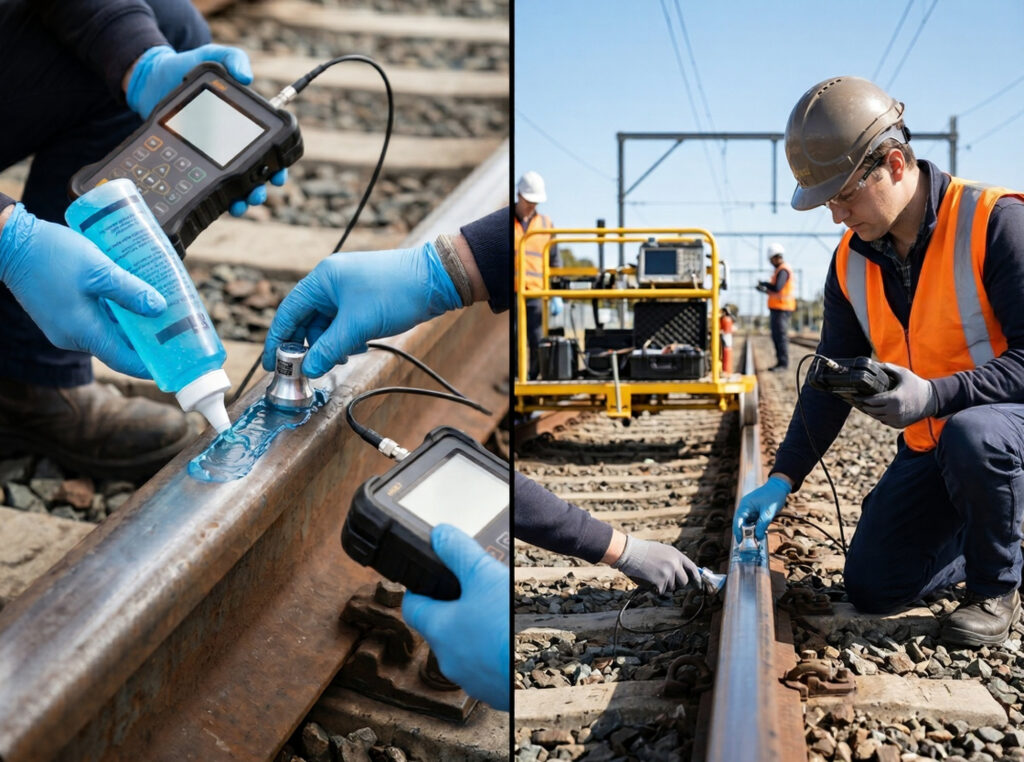
Rail inspection failures often trace back to something surprisingly small: poor acoustic contact. Ultrasonic couplant plays a critical role in ensuring accurate signal transmission during testing. Ultrasonic couplant creates a consistent medium that allows sound waves to travel efficiently from the probe into the rail.
Rail networks operate under constant stress from heavy loads and environmental exposure. Even a minor defect can develop into a serious structural issue if inspectors fail to detect it early. The correct use of ultrasonic couplant ensures that inspection systems deliver precise readings under real-world conditions. According to established writing and technical standards , clarity and accuracy remain essential in such safety-critical discussions.
What Is Ultrasonic Couplant and Why Does It Matter in Rail Inspection?
Ultrasonic testing depends on sound waves traveling through solid materials without interruption. However, air disrupts this process because it reflects nearly all ultrasonic energy. A couplant removes this barrier and enables smooth transmission between the transducer and the rail surface.
Rail inspection environments rarely offer ideal conditions. Surfaces often contain rust, oil, or debris, which makes consistent signal transfer difficult. In these situations, ultrasonic couplant becomes the bridge that connects technology with reality, ensuring reliable inspection outcomes.
What Is the Purpose of a Couplant Used During Ultrasonic Inspections?
A couplant allows ultrasonic waves to pass efficiently from the probe into the test material. It eliminates air gaps that would otherwise block signal transmission. This function ensures that inspection equipment captures accurate reflections from within the rail.
In rail systems, surfaces are uneven and exposed to harsh conditions. Ultrasonic couplant helps maintain consistent acoustic contact even when the rail surface is rough or contaminated. Without it, inspection accuracy drops significantly.
How Sound Transmission Works in Rail Testing
Sound waves require a continuous medium to travel effectively. When a transducer sends waves into steel, those waves must enter without reflection at the surface. Air pockets prevent this transfer and weaken the signal.
Liquids such as gels, oils, and water-based solutions fill these gaps. They match the acoustic impedance between the probe and steel. This matching allows energy to move efficiently into the rail and return with useful data.
The success of ultrasonic testing depends on this simple yet critical interaction. Without proper coupling, even advanced inspection systems struggle to detect internal flaws.
Common Couplant Types Used in Rail Inspection
Rail inspectors rely on various couplant types depending on environmental and operational needs:
- Water-based gels remain the most widely used option for general inspections.
- Glycerin-based fluids perform well on rough or corroded surfaces.
- Machine oils support inspections in high-temperature environments.
- Specialty compounds handle extreme heat or automated inspection systems.
- Advanced solutions from manufacturers like EMA Quality Industries address modern rail inspection challenges.
Each type offers different viscosity levels, temperature tolerance, and durability. Inspectors must match these characteristics with field conditions to achieve optimal results.
In practice, the choice often depends on more than just availability. It requires understanding how each type behaves under pressure, heat, and movement.
With so many couplant types available, how does a rail inspector choose the right one? The answer depends on several factors that most teams overlook and they are coming up next.
How to Select the Right Ultrasonic Couplant for Rail Applications
Selecting the correct ultrasonic couplant requires careful evaluation of field conditions. Inspectors must consider environmental factors, equipment requirements, and surface characteristics before making a choice.
A mismatch between the couplant and the application can lead to signal distortion. This distortion reduces the reliability of inspection results and may require costly rework.
Key Selection Factors
Rail inspection teams evaluate several critical factors:
- Surface temperature of the rail
Temperature directly affects viscosity and stability. High heat can thin the couplant, while cold conditions can thicken it. - Rail surface condition
Rust, oil, and debris influence how well the couplant adheres to the surface. - Transducer frequency range
High-frequency inspections require consistent coupling to maintain signal clarity. - Application method
Manual and automated systems demand different flow and spread characteristics. - Environmental compliance
Regulations may restrict certain chemical compositions, especially in sensitive areas. - Viscosity and flow characteristics
The couplant must remain stable without excessive dripping or drying.
Each of these factors contributes to overall inspection accuracy. Ignoring even one can compromise the entire testing process.
Couplant Types vs. Rail Inspection Conditions
| Couplant Type | Best For | Temperature Range | Viscosity |
| Water-based gel | General field use | -10°C to 50°C | Medium |
| Glycerin-based fluid | Rough or corroded surfaces | 0°C to 60°C | High |
| Oil-based couplant | High-temperature zones | Up to 120°C | Low–Medium |
| Specialty ultrasonic paste | Automated high-speed systems | Variable | Very High |
The correct pairing between couplant type and inspection condition improves signal strength and consistency. Rail operators often depend on engineered solutions, such as those developed by EMA Quality Industries, to handle complex field requirements.
Proper selection reduces inspection time, improves defect detection rates, and minimizes operational disruptions.
Choosing the right couplant is only half the challenge. What happens when it performs under real field conditions heat, vibration, and debris, is where things get truly interesting.
What Are the Methods of Ultrasonic Inspection in Rail Testing?
Ultrasonic inspection uses multiple techniques to detect internal defects within rail structures. Each method relies on sound wave behavior and requires proper coupling to function effectively.
Main Ultrasonic Testing Methods
- Pulse-echo method
This method sends sound waves into the rail and measures reflections. It identifies defects based on changes in echo patterns. - Through-transmission method
This technique uses two probes placed on opposite sides. One transmits sound while the other receives it. - Phased array ultrasonic testing (PAUT)
PAUT uses multiple elements to steer and focus sound beams. It provides detailed imaging of internal structures. - Time-of-flight diffraction (TOFD)
TOFD measures the time taken for diffracted waves to travel from defects. It offers precise crack sizing.
Each method serves a specific purpose in rail inspection. However, they all depend on consistent signal transmission.
Ultrasonic couplant ensures that these methods deliver accurate results. It maintains a stable connection between the probe and the rail, allowing sound waves to travel without interruption.
Without proper coupling, even advanced techniques like PAUT and TOFD lose their effectiveness.
Field Performance of Ultrasonic Couplant in Rail Environments
Rail inspection does not occur in controlled laboratory settings. Instead, it takes place in dynamic environments where conditions change rapidly.
Temperature fluctuations, track vibration, and surface contamination all influence performance. Under these conditions, ultrasonic couplant must remain stable and reliable.
Field performance determines whether inspectors can trust their readings or need to repeat inspections.
Temperature Effects on Couplant Performance
Temperature plays a critical role in couplant behavior. High temperatures reduce viscosity, causing the couplant to spread too thin. This thinning weakens the acoustic connection and reduces signal strength.
Cold conditions create the opposite effect. The couplant becomes thick and difficult to apply evenly. Uneven application leads to inconsistent signal transmission.
Studies in non-destructive testing suggest that improper temperature selection can reduce signal efficiency by up to 30 percent. This reduction highlights the importance of choosing temperature-specific formulations.
Manufacturers now offer couplants designed for extreme environments. These products maintain stable viscosity across a wide temperature range.
Surface Contamination and Its Impact
Rail surfaces face constant exposure to contaminants. Oil, rust, and dust create irregular surfaces that interfere with coupling.
These contaminants form micro-barriers that prevent proper contact between the probe and the rail. As a result, signal transmission weakens, and defect detection becomes unreliable.
Inspectors follow essential preparation steps to address this challenge:
- Remove loose debris from the rail surface
- Clean oil and grease residues thoroughly
- Ensure the surface is suitable for coupling
- Apply the couplant evenly across the inspection area
Experts emphasize that surface preparation plays a crucial role in inspection success. Even the best ultrasonic couplant cannot compensate for poor surface conditions.
Field performance reveals the true capabilities of any couplant. It shows how well the product adapts to real-world challenges and maintains signal integrity.
However, performance alone does not guarantee success. Application techniques, standards, and operational practices also play a vital role.
Best Practices for Applying Ultrasonic Couplant on Rail Tracks
Even the most advanced inspection system can fail without proper application techniques. Ultrasonic couplant must be applied correctly to maintain consistent signal quality and ensure accurate defect detection. In many field cases, inspectors have observed that improper handling of ultrasonic couplant leads to signal inconsistencies that cannot be corrected through equipment adjustments alone.
Rail inspection teams often prioritize equipment calibration and overlook application precision. This oversight creates gaps in inspection quality. Ultrasonic couplant acts as the final link between technology and the rail surface, and its application directly influences data accuracy. A well-applied layer ensures uniform transmission, while poor application introduces variability that can mask critical defects.
Manual Application Techniques
Manual application remains a standard practice across many rail inspection environments. It offers flexibility, especially in remote or complex track conditions. However, it demands discipline and consistency from inspectors.
A structured approach improves results significantly:
- Surface Preparation
Inspectors begin by cleaning the rail surface. Dust, rust, and oil residues must be removed to prevent interference. Even minor contaminants can disrupt coupling efficiency. - Controlled Application
Inspectors apply ultrasonic couplant in a thin, even layer. Excess material can cause pooling, while insufficient coverage creates air gaps. - Transducer Alignment
Proper positioning ensures full contact between the probe and the rail. Misalignment reduces signal clarity. - Consistent Reapplication
As the inspection progresses, the couplant layer may dry or disperse. Regular reapplication maintains continuity. - Signal Monitoring
Inspectors continuously observe signal feedback. Any fluctuation often indicates a coupling issue rather than a structural defect.
Manual application also requires adaptability. Environmental conditions such as wind, temperature, and humidity affect how ultrasonic couplant behaves on the rail surface. Skilled inspectors adjust their techniques based on these variables to maintain consistency.
Automated Application in High-Speed Rail Inspection Systems
Rail networks have expanded rapidly, and inspection demands have increased accordingly. High-speed rail systems require faster and more efficient inspection methods. Automated application systems address this need by delivering ultrasonic couplant with precision and consistency.
These systems use metered dispensing mechanisms. They control the volume and distribution of couplant across the rail surface. This consistency eliminates variations that often occur during manual application.
Automation provides several advantages:
- Uniform application across long rail sections
- Reduced material waste
- Improved inspection speed
- Enhanced safety for operators
Many modern inspection vehicles integrate automated couplant delivery systems. Manufacturers such as EMA Quality Industries develop solutions tailored for these high-performance environments. Their systems ensure that ultrasonic couplant maintains consistent coverage even at high speeds.
Automation also reduces human fatigue. Inspectors can focus on analyzing data rather than managing application processes. This shift improves overall inspection reliability and efficiency.
Best practices on the ground matter but how do international standards define what is truly acceptable? The answer shapes every inspection protocol a rail operator follows.
ASME and Industry Standards for Ultrasonic Testing in Rail Inspection
Rail inspection operates within a framework of strict standards. These standards ensure consistency, reliability, and safety across different regions and operators.
The ASME Section V, Article 4 standard serves as a primary reference for ultrasonic testing. It defines procedures for equipment setup, calibration, and inspection methods. It also addresses the role of materials used during testing, including ultrasonic couplant.
Standards emphasize that couplant selection must align with inspection requirements. The material must support effective sound transmission without introducing contaminants or affecting the test surface.
In addition to ASME, other standards provide guidance:
- ASTM E114 outlines ultrasonic testing procedures and equipment requirements
- EN 583 supports ultrasonic testing practices across European rail systems
These standards create a unified approach to inspection. They ensure that results remain consistent regardless of location or operator.
Ultrasonic couplant plays a critical role in meeting these standards. Its selection and application must follow documented procedures to ensure compliance.
Documentation Requirements for Couplant Use
Accurate documentation forms the backbone of compliance. Inspectors must record detailed information about every inspection process.
Key documentation elements include:
- Type and composition of ultrasonic couplant used
- Manufacturer details and batch identification
- Application method, whether manual or automated
- Environmental conditions during inspection
- Observations related to coupling performance
Documentation provides traceability. It allows operators to review inspection conditions and verify compliance with standards.
In the event of a rail failure, these records become essential. They help investigators determine whether inspection procedures were followed correctly.
Maintaining detailed records also supports continuous improvement. Operators can analyze past data to refine their inspection strategies and improve performance.
Standards govern the inspection of rail steel in general but what about the most vulnerable spots on any rail line: the welds? Here is where couplant selection becomes even more critical.
How Ultrasound Can Be Used for Weld Inspection on Rail Lines
Ultrasound detects internal weld defects by analyzing reflected sound waves. It identifies discontinuities such as cracks, porosity, and incomplete fusion. This method provides a non-destructive way to assess weld integrity.
Rail welds represent high-risk areas. They experience concentrated stress and often serve as starting points for structural failure. Inspectors must examine these zones with greater precision.
Ultrasonic couplant becomes essential in weld inspection because weld surfaces are rarely smooth. Irregularities in the weld bead create challenges for maintaining consistent contact.
A properly selected couplant ensures that sound waves penetrate the weld zone effectively. It enables accurate detection of internal flaws that could compromise rail safety.
Couplant Considerations for Rail Weld Zones
Weld inspection introduces unique challenges that require specialized couplant properties:
- Heat Resistance
Weld zones often retain heat after fabrication. The couplant must remain stable under elevated temperatures. - High Viscosity
Rough weld surfaces require thicker couplants to fill irregular gaps. - Adhesion Stability
The material must stay in place despite vibration and uneven geometry. - Compatibility with Testing Methods
Different ultrasonic techniques demand consistent coupling across varying angles.
These factors make couplant selection critical in weld inspection. A mismatch can lead to incomplete data and missed defects.
Common Mistakes to Avoid When Using Ultrasonic Couplant
Even experienced inspectors encounter challenges during field operations. Mistakes often arise from routine practices rather than lack of knowledge.
Ultrasonic couplant must be handled with precision to ensure consistent results.
Frequent Mistakes in Rail Inspection
- Incorrect Viscosity Selection
Choosing a couplant that does not match the ambient temperature leads to poor performance. - Insufficient Application
Applying too little material creates air gaps and weakens signal transmission. - Failure to Reapply
Long inspection runs require periodic reapplication to maintain consistency. - Non-compliant Materials
Using unapproved couplants can violate safety and environmental regulations. - Ignoring Surface Preparation
Skipping cleaning steps reduces coupling effectiveness. - Residual Build-Up
Leaving couplant residue can lead to corrosion or contamination over time.
Each of these mistakes directly impacts inspection accuracy. Addressing them improves reliability and reduces the need for repeat inspections.
A disciplined approach ensures that ultrasonic couplant performs as intended across different conditions.
Final Thoughts
Rail safety depends on precise inspection methods and reliable data. Ultrasonic couplant plays a central role in ensuring that ultrasonic testing systems perform effectively in real-world environments. From initial selection to final application, every step influences how ultrasonic couplant contributes to inspection success.
Consistent use of ultrasonic couplant improves signal transmission, enhances defect detection, and supports compliance with industry standards. It allows inspectors to identify potential failures before they escalate into serious incidents.
Companies such as EMA Quality Industries continue to advance couplant technology. Their innovations address the evolving challenges of modern rail systems, from high-speed networks to extreme environmental conditions.
Rail operators who prioritize proper ultrasonic couplant selection and application protect infrastructure and public safety. Ultrasonic couplant may appear simple, but its impact extends across every aspect of rail inspection and long-term reliability.
Key Takeaways
- Ultrasonic couplant plays a crucial role in ensuring accurate signal transmission during rail inspection processes.
- Proper selection of ultrasonic couplant significantly improves defect detection and overall inspection reliability.
- Environmental factors like temperature and contamination directly influence ultrasonic couplant performance in field conditions.
- Manual application techniques require consistency and attention to detail for maintaining effective acoustic coupling.
- Automated systems enhance efficiency by applying ultrasonic couplant uniformly across high-speed rail inspection operations.
- Compliance with ASME and ASTM standards ensures safe and standardized ultrasonic testing practices across industries.
- Weld inspection demands specialized ultrasonic couplant properties due to surface irregularities and heat exposure.
- Incorrect viscosity selection of ultrasonic couplant can lead to signal loss and inaccurate inspection results.
- Regular reapplication of ultrasonic couplant helps maintain consistent signal quality during long inspection runs.
- Choosing high-quality ultrasonic couplant solutions supports long-term rail safety and operational performance.
FAQs
What material is used in couplant?
Ultrasonic couplants are typically made from water-based gels, glycerin, oils, or specialized chemical compounds. These materials are designed to eliminate air gaps and allow efficient transmission of ultrasonic waves between the probe and the rail surface.
What is the basic principle of UT?
The basic principle of ultrasonic testing involves transmitting high-frequency sound waves into a material and analyzing the reflected signals. Changes in these signals help identify internal defects such as cracks or voids within the rail.
What are two disadvantages of ultrasonic inspection?
Ultrasonic inspection requires skilled operators to interpret results accurately. It can also struggle with rough or irregular surfaces, where maintaining proper coupling becomes difficult.
What are the two types of ultrasonic?
The two main types of ultrasonic testing are contact testing and immersion testing. Contact testing uses a couplant between the probe and the surface, while immersion testing involves submerging the material in a liquid medium.
What is the ultrasonic inspection process?
The ultrasonic inspection process involves surface preparation, application of couplant, placement of the transducer, and transmission of sound waves into the material. Inspectors then analyze the returned signals to detect internal defects and assess material integrity.
