

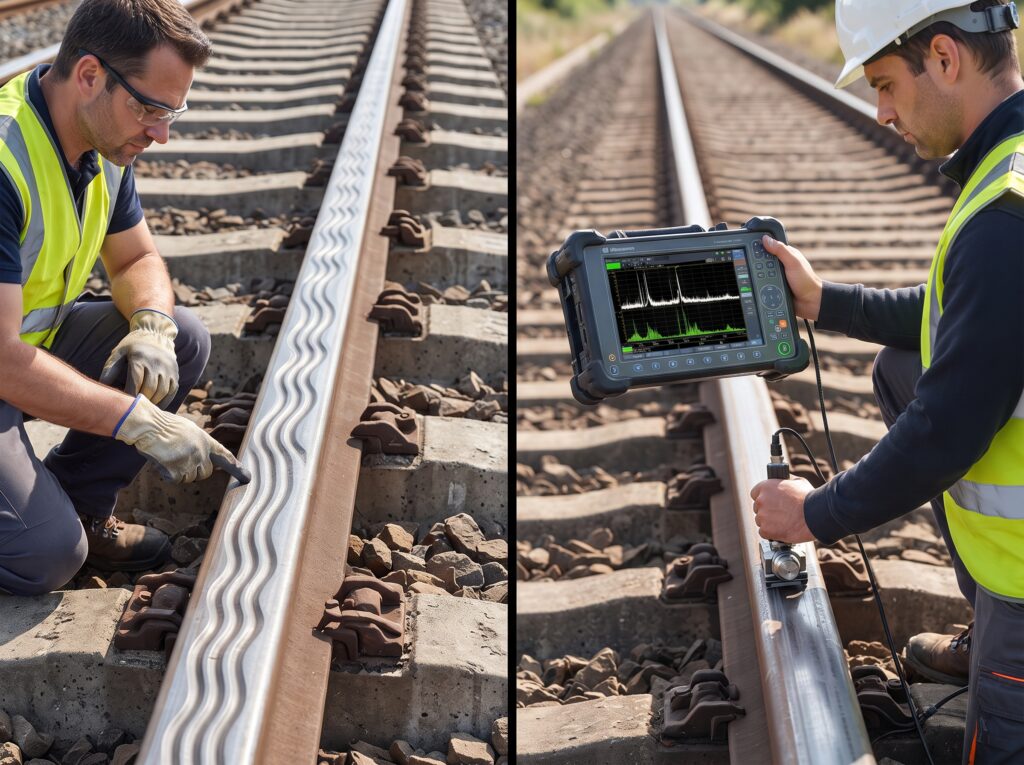
Corrugation on rail is one of the most recognisable forms of rail-surface deterioration, yet its causes are far more complex than a simple wear pattern. Corrugation on Rail develops as repeating waves or periodic irregularities can change the way wheels and rails interact with each other. The result can include higher vibration, increased noise, accelerated component wear and greater maintenance demand.
For railway operators, the concern goes beyond what can be seen on the rail head. A corrugated surface can alter dynamic wheel–rail forces and may affect inspection conditions, including the consistency of ultrasonic testing (UT).
What Is Rail Corrugation?
Corrugation on rail refers to a periodic, wave-like pattern that develops along the rail surface. Instead of appearing as one random scratch, crack or isolated depression, the surface develops repeated peaks and valleys with a relatively consistent wavelength. Engineers commonly describe the condition through wavelength, wave depth, amplitude or related roughness measures.
Research continues to debate the exact mechanism behind every type of corrugation. The literature commonly separates the problem into a wavelength-fixing mechanism, which helps determine the characteristic spacing of the waves, and a damage mechanism, which describes how wear or plastic deformation grows under repeated excitation. RailDamage also describes these two mechanisms as central to understanding the development of corrugation.
The visible wave pattern, therefore, is only the end result. The more useful question is what repeatedly creates and reinforces that pattern.
What Causes Corrugation on Rail?
Wheel–Rail Interaction
At the heart of corrugation on rail is the small contact area between a steel wheel and the rail. That contact carries substantial vertical loads while also transmitting traction and braking forces. Friction, creepage and changes in contact conditions can produce tangential forces that vary as the wheel moves over the rail.
A small roughness on the rail does not necessarily remain small. As successive wheels pass over it, the irregularity changes the dynamic contact conditions. The resulting forces can encourage differential wear or plastic deformation. In some cases, the process reinforces a particular wavelength, creating a repeating pattern that becomes deeper with traffic.
Track Dynamics and Vibration
The rail does not act alone. It forms part of a coupled system containing wheels, wheelsets, suspension components, rails, fasteners, sleepers, slabs and other support elements. Each component has stiffness, damping and natural vibration characteristics.
The Springer study of metro lines provides a useful example. Field measurements found characteristic wavelengths of 34 mm and 59 mm on the inner and outer rails of one steel-spring floating-slab section. Frequency-response modelling then identified system eigenfrequencies close to the measured corrugation passing frequencies. The researchers linked the inner-rail pattern to third-order wheelset bending and the outer-rail pattern to lateral rail bending in that section.
This does not mean every railway will develop corrugation through exactly the same mode. It shows why the track structure matters. Changing fastener stiffness or other support characteristics can shift the system’s vibration frequencies and may reduce the likelihood of reinforcing the original wavelength.
Rail Material and Hardness
Material properties also influence corrugation on rail. In practical maintenance planning, corrugation on rail should be considered alongside the rail grade and contact conditions. Rail hardness affects resistance to wear, while changes in material behaviour can influence rolling-contact fatigue. Head-hardened rail and other wear-resistant steels can delay certain forms of deterioration, but a harder rail does not automatically remove every corrugation mechanism.
RailDamage highlights this trade-off: measures that reduce wear can also change the balance between wear and rolling-contact fatigue.
Operating Conditions
Train speed, axle load, braking, traction, curve radius and traffic frequency all affect wheel–rail behaviour. Curves can create additional lateral and tangential forces, while repeated acceleration and braking can alter contact conditions.
Metro lines offer a particularly demanding environment because trains operate frequently and often encounter curves and repeated braking and acceleration. The Springer research notes that corrugation can occur frequently at the wheel–rail interface in such systems, including on both curved and some straight sections.
Types and Patterns of Rail Corrugation
Corrugation on rail can be classified by wavelength, appearance and suspected formation mechanism. Short-pitch patterns often receive particular attention because their wavelengths can remain relatively consistent even when operating speed changes. The mechanism behind these patterns remains an active research topic.
Longer-wavelength patterns can arise under different combinations of loading, track geometry and support conditions. Sleeper spacing and track stiffness can influence the dynamic response, which means a change in support design can affect how surface irregularities develop.
A useful distinction is between classification and diagnosis. A short wavelength alone does not prove a particular cause. The same broad wavelength range can emerge from different combinations of vibration, friction, wear and track conditions. That is why profile measurements work best when combined with operating and track data. The MDPI review identifies wavelength, formation mechanism and damage mechanism as important ways of classifying the phenomenon.
What Are the Types of Defects in Rails?
Corrugation on rail is only one category of rail deterioration. Other defects include rolling-contact fatigue, head checks, squats, shelling, cracks and general wear. Some defects originate at or near the surface, while others can develop below the surface and require non-destructive inspection to identify.
The distinction matters because a corrugated surface is not automatically evidence of an internal rail defect. It is primarily a geometric and surface-condition issue, although the dynamic loading associated with it can contribute to other forms of damage.
How Is Corrugation on Rail Measured?
Measurement turns a visible maintenance concern into usable engineering data. Corrugation on rail can be assessed by recording the longitudinal rail profile and analysing the repeating components within that profile.
Rail Profile Measurement
A profile measurement captures changes in rail height along a defined distance. RailDamage describes two broad approaches: inertial-based and chord-based measurement. Its examples include a hand-push corrugation analysis trolley and a higher-speed rail corrugation analysis system. Chord-based systems can derive the corrugation profile using multiple measurement points and an appropriate transfer function.
The measurement method matters because a system must distinguish genuine rail roughness from movement of the measuring equipment. High-speed systems therefore need careful sensor positioning, compensation and calibration.
Vibration and Acceleration Measurements
Another approach uses vibration generated by corrugation on rail as wheels pass over the rail. A periodic surface pattern can produce a corresponding passing frequency. The relationship between train speed and wavelength can be expressed as f = v/λ when units are handled consistently.
The Springer study illustrates the principle clearly. At an operating speed close to 99 km/h, measured wavelengths of 34 mm and 59 mm corresponded to passing frequencies of about 809 Hz and 466 Hz. Those frequencies were then compared with the calculated vibration response of the wheel–track models.
Advanced Detection Methods
Modern railway inspection increasingly combines several data sources. Laser-based profile measurement can capture surface geometry, while vibration sensors can identify dynamic responses. Other research directions include acoustic emission, fibre-optic sensing, machine vision and machine-learning techniques. The MDPI review specifically discusses acceleration measurements, wavelet analysis, computer vision and digital filtering as developing detection approaches.
The goal is gradually shifting from finding severe corrugation on rail after it has formed to tracking how quickly it develops. Accurate repeated measurements can support predictive grinding, allowing intervention to follow the actual deterioration trend rather than relying only on fixed maintenance intervals. RailDamage specifically identifies long-term monitoring as an enabler of predictive grinding.
Measurement can show where the rail has developed a problem, but the next challenge is understanding what that surface condition means for ultrasonic inspection.
Corrugation on Rail and Ultrasonic Testing (UT)
Ultrasonic testing examines the rail for internal and subsurface conditions by sending high-frequency sound waves into the material. The technique differs from surface-profile measurement because UT is concerned primarily with discontinuities within the rail rather than the shape of the running surface.
A corrugated rail can still matter to the UT process. Surface irregularities can influence probe contact, coupling conditions and the consistency of the signal entering the rail. If the inspection system experiences variable contact, the resulting data can become more difficult to interpret. Surface condition should therefore form part of the context in which UT results are evaluated.
That does not mean corrugation on rail itself represents an internal defect. Instead, it can be an important surface condition that affects inspection quality and the interpretation of other indications. Consistent surface preparation, suitable inspection equipment and reliable coupling help reduce uncertainty.
A stronger condition-monitoring approach combines rail-profile information with UT results. Profile data can identify surface deterioration, while UT can reveal internal conditions that are not visible from the surface. Together, the two methods provide a broader picture of rail health.
How Corrugation on Rail Affects Railway Performance
The most immediate impact is increased wheel–rail vibration. As a wheel travels over repeated waves, it experiences cyclic changes in contact conditions. Those changes can generate higher dynamic forces and vibration, particularly when the corrugation wavelength interacts strongly with a system resonance.
Noise is another visible consequence. The RailDamage review notes that corrugation can increase wheel–rail vibration and noise while contributing to component degradation, rolling-contact fatigue and reduced ride comfort.
The effects can spread beyond the rail itself. Wheels, bearings, fasteners and other vehicle-track components can experience additional dynamic loading. On passenger systems, vibration and noise can affect ride quality and the surrounding environment. On heavily used routes, repeated deterioration can increase grinding and inspection requirements.
This is why the cost of corrugation on rail is not limited to the material removed during grinding. The wider cost can include inspection, maintenance possessions, component wear, noise-control measures and the consequences of more frequent intervention.
What Causes Buckling in Railway Tracks?
Corrugation on rail and track buckling are often mentioned together in general railway discussions, but they describe very different problems. Corrugation concerns repeated surface irregularities, while buckling involves a loss of track stability that can cause lateral deformation.
Thermal expansion plays a major role in buckling on continuously welded rail. As rail temperature rises, the steel attempts to expand. If the track cannot accommodate the resulting compressive forces because of insufficient resistance or poor lateral stability, the track can deform sideways.
Track condition, ballast resistance, alignment, rail temperature and maintenance quality all influence buckling risk. The problem therefore requires a different monitoring and prevention strategy from surface corrugation.
Why Early Detection Matters for Rail Asset Management
Early detection changes the maintenance question from “How should severe damage be repaired?” to “What is causing this section to deteriorate, and when should intervention occur?”
A practical monitoring programme can combine:
1. rail-profile measurements to track surface roughness;
2. vibration measurements to identify dynamic responses;
3. UT data to identify internal conditions;
4. track-geometry information to identify supporting factors; and
5. operating data to relate deterioration to speed, loading and traffic.
This integrated approach gives corrugation on rail a place within a wider asset-management strategy. Instead of treating each measurement as a separate inspection activity, engineers can use the combined evidence to understand deterioration and plan maintenance around actual risk.
Careful measurement also gives maintenance teams a common reference for comparing locations, checking treatment results and deciding whether deterioration is accelerating or remaining stable over time. The strongest strategy is to monitor the rail early, connect surface data with UT and system behaviour, and use those findings to guide predictive maintenance.
Final Thoughts
Corrugation on rail develops from a complicated interaction between wheel–rail contact, vibration, material behaviour, track support and operating conditions. Its repeating surface pattern can increase noise, vibration, component loading and maintenance requirements, while its surface irregularity can also matter when UT inspections are performed.
The research shows why a single universal remedy is unlikely to work for every railway. Measurement, vibration analysis, rail grinding, friction management and changes to vehicle-track properties can all contribute when they match the underlying mechanism. The strongest strategy is to monitor the rail early, connect surface data with UT and system behaviour, and use those findings to guide predictive maintenance. In that approach, corrugation on rail becomes not simply a defect to remove, but a measurable signal of how the wider railway system is behaving.
Key Takeaways
- Corrugation on rail develops through repeated wheel–rail interaction, vibration, friction, wear and track dynamics.
- Rail speed, axle loading, track geometry and operating conditions can influence corrugation development rates.
- Corrugation on rail creates repeating surface irregularities that can increase vibration, noise and component loading.
- Rail profile measurements help engineers identify corrugation wavelength, depth, severity and development over time.
- Vibration measurements can reveal dynamic responses associated with specific corrugation wavelengths and operating speeds.
- Ultrasonic testing examines internal rail conditions, while surface measurements provide important information about external deterioration.
- Corrugation on rail does not automatically indicate an internal rail defect requiring ultrasonic inspection.
- Rail grinding can remove developed corrugation, but underlying vibration mechanisms may cause recurrence.
- Predictive maintenance combines profile, vibration, UT, track geometry and operating data for better intervention planning.
- Early detection helps railway operators control maintenance costs while improving rail reliability, safety and service performance.
Frequently Asked Questions
What causes corrugation?
Yes. Corrugation develops when repeated wheel–rail interaction creates periodic changes in contact forces, wear and vibration. Train speed, axle loads, friction, track stiffness, rail hardness, curves and vehicle dynamics can all influence its development. Small surface irregularities can become amplified when their wavelength interacts with a characteristic vibration mode in the vehicle–track system.
Which defect is found during rail testing?
Yes. Rail testing can identify several defects, including internal cracks, rolling-contact fatigue, squats, shelling, head checks and other discontinuities. Ultrasonic testing mainly detects internal or subsurface conditions, while visual inspection and profile measurement can identify surface deterioration such as wear and Corrugation on Rail. Different defects require different inspection and maintenance responses.
How are train tracks repaired?
Yes. Train tracks are repaired using methods selected according to the type and severity of deterioration. Rail grinding can restore a damaged rail profile, while track maintenance can include tamping, ballast renewal, sleeper replacement, fastening repairs and rail replacement. Corrugation on rail may require grinding combined with investigation of the wheel–rail and track dynamics causing recurrence.
What is a rail head squat defect?
No. A rail head squat is not the same as corrugation on rail. A squat is a localized rail-head defect commonly associated with rolling-contact fatigue and plastic deformation. It can develop as a depression or damaged area on the running surface and may contain subsurface cracking. Ultrasonic and other non-destructive inspection methods can help identify associated internal damage.
