

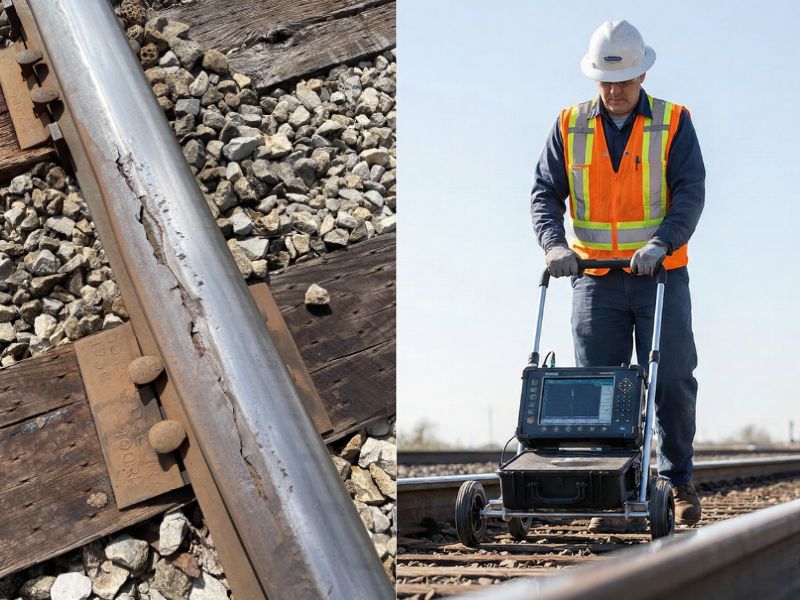
Rail failures rarely happen without warning, yet many defects go unnoticed until serious damage occurs. Detecting rail defects early is one of the most important responsibilities of rail inspectors, directly affecting safety, service continuity, and maintenance costs.
This guide explains how inspectors identify rail defects before they become critical. It covers common defect types, their causes, inspection methods, testing technologies, inspection planning, and the correct actions after a defect is found. By the end, readers will have a clear, practical reference for improving inspection accuracy and making informed maintenance decisions.
Why Detecting Rail Defects Is Critical
Railways operate under constant load, vibration, and environmental stress. A single undetected defect can escalate quickly, turning a minor flaw into a serious safety incident. Detecting rail defects at an early stage allows inspectors to intervene before cracks grow, rails fail, or trains leave the track.
Safety and derailment prevention
Rail defects are one of the leading contributors to derailments worldwide. Small surface cracks or hidden internal flaws can suddenly propagate under repeated wheel loads. When this happens, rail breakage may occur without visible warning. Effective inspection reduces this risk by identifying defects before they reach a critical size.
Early detection helps inspectors:
- Prevent sudden rail fractures
- Reduce derailment risk at high-speed and high-tonnage routes
- Protect passengers, crew, and trackside workers
In addition, regulatory bodies expect strict compliance with inspection standards. Failing to detect defects can result in enforcement action, service shutdowns, and reputational damage for rail operators.
Service reliability and cost control
Beyond safety, rail defects have a direct impact on network performance and operating costs. Emergency repairs, unplanned speed restrictions, and service delays are far more expensive than planned maintenance. Detecting Rail Defects early supports predictive maintenance rather than reactive repairs.
From a cost and reliability perspective, early detection helps to:
- Reduce emergency track possessions
- Extend rail life through timely grinding or repairs
- Minimise train delays and cancellations
- Control long-term maintenance budgets
When defects are found early, operators gain time to plan repairs efficiently. However, knowing why defects form is only part of the challenge. Inspectors must also recognise what they are looking for on the rail itself, and that begins with understanding defect types.
Types of Rail Defects Inspectors Find
Rail defects appear in different forms depending on traffic levels, rail material, and track conditions. Some are visible on the surface, while others develop deep inside the rail head. Accurate defect identification is essential for selecting the correct inspection method and response.
Surface defects
Surface defects form on the rail head where wheels make direct contact. These are often the first signs of fatigue and wear, making them critical indicators during visual inspections.
Common surface defects include:
- Head checks and gauge corner cracking
- Squats caused by rolling contact fatigue
- Corrugation and severe wear patterns
Although surface defects are easier to spot, they should never be underestimated. Left untreated, many surface cracks can grow downward into the rail, becoming far more dangerous internal defects.
Internal defects
Internal defects develop beneath the rail surface and are not visible to the naked eye. These flaws pose a significant risk because they can grow unnoticed until sudden failure occurs. Ultrasonic testing plays a key role in Detecting Rail Defects of this type.
Typical internal defects include transverse fissures, vertical split heads, and bolt hole cracks. These defects often originate from manufacturing flaws or long-term fatigue and require precise testing methods to identify their size and location accurately.
Weld and fatigue defects
Welded joints are critical points within the rail network and are especially vulnerable to fatigue. Poor weld quality, improper alignment, or repeated stress can lead to cracking at or near the weld zone.
Inspectors frequently encounter:
- Thermite weld cracking
- Heat-affected zone fatigue
- Fractures near old or repaired welds
Weld defects demand close monitoring because failure at these locations can be sudden and severe. As traffic loads increase and networks age, these defects become more common raising an important question. How can inspectors reliably find both visible and hidden defects before they reach failure? That answer lies in the inspection methods themselves.
What Causes Rail Defects
Rail defects do not occur randomly. They develop over time due to repeated stress, poor support, and external influences. Understanding these causes helps inspectors anticipate where defects are most likely to appear and focus inspection efforts more effectively. Detecting rail defects becomes far more reliable when inspectors know the conditions that accelerate rail damage.
Wheel loads and traffic levels
Every passing train applies vertical, lateral, and impact forces to the rail. Heavy axle loads, high-speed traffic, and frequent train movements significantly increase fatigue stress within the rail head and web. Over time, this repeated loading leads to crack initiation and growth.
High-risk conditions include:
- Heavy freight routes with high axle loads
- Mixed traffic lines with frequent braking and acceleration
- High-speed passenger corridors
As traffic levels increase, even minor defects can grow rapidly. This is why heavily used routes demand shorter inspection intervals and closer monitoring.
Track condition and support
Poor track support places uneven stress on the rail, accelerating defect formation. When sleepers, ballast, or fastenings deteriorate, the rail is forced to absorb loads it was not designed to handle alone.
Common support-related contributors include uneven ballast support, poor drainage, loose fastenings, and track geometry faults. These conditions allow excessive rail movement, increasing bending stress and crack growth. In such locations, Detecting Rail Defects early can prevent repeated failures at the same track sections.
Material and environmental factors
Rail material quality and environmental exposure also play a major role in defect development. Manufacturing inconsistencies, residual stresses, and steel fatigue can create weak points within the rail.
Environmental influences such as temperature changes, moisture, and corrosion further accelerate damage. Extreme heat and cold cycles increase stress, while water ingress promotes corrosion around welds and fasteners. These factors often work together, making defect progression faster than expected.
Knowing what causes defects is essential, but recognising them in the field is where inspection skills truly matter.
Visual Rail Inspection Methods
Visual inspection remains the first line of defence in rail safety. While advanced testing methods are essential, many early-stage defects can still be identified by trained inspectors on foot or from inspection vehicles. Visual checks play a key role in Detecting Rail Defects before they develop into critical failures.
Surface checks and warning signs
Inspectors look for visible changes in the rail surface that indicate fatigue, wear, or cracking. These signs often appear first at high-stress locations such as curves, joints, and welded sections.
Key warning signs include:
- Fine cracks along the gauge corner
- Dark spots or shelling on the rail head
- Deformation, spalling, or unusual wear patterns
- Signs of overheating or metal flow
Early identification of these indicators allows timely follow-up testing using ultrasonic or eddy current methods.
Tools and limits of visual inspection
Visual inspections rely on simple tools but skilled judgement. Commonly used tools include inspection lamps, mirrors, measuring gauges, and marking paint. However, visual inspection has clear limitations.
It cannot detect internal defects, depth of cracking, or subsurface fatigue. Poor lighting, weather conditions, and traffic constraints can also reduce accuracy. For this reason, visual inspection should never stand alone. It serves as the trigger, pointing inspectors toward areas that require deeper testing.
And once visual signs raise concern, the next step becomes critical: choosing the right testing method to confirm what lies beneath the rail surface.
Ultrasonic and Eddy Current Testing
Visual inspections can only reveal part of the picture. Many of the most dangerous failures originate below the rail surface, where cracks grow unseen. This is where advanced testing becomes essential. Detecting rail defects accurately depends on using the right technology for the right defect type.
Defects each method detects
Ultrasonic testing (UT) is primarily used to identify internal rail defects. It sends high-frequency sound waves into the rail and analyses reflections from cracks or discontinuities. UT is effective for locating defects within the rail head, web, and foot.
Ultrasonic testing commonly detects:
- Transverse fissures
- Vertical split heads
- Bolt hole cracks
- Internal fatigue cracking
Eddy current testing (ECT), on the other hand, focuses on surface and near-surface defects. It uses electromagnetic fields to detect changes caused by cracking or metal deformation close to the rail surface.
Eddy current testing is best suited for:
- Gauge corner cracking
- Head checks
- Shallow surface cracks
- Early-stage rolling contact fatigue
When used together, these methods provide a more complete view of rail condition than either method alone.
Strengths and limitations
Each testing method has clear advantages, but also limitations inspectors must understand. Ultrasonic testing offers deep penetration and reliable detection of internal flaws, making it essential for preventing sudden rail breaks. However, UT can struggle in areas with complex geometry, severe surface damage, or poor coupling conditions.
Eddy current testing excels at detecting very small surface cracks that may not yet be visible. It works well at higher inspection speeds and is less affected by surface contamination. However, it cannot detect deep internal defects and provides limited information about crack depth.
Because no single method is sufficient on its own, inspection programmes must combine visual checks, UT, and ECT. The challenge then becomes deciding when and where to apply each method, which leads directly to inspection planning.
Inspection Planning and Frequency
Effective inspection is not only about technique, but also timing. Rail defects develop faster in certain locations and under specific operating conditions. Planning inspections strategically ensures resources are focused where risk is highest, improving the success of Detecting Rail Defects.
High-risk locations
Some track sections experience higher stress and defect rates than others. Inspectors prioritise these areas due to their increased likelihood of failure.
High-risk locations include:
- Tight curves and gauge face contact zones
- Welded joints and heat-affected zones
- Bridge approaches and level crossings
- Areas with poor drainage or weak ballast support
- High-tonnage freight routes
These locations often require additional inspection methods and shorter inspection cycles.
Standard inspection intervals
Inspection frequency is typically set by traffic levels, axle loads, and regulatory requirements. Heavily trafficked mainlines require more frequent ultrasonic and eddy current testing, while lightly used routes may follow longer intervals.
Standard intervals are adjusted when defects are found, traffic increases, or environmental conditions worsen. Once a defect is identified, follow-up inspections become critical to monitor growth and confirm repair effectiveness.
The final step is knowing what to do once a defect is confirmed, because detecting the problem is only half the job.
Recording Defects and Taking Action
Finding a defect is only effective if it is recorded correctly and acted upon without delay. Accurate documentation and timely response are essential parts of detecting rail defects, ensuring that safety risks are controlled and defects do not progress unchecked.
Defect severity and reporting
Once a defect is identified, inspectors must assess its severity based on size, location, and growth potential. This classification determines how urgently action is required and what measures must be taken.
Defect severity is typically recorded using:
- Defect type and exact location
- Measured size, depth, and orientation
- Inspection method used
- Risk level and recommended action
Clear and consistent reporting allows maintenance teams and decision-makers to prioritise work effectively. Digital inspection systems are increasingly used to store defect history, track growth trends, and support data-driven maintenance planning. Poor or incomplete records can result in missed follow-up inspections and repeated failures at the same locations.
Repairs, restrictions, and follow-up inspections
The response to a defect depends on its severity and rate of progression. Minor defects may be monitored, while critical defects demand immediate intervention to protect rail users and infrastructure.
Common actions include:
- Imposing temporary speed restrictions
- Grinding to remove shallow surface defects
- Installing clamps or carrying out weld repairs
- Replacing damaged rail sections
After repairs, follow-up inspections are essential to confirm that corrective actions were effective and no secondary defects have developed. These inspections also help validate inspection intervals and improve future defect detection strategies.
At this stage, the inspection cycle comes full circle. With defects recorded, actions taken, and follow-ups planned, inspectors gain the information needed to refine their approach, strengthening the entire process of detecting rail defects across the network.
Conclusion
Detecting rail defects is a critical responsibility that directly affects safety, reliability, and long-term network performance. Throughout this guide, the focus has been on how defects form, where they are most likely to occur, and the inspection methods inspectors rely on to find them before failure happens.
By combining visual inspections with ultrasonic and eddy current testing, inspectors can identify both surface and internal defects with greater accuracy. Effective inspection planning, proper defect recording, and timely corrective action ensure that risks are controlled and maintenance is proactive rather than reactive.
When these practices are applied consistently, detecting rail defects becomes a structured, repeatable process that supports safer operations, reduced disruptions, and more efficient asset management across the rail network.
Key Points
- Detecting Rail Defects early is essential for preventing derailments and serious safety incidents.
- Rail defects develop over time due to wheel loads, traffic levels, poor support, and environmental factors.
- Surface defects are often the first visible signs of fatigue and should never be ignored.
- Internal rail defects pose a high risk because they can grow without visible warning.
- Visual inspection is the first line of defence but cannot identify subsurface defects.
- Ultrasonic testing is critical for detecting internal rail flaws such as transverse fissures.
- Eddy current testing is effective for identifying early-stage surface and near-surface cracking.
- High-risk locations require more frequent and targeted inspection programmes.
- Accurate defect recording supports prioritised maintenance and prevents repeat failures.
- Timely repairs, speed restrictions, and follow-up inspections complete the defect management cycle.
FAQs
What are the signs of surface defects during visual inspection?
Signs include cracks along the gauge corner, corrugation, surface wear, and unusual rail deformation. Visual inspection helps flag areas for deeper testing.
How are rail defects recorded and reported?
Inspectors classify defects by severity, location, and type, and enter them into an inspection database to prioritise maintenance and track defect growth over time.
What action is taken after a defect is detected?
Actions can include speed restrictions, grinding of surface defects, rail replacement, or follow‑up inspections to confirm repair effectiveness.
Can technology replace manual rail inspections?
Automated inspection systems (e.g., sensors, automated testing vehicles) can enhance rail defect detection, but manual inspection remains critical because technology may miss some conditions that experienced inspectors can identify.
