
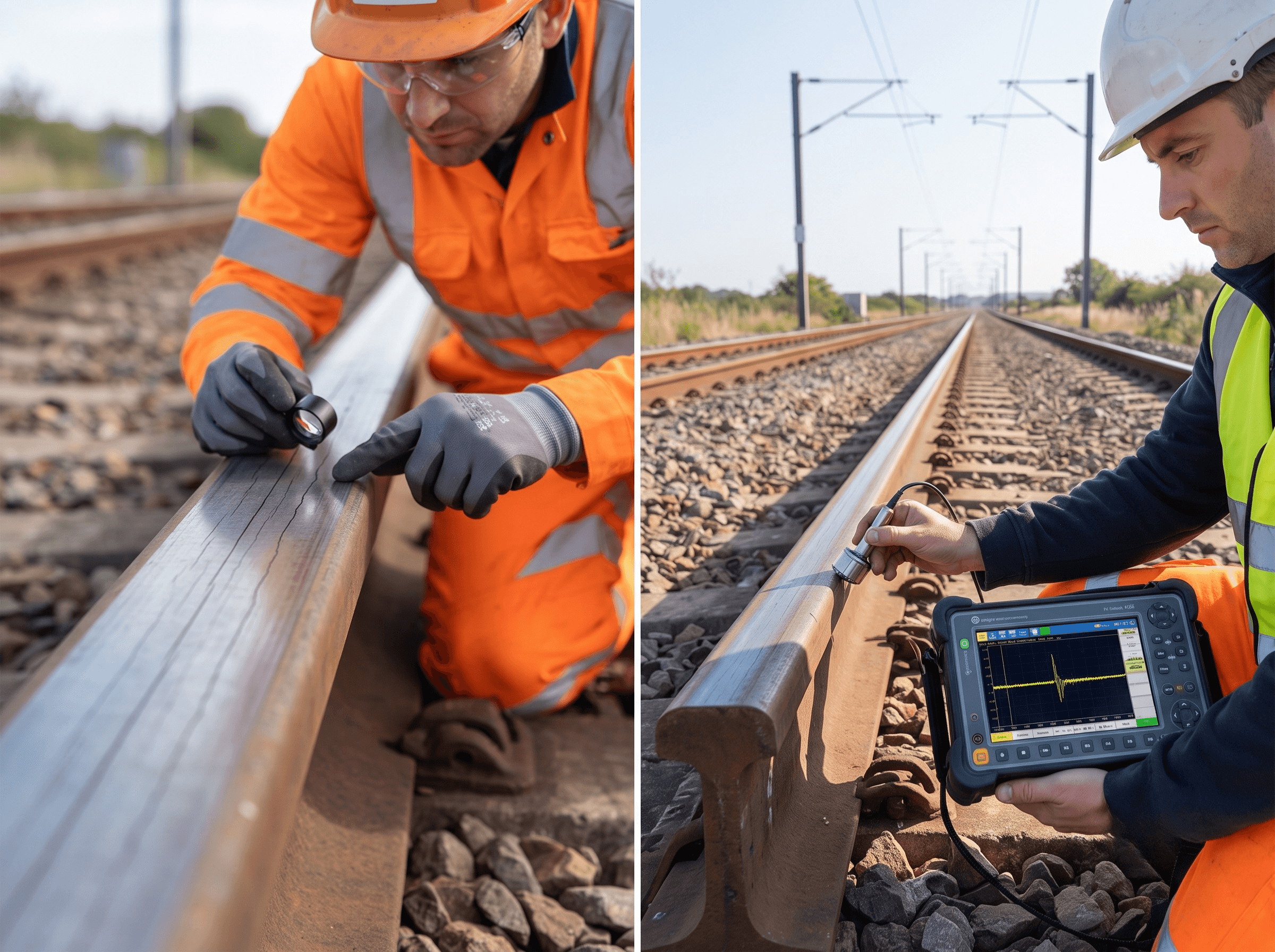
Head checks rail. Three words that make maintenance crews sit up a little straighter. Anyone who has spent time around rail networks has run into head checks rail sooner or later, usually during an inspection that turns up more than expected.
It shows up quietly at first. A few faint lines on the rail surface, nothing dramatic. But head checks rail does not stay quiet for long, and that is exactly why this article exists.
This piece covers what head checks rail actually is, why it forms, how it moves through different stages, and the point where it stops being routine and starts being risky. Budgets are tight. Inspection windows are shorter than anyone wants. So knowing exactly which defects deserve urgent attention matters, and head checks rail belongs near the top of that list.
What Is Head Checks Rail?
Head checks rail is a pattern of small cracks that form across the top of a rail, usually right on the gauge corner. That is the spot where wheels press down hardest. The cracks run in fine, tight lines, almost parallel to each other. From a distance, they look harmless. Almost decorative.
They are not decorative. Head checks rail develops from repeated stress between wheel and rail, and curves tend to show it first. Leave it alone long enough, and it deepens. Branches downward. What started as a surface pattern turns into something structural, and that shift does not always announce itself.
What Do Poor Railhead Conditions Mean?
Poor railhead conditions mean the rail surface has degraded past the point of safe, smooth wheel contact. Rough patches. Uneven wear. Not enough lubrication. Cracking, including the early stages of head checks rail. Once conditions decline, every passing train adds a bit more damage.
A few signs tend to show up together:
- Rough or corrugated rail surface texture
- Visible surface cracking, including early head checks rail lines
- Discoloration from overheating or friction
- Uneven wheel-rail contact marks
- Reduced lubrication or contaminated rail surfaces
None of these signs are dramatic on their own. But they build. Poor railhead conditions rarely appear overnight, and head checks rail is often the first visible clue that something underneath has already started shifting.
So the signs are there. But why does head checks rail actually form in the first place, and why does it show up on some rails far more than others? That question deserves its own section.
Common Causes of Head Checks Rail
Head checks rail does not appear out of nowhere. It builds from mechanical stress, material behavior, and environmental exposure, stacked together over months and years of rail use. Knowing these causes helps maintenance teams decide where to look first.
Wheel-Rail Contact Stress
Repeated stress at the wheel-rail contact point drives most head checks rail. Every curve puts the wheel flange under heavy pressure against the gauge corner. That pressure creates rolling contact fatigue, and rolling contact fatigue is the mechanical process behind nearly all of this cracking.
Thousands of wheel passes later, tiny fatigue cracks form just beneath the surface. Eventually they reach the top. That is when the fine parallel lines tied to head checks rail become visible. Curves see it more. So do sections with heavy braking or constant acceleration. Straight, low-traffic stretches barely see it at all.
One senior track engineer, speaking at an industry safety briefing, put it simply: "the earlier a crew catches surface cracking, the cheaper and safer the fix becomes." That line applies directly to head checks rail. Catch it early, and the fix is cheap. Miss it, and the fix becomes an emergency.
Environmental and Material Factors
Lubrication is a balancing act. Too much causes slip. Too little raises friction and heat at the contact point. Either extreme accelerates head checks rail. Grinding schedules, track curvature, axle loads, all of it interacts, and all of it determines how fast the defect spreads.
Curved sections carrying heavy freight report head checks rail far more often than straight passenger lines. That is not a coincidence. It is a pattern maintenance planners rely on to prioritize inspection routes and allocate grinding resources.
What Are Common Issues That Can Affect Railway Tracks?
Railway tracks deal with more than just head checks rail. Understanding the full list helps put this particular defect into perspective. Tracks absorb enormous, repeated loads, and several types of damage tend to show up over a rail's working life.
Common issues affecting railway tracks include:
- Rail corrugation, a wavy wear pattern on the surface
- General wear from long-term wheel contact
- Spalling, where small pieces of rail material break away
- Head checks rail and other rolling contact fatigue cracks
- Rail head flow, where the metal surface deforms under pressure
- Corrosion, especially in humid or coastal areas
Head checks rail is the tricky one. It is hard to spot early without the right tools, yet it worsens fast once it starts. Corrosion and general wear creep along slowly and predictably. Head checks rail does not play by those rules. Under the wrong conditions, it can escalate within a single inspection cycle.
Lining these issues up side by side helps engineers decide what needs urgent attention and what can wait. And head checks rail usually lands near the top, simply because of how quickly a minor surface pattern can turn into a deeper structural concern.
Which raises the obvious next question. If head checks rail escalates this fast, how exactly does it move through its stages, and what does each stage look like on the actual rail? That is where the real risk assessment starts.
How Head Checks Rail Progresses Over Time
Head checks rail does not sit still once it forms. It moves through recognizable stages, and each one carries a different level of risk. Maintenance teams track these stages closely before deciding on grinding, monitoring, or full replacement.
A rail with faint surface lines during one inspection might look completely different a year later. That shift is not random. It follows a fairly predictable path shaped by wheel-rail stress, traffic volume, and the rail's own material. Knowing where a rail sits on that path is what lets crews act before things get expensive. Or dangerous.
The table below lays out how head checks rail typically develops, from first appearance to advanced structural risk.
| Stage | Description | Typical Cause | Risk Level |
| Initial Cracking | Fine, shallow surface lines appear on the gauge corner | Rolling contact fatigue begins | Low |
| Surface Spreading | Cracks multiply and become more visible across the rail head | Continued wheel-rail stress | Low to Moderate |
| Depth Progression | Cracks extend deeper beneath the surface | Untreated fatigue combined with heavy loads | Moderate |
| Branching | Cracks begin joining and branching into larger networks | Prolonged exposure without grinding | Moderate to High |
| Structural Risk | Cracks threaten rail head integrity and breakage | Advanced, unmanaged head checks rail | High |
Early-stage head checks rail is manageable. Routine grinding handles it fine. But once cracks hit the branching stage, everything changes, and the rail needs far closer attention to avoid outright failure.
Picture a curved freight corridor carrying heavy tonnage every day. A rail there might show only faint surface spreading during a spring inspection. By autumn, without grinding, those same cracks could be joining into networks. Same rail. Same six months. Completely different risk profile. That is the kind of pace head checks rail can move at when nobody intervenes.
Recognizing Rail Defects: Detection Methods
Catching head checks rail early isn't about luck. It's about discipline. The cracks start small, shallow, barely visible, the kind of thing a rushed inspection walks right past. Slow down, look twice, and the pattern usually gives itself away before it turns into a bigger headache.
Common detection methods used to identify this defect include:
- Visual inspection during routine track walks
- Ultrasonic testing to detect subsurface cracking
- Eddy current testing for near-surface defect detection
- Rail-mounted sensor systems that log stress patterns over time
- Automated inspection vehicles equipped with cameras and sensors
Visual checks work fine once cracks show up on the surface. But ultrasonic and eddy current testing can flag head checks rail long before anyone sees a single line. Combine both, and track owners get their best shot at catching the defect while it's still cheap to fix.
Inspection frequency matters too. A curved, high-traffic section might need eyes on it every few weeks. A quiet straight stretch? Months can pass between checks, and that's usually fine. Matching the schedule to actual risk keeps budgets pointed where this cracking pattern is most likely to show up.
When Does Head Checks Rail Become Dangerous?
Head checks rail turns dangerous once surface cracking pushes into deep, branching fractures, the kind that threaten the rail's structural integrity. At that stage, the rail isn't just worn. It's genuinely at risk of breaking apart under ordinary traffic loads. And that's the line between routine maintenance and an actual safety hazard.
Signs of Escalating Risk
A few warning signs suggest this defect has moved past the manageable stage:
- Cracks visibly joining together or branching in multiple directions
- Small pieces of rail material breaking away near the crack network
- Noticeable rail head deformation or flattening
- Rapid crack growth between consecutive inspections
- Unusual noise or vibration reported by train crews on a specific section
Any single sign is worth a closer look. Several showing up together on the same stretch? That's a stronger signal. Head checks rail has likely crossed into dangerous territory at that point, and the consequences can include fragments breaking off, sudden rail fracture, or, in the worst cases, derailment risk.
The danger zone in rail is basically that tipping point, where crack depth and density get deep enough to compromise load-bearing capacity. Once a rail crosses into that zone, waiting around for the next scheduled inspection isn't a safe bet. Grinding, speed restrictions, or outright replacement usually need to happen fast.
So what actually stops head checks rail before it reaches that point? And how do crews manage a rail that's already showing early trouble? That's next.
Prevent and Manage Head Checks Rail
Preventing this defect from spiraling comes down to consistency, not one-off fixes. A rail that gets regular attention almost never reaches the dangerous, structural-risk stage described above.
Rail grinding is still the single most effective weapon against head checks rail. Shave off a thin layer of surface material on a regular schedule, and early cracking never gets the chance to dig deeper into the rail. Plenty of networks now run grinding trains on a fixed rotation just to stay ahead of this pattern before it turns costly. Skip a cycle or two, though, and the backlog catches up fast, cracks don't wait around for a budget approval.
Site safety matters here too, and not just for the rail itself. A site lookout typically uses three methods to warn a group of an approaching train: a verbal shout paired with a visual hand signal, an audible horn or whistle, and a radio or handheld alert to the wider crew. Three layers, not one. That redundancy is what gives workers enough time to clear the track while inspections for this defect, and everything else, carry on nearby.
Final Thoughts
Head checks rail starts small. A few thin lines on the surface, nothing that stops anyone in their tracks. But it doesn't stay small. Left alone, it deepens, branches, and eventually threatens the rail's whole structure.
The causes trace back to wheel-rail contact stress, mostly on curves where pressure never really lets up. And the progression follows a pattern, moving from faint cracking to something that demands immediate attention. That pattern is predictable. Which means it's also preventable.
Catch head checks rail early through proper detection, and grinding handles the rest. Skip a few cycles, though, and the defect doesn't wait politely for a budget meeting. It just keeps spreading.
Rail teams that stay ahead of head checks rail protect more than equipment. They protect the people riding on it, working near it, depending on it daily. That's really what all this monitoring comes down to. Not paperwork. Just staying a step ahead of a defect that, left ignored, turns into something far more serious.
Key Takeaways
- Head checks rail is a pattern of fine surface cracks caused mainly by repeated wheel-rail contact stress on curves
- Poor railhead conditions, including rough texture and weak lubrication, accelerate how quickly this defect forms and spreads
- Curved, high-traffic sections carrying heavy freight loads tend to develop this cracking pattern faster than straight track
- Rail steel quality and environmental exposure both influence how soon this defect appears on a given rail
- The defect progresses through recognizable stages, moving from initial cracking to branching and eventual structural risk
- Detection methods such as ultrasonic testing and eddy current testing can catch this defect before it becomes visible
- Once cracks reach the branching stage, a rail enters the danger zone and requires immediate maintenance attention
- Regular grinding schedules remain the most effective way to prevent this defect from reaching a dangerous stage
- Site lookouts play an important safety role during inspections, using layered warnings to protect crews near live track
- Staying ahead of head checks rail through consistent monitoring protects both rail equipment and everyday passenger safety
FAQs
What are the causes of rail failure?
Not one single cause. Fatigue cracking. Corrosion. Maintenance that got pushed back one too many times. And then there's head checks rail , a surface defect that looks small at first, right up until it isn't. Weak lubrication speeds things up. So does a missed grinding cycle. A rail that seemed fine last spring can be a genuine problem by fall.
How will a lookout give you an urgent warning?
Loud. Immediate. No room for hesitation. A sharp shout, a hand or flag signal thrown up fast enough to catch the eye. Sometimes a horn follows. Sometimes a radio call does the job instead. But speed is the whole point , a crew out checking for head checks rail doesn't get a second warning if the first one comes too late.
What are 5 safety hazards?
Trains, obviously. That's the big one. But damaged or cracked rail surfaces belong on the list too, along with tools left where they shouldn't be, visibility that isn't what it should be, and ballast underfoot that shifts when least expected. Anyone out inspecting head checks rail is often facing two or three of these at once.
Explain a 4-hour rule for the danger zone?
Depends who's asked. Different rail authorities word it differently, but the idea is the same: a cap on how long a worker stays inside the danger zone without a break or extra protection. Some call it a four-hour rule. Others don't use that phrase at all. Either way, crews dealing with head checks rail should follow whatever rulebook actually governs their site , not a number picked up somewhere online.