
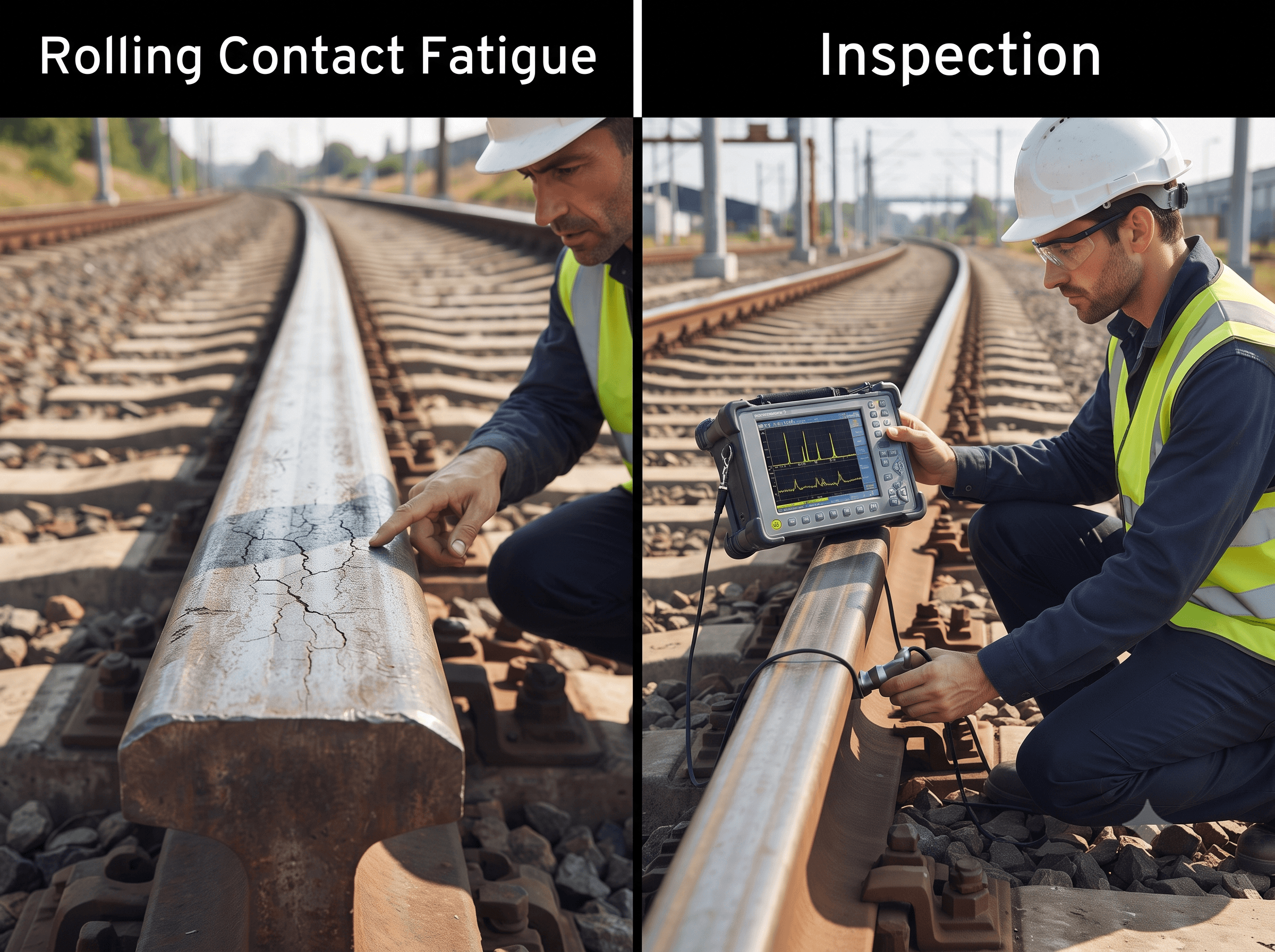
Rolling contact fatigue rail represents one of the most critical challenges facing modern railway systems worldwide. This rolling contact fatigue rail phenomenon occurs when wheels repeatedly stress steel rail surfaces under intense loading conditions. Understanding rolling contact fatigue rail, its underlying causes, distinct defect types, and modern detection methods, becomes absolutely essential for railway safety and operational longevity.
The stakes grow higher as railway traffic intensifies. Modern trains operate heavier and faster than ever before. Safety regulators maintain strict inspection protocols to prevent derailments and accidents. Understanding what causes rail deterioration helps operators implement smarter maintenance strategies that save money while protecting lives.
Rolling Contact Fatigue in Rail Systems
Rolling contact fatigue rail develops through a complex mechanical process that occurs beneath the rail surface and across its contact areas. The term describes cumulative damage that accumulates over thousands of wheel passages rather than from a single catastrophic event.
The process begins when wheels press against rail surfaces with tremendous force. This contact pressure creates stress patterns that extend deep into the steel. Each wheel passage adds microscopic deformation to the rail material. Over time, these tiny deformations accumulate and eventually form visible cracks. The cracks grow larger with continued wheel traffic.
Environmental factors accelerate this degradation process significantly. Moisture seeping into developing cracks causes rapid expansion. Temperature fluctuations create additional stress cycles within the steel structure. Lubrication variations on the rail surface affect how wheel traction distributes its forces. All these factors combine to make rolling contact fatigue rail a persistent maintenance headache.
The economic impact extends beyond simple replacement costs. Derailments disrupt schedules and damage cargo. Safety incidents create liability concerns and regulatory scrutiny. Infrastructure damage compounds repair expenses. This explains why railroads invest substantially in rolling contact fatigue rail prevention and detection systems.
What is the Cause of Rolling Contact Fatigue?
Multiple factors work together to create rolling contact fatigue rail damage on railway systems. Understanding these root causes helps operators implement targeted prevention strategies that address the most critical issues first.
Heavy Loading and Contact Stress
Modern freight trains carry unprecedented amounts of cargo per axle. Wheel loads have nearly doubled over the past four decades. This increased pressure concentrates tremendous force onto relatively small contact areas between wheels and rails. The intense contact stress deforms the steel surface through each loading cycle. Rolling contact fatigue rail initiates most readily in areas experiencing the highest stress concentrations.
High-speed passenger trains create different stress patterns but equally damaging conditions. Rapid wheel passages limit the steel's recovery time between impacts. Cumulative fatigue builds faster under these conditions. The gauge corner of rails, where wheels press hardest during curve navigation, becomes especially vulnerable to rolling contact fatigue rail damage.
Track Geometry and Design Issues
Poor track alignment contributes substantially to rolling contact fatigue rail formation. When gauge widths vary from standard specifications, wheels press unevenly against rails. Cant deficiencies cause wheels to shift laterally repeatedly. Crosslevel errors force additional loading onto specific rail portions. Each geometry error amplifies the stress patterns that initiate rolling contact fatigue rail cracks.
Sharp curves demand constant lateral force adjustments from wheels. Low rails in curves experience outer-edge stress concentrations. High rails sustain inner-edge gauge corner contact pressures. Both rail configurations suffer increased rolling contact fatigue rail damage in curved track sections. Maintaining precise track geometry significantly reduces defect formation.
Environmental and Moisture Factors
Rainfall and humidity create conditions that accelerate rolling contact fatigue rail damage. Water infiltrates developing surface cracks and accumulates at crack tips. The hydraulic pressure from trapped water forces cracks to expand faster than dry conditions would allow. This hydraulic mechanism represents a critical factor in rapid crack propagation beneath the rail surface.
Temperature extremes add additional stress cycles. Winter cold creates contraction stresses in rail steel. Summer heat generates expansion forces. These thermal cycles combine with mechanical loading to accelerate rolling contact fatigue rail crack initiation and growth rates significantly.
Material Properties and Steel Composition
Rail steel quality directly impacts rolling contact fatigue rail resistance. Harder steel grades withstand contact stress better than softer materials. Modern premium rail steels offer approximately 45 percent greater stress resistance compared to older standard grades. Metallurgical cleanliness matters tremendously, smaller nonmetallic inclusions result in longer rail life.
The manufacturing process influences residual stress patterns throughout the rail. Proper heat treatment creates beneficial compressive stresses in the rail head that resist rolling contact fatigue rail initiation. Poor manufacturing can leave surface tensile stresses that promote crack formation.
Primary Causes of Rolling Contact Fatigue Rail and Their Impacts
| Cause Category | Primary Impact | Typical Severity |
| Heavy wheel loading | Gauge corner cracking, shelling | High |
| Track geometry errors | Clustered defects, accelerated wear | Medium-High |
| Moisture infiltration | Rapid crack propagation | High |
| Material composition | Overall defect resistance | Medium |
The most common causes of rolling contact fatigue rail failures include:
- Excessive wheel loads combined with track geometry defects
- Moisture penetration into developing surface cracks
- Inadequate lubrication allowing high traction forces
Now that we understand WHY rolling contact fatigue rail develops through these complex mechanical processes, the critical question becomes unavoidable: What TYPES of visible defects actually emerge from these various causes? Each cause produces characteristic damage patterns that experienced inspectors learn to recognize. Let's discover the different manifestations of rolling contact fatigue rail damage in the next section.
Types of Rolling Contact Fatigue Rail Defects
Rolling contact fatigue rail damage manifests in numerous distinct defect patterns that reflect different mechanical failure mechanisms. Operators must understand these various defect types because each requires different management approaches.
The rail defect landscape includes over nine major categories affecting the rail head, web, and base. Additionally, wheels develop their own set of rolling contact fatigue rail defects that parallel rail damage but differ significantly in how they form and propagate. Railway maintenance teams develop expertise in identifying these patterns through visual inspection and sophisticated detection equipment.
Defect location provides clues about underlying causes. Gauge corner damage typically indicates excessive curve loading. Head surface squats suggest high traction environments. Subsurface shelling reveals deep stress penetration.
Rail Defects Associated with Rolling Contact Fatigue Rail
Rails experience numerous rolling contact fatigue rail defect types depending on track location, traffic patterns, and environmental conditions. Each defect type presents unique challenges for detection and repair.
Gauge Corner Cracking
Gauge corner cracking appears as thin lines at the gauge corner of rails, most frequently on the high rail of curves. These cracks often develop in regular spacing patterns extending across entire curve sections. Rolling contact fatigue rail creates these stress concentrations through the combination of heavy wheel loading and lateral creepage forces.
The cracks start shallow but gradually penetrate deeper into the rail head. Early-stage gauge corner cracking remains difficult to detect by visual inspection alone. If left unattended, these cracks eventually link together to form larger damage patterns.
Rail Squats
Rail squats appear as dark depressions on the rail surface, resembling small impact marks. These defects form beneath the surface through rolling contact fatigue rail mechanisms that create subsurface voids. The void eventually collapses, creating the visible depression at the rail surface. Squats develop most commonly on tangent track and high-speed lines.
The internal structure of squats reveals two primary cracks, a short leading crack and a much longer trailing crack. This configuration makes detection challenging because the trailing crack shields portions of the damage from ultrasonic inspection equipment. Squats represent particularly dangerous rolling contact fatigue rail defects because their internal severity often exceeds their external appearance.
Shelling and Spalling
Shelling occurs when chunks of rail material separate from the rail surface through rolling contact fatigue rail mechanisms. This damage typically starts as interconnected subsurface cracks that eventually link together. The loss of material creates significant geometric irregularities that cause impact loading for subsequent trains.
Gauge corner collapse produces the most severe shelling patterns. This rolling contact fatigue rail failure mode occurs when excessive loading at the gauge corner causes the steel to yield in shear. The resulting damage can extend several centimeters into the rail head.
Transverse Defects
Transverse defects run perpendicular to the rail length and represent particularly dangerous rolling contact fatigue rail damage. These cracks typically initiate at metallurgical inclusions within previously damaged areas. Once initiated, transverse defects propagate rapidly under combined bending, residual, and thermal stresses.
A transverse crack that propagates completely through the rail head results in rail breakage. This rolling contact fatigue rail failure mode creates the immediate risk of derailment. Emergency repairs require rail removal and complete replacement of affected sections.
Crushed Rail Heads
Crushed heads develop when rolling contact fatigue rail damage progresses until the rail head collapses under continued loading. This defect typically affects short rail sections, often 0.25 to 0.5 meters long. The crushed area exhibits increased cracking and plastic flow to one or both sides of the running surface.
Improper grinding, track geometry defects, and metallurgical issues all contribute to crushed head formation. Rolling contact fatigue rail creates the initial cracks that reduce structural integrity. Subsequent loading then deforms the weakened material plastically.
While rail defects pose serious maintenance challenges for track operators, wheels face their own equally destructive set of rolling contact fatigue rail problems that parallel rail damage. But what exactly are these wheel defects, and how do they differ fundamentally from rail damage? The answer reveals surprising mechanical differences rooted in wheel geometry and material properties. Continue reading to discover how wheels suffer rolling contact fatigue rail damage that demands equally sophisticated inspection and prevention strategies.
Wheel Defects and Rolling Contact Fatigue Rail Damage
Wheels develop rolling contact fatigue rail defects through distinct mechanical processes that differ significantly from rail damage patterns. Understanding these wheel-specific failures helps operators recognize systemic problems in their rolling stock maintenance programs.
Wheel Tread Cracking
Wheel tread cracking develops through surface rolling contact fatigue rail mechanisms similar to rail damage but with different stress distributions. Cracks initiate perpendicular to the traction direction, creating distinctive crack orientations that reveal their mechanical cause. The field side of wheels typically shows more severe cracking than other locations during wet weather operation.
These cracks rarely progress into full wheel shelling. The cracks tend to remain relatively shallow compared to rail defects. However, repeated wheel passages over defective track can accelerate wheel tread cracking significantly. Regular wheel inspection becomes essential for detecting these defects early.
Shattered Wheel Rims
Shattered rim failures originate from subsurface defects located 12-20 millimeters below the wheel running surface. These rolling contact fatigue rail-related defects propagate roughly parallel to the wheel tread. The crack eventually exits through the wheel's rim side, creating a sudden catastrophic failure.
Nonmetallic inclusions, particularly hard aluminosilicate particles, trigger shattered rim initiation. Modern steelmaking improvements have reduced inclusion sizes dramatically. Combined with improved ultrasonic inspection protocols, shattered rim failures have decreased substantially in recent decades. However, older wheel metallurgy still contains inclusions that pose ongoing risks.
Wheel Spalling
Wheel spalling results from thermal damage rather than pure rolling contact fatigue rail stress. Sliding friction generates extreme temperatures at the wheel-rail interface during wheel slip. This rolling contact fatigue rail companion failure creates brittle martensite layers that crack under subsequent loading. The martensite spalls out, creating visible surface damage.
Brake system malfunctions and wheel spin incidents trigger spalling failures. These defects differ fundamentally from rolling contact fatigue rail damage caused by normal contact stresses. Prevention requires addressing underlying brake system performance issues rather than modifying rolling contact fatigue rail management strategies.
Vertical Split Rims
Vertical split rims separate circumferentially from the wheel body through rolling contact fatigue rail-related bending stresses. These defects originate from rim-side structural loading in curves. Hollow treads and false flanges increase the risk of this particular rolling contact fatigue rail failure mode. The rim separates suddenly, creating catastrophic failure conditions.
What are Common Issues That Affect Railway Tracks?
Multiple rolling contact fatigue rail defect types create operational challenges for railway systems worldwide. Early identification prevents derailments and extends infrastructure life significantly.
Railway operators encounter these common rolling contact fatigue rail issues regularly:
- Gauge corner cracking and head checking in curved track sections
- Surface squats and depressions, especially on high-speed lines
- Subsurface shelling and material loss beneath the rail surface
- Wheel tread and rim damage affecting rolling stock
- Transverse rail fractures leading to broken rails
- Crushed head formations from severe contact stress
- Surface spalling from thermal wheel damage
- Weld defects and joint-related cracking
These rolling contact fatigue rail problems demand systematic detection and management approaches. Ignoring early warning signs leads to expensive emergency repairs and safety incidents.
Understanding these various rolling contact fatigue rail defects represents only half of the operational challenge facing modern railways. The real engineering problem lies in FINDING these hidden damage patterns before they cause catastrophic failures. Let's explore these critical inspection techniques in detail.
Inspection Methods for Rolling Contact Fatigue Rail Detection
Modern railways employ multiple detection technologies to identify rolling contact fatigue rail defects before they become dangerous. No single method detects all defect types equally well. Comprehensive inspection programs combine several complementary technologies for maximum reliability.
Ultrasonic Testing for Rolling Contact Fatigue Rail
Ultrasonic testing transmits sound waves through rail steel to detect internal defects. High-frequency sound waves reflect back from cracks and material discontinuities. Skilled operators interpret these acoustic signals to identify rolling contact fatigue rail damage locations and approximate depths. This proven technology remains the industry standard for mainline rail inspection.
Eddy Current Testing
Eddy current equipment uses electromagnetic induction to detect surface and near-surface rolling contact fatigue rail cracks. Induced electrical currents respond to defects by creating detectable signal changes. This technology specializes in measuring surface crack lengths, providing quantitative data for maintenance decisions.
Eddy current systems operate faster than ultrasonic equipment. Automated scanning provides consistent detection sensitivity across varying operators. However, eddy current penetration remains limited to shallow depths. Surface contamination and rail condition variations can affect signal reliability for rolling contact fatigue rail defect sizing.
Vision and Image Analysis Systems
Advanced camera systems capture high-resolution images of rail surfaces for automated defect recognition. Artificial intelligence algorithms analyze images to identify rolling contact fatigue rail damage patterns. This emerging technology promises faster inspection speeds and objective defect classification.
Current vision systems excel at detecting surface defects like squats and head checking. Lighting conditions and rail surface cleanliness affect detection reliability. Integration with other detection methods improves rolling contact fatigue rail identification accuracy significantly.
Acceleration-Based Detection Systems
Wayside accelerometers detect vibration patterns generated by wheel impacts on rolling contact fatigue rail defects. High impacts on defective rail produce characteristic acceleration signatures. Modern systems collect and analyze this data to identify problem locations requiring detailed inspection.
These rolling contact fatigue rail detection systems operate continuously without inspecting vehicle presence. Data analysis can predict defect growth patterns and recommend maintenance scheduling. However, acceleration-based systems excel at finding deep defects but cannot reliably support preventive maintenance programs alone.
Laser Ultrasonic Technology
Emerging laser ultrasonic systems generate sound waves without contacting the rail surface. Lasers create ultrasonic waves while interferometers detect returning signals. This rolling contact fatigue rail detection method eliminates coupling agent requirements and enables faster scanning speeds.
Laboratory testing demonstrates impressive detection capabilities for rolling contact fatigue rail damage. Field deployment remains limited as technology developers optimize equipment for railway conditions. Future adoption could revolutionize rolling contact fatigue rail inspection efficiency.
Inspection Method Comparison for Rolling Contact Fatigue Rail Detection
| Detection Method | Penetration Depth | Speed | Detection Accuracy | Cost Level |
| Ultrasonic Testing | Deep (50+ mm) | Moderate | High | Medium |
| Eddy Current | Shallow (10 mm) | Fast | Good | Medium |
| Vision Analysis | Surface only | Fast | Good | Low-Medium |
| Acceleration-Based | Variable | Continuous | Fair | Medium |
| Laser Ultrasonic | Deep | Fast | Excellent | High |
Comprehensive rolling contact fatigue rail inspection programs integrate multiple detection methods. Ultrasonic testing provides deep defect detection. Eddy current offers surface crack measurement. Vision systems enable automated screening. Combined approaches maximize detection reliability while optimizing inspection resource allocation.
While detecting rolling contact fatigue rail defects proves absolutely critical for railway safety, preventing these defects from forming initially delivers superior economic and operational benefits. The ultimate goal transcends mere detection, operators seek to eliminate rolling contact fatigue rail damage before it develops. But what practical strategies actually PREVENT rolling contact fatigue rail damage in real-world railway operations? Which prevention approaches deliver measurable results across different railway environments? The solutions combine cutting-edge technology with proven maintenance practices that operators have refined over decades.
Managing and Preventing Rolling Contact Fatigue Rail Issues
Multiple prevention strategies work together to minimize rolling contact fatigue rail damage in modern railway systems. Preventive approaches consistently outperform reactive repairs in both economic and safety measures.
Preventive Rail Grinding Programs
Rail grinding removes surface damage before cracks penetrate deeply into the rail head. Periodic grinding intervals prevent rolling contact fatigue rail defect accumulation and propagation. Ground rails exhibit smoother surfaces that distribute wheel loading more evenly.
Modern grinding equipment removes precise amounts of steel while maintaining proper rail profiles. Grinding costs appear substantial initially but reduce emergency repairs and extend rail life significantly. Strategic grinding prevents rolling contact fatigue rail initiating at stress concentration points created by defects or improper profiles.
Friction Management and Lubrication
Controlling wheel-rail friction reduces traction forces that initiate rolling contact fatigue rail cracks. Top-of-rail lubrication systems apply controlled friction modifiers to rail surfaces. Reduced friction lowers the stress state in both wheels and rails.
Advanced lubrication systems optimize friction for curve navigation while minimizing rolling contact fatigue rail damage. Proper lubrication reduces wear and extends both rail and wheel service life. However, excessive lubrication creates different problems, requiring careful system calibration for specific operating environments.
Track Geometry Optimization
Maintaining precise track geometry reduces the irregular loading that accelerates rolling contact fatigue rail defect initiation. Proper gauge width, cant angle, and crosslevel minimize stress concentrations. Geometry defects create localized rolling contact fatigue rail damage clusters that demand expensive repairs.
Regular track geometry measurements identify problems before rolling contact fatigue rail damage becomes severe. Corrective tamping and profile grinding restore proper alignment. Sound track geometry represents the foundation for rolling contact fatigue rail management.
Advanced Steel Formulations
Modern premium rail steels resist rolling contact fatigue rail damage far better than older standard grades. Increased hardness resists surface deformation under heavy loading. Improved cleanliness eliminates harmful nonmetallic inclusions that trigger defect initiation. Bainitic steel compositions offer superior rolling contact fatigue rail resistance compared to pearlitic steels.
Investment in premium rail steels requires higher initial capital expenditure. However, extended rail life and reduced grinding requirements produce substantial long-term savings. Metallurgical improvements directly address rolling contact fatigue rail resistance at the material level.
Final Thoughts
Rolling contact fatigue rail represents a manageable challenge when operators implement comprehensive prevention and detection strategies. Understanding rolling contact fatigue rail causes, defect types, and inspection methods enables informed decision-making.
Modern railways successfully manage rolling contact fatigue rail through integrated approaches combining multiple technologies. Preventive grinding removes surface damage before rolling contact fatigue rail cracks propagate dangerously. Advanced inspection equipment identifies defects early. Friction management reduces stress initiation. Strategic rail steel selection improves material resistance.
The rail industry has made tremendous progress in controlling rolling contact fatigue rail over recent decades. Economic factors drive continuous improvement in rolling contact fatigue rail management practices. Safety requirements demand rigorous rolling contact fatigue rail detection and prevention. Operators who prioritize rolling contact fatigue rail management experience fewer derailments and longer infrastructure life.
Rolling contact fatigue rail will remain a permanent feature of railway operations. However, modern tools enable operators to minimize its impacts substantially. Investing in rolling contact fatigue rail prevention delivers returns through extended equipment life and improved safety performance. The future brings continued technological advances in rolling contact fatigue rail detection and prevention capabilities.
Key Takeaways
- Rolling contact fatigue rail develops from mechanical, environmental, and material factors combined together.
- Heavy wheel loads and poor track geometry create dangerous stress concentration points.
- Multiple wheel and rail defect types require different detection and management approaches.
- Moisture infiltration accelerates rolling contact fatigue rail crack propagation significantly more than dry conditions.
- Comprehensive inspection programs combining multiple detection technologies provide superior rolling contact fatigue rail safety.
- Gauge corner cracking, squats, shelling, and transverse defects represent most dangerous rolling contact fatigue rail failures.
- Wheel defects including tread cracking and shattered rims differ mechanically from rolling contact fatigue rail damage.
- Ultrasonic testing detects subsurface defects while eddy current measures surface cracks accurately.
- Preventive grinding, friction management, and track geometry optimization reduce rolling contact fatigue rail damage substantially.
- Modern premium rail steels offer superior rolling contact fatigue rail resistance compared to older standard grades.
FAQs
What is Contact Fatigue?
Contact fatigue is cyclic stress damage occurring beneath rolling surfaces from repeated wheel-rail interactions. This rolling contact fatigue rail phenomenon develops gradually through accumulated microscopic deformations that eventually form visible cracks and defects.
What are the Defects of Rolling?
Rolling defects include gauge corner cracking, squats, shelling, transverse defects, and crushed rail heads. Each rolling contact fatigue rail defect type requires specific detection methods and tailored management strategies for safe operations.
What are Three Types of Defects?
Surface cracking, subsurface shelling, and wheel rim damage represent three primary rolling contact fatigue types. Surface defects remain visible while subsurface rolling contact fatigue rail damage requires advanced inspection technology to detect.
What is the Rolling Fatigue Life?
Rolling fatigue life measures the operational duration before rolling contact fatigue rail damage becomes critical. Modern premium rail steels significantly extend rolling fatigue life compared to older standard grade materials.