

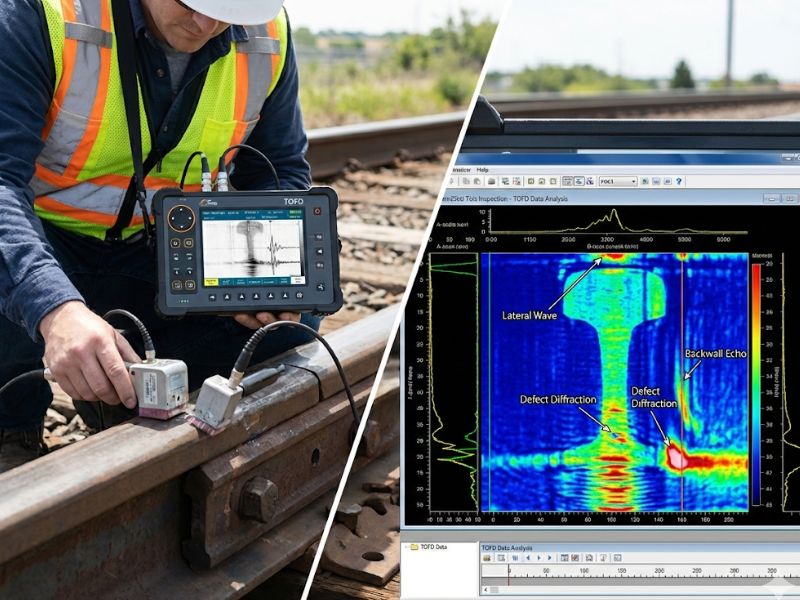
Rail failures can lead to costly delays and serious safety risks if hidden defects go undetected. TOFD rail inspection has become a reliable method for identifying internal rail flaws before they develop into major failures.
TOFD rail inspection plays a key role in modern railway maintenance by providing accurate defect detection and precise sizing of cracks, especially in rail welds. This article explains how TOFD rail inspection works, the types of rail defects it detects, its advantages and limitations, and how it compares with other rail testing methods, giving a clear view of its value in improving railway safety and reliability.
What Is TOFD Rail Inspection and How It Works
Hidden defects inside rails are often impossible to see from the surface, yet they can grow silently under repeated train loads. TOFD rail inspection is a non-destructive testing method designed to find these internal problems early, before they affect rail performance or safety.
TOFD rail inspection stands for Time of Flight Diffraction. It uses ultrasonic waves to detect and size internal defects within rails and rail welds. Unlike basic ultrasonic testing that relies mainly on reflected signals, TOFD focuses on diffracted signals that come from the tips of cracks. This makes defect detection more accurate and reliable, especially for deeper flaws.
Basic working principle of TOFD rail inspection
The working process is straightforward and consistent across railway applications:
- Two ultrasonic probes are placed on opposite sides of the rail or rail weld
- One probe sends ultrasonic waves into the rail material
- When the waves encounter a defect, they diffract from the crack tips
- The second probe receives these diffracted signals
- Software calculates the time taken for the waves to travel, showing defect depth and size
Because the method measures time rather than signal strength alone, TOFD rail inspection provides accurate sizing of defects, even when surface conditions are not ideal.
Key features of how it works include:
- Precise depth measurement of defects
- Clear imaging of internal rail structure
- Permanent digital records for future comparison
This accuracy is why TOFD rail inspection is widely used for critical rail sections and welded joints. However, knowing how the technology works is only part of the picture. The real value lies in what it can actually detect, and that is where its impact on railway safety becomes clear.
Rail Defects Detected by TOFD Rail Inspection
Rail defects often begin small and invisible, but they rarely stay that way. TOFD rail inspection is especially effective at detecting internal defects that traditional visual checks cannot identify.
Internal rail cracks
Internal cracks develop due to repeated stress, material fatigue, and thermal effects. TOFD rail inspection detects these cracks by identifying diffraction signals from crack tips, even when the rail surface appears intact. This allows maintenance teams to act before cracks propagate further.
Fatigue-related defects
Rails experience constant cyclic loading from passing trains. Over time, this can lead to fatigue defects within the rail body or near weld zones. TOFD rail inspection is well suited for:
- Early-stage fatigue cracks
- Subsurface defects caused by long-term loading
- Crack growth monitoring through repeated inspections
By identifying fatigue defects early, rail operators can reduce the risk of sudden rail failure.
Rail weld flaws
Rail welds are among the most critical points in the track system. TOFD rail inspection is commonly used for inspecting:
- Flash butt welds
- Thermite welds
- Heat-affected zones around welds
Common weld-related defects detected include lack of fusion, incomplete penetration, and internal cracking. The ability to accurately size these defects helps engineers decide whether a weld can remain in service or requires repair.
At this stage, TOFD rail inspection has proven its strength in defect detection. Yet detection alone is not enough. The next question is how this method compares to other rail inspection techniques and why railways increasingly rely on it for long-term safety decisions.
TOFD Rail Inspection for Rail Weld Testing
Rail welds are among the most highly stressed sections of the track and are often the starting point for serious failures. TOFD rail inspection plays a critical role in rail weld testing by detecting internal defects that may form during the welding process or develop later under traffic loads.
In flash butt welding, TOFD rail inspection is widely used to assess the quality of the weld and the surrounding heat-affected zone. The method allows inspectors to detect internal cracking, lack of fusion, and other volumetric defects that are difficult to identify using surface-based techniques. Because flash butt welds are produced in large numbers, TOFD provides a fast and repeatable inspection method that supports consistent quality control.
For thermite welds, inspection is even more important due to the higher risk of internal defects. TOFD rail inspection is effective in identifying flaws such as shrinkage cavities, slag inclusions, and internal cracks within the weld metal. Its ability to accurately size defects helps maintenance teams determine whether a weld meets acceptance criteria or requires corrective action.
Key reasons TOFD is preferred for rail weld testing include:
- Reliable detection of internal weld defects
- Accurate defect sizing for acceptance decisions
- Minimal influence from weld surface condition
With weld inspection covered, attention naturally shifts to the overall strengths and weaknesses of TOFD rail inspection in real railway environments.
Advantages and Limitations of TOFD Rail Inspection
The growing use of TOFD rail inspection in the railway industry is driven by its strong technical advantages. However, like any inspection method, it also has practical limitations that must be considered.
Advantages of TOFD rail inspection
One of the main advantages is its high accuracy. TOFD provides precise information about defect depth and height, which supports better maintenance decisions and reduces unnecessary rail replacements. This accuracy is especially valuable when assessing critical rail welds.
Another major benefit is data recording. TOFD rail inspection produces permanent digital records that can be stored and reviewed over time. This allows:
- Trend analysis of defect growth
- Verification of previous inspection results
- Improved asset management planning
In addition, TOFD is less sensitive to signal amplitude variations, making results more consistent across different inspections and operators.
Limitations of TOFD rail inspection
Despite its strengths, TOFD rail inspection does have limitations. It is less effective at detecting very small surface-breaking defects, which may require complementary inspection methods. Proper probe positioning and surface preparation are also essential to achieve reliable results.
Other practical limitations include:
- Requirement for skilled and trained operators
- Limited coverage of complex rail geometries
- Higher equipment cost compared to basic ultrasonic testing
Understanding both the advantages and limitations of TOFD rail inspection helps rail operators use the method effectively. This balance sets the stage for comparing TOFD with other rail testing techniques and understanding why it is often used as part of a combined inspection approach.
TOFD Rail Inspection vs Other Rail Testing Methods
Railway maintenance relies on several inspection techniques, each with its own strengths. TOFD rail inspection is often used alongside other rail testing methods, but its capabilities differ significantly from conventional approaches.
TOFD rail inspection vs conventional ultrasonic testing
Conventional ultrasonic testing is widely used to detect internal rail defects, but it mainly depends on signal reflection and amplitude. This can make accurate defect sizing difficult, especially for complex rail weld flaws. In contrast, TOFD rail inspection uses diffracted signals from crack tips, which allows more precise measurement of defect depth and height.
Key differences include:
- TOFD provides more accurate defect sizing
- Conventional ultrasonic testing is more sensitive to operator settings
- TOFD produces clearer and more consistent defect images
While conventional ultrasonic testing remains useful for rapid scanning, TOFD rail inspection is often selected when detailed defect assessment is required.
TOFD rail inspection vs visual inspection
Visual inspection is limited to surface-level defects and obvious damage. It cannot detect internal cracks or subsurface weld flaws. TOFD rail inspection overcomes this limitation by examining the internal structure of rails and welds, even when the surface appears sound.
Visual inspection is best suited for:
- Identifying visible damage or deformation
- Supporting routine track patrols
However, it must be combined with TOFD rail inspection to ensure hidden defects are not missed.
With these comparisons in mind, the importance of TOFD rail inspection becomes even clearer when considering its direct impact on railway safety.
Role of TOFD Rail Inspection in Railway Safety
Railway safety depends on early defect detection and informed maintenance decisions. TOFD rail inspection supports this by identifying internal rail and weld defects before they reach critical sizes that could lead to rail failure.
By providing accurate defect sizing, TOFD allows engineers to prioritise repairs based on actual risk rather than assumptions. This reduces the likelihood of sudden rail breaks, derailments, and service disruptions. The availability of permanent inspection data also supports long-term safety planning and compliance with railway standards.
TOFD rail inspection contributes to safer railway operations by:
- Detecting hidden defects at an early stage
- Supporting condition-based maintenance strategies
- Reducing unexpected rail and weld failures
As railway networks continue to carry heavier loads and higher traffic volumes, the role of TOFD rail inspection becomes increasingly important. It not only improves defect detection but also strengthens the overall safety framework that keeps railway systems reliable and secure.
Conclusion
TOFD rail inspection has become an essential tool in the modern railway industry, offering a reliable way to detect and accurately size internal rail and weld defects that cannot be identified through surface checks alone.
By using diffracted ultrasonic signals, it provides clearer insight into crack depth and growth, supporting better maintenance decisions across critical track sections.
Throughout this article, TOFD rail inspection has been shown to play a key role in rail weld testing, particularly for flash butt and thermite welds, while also complementing conventional ultrasonic and visual inspection methods.
Its ability to produce permanent inspection data, reduce the risk of sudden rail failures, and support condition-based maintenance makes it a strong contributor to railway safety. When used correctly and alongside other inspection techniques, TOFD rail inspection helps ensure safer, more reliable, and more efficient railway operations.
Key Points
- TOFD rail inspection is a non-destructive testing method used to detect internal rail and weld defects.
- It works by analysing diffracted ultrasonic signals from crack tips rather than surface reflections.
- TOFD rail inspection provides accurate defect depth and size measurements.
- The method is widely used for inspecting flash butt and thermite rail welds.
- Internal cracks and fatigue-related defects can be detected before reaching critical stages.
- TOFD rail inspection produces permanent digital records for future analysis and comparison.
- It is less affected by surface condition than many traditional inspection methods.
- TOFD complements conventional ultrasonic testing by offering improved defect sizing accuracy.
- Visual inspection alone cannot detect the internal defects identified by TOFD rail inspection.
- Early defect detection through TOFD rail inspection helps prevent rail failures and improves railway safety.
FAQs
What are limitations of TOFD rail inspection?
Limitations include the need for access to both sides of a rail or weld, the requirement for skilled operators, and reduced detection capability near the surface or in very thin materials.
How does TOFD rail inspection support railway safety?
By detecting hidden defects early and accurately sizing them, TOFD rail inspection helps prevent rail failures and supports better planning of maintenance and repairs.
How is TOFD rail inspection data recorded and used?
Results are stored as digital records and images (B-scan or D-scan), which can be reviewed later to monitor defect growth and guide maintenance decisions.
Does TOFD replace all other rail inspection methods?
No, while TOFD is excellent for internal defect sizing, it is often used alongside other methods like conventional UT or visual inspection for comprehensive coverage.
