

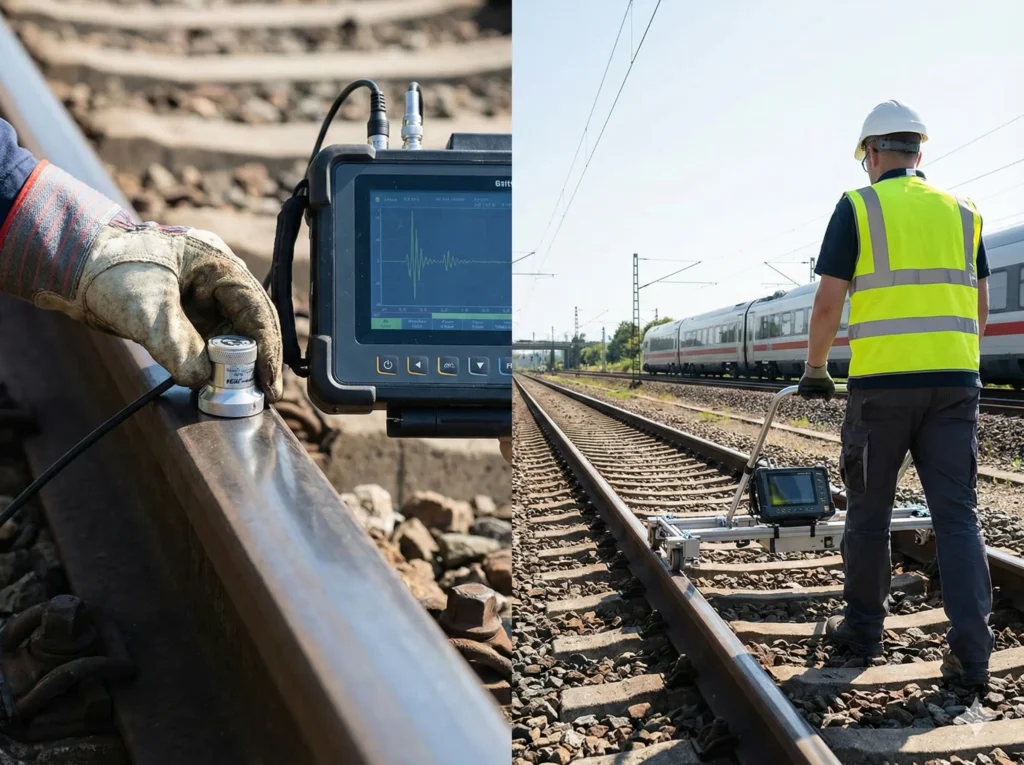
Detecting hidden defects in materials can mean the difference between safety and disaster. ultrasonic flaw detection is a powerful method that allows engineers and inspectors to find cracks, voids, and other flaws without damaging the material.
This article will explain how ultrasonic flaw detection works, the key equipment used, common testing methods, types of flaws it can identify, its advantages and limitations, and its main industrial applications. By the end, you’ll have a clear understanding of why this technique is essential for ensuring quality and safety across industries.
How It Works
Ultrasonic flaw detection is a widely used technique in non-destructive testing, allowing engineers to detect defects hidden deep inside materials. The method works by sending high-frequency sound waves into a component and analysing the echoes that bounce back.
When these waves encounter a flaw, such as a crack, void, or inclusion, they reflect differently compared to intact material, producing signals that can be interpreted to locate and size the defect.
Generation of Ultrasonic Waves
At the core of the process is the transducer, which converts electrical energy into ultrasonic waves. These waves travel through the material, interacting with its internal structure. Depending on the material properties and the type of flaw, the waves may be reflected, refracted, or scattered.
Reflection from Flaws
When ultrasonic waves hit a discontinuity within the material:
- Part of the wave is reflected back to the transducer.
- The strength and time of the reflected wave indicate the flaw’s size and location.
- The angle and shape of the flaw affect how clearly the signal appears on the display.
Signal Interpretation
- The returning echoes are displayed as graphs or images on the device.
- Different scan formats provide varying levels of detail:
- A-Scan: Shows amplitude versus time for a single point.
- B-Scan: Cross-sectional view of the material.
- C-Scan: Top-down mapping of defects across a surface.
Interpreting these signals requires skill and experience, as noise or material irregularities can create confusing patterns. With a clear understanding of how ultrasonic waves behave, the next step is to explore the equipment that makes this testing possible. After all, even the best technique cannot work without the right tools.
Key Equipment
The effectiveness of ultrasonic flaw detection relies on properly selected and calibrated equipment. Each component plays a vital role in generating, sending, and interpreting ultrasonic waves.
Transducers and Probes
Transducers are the heart of the system, converting electrical pulses into ultrasonic waves and receiving the echoes. Key types include:
- Straight-beam probes: Best for detecting flaws directly beneath the surface.
- Angle-beam probes: Ideal for inspecting welds or angled surfaces.
- Phased array probes: Allow electronic steering of the beam to scan large areas or complex shapes efficiently.
Pulser-Receiver Unit
This unit generates the electrical pulses sent to the transducer and amplifies the returning echoes. A high-quality pulser-receiver ensures that even small or deep flaws are detectable, making it essential for accurate ultrasonic flaw detection.
Display and Scan Formats
The returning signals are converted into visual formats that inspectors can analyse:
- A-Scan: Simple graph for amplitude over time; ideal for pinpointing echo timing.
- B-Scan: Produces a side-on cross-section of the material.
- C-Scan: Offers a top-down view to map defects across an entire area.
Supporting Equipment
- Couplants: Gels or liquids that improve the transmission of ultrasonic waves into the material.
- Calibration blocks: Standardised test blocks used to verify measurement accuracy and adjust equipment settings.
With the equipment prepared and calibrated correctly, inspectors can now apply different testing methods to detect flaws efficiently. These methods directly influence the accuracy and reliability of ultrasonic inspections, which we will explore in the next section.
Testing Methods
Different ultrasonic flaw detection techniques are used depending on the material type, shape, and the type of defect being inspected. Choosing the right method ensures accurate detection and avoids false readings.
Straight-Beam Testing
This is the simplest method, where the ultrasonic waves travel straight into the material. It is ideal for detecting flaws located directly beneath the surface.
- Works best for flat plates and simple geometries.
- Detects cracks, voids, and inclusions near the entry surface.
- Provides clear, easy-to-read A-Scan signals.
Angle-Beam Testing
Angle-beam testing uses a probe that sends waves at a specific angle into the material.
- Commonly used for weld inspection and angled components.
- Detects flaws that are not directly under the surface.
- Can reveal cracks along welds and structural edges.
Immersion Testing
In immersion testing, the component is submerged in water, and the probe is moved above it.
- Water acts as a couplant, improving wave transmission.
- Provides uniform coverage for complex shapes.
- Often combined with scanning systems for automated inspection.
Phased Array Testing
Phased array is an advanced technique where multiple small transducers send ultrasonic waves in a sequence, allowing electronic steering of the beam.
- Can create 2D and 3D images of defects.
- Scans large areas quickly and efficiently.
- Ideal for high-precision industries such as aerospace and oil pipelines.
Selecting the appropriate testing method is crucial, but detecting a flaw is only half the job. The next step is evaluating the flaw itself, determining its type, size, and severity.
Flaw Detection and Evaluation
Once a defect is detected using ultrasonic flaw detection, it must be carefully evaluated to understand its potential impact on the material’s integrity.
Types of Flaws
Different types of defects can occur in materials, and each affects the ultrasonic signal differently:
- Cracks: Sharp discontinuities that reflect strong echoes.
- Voids: Air-filled gaps that produce distinctive signals.
- Inclusions: Foreign materials trapped inside, often producing irregular reflections.
- Delamination or Disbonding: Layers separating in composites or welds, typically detected with phased array or immersion methods.
Sizing Methods
- Time-of-Flight Measurement: Measures the time taken for echoes to return to determine depth.
- Amplitude Analysis: Stronger echoes often indicate larger or more severe defects.
- Visual Mapping (C-Scan): Provides a top-down view of flaw distribution across a surface.
Evaluating Severity
- Compare the flaw size and location against industry standards.
- Consider the material type and operating conditions.
- Prioritise critical flaws that may compromise safety or performance.
With these evaluation techniques, inspectors can make informed decisions on maintenance, repair, or replacement. Next, we will explore the advantages and limitations of ultrasonic flaw detection to understand why it is both powerful and, at times, challenging to use.
Overall, ultrasonic flaw detection is essential for identifying hidden rail defects and preventing failures. Our ultrasonic examination services provide precise detection, while our Level III services ensure expert oversight and compliance. Protect your railway infrastructure with our professional NDT solutions.
Conclusion
Ultrasonic flaw detection is a powerful and reliable method for identifying hidden defects in materials without causing any damage. From understanding how ultrasonic waves travel and reflect, to using the right equipment and testing methods, each step plays a crucial role in ensuring accurate results.
By evaluating flaws carefully and knowing the advantages and limitations of this technique, industries such as aerospace, pipelines, and construction can maintain safety, quality, and performance. Whether detecting cracks, voids, or delamination, ultrasonic flaw detection remains an essential tool for preventing failures and ensuring long-term reliability in critical components.
Key Points
- Ultrasonic flaw detection uses high-frequency sound waves to detect hidden defects in materials without causing damage.
- Waves reflect differently when they encounter flaws, allowing inspectors to locate and size defects.
- Key equipment includes transducers/probes, pulser-receivers, display units, and supporting tools like couplants and calibration blocks.
- Transducer types include straight-beam, angle-beam, and phased array probes, each suited for different inspection needs.
- Scan formats such as A-Scan, B-Scan, and C-Scan provide various visualisations for interpreting flaws.
- Testing methods include straight-beam, angle-beam, immersion, and phased array techniques, chosen based on material and flaw type.
- Common types of flaws detected are cracks, voids, inclusions, and delamination or disbonding.
- Flaw evaluation involves measuring depth, size, and severity using techniques like time-of-flight and amplitude analysis.
- Advantages include high accuracy, non-destructive testing, and versatility; limitations involve complex shapes, operator skill, and accessibility.
- Industrial applications span aerospace, pipelines, construction, automotive, power generation, and manufacturing, ensuring safety and quality.
FAQs
What are the limitations of Ultrasonic Flaw Detection?
Limitations include the need for skilled operators, challenges with rough or irregular surfaces, and reduced effectiveness in highly attenuating or coarse‑grained materials.
Is surface preparation important for Ultrasonic Flaw Detection?
Yes. Proper surface preparation and a suitable couplant are critical to ensure good sound transmission from the probe into the material.
How accurate is Ultrasonic Flaw Detection?
When set up and interpreted correctly, ultrasonic flaw detection can precisely locate and size internal flaws, often outperforming other non‑destructive methods in sensitivity and depth penetration.
Where is Ultrasonic Flaw Detection used?
It is widely used in aerospace, oil & gas pipelines, manufacturing quality control, automotive inspection, construction and infrastructure, and power generation for ensuring material integrity and safety.
