Every rail journey relies on one vital promise, safety. Beneath the strength of steel tracks lies an invisible threat: hidden cracks and internal flaws that can trigger catastrophic failures if left undetected. Ultrasonic Rail Flaw Detection: Advancing Railway Safety with Precision Technology has become the backbone of modern railway maintenance, allowing engineers to uncover internal defects long before they pose a danger.
This cutting-edge inspection method uses high-frequency sound waves to detect even the smallest imperfections, ensuring that rail networks remain both safe and efficient.
In this article, you’ll learn how ultrasonic testing for rails works, why it’s more effective than traditional inspection methods, and what technologies are leading the way in flaw detection.
We’ll also explore the latest innovations, practical challenges, and how this precision technology is shaping the future of railway safety. Whether you’re part of the rail industry or simply curious about how trains stay on track, this guide will show how ultrasonic inspection is redefining reliability on the rails.
Common Rail Defects and Their Impact
Rail tracks face constant stress from high-speed trains, fluctuating weather, and heavy freight loads. Over time, these forces can cause hidden structural weaknesses that compromise safety. Detecting such defects early is critical, and this is exactly where Ultrasonic Rail Flaw Detection transforms maintenance from reactive to preventive.
Main Types of Rail Defects
Rail defects can develop in various forms, each posing unique risks to railway operations. The most common include:
- Internal Cracks: Form deep within the rail and are invisible during surface inspections. They often result from repeated train loads and metal fatigue.
- Head Checks: Appear as fine cracks on the rail head due to wheel friction and repeated contact stress. These can extend downward and lead to fractures.
- Weld Flaws: Weaknesses in joints caused by poor welding practices or thermal fatigue. These areas are prone to failure under heavy loads.
- Corrosion: Caused by moisture, salt, or chemicals that deteriorate the metal, weakening the track’s strength and structure.
Even minor flaws can expand under the constant pressure of passing trains. Internal cracks, in particular, are dangerous because they can grow silently until a sudden failure occurs, sometimes leading to derailments or track breakage.
Causes of Rail Defects
Rail damage rarely happens overnight. Instead, it’s the result of long-term stress and environmental conditions. Common causes include:
- Heavy Loads: Freight trains place immense stress on the track, accelerating fatigue.
- Thermal Stress: Temperature changes cause rail expansion and contraction, leading to stress fractures.
- Material Fatigue: Continuous stress cycles weaken the metal’s internal structure over time.
- Poor Maintenance or Welding: Substandard welding or neglected upkeep increases the risk of defect formation.
Each of these factors contributes to structural wear and, without intervention, can result in costly repairs or service interruptions. The challenge lies in identifying these faults before they become visible, and that’s where advanced inspection tools come in.
So, how can rail engineers detect these invisible threats before disaster strikes? The answer lies in a breakthrough technology that listens beneath the surface.
Overview of Ultrasonic Non-Destructive Testing (NDT)
Ultrasonic Non-Destructive Testing (NDT) is one of the most advanced railway track inspection technologies used today. It relies on high-frequency sound waves to detect flaws deep inside the rail without causing any damage.
Here’s how the process works:
- An ultrasonic probe sends high-frequency sound waves into the rail.
- When these waves hit a boundary, such as a crack or inclusion, they reflect back.
- The returning echoes are displayed as signals, revealing the size and position of the flaw.
This technology allows engineers to locate hidden internal cracks, weld defects, and voids with extreme precision. Since the inspection is non-destructive, it can be performed during routine maintenance without disrupting operations.
Why Ultrasonic NDT is Essential for Rail Safety
Unlike conventional inspection methods, ultrasonic testing penetrates deep into the rail material. This capability makes it invaluable for detecting flaws that visual inspections or surface-based methods often miss. It ensures that even the smallest defects are identified before they evolve into major hazards.
Comparison with Other Inspection Methods
To understand why ultrasonic inspection is so effective, it helps to compare it with other testing approaches:
- Visual Inspection: Limited to surface-level damage and cannot detect internal flaws.
- Magnetic Testing: Useful for certain metals but struggles with non-ferromagnetic materials and deep cracks.
- Ultrasonic Rail Flaw Detection: Capable of identifying both surface and internal defects, providing more accurate data for predictive maintenance.
While other techniques have their place, ultrasonic testing for rails offers unmatched precision and reliability, a reason it’s now the preferred method across rail networks worldwide.
Rail Flaw Detection Systems and Equipment
As railway networks expand and train speeds increase, the demand for efficient and accurate inspection methods grows stronger. Ultrasonic Rail Flaw Detection systems have become the cornerstone of global railway safety, offering continuous and precise evaluation of rail health.
These systems combine cutting-edge hardware and intelligent software to ensure no defect goes unnoticed, even those invisible to traditional inspection methods.
Overview of Ultrasonic Rail Flaw Detection Systems
Across the world, rail operators rely on ultrasonic testing for rails to identify defects before they cause serious incidents. These systems transmit ultrasonic waves through the rail to detect internal discontinuities and flaws. The reflected signals are then analysed in real time to pinpoint defects with remarkable accuracy.
There are two main approaches:
- Manual or Semi-Automated Systems: Used for targeted inspections, often during scheduled maintenance.
- Fully Automated Detection Systems: Mounted on inspection vehicles that scan large rail sections at high speed, producing instant results for maintenance crews.
Together, these technologies form the backbone of modern rail flaw detection systems, improving both safety and operational efficiency.
Key Components of Ultrasonic Inspection Systems
Each system relies on several essential components that work in harmony to detect and interpret flaws:
- Probes and Transducers: Convert electrical energy into ultrasonic waves that travel through the rail.
- Couplants: Gels or liquids applied between the probe and the rail surface to improve wave transmission.
- Data Processors: Capture and analyse the reflected signals, identifying anomalies that indicate flaws.
- Signal Displays and Software: Present visual data outputs such as A-scans and B-scans, showing the flaw’s depth and location.
Together, these components make it possible to identify even microscopic defects, ensuring proactive maintenance and preventing potential failures.
Mobile and Portable Testing Equipment
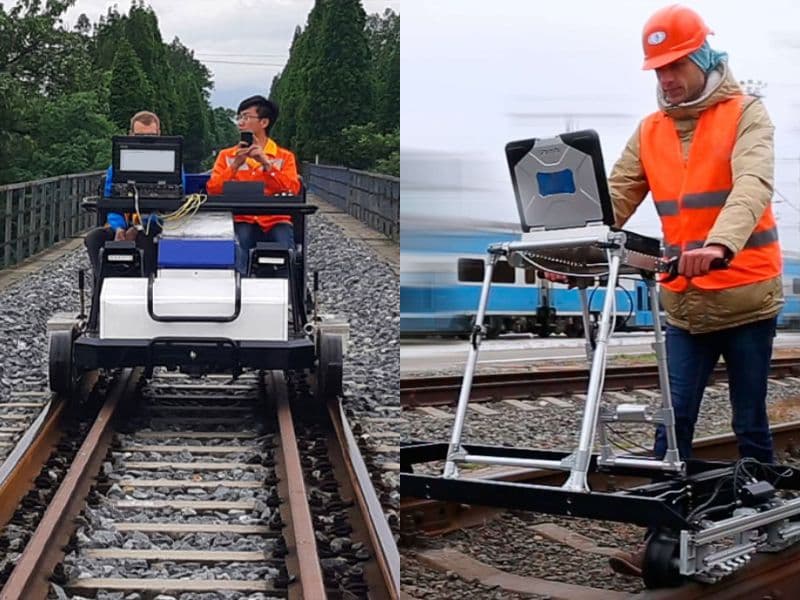
Mobile inspection vehicles, also called ultrasonic test cars, are equipped with multiple sensors and computer systems that scan the track while moving at moderate speeds. They are ideal for covering long distances quickly and are widely used by railway authorities in Europe, the US, and Asia.
For shorter track sections or difficult-to-reach areas, handheld ultrasonic devices and portable scanners allow technicians to conduct detailed inspections on-site. These compact tools provide flexibility and real-time feedback, making them indispensable for targeted maintenance.
Examples of Leading Detection Systems
Several manufacturers have developed world-class railway track inspection technology, including:
- ENSCO URFS (Ultrasonic Rail Flaw System): Used across major rail networks for automated defect detection.
- OKOndt Group Systems: Offer advanced portable ultrasonic solutions for weld and rail flaw testing.
- GE RailScan Systems: Known for precision scanning and data management integration.
These systems continue to evolve, enhancing speed, accuracy, and data interpretation. But the next wave of innovation takes this even further, combining ultrasonic precision with artificial intelligence and predictive analytics.
Advances in Railway Track Inspection Technology
Technology in the rail industry is advancing at record speed. Modern railway track inspection technology now integrates artificial intelligence, advanced sensors, and real-time analytics to push the limits of accuracy and efficiency.
These innovations make inspections faster, smarter, and more reliable, reducing human error and improving predictive maintenance.
Integration of AI and Data Analytics
AI-driven algorithms can now interpret ultrasonic data more accurately than ever before. By analysing vast amounts of signal data, AI systems can:
- Automatically identify and classify different types of rail defects.
- Reduce false positives and missed flaws.
- Predict defect growth and estimate maintenance needs.
This automation allows railway operators to make quicker, data-backed decisions, significantly improving safety outcomes. AI also enables centralised data storage, making it easier to track rail performance over time.
Phased Array and Guided-Wave Ultrasonic Methods
Traditional ultrasonic testing has evolved with newer techniques like Phased Array Ultrasonic Testing (PAUT) and Guided-Wave Ultrasonic Testing (GWUT).
- Phased Array UT: Uses multiple elements to steer and focus sound beams, generating 3D images of internal structures. This helps identify complex cracks and weld flaws with greater precision.
- Guided-Wave UT: Sends sound waves along the rail’s length, allowing large sections to be inspected from a single location. It’s particularly useful for detecting corrosion and long-distance defects.
These advanced ultrasonic methods not only increase accuracy but also reduce inspection time, improving the overall efficiency of rail maintenance programmes.
Continuous Rail Monitoring and Digital Data Systems
Another major step forward is the shift towards continuous rail monitoring. Sensors installed along the track can collect data around the clock, detecting early signs of degradation. The results are stored digitally, allowing for trend analysis and predictive maintenance planning.
Rail operators can now:
- Access historical inspection records instantly.
- Compare past and current readings to monitor defect progression.
- Schedule maintenance proactively based on data insights.
With continuous monitoring and digital analytics, railway systems are becoming more intelligent and self-sustaining, ensuring safer journeys for passengers and freight alike.
Rail Flaw Detection Systems and Equipment
As railway networks expand and train speeds increase, the demand for efficient and accurate inspection methods grows stronger. Ultrasonic Rail Flaw Detection systems have become the cornerstone of global railway safety, offering continuous and precise evaluation of rail health.
These systems combine cutting-edge hardware and intelligent software to ensure no defect goes unnoticed, even those invisible to traditional inspection methods.
Overview of Ultrasonic Rail Flaw Detection Systems
Across the world, rail operators rely on ultrasonic testing for rails to identify defects before they cause serious incidents. These systems transmit ultrasonic waves through the rail to detect internal discontinuities and flaws. The reflected signals are then analysed in real time to pinpoint defects with remarkable accuracy.
There are two main approaches:
- Manual or Semi-Automated Systems: Used for targeted inspections, often during scheduled maintenance.
- Fully Automated Detection Systems: Mounted on inspection vehicles that scan large rail sections at high speed, producing instant results for maintenance crews.
Together, these technologies form the backbone of modern rail flaw detection systems, improving both safety and operational efficiency.
Key Components of Ultrasonic Inspection Systems
Each system relies on several essential components that work in harmony to detect and interpret flaws:
- Probes and Transducers: Convert electrical energy into ultrasonic waves that travel through the rail
- Couplants: Gels or liquids applied between the probe and the rail surface to improve wave transmission.
- Data Processors: Capture and analyse the reflected signals, identifying anomalies that indicate flaws.
- Signal Displays and Software: Present visual data outputs such as A-scans and B-scans, showing the flaw’s depth and location.
Together, these components make it possible to identify even microscopic defects, ensuring proactive maintenance and preventing potential failures.
Mobile and Portable Testing Equipment
Mobile inspection vehicles, also called ultrasonic test cars, are equipped with multiple sensors and computer systems that scan the track while moving at moderate speeds. They are ideal for covering long distances quickly and are widely used by railway authorities in Europe, the US, and Asia.
For shorter track sections or difficult-to-reach areas, handheld ultrasonic devices and portable scanners allow technicians to conduct detailed inspections on-site. These compact tools provide flexibility and real-time feedback, making them indispensable for targeted maintenance.
Examples of Leading Detection Systems
Several manufacturers have developed world-class railway track inspection technology, including:
- ENSCO URFS (Ultrasonic Rail Flaw System): Used across major rail networks for automated defect detection.
- OKOndt Group Systems: Offer advanced portable ultrasonic solutions for weld and rail flaw testing.
- GE RailScan Systems: Known for precision scanning and data management integration.\
These systems continue to evolve, enhancing speed, accuracy, and data interpretation. But the next wave of innovation takes this even further, combining ultrasonic precision with artificial intelligence and predictive analytics.
So, what does the future of rail inspection look like when data, AI, and ultrasonic testing unite? Let’s find out.
Advances in Railway Track Inspection Technology
Technology in the rail industry is advancing at record speed. Modern railway track inspection technology now integrates artificial intelligence, advanced sensors, and real-time analytics to push the limits of accuracy and efficiency. These innovations make inspections faster, smarter, and more reliable, reducing human error and improving predictive maintenance.
Integration of AI and Data Analytics
AI-driven algorithms can now interpret ultrasonic data more accurately than ever before. By analysing vast amounts of signal data, AI systems can:
- Automatically identify and classify different types of rail defects.
- Reduce false positives and missed flaws.
- Predict defect growth and estimate maintenance needs.
This automation allows railway operators to make quicker, data-backed decisions, significantly improving safety outcomes. AI also enables centralised data storage, making it easier to track rail performance over time.
Phased Array and Guided-Wave Ultrasonic Methods
Traditional ultrasonic testing has evolved with newer techniques like Phased Array Ultrasonic Testing (PAUT) and Guided-Wave Ultrasonic Testing (GWUT).
- Phased Array UT: Uses multiple elements to steer and focus sound beams, generating 3D images of internal structures. This helps identify complex cracks and weld flaws with greater precision.
- Guided-Wave UT: Sends sound waves along the rail’s length, allowing large sections to be inspected from a single location. It’s particularly useful for detecting corrosion and long-distance defects.
These advanced ultrasonic methods not only increase accuracy but also reduce inspection time, improving the overall efficiency of rail maintenance programmes.
Continuous Rail Monitoring and Digital Data Systems
Another major step forward is the shift towards continuous rail monitoring. Sensors installed along the track can collect data around the clock, detecting early signs of degradation. The results are stored digitally, allowing for trend analysis and predictive maintenance planning.
Rail operators can now:
- Access historical inspection records instantly.
- Compare past and current readings to monitor defect progression.
- Schedule maintenance proactively based on data insights
With continuous monitoring and digital analytics, railway systems are becoming more intelligent and self-sustaining, ensuring safer journeys for passengers and freight alike.
Conclusion
Rail safety depends on more than just strong steel and careful construction, it relies on the ability to detect the invisible. Ultrasonic Rail Flaw Detection has revolutionised how railway networks maintain their tracks, offering unmatched precision in uncovering defects hidden deep within the metal.
By harnessing the power of ultrasonic non-destructive testing (NDT), engineers can now prevent accidents before they happen, ensuring smoother, safer, and more reliable journeys.
From advanced probes and mobile inspection vehicles to AI-driven analysis and continuous monitoring, railway track inspection technology has reached new levels of accuracy and efficiency.
The integration of ultrasonic testing for rails into daily maintenance routines doesn’t just save time and money, it saves lives. As innovation continues, the rail industry moves closer to a future where predictive maintenance and real-time flaw detection become standard practice across every network.
In essence, the path forward for railway safety lies not in reacting to failures, but in anticipating them. With ongoing advancements in rail flaw detection systems, ultrasonic inspection remains at the heart of that mission, listening beneath the surface to protect what truly matters: the safety and reliability of every rail journey.
Key Points
- Ultrasonic Rail Flaw Detection is a precision-based method that uses high-frequency sound waves to locate hidden internal defects in railway tracks without causing damage.
- Common rail defects include internal cracks, head checks, weld flaws, and corrosion, all of which can lead to derailments and costly repairs if left undetected.
- Defects are mainly caused by heavy loads, thermal stress, metal fatigue, and poor maintenance, which gradually weaken the rail’s structure over time.
- Ultrasonic Non-Destructive Testing (NDT) allows engineers to detect flaws deep inside the rail, making it more effective than magnetic or visual inspection methods.
- Rail flaw detection systems combine probes, transducers, couplants, and data processors to capture and interpret sound wave reflections from internal cracks or voids.
- Mobile inspection vehicles and handheld ultrasonic devices enable both large-scale and targeted rail inspections, providing real-time, accurate results.
- Leading global technologies like ENSCO URFS, OKOndt, and GE RailScan systems deliver automated and precise flaw detection for rail operators worldwide.
- Recent advancements include the integration of AI and data analytics, which help classify defects automatically, reduce false readings, and predict future maintenance needs.
- Innovative ultrasonic methods such as Phased Array Ultrasonic Testing (PAUT) and Guided-Wave UT allow for deeper inspection coverage and faster flaw identification.
- The future of railway safety lies in continuous rail monitoring and predictive maintenance, supported by digital data systems and ultrasonic precision technologies.
FAQs
How do mobile inspection vehicles and handheld devices compare?
Mobile inspection vehicles (detector cars) can scan long stretches of track quickly and continuously, often while moving. Handheld or portable devices (trolleys, carts) are useful for targeted inspections, tight spots, verification, or areas where large vehicles can’t reach. Together, they provide flexible coverage across different rail environments.
How often should rail inspection using ultrasonic methods be done?
The inspection interval depends on rail usage, traffic load, and risk profile. Higher-use or critical lines may require more frequent inspections. A risk-based approach is common, rails with heavier loads or known defects get inspected more often.
Can data from ultrasonic rail inspections predict future failures?
Yes. Modern systems store detailed defect data over time. When combined with trend analysis and AI, operators can monitor how defects evolve and forecast when maintenance will be needed before a failure occurs.