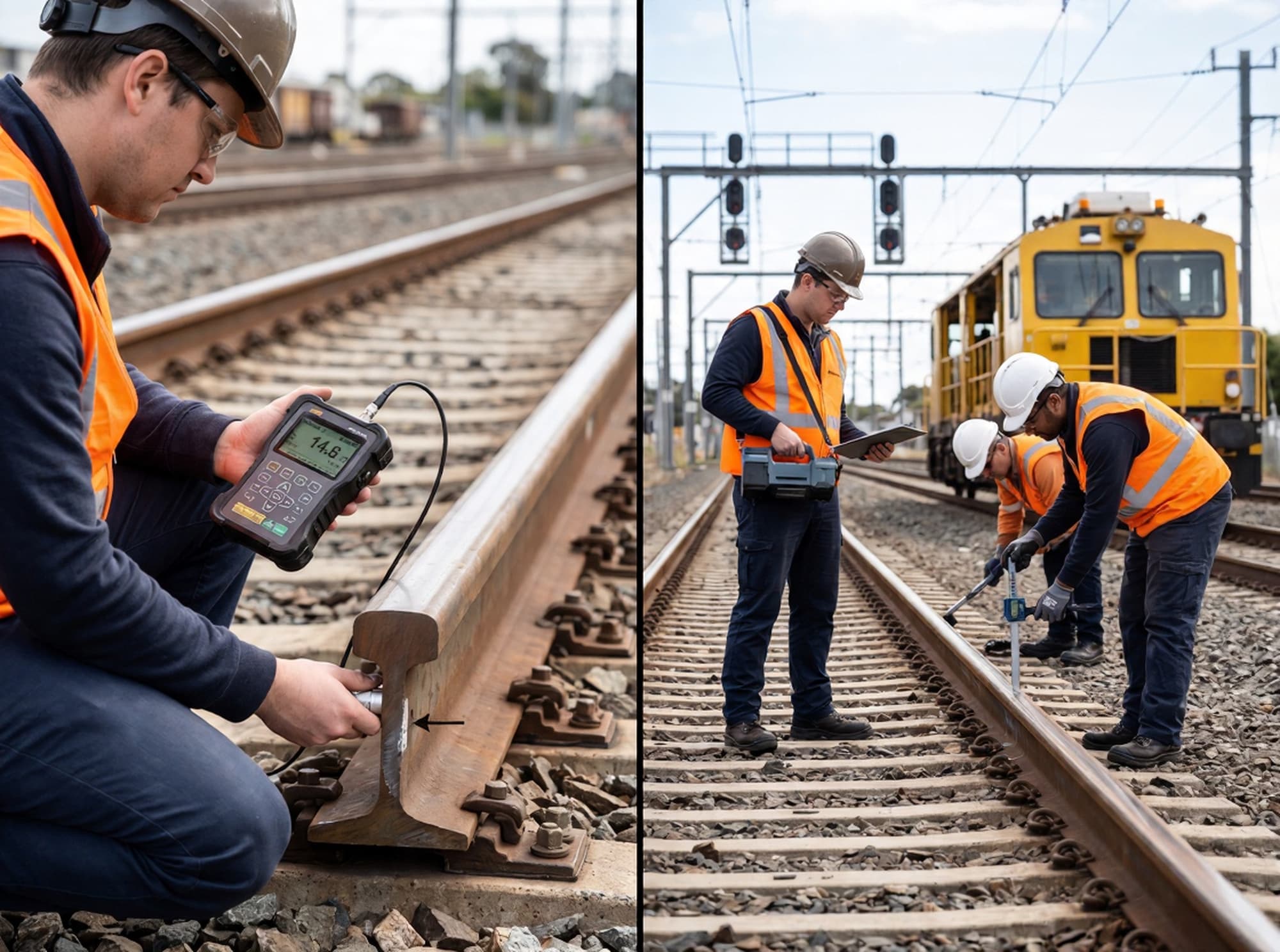
Railway safety depends heavily on tools like the ultrasonic thickness gauge, which plays a critical role in detecting hidden structural weaknesses. An ultrasonic thickness gauge allows engineers to measure internal rail conditions without damaging the track. In modern rail maintenance, the ultrasonic thickness gauge has become essential for identifying early signs of wear that could otherwise go unnoticed.
Across global railway networks, rail failures continue to raise concerns among safety authorities. Studies show that a significant percentage of derailments occur due to internal defects rather than visible damage. These failures often develop silently inside the rail structure, making them difficult to detect using traditional inspection methods.
Rail infrastructure carries massive loads daily. Freight trains, high-speed passenger systems, and urban transit lines all depend on the integrity of steel rails. Even a small reduction in thickness within a critical section can compromise safety. This is where precise, non-destructive measurement techniques become indispensable.
Our article explores the concept of rail web thickness, explains how measurement tools function, and highlights when and why these inspections matter. It also aligns with structured industry practices outlined in , ensuring both safety and compliance remain at the forefront.
What Is Rail Web Thickness and Why Does It Matter?
Rail web thickness refers to the vertical section of a rail that connects the head and the foot. This part may look simple, but it plays a crucial role in maintaining structural strength. It carries shear forces and distributes loads across the rail profile.
Every passing train applies pressure, vibration, and stress to this section. Over time, repeated loading weakens the material. Environmental factors like moisture, temperature changes, and corrosion accelerate this process.
The real challenge lies in visibility. Unlike the rail head, which shows wear on the surface, the web often deteriorates internally. Cracks, corrosion, and thinning can develop without any external signs.
When the web loses thickness, the entire rail becomes vulnerable. It may not fail immediately, but its ability to withstand stress reduces significantly. This creates a dangerous situation where failure can occur suddenly under heavy load.
The consequences of ignoring rail web thinning can be severe:
- Stress fractures develop due to repeated loading cycles
- Sudden rail collapse becomes a real possibility
- Maintenance costs increase due to emergency repairs
- Safety regulations may be violated, leading to penalties
Railway operators cannot afford to overlook these risks. Even a minor defect in the web can escalate into a major failure if left undetected. This is why accurate measurement methods are essential.
What Is the Thickness of Rail Track?
The thickness of a rail track varies depending on its design, but the rail web typically ranges between 13 mm and 16 mm in standard profiles.
Rail tracks consist of three main parts: the head, the web, and the foot. Each section serves a distinct purpose. The head supports the train wheels, the foot stabilizes the rail, and the web connects both while carrying internal stress.
Different rail profiles are used across the world. These profiles vary based on load requirements, speed, and operational conditions. Below is a simplified comparison of common rail types:
| Rail Profile | Typical Web Thickness |
| UIC 60 | ~16 mm |
| 54E1 | ~14–15 mm |
| 49E1 | ~13–14 mm |
Railway authorities define acceptable wear limits for each profile. Once the thickness drops below these limits, the rail is considered unsafe. Replacement or repair becomes mandatory.
These limits are not fixed globally. High-speed rail systems often require tighter tolerances. Freight-heavy routes may allow slightly higher wear but demand frequent inspections.
It is also important to consider operational conditions. Rails exposed to coastal environments or heavy industrial use may deteriorate faster. This makes regular measurement even more critical.
While these numbers provide a baseline, they do not guarantee safety on their own. Accurate measurement techniques are needed to ensure the rail remains within safe limits.
How Does an Ultrasonic Thickness Gauge Work on Rail Webs?
An ultrasonic thickness gauge operates using sound waves to measure material thickness. It sends high-frequency ultrasonic pulses into the rail. These pulses travel through the metal and reflect back when they hit a boundary.
The device calculates thickness based on the time taken for the echo to return. This method allows engineers to measure internal conditions without cutting or damaging the rail.
The ultrasonic thickness gauge proves especially useful in rail inspection because it detects internal defects. Visual inspections often fail to identify issues like internal corrosion or fatigue cracks. Ultrasonic testing fills this gap.
Railways operate under constant stress. Over time, this stress creates micro-cracks within the material. These cracks may not appear on the surface but can weaken the structure significantly. The ultrasonic thickness gauge helps identify such hidden risks.
Another advantage lies in accuracy. The device provides precise measurements even in challenging environments. This makes it suitable for both routine inspections and emergency assessments.
Key Components of an Ultrasonic Thickness Gauge
A typical ultrasonic thickness gauge consists of several important components:
- Transducer or Probe
This component sends and receives ultrasonic waves. It plays a central role in measurement accuracy. - Couplant Gel
The gel ensures proper transmission of sound waves from the probe into the rail surface. - Digital Display
This shows real-time thickness readings, allowing inspectors to make quick decisions. - Data Logger
It stores measurements for later analysis, helping track changes over time.
Different probes serve different purposes. Single-element probes work well on flat surfaces. Dual-element probes perform better on curved or uneven rail sections.
Calibration is another key factor. Engineers must calibrate the ultrasonic thickness gauge based on the rail material. Different steel compositions require different calibration settings.
Knowing how the tool works is one thing but knowing exactly when to deploy it in a rail maintenance schedule is what separates reactive repairs from proactive safety. That question gets answered next.
When Should Rail Web Thickness Measurements Be Taken?
Rail web thickness measurements should be taken regularly and under specific conditions that increase risk.
Routine inspections form the foundation of rail maintenance. Many railway operators conduct these inspections annually or semi-annually. However, relying solely on schedules may not be enough.
Certain conditions demand immediate measurement using an ultrasonic thickness gauge:
- Extreme weather events like floods or freezing temperatures
- Post-derailment or near-miss incidents
- Visible corrosion, pitting, or surface cracks
- High-tonnage freight routes exceeding design limits
These situations accelerate wear and increase the likelihood of internal damage. Ignoring them can lead to sudden failures.
Timing plays a critical role in rail safety. Early detection allows maintenance teams to address issues before they become severe. This reduces downtime and prevents costly repairs.
Proactive inspection strategies also improve operational efficiency. Rail operators can plan maintenance activities rather than reacting to emergencies.
Using an ultrasonic thickness gauge at the right time ensures that hidden defects are identified early. This approach supports long-term infrastructure reliability.
Why Is It Necessary to Determine Gauge Clearance Measurements?
Gauge clearance measurements are necessary because they ensure proper spacing between rails, which is critical for safe train operation.
Rail gauge refers to the distance between the inner sides of two rails. Maintaining this distance is essential for stability and alignment. Even small deviations can lead to serious safety issues.
The condition of the rail web directly affects gauge stability. As the web thins, the rail loses lateral strength. This makes it harder to maintain the correct spacing under load.
Engineers often combine gauge clearance checks with ultrasonic thickness gauge inspections. This provides a complete view of rail condition.
Regulatory bodies require these measurements as part of safety compliance. Organizations like the FRA and UIC set strict standards for gauge limits.
Ignoring gauge clearance can result in misalignment, uneven wear, and increased stress on rolling stock. Over time, this can lead to derailments or structural failure.
Railway safety depends on a combination of accurate measurements and timely action. Gauge clearance measurement plays a key role in this process.
Bridging Toward Smarter Rail Safety
Rail web thickness measurement stands as a critical element in modern railway safety systems. It helps identify hidden defects, ensures compliance with safety standards, and supports long-term infrastructure planning.
The ultrasonic thickness gauge continues to serve as a reliable tool for non-destructive testing. It allows engineers to detect problems early and take corrective action before failures occur.
However, measurement alone is not enough. The real value lies in how the data is used. Inspection results must be recorded, analyzed, and integrated into maintenance strategies.
And that raises an important question, how do global standards, advanced tools, and digital systems come together to transform rail inspection into a smarter, data-driven process? The next part explores exactly that.
Advancing Rail Safety Through Precision and Data
Railway inspection does not end with basic measurement. It evolves into a structured system where standards, tools, and data work together. The ultrasonic thickness gauge continues to serve as a central element in this system, helping engineers move from simple detection to predictive safety strategies.
Rail networks today operate under increasing pressure. Higher speeds, heavier loads, and aging infrastructure create new challenges. These challenges demand more than routine inspections. They require a deeper understanding of how rail components behave over time.
The ultrasonic thickness gauge supports this shift by providing accurate, repeatable data. This data allows engineers to track wear patterns and predict failures before they occur. As railway systems expand, this capability becomes even more critical.
Industry Standards That Govern Rail Web Thickness Inspection
Railway safety relies heavily on global standards. These standards define how inspections should be conducted and what limits must be maintained.
Organizations like the International Union of Railways, AREMA, and European regulatory bodies provide detailed guidelines. These guidelines ensure consistency across different railway systems.
Each standard focuses on specific aspects of rail performance. Some emphasize manufacturing tolerances, while others focus on operational safety and inspection frequency. Together, they create a comprehensive framework.
Rail systems must follow these standards to maintain safety. Failure to comply can result in operational shutdowns or penalties.
Below is a simplified overview of key standards:
| Standards Body | Region | Key Focus |
| UIC Code | Global | Rail inspection and maintenance |
| AREMA | USA | Freight rail safety |
| EN Standards | Europe | Rail production and quality |
| Network Rail | UK | Operational inspection protocols |
Different rail systems require different approaches. High-speed rail networks demand stricter inspection intervals. Freight lines, on the other hand, focus more on load-bearing capacity.
Minimum web thickness limits vary depending on these standards. Inspectors must ensure that rails do not fall below these limits.
The ultrasonic thickness gauge plays a vital role here. It provides the accurate data needed to confirm compliance with these standards.
Rail operators who fail to meet these requirements risk serious consequences. Safety incidents, financial losses, and reputational damage can all result from non-compliance.
Standards define what is acceptable but they do not guarantee accuracy. That responsibility falls on the tools used during inspection. So, what makes one measurement device more reliable than another?
Choosing the Right Ultrasonic Thickness Gauge for Rail Inspection
Selecting the right ultrasonic thickness gauge is critical for effective rail inspection. Not all devices are suitable for harsh railway environments.
Rail inspection involves exposure to dirt, moisture, vibration, and temperature changes. Equipment must perform reliably under these conditions.
A high-quality ultrasonic thickness gauge ensures accurate readings even in challenging situations. This reduces the risk of errors that could compromise safety.
Features to Prioritize
Several features determine the effectiveness of an ultrasonic thickness gauge:
- Appropriate Frequency Range
Devices operating within 2–10 MHz are ideal for steel rail measurements. - A-Scan Capability
This feature allows inspectors to verify signal accuracy and detect anomalies. - Durability
Rugged construction and high IP ratings protect the device in field conditions. - Data Storage and Connectivity
Modern devices offer USB or wireless data transfer for easier reporting. - Temperature Compensation
This ensures accurate readings despite environmental changes.
Handheld devices remain widely used due to their portability. However, automated systems are becoming more common. These systems scan large sections of track efficiently.
The ultrasonic thickness gauge must match the inspection environment. High-speed rail systems often require advanced solutions. Smaller rail networks may rely on simpler tools.
Training also plays a key role. Even the best device can produce inaccurate results if used incorrectly. Proper calibration and handling are essential.
Choosing the right equipment ensures reliable measurements. But even with the best tools, inspectors face several challenges in real-world conditions.
Common Challenges in Rail Web Thickness Measurement
Rail web thickness measurement is not always straightforward. Inspectors encounter various challenges during field operations.
One major challenge is surface contamination. Dirt, rust, and grease can interfere with ultrasonic signals. This affects the accuracy of measurements.
Another issue is the curved shape of rail surfaces. Standard probes may not maintain proper contact. This makes it difficult to obtain consistent readings.
Access limitations also create difficulties. Inspectors often work in confined spaces like tunnels or bridges. These environments restrict movement and visibility.
Environmental factors add another layer of complexity. Temperature changes can affect material properties and measurement results.
To address these challenges, inspectors follow specific best practices:
- Clean the rail surface before taking measurements
- Use specialized probes for curved or uneven surfaces
- Apply proper couplant to improve signal transmission
- Calibrate the ultrasonic thickness gauge regularly
- Use extension tools in restricted areas
These practices help ensure reliable results. However, challenges still exist, especially in large rail networks.
The ultrasonic thickness gauge remains effective despite these obstacles. Its accuracy and versatility make it a preferred choice for rail inspection.
Still, measurement alone is not enough. The real value lies in how the collected data is managed and used.
The Role of Digital Data Logging in Rail Safety Programs
Modern railway systems rely on data-driven decision-making. Digital data logging has transformed how inspections are conducted and analyzed.
Today’s ultrasonic thickness gauge devices can store hundreds of readings. Many models also include location tracking features. This allows inspectors to map measurements across the rail network.
Data logging provides valuable insights over time. Engineers can identify trends and predict future wear patterns. This supports preventive maintenance strategies.
Predictive maintenance reduces unexpected failures. Instead of reacting to damage, operators can plan repairs in advance.
Integration with asset management systems further enhances efficiency. Inspection data can be linked to maintenance schedules and operational records.
Digital records also support compliance with safety regulations. Authorities often require detailed inspection reports. Stored data provides clear documentation.
The ultrasonic thickness gauge plays a key role in this digital transformation. It not only measures thickness but also contributes to long-term safety planning.
However, even with advanced systems in place, the consequences of missed inspections remain severe.
Real-World Impact: What Happens When Measurements Are Missed
Railway accidents often highlight the importance of proper inspection. Many incidents occur due to undetected internal defects.
Investigations frequently reveal that rail web thinning went unnoticed. In such cases, an ultrasonic thickness gauge could have identified the issue early.
The impact of these failures is significant. Derailments can cause injuries, loss of life, and major financial losses.
Operational disruptions also affect passengers and freight services. Repairing damaged infrastructure takes time and resources.
Experts consistently emphasize the importance of preventive maintenance. Regular inspections reduce risks and improve reliability.
The cost of inspection is minimal compared to the cost of failure. Investing in proper tools and procedures is essential for safe operations.
Rail operators who prioritize measurement and monitoring achieve better outcomes. They reduce risks and maintain consistent performance.
Final Thoughts
Rail web thickness measurement remains a critical pillar of modern railway safety, ensuring that hidden structural weaknesses are identified before they lead to failure. The ultrasonic thickness gauge enables accurate, non-destructive evaluation of rail integrity, allowing engineers to detect internal corrosion and fatigue early. By integrating the ultrasonic thickness gauge into regular maintenance schedules, railway operators can move from reactive repairs to proactive safety management. This approach not only reduces the risk of derailments but also improves long-term infrastructure reliability.
As rail networks continue to evolve under increasing load demands, the role of the ultrasonic thickness gauge becomes even more essential. It supports compliance with global standards, enhances inspection accuracy, and strengthens overall track performance. Ultimately, consistent use of the ultrasonic thickness gauge ensures safer rail operations, minimizes costly disruptions, and protects both passengers and freight systems across the network.
Key Takeaways
- Rail web thickness is a critical structural factor that directly influences overall railway track safety and performance.
- Internal rail defects often remain hidden, making advanced inspection tools essential for accurate detection.
- The ultrasonic thickness gauge enables non-destructive testing, allowing engineers to assess internal rail conditions effectively.
- Regular inspections using the ultrasonic thickness gauge help identify early-stage corrosion and fatigue damage.
- Proactive maintenance strategies significantly reduce the risk of unexpected rail failures and costly repairs.
- Global railway standards define strict limits for acceptable rail wear and inspection frequency requirements.
- Selecting the right ultrasonic thickness gauge ensures consistent, reliable measurements even in harsh field environments.
- Gauge clearance measurements complement thickness inspections to maintain proper rail alignment and stability.
- Digital data logging allows engineers to track wear trends and plan predictive maintenance activities efficiently.
- Consistent inspection practices improve operational safety, extend rail lifespan, and enhance long-term infrastructure reliability.
FAQs
What is the measurement of railway track?
The measurement of a railway track mainly refers to the distance between the inner sides of the two rails, known as the gauge. Standard gauge measures 1435 mm, while other gauges vary depending on region and application. Along with gauge, rail components like the web, head, and foot also have defined thickness ranges that ensure structural safety.
What is 1000 mm gauge railway?
A 1000 mm gauge railway is known as a metre gauge track. It is narrower than the standard gauge and is commonly used in regions where construction costs need to be lower or where terrain conditions require tighter curves. These systems still require proper rail thickness monitoring to maintain safety.
What are the three types of railway tracks?
The three main types of railway tracks are standard gauge, broad gauge, and narrow gauge. Each type is designed for different operational needs, like speed, load capacity, and terrain adaptability. Regardless of the type, maintaining rail integrity through thickness inspection remains essential.
Why are rails 4 ft 8.5 inches?
Rails are set at 4 feet 8.5 inches (1435 mm) because this standard gauge offers an optimal balance between stability, speed, and construction efficiency. It has become the most widely used gauge worldwide due to its proven performance in both passenger and freight systems.
What is 90 UTS rail?
90 UTS rail refers to rail steel with an ultimate tensile strength of 90 tons per square inch. This indicates the material’s ability to withstand high stress before failure. Such rails are commonly used in heavy-duty applications, where monitoring internal wear using advanced inspection methods is crucial for safety.