
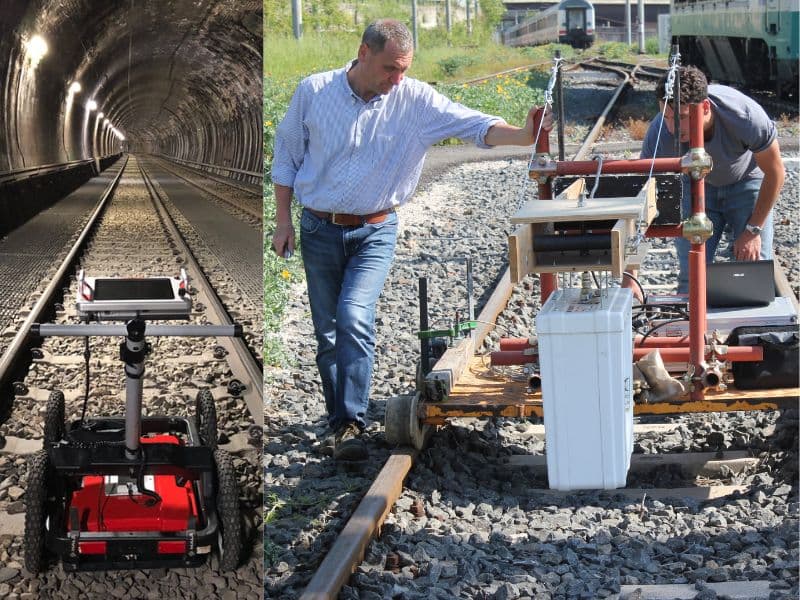
Railway networks are the backbone of modern transportation, yet the most critical issues often lie hidden beneath the tracks. GPR in railway has emerged as a powerful solution, allowing engineers to see what the eye cannot, subsurface conditions that directly affect safety and performance.
By sending electromagnetic waves into the track bed and analyzing the reflections, Ground Penetrating Radar (GPR) provides a fast, non-destructive method of assessing railway infrastructure.
In this article, we’ll explore how GPR works in the railway sector, its key applications like railway subsurface imaging, ballast condition monitoring, and track bed inspection, and why it’s becoming an essential tool for maintenance teams.
You’ll also learn about the advantages, limitations, real-world applications, and future innovations in railway GPR testing. Whether you’re a railway professional, researcher, or simply curious about the technology, this guide will give you a clear understanding of why GPR is transforming railway maintenance.
How GPR Works in Railway Applications
At its foundation, GPR in railway is based on the behavior of electromagnetic waves. Ground Penetrating Radar transmits high-frequency radio signals into the railway track bed. When these waves encounter materials with different dielectric properties, such as ballast, sub-ballast, or soil they bounce back to the receiver.
The time it takes for these reflections to return, and the strength of the signals, allow engineers to interpret what lies beneath the tracks. This process converts invisible subsurface conditions into data that can be analyzed and transformed into clear images, revealing both the structure and potential weaknesses of the railway foundation.
Equipment Setup: Antennas, Train-Mounted Systems, and Data Collection
Carrying out railway GPR testing requires the right combination of equipment. Antennas are at the heart of the system, and their frequency determines both the depth and the resolution of the scan. Low-frequency antennas can penetrate deeper layers of the track structure but provide less detail, while high-frequency antennas offer sharper resolution at shallower depths.
For railway applications, these antennas are often mounted on moving platforms such as inspection trains or specialized trolleys. This setup allows long stretches of track to be scanned quickly without interrupting train services.
The collected reflections are recorded by data loggers and later processed with advanced software, creating layered images that highlight the condition of ballast, subgrade, and drainage systems. With this setup, railway operators gain real-time insights that were once impossible to obtain without disruptive and costly excavation.
As powerful as this technology is, its true impact becomes clear when we examine how it is applied in maintaining and monitoring railway infrastructure.
Key Uses of GPR in Railway Infrastructure
The value of GPR in railway goes far beyond simply detecting what lies beneath the tracks. Its applications touch every layer of the railway system, from the ballast that supports the sleepers to the deeper subgrade and drainage channels that ensure long-term stability.
By delivering accurate subsurface imaging, GPR helps engineers make smarter maintenance decisions, reduce unexpected failures, and extend the service life of track components. Let’s explore some of the most important areas where this technology is applied.
Railway Track Bed Inspection
The track bed is a critical component of railway stability, and its deterioration often leads to costly failures or safety risks. With ground penetrating radar railway technology, engineers can inspect the thickness and quality of ballast and subgrade layers without digging.
GPR helps detect issues such as settlement, voids, and water infiltration, problems that weaken the foundation and affect ride quality. By providing a continuous profile of the track bed, GPR enables maintenance teams to schedule interventions before small defects turn into major disruptions.
Ballast Condition Monitoring with GPR
Ballast plays an essential role in providing strength and drainage for the track. Over time, however, it becomes fouled with fine particles, moisture, and debris, reducing its effectiveness.
Ballast condition monitoring with GPR helps railway engineers evaluate the state of ballast by identifying clean versus fouled areas. The data can also reveal moisture levels that compromise stability. With this information, maintenance teams can target ballast cleaning or replacement only where it is truly needed, reducing costs and extending the lifespan of the material.
Railway Subsurface Imaging for Defects and Drainage Issues
Beyond ballast and track bed thickness, railway subsurface imaging allows for the detection of deeper issues that threaten long-term stability. GPR can reveal defects such as ballast pockets, mud pumping zones, and inadequate drainage systems.
These conditions often remain hidden until they cause visible damage, but with GPR, they can be spotted early and addressed proactively. Detecting drainage issues is especially valuable, as poor water management is one of the leading causes of track degradation worldwide.
By covering everything from ballast quality to subsurface defects, GPR in railway proves to be more than just an inspection tool, it is a technology that enables predictive maintenance and smarter asset management.
Railway GPR Testing Methods
Before railway operators can fully rely on Ground Penetrating Radar results, consistent testing methods must be in place. Railway GPR testing involves both field applications and controlled studies that ensure accuracy, repeatability, and meaningful interpretation of the data.
Field Surveys and Laboratory Calibration
In real-world practice, field surveys are carried out using train-mounted or trolley-based GPR systems to scan long stretches of track. These surveys provide a continuous profile of the track bed and ballast conditions under operational environments. To validate the accuracy of these readings, laboratory calibration is often performed.
Controlled tests on ballast samples, with varying levels of fouling or moisture, help researchers understand how specific conditions influence GPR signals. Together, field data and lab calibration create a reliable framework for interpreting results.
Data Acquisition and Processing Techniques
Collecting reflections is just the first step, making sense of the data is equally important. GPR systems record massive amounts of information, which are then processed using advanced software.
Engineers analyze the time, strength, and pattern of reflections to distinguish between ballast, sub-ballast, and subgrade. Techniques such as signal filtering, migration, and layer detection help create clear images of the subsurface. Increasingly, automated algorithms and machine learning are being applied to speed up this interpretation and reduce human error.
Standards and Testing Protocols
Consistency is vital in railway maintenance, which is why international guidelines and testing protocols are being developed for ground penetrating radar railway inspections. Standards define antenna frequency ranges, data collection spacing, calibration requirements, and reporting formats.
Following these protocols ensures that results are comparable across different railway networks and inspection teams. As adoption of GPR grows worldwide, these standards are becoming essential for making GPR a recognized part of routine railway inspections.
While these methods define how GPR is applied, its real strength comes from the benefits it offers railway operators. That’s where the advantages of GPR in railways truly stand out.
Advantages of GPR in Railways
Implementing GPR in railway maintenance has transformed the way engineers approach inspection and monitoring. Unlike traditional methods that often involve disruptive excavation or slower manual checks, GPR offers a faster, more reliable, and non-invasive solution.
Non-Destructive and Efficient
One of the greatest benefits of GPR is that it’s completely non-destructive. Engineers can scan entire sections of track without removing ballast or halting train operations.
Mounted systems allow for inspections at normal train speeds, making large-scale surveys both cost-effective and time-efficient. This efficiency means maintenance decisions can be based on up-to-date information gathered with minimal disruption.
Detects Hidden Defects Early
Many of the most dangerous railway problems develop out of sight, drainage issues, ballast fouling, or subgrade weaknesses. GPR excels at detecting these hidden defects long before they manifest as surface-level failures. By identifying trouble spots early, operators can prioritize repairs and prevent costly or catastrophic incidents.
Supports Predictive Maintenance
Perhaps the most strategic advantage is the role of GPR in predictive maintenance. Instead of reacting to failures, railway teams can use GPR data to forecast where problems are likely to occur.
This proactive approach not only enhances safety but also reduces overall maintenance costs. Predictive maintenance strategies informed by GPR extend asset lifespans and allow operators to allocate resources more effectively.
From non-destructive inspections to predictive planning, the benefits of GPR are clear. Yet, like any technology, it also has its challenges and limitations, issues that must be addressed to maximize its effectiveness.
Challenges and Limitations
While GPR in railway offers clear advantages, it is not without challenges. Engineers must balance technical trade-offs, manage environmental influences, and weigh costs against benefits. Understanding these limitations is key to applying the technology effectively.
Penetration vs. Resolution Trade-Offs
A fundamental challenge with railway GPR testing is choosing the right antenna frequency. Low-frequency antennas penetrate deeper into the subgrade but sacrifice detail, while high-frequency antennas offer sharper images at shallower depths.
This trade-off means that no single setup is perfect for every inspection. Engineers often have to compromise between depth and resolution, or even combine systems to get the most accurate results.
Interpretation Complexity and Environmental Influences
Another limitation lies in the complexity of interpreting GPR data. Reflections can be affected by moisture, temperature, and even seasonal changes in the track bed. Wet ballast, for example, can produce signals that look similar to fouling, making results harder to analyze.
Without proper calibration and expert interpretation, there is a risk of misdiagnosis. This is why railway subsurface imaging often requires both automated software and trained specialists to deliver accurate insights.
Cost and Need for Skilled Operators
Although costs have decreased with technological advances, GPR systems still represent a significant investment. High-quality antennas, train-mounted setups, and specialized software are not inexpensive.
In addition, skilled operators and data analysts are needed to set up surveys and interpret results correctly. This combination of equipment and expertise makes GPR adoption a challenge for smaller railway networks or those with limited budgets.
Despite these challenges, the potential of GPR continues to expand. Advances in speed, integration, and predictive analytics point to an exciting future for this technology in railways.
Future of GPR in Railway Maintenance
The evolution of ground penetrating radar railway applications is shaping the next generation of track monitoring and maintenance. As the technology matures, it is becoming faster, smarter, and more integrated into broader asset management systems.
High-Speed Inspection Systems
One of the most promising developments is the deployment of high-speed GPR systems mounted on operational trains. These systems can scan tracks continuously without slowing down services, making real-time monitoring a possibility. Faster inspections mean problems can be identified sooner, enabling quicker interventions and reducing safety risks.
Integration with Other Railway Monitoring Technologies
Future railway maintenance will not rely on a single tool but on an ecosystem of technologies. GPR is increasingly being combined with other inspection methods, such as track geometry measurements, stiffness testing, and remote sensing.
By integrating railway subsurface imaging with these complementary techniques, operators can gain a holistic view of track health. This integration supports smarter decision-making and more efficient use of resources.
Role in Predictive and Data-Driven Maintenance Strategies
Perhaps the most transformative trend is the role of GPR in predictive, data-driven strategies. With advances in artificial intelligence and machine learning, massive volumes of GPR data can be analyzed quickly and accurately.
This enables operators to move from reactive maintenance to predictive planning, forecasting defects before they occur and optimizing maintenance schedules. As a result, GPR is set to become a cornerstone of predictive railway maintenance worldwide.
With high-speed systems, multi-technology integration, and data-driven strategies, the future of GPR in railway looks set to revolutionize how networks are maintained. But before railway operators can unlock its full potential, they must balance the technology’s advantages against its challenges.
Nevertheless, accurate railway thickness measurement is vital for safety and efficiency. Our ultrasonic examination ensures precise defect detection, while our Level III services provide expert guidance for reliable inspections. Partner with us to maintain strong, dependable railway infrastructure.
Conclusion
GPR in railway has transformed how engineers inspect and maintain track infrastructure. By revealing what lies beneath the surface, this technology allows for railway subsurface imaging, ballast condition monitoring, and detailed track bed inspections without disrupting operations.
From detecting hidden defects early to supporting predictive maintenance strategies, GPR provides insights that were once impossible to obtain with traditional inspection methods.
Despite challenges like penetration versus resolution trade-offs, environmental influences, and the need for skilled operators, the advantages of GPR far outweigh its limitations.
With ongoing advancements, such as high-speed inspection systems, integration with other monitoring technologies, and AI-driven predictive analysis, GPR is set to become an essential tool in the future of railway maintenance. For railway operators and engineers, embracing this technology means safer tracks, smarter maintenance decisions, and longer-lasting infrastructure.
Key Points
- GPR in railway uses electromagnetic waves to detect subsurface conditions such as ballast, sub-ballast, and track bed layers.
- The technology is non-destructive, allowing inspections without removing ballast or disrupting train operations.
- Antenna frequency selection is crucial: low-frequency antennas penetrate deeper with less detail, while high-frequency antennas provide finer resolution at shallower depths.
- Railway GPR testing involves field surveys with train-mounted or trolley-based systems, supplemented by laboratory calibration for accuracy.
- Data acquisition and processing techniques, including signal filtering and layer analysis, convert reflections into clear images of the track bed and subgrade.
- Key applications include railway track bed inspection, ballast condition monitoring (clean vs fouled), and railway subsurface imaging for defects and drainage issues.
- Advantages of GPR include early defect detection, efficiency, support for predictive maintenance, and cost savings through targeted interventions.
- Limitations include penetration vs resolution trade-offs, interpretation complexity, environmental influences, and the need for skilled operators and investment in equipment.
- Future trends involve high-speed inspection systems, integration with other railway monitoring technologies, and AI-driven, data-based predictive maintenance strategies.
- Overall, GPR provides railway operators with actionable insights that enhance safety, optimize maintenance, and extend the service life of track infrastructure.
FAQs
Can GPR detect ballast fouling and moisture content?
Yes, GPR is effective in detecting ballast fouling and moisture content. Changes in the dielectric properties of the ballast material due to fouling or moisture infiltration affect the GPR signal, allowing for the identification of these conditions.
What role does GPR play in predictive maintenance strategies for railways?
GPR contributes to predictive maintenance by providing detailed subsurface images that help identify potential issues before they lead to track failures. This proactive approach allows for targeted maintenance activities, reducing unexpected downtime and extending the lifespan of railway infrastructure.
Is GPR suitable for all types of railway track beds?
GPR is versatile and can be used on various types of railway track beds. However, its effectiveness can be influenced by factors such as soil composition, moisture content, and the presence of conductive materials. In some cases, additional calibration or complementary inspection methods may be necessary.
How does GPR compare to traditional track inspection methods?
Compared to traditional methods like visual inspections or drilling, GPR offers a non-invasive, rapid, and comprehensive approach to assessing track bed conditions. It provides detailed subsurface images without disrupting train operations, leading to more informed maintenance decisions.
What are the future trends in GPR technology for railway maintenance?
Future trends in GPR technology for railway maintenance include the development of high-speed inspection systems that can collect data while trains are in motion, integration with other monitoring technologies for comprehensive assessments, and the use of artificial intelligence and machine learning to analyze GPR data for predictive maintenance.