

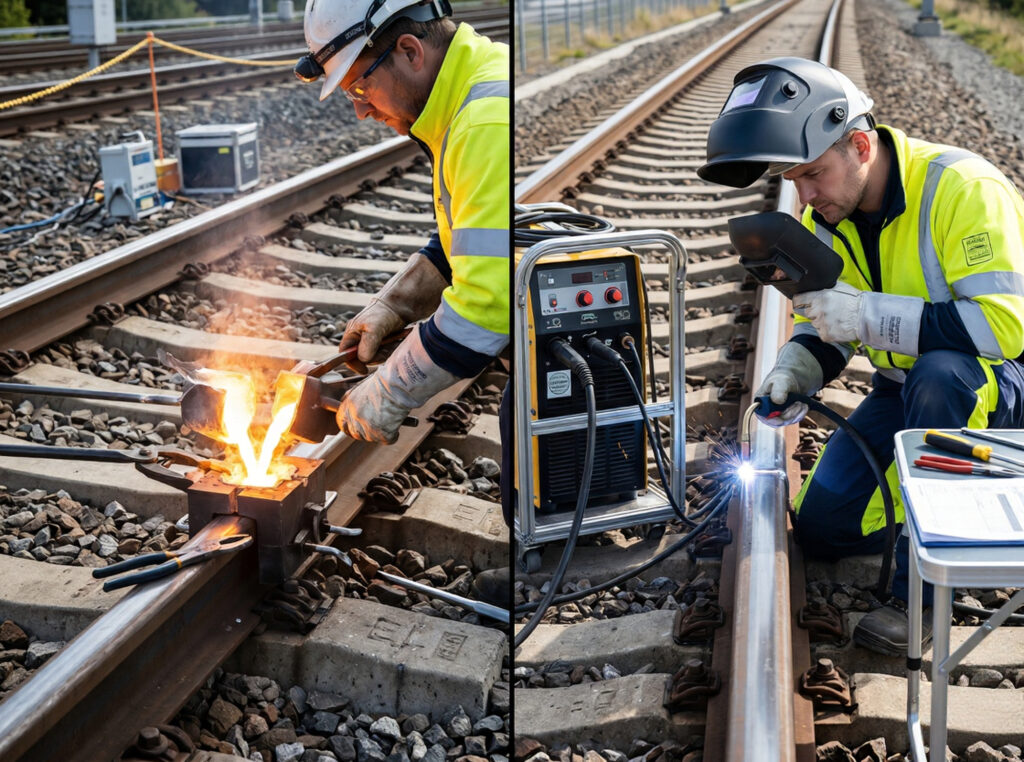
Modern railway systems depend on precision engineering and robust infrastructure to ensure seamless transportation. At the heart of this progress lie the different types of rail welding that connect steel rails into continuous, reliable tracks. These different types of rail welding play a vital role in enhancing safety, durability, and operational efficiency across global railway networks. From high-speed rail corridors to urban metro systems, understanding the different types of rail welding is essential for ensuring optimal performance and long-term sustainability.
Rail welding has revolutionized the way railway lines are constructed and maintained. In the past, rail joints created noise, vibration, and frequent maintenance challenges. Today, advanced welding techniques eliminate these issues by forming smooth and continuous tracks. This advancement reduces wear and tear, improves passenger comfort, and enables trains to operate at higher speeds. As railway infrastructure continues to expand worldwide, selecting the right welding method has become increasingly crucial for engineers, contractors, and manufacturers.
Our article explores the advanced welding techniques used in modern railway systems. It highlights their processes, advantages, and applications while providing valuable insights into how technological innovations continue to transform the rail industry.
What Are the Different Types of Welding in Railway Track?
The different types of welding in railway tracks include thermite welding, flash butt welding, gas pressure welding, and arc welding. These methods are widely used across the world to ensure strong, seamless, and durable rail joints. Each technique offers distinct advantages, depending on operational requirements, environmental conditions, and project scale.
Railway authorities select specific welding methods based on cost efficiency, track location, and expected traffic loads. Collectively, these different types of rail welding ensure the reliability and longevity of modern railway infrastructure.
The primary welding methods used globally include:
- Thermite (Exothermic) Welding – Ideal for field installations and remote railway repairs.
- Flash Butt Welding – Preferred for manufacturing continuous welded rails and high-speed networks.
- Gas Pressure Welding – Widely adopted in metro systems and dense urban railway corridors.
- Arc Welding – Commonly used for maintenance, reinforcement, and minor repairs.
Each of these techniques contributes to seamless rail connectivity, reducing maintenance costs and enhancing passenger safety. By eliminating mechanical joints, welded rails significantly improve ride comfort and minimize noise pollution. As railway systems evolve to accommodate increasing demand, advanced welding methods continue to serve as the backbone of global rail transportation.
Thermite Welding: The Oldest Method Still in Use
Thermite welding remains one of the most enduring and trusted techniques in railway engineering. Developed in the late 19th century by German chemist Hans Goldschmidt, this method has proven its effectiveness for over a century. Despite technological advancements, it continues to be widely used in field applications due to its portability and efficiency. Among the different types of rail welding, thermite welding stands out for its adaptability in remote and challenging environments.
How Thermite Welding Works
Thermite welding relies on an exothermic chemical reaction between iron oxide and aluminium powder. This reaction generates molten steel at extremely high temperatures, which fuses the rail ends into a single, continuous structure.
The process involves the following steps:
- Rail Alignment: Technicians precisely align and clamp the rail ends to maintain accuracy.
- Mould Installation: A heat-resistant mould is placed around the gap between the rails.
- Ignition of Thermite Mixture: The thermite compound is ignited, producing intense heat exceeding 2,500°C.
- Molten Metal Fusion: Molten steel flows into the mould, filling the gap and joining the rails.
- Cooling and Finishing: After cooling, excess metal is trimmed and the joint is ground for a smooth finish.
Applications of Thermite Welding
Thermite welding is commonly used in:
- Remote railway installations
- Track maintenance and renewal projects
- Emergency rail repairs
- Continuous welded rail connections
- Turnouts and crossings
This method offers several advantages, including portability, cost-effectiveness, and independence from external power sources. It allows engineers to perform welding operations in locations where sophisticated machinery is unavailable. However, the process requires skilled professionals to ensure precision and prevent defects.
Thermite welding has stood the test of time but one method takes precision to an entirely new level. What makes flash butt welding the preferred choice for high-speed rail networks? The next section reveals the answer.
Flash Butt Welding: Precision at Scale
Flash butt welding represents one of the most advanced and reliable techniques used in modern railway construction. Known for its accuracy and efficiency, this method produces strong, uniform welds that meet the stringent demands of high-speed rail systems. Among the different types of rail welding, flash butt welding is widely regarded as the gold standard for large-scale infrastructure projects.
This technique is typically performed in controlled environments such as rail manufacturing plants and specialized workshops. It is essential for producing continuous welded rails (CWR), which provide smoother and quieter train operations.
Why Flash Butt Welding Dominates Modern Rail Networks
Flash butt welding uses electrical resistance heat to join rail ends. When an electric current passes through the rails, it generates intense heat that softens the metal. Controlled pressure is then applied, forging the rails into a seamless bond.
Key advantages include:
- Exceptional Joint Strength: Produces durable, high-quality welds.
- Automation and Consistency: Ensures uniform and repeatable results.
- Minimal Maintenance Requirements: Reduces wear and long-term costs.
- Enhanced Ride Comfort: Eliminates vibration and noise from rail joints.
- High-Speed Rail Compatibility: Ideal for bullet trains and heavy freight corridors.
- Reduced Post-Weld Processing: Requires minimal finishing work.
Flash butt welding is extensively used in advanced railway systems across Europe, China, Japan, and North America. Its ability to deliver superior precision makes it indispensable for modern rail networks.
Compared with thermite welding, flash butt welding offers higher consistency and metallurgical integrity. However, it requires sophisticated equipment and a reliable power supply, making it less suitable for remote applications.
Flash butt welding delivers unmatched accuracy but what happens when electricity is not readily available? Another innovative technique relies solely on heat and force, and it has quietly transformed rail construction across Asia.
Gas Pressure Welding: Heat Meets Force
Gas pressure welding is a specialized rail joining method that combines intense heat with mechanical force. This technique uses an oxy-acetylene flame to heat rail ends until they become plastic. Axial pressure is then applied to forge the rails together without the need for filler material. Among the different types of rail welding, this process is renowned for producing strong and uniform joints with excellent metallurgical properties.
This method has gained widespread popularity in countries such as Japan, India, and Germany. It is particularly suitable for metro systems, suburban railways, and urban transit networks where reliability and efficiency are essential.
Advantages of Gas Pressure Welding
Gas pressure welding offers several benefits:
- Produces high-strength and defect-free joints
- Requires no additional filler material
- Ensures superior metallurgical bonding
- Reduces residual stresses within the rails
- Provides long-term durability and reliability
- Minimizes maintenance requirements
Despite its advantages, this method demands highly skilled operators and precise temperature control. Any deviation can affect the integrity of the weld. As a result, rigorous training and quality checks are essential during implementation.
Gas pressure welding continues to support railway expansion across densely populated regions, ensuring smooth and efficient transportation systems.
What Are the 4 Types of Welding?
The four primary types of welding used in railway tracks are thermite welding, flash butt welding, gas pressure welding, and arc welding. Each technique serves a unique purpose in the construction and maintenance of railway infrastructure. Together, they represent the most widely adopted different types of rail welding used worldwide.
Comparison of Major Rail Welding Methods
| Welding Type | Method | Best Use Case | Cost Level |
| Thermite Welding | Chemical Reaction | Field repairs and remote installations | Low-Medium |
| Flash Butt Welding | Electric Resistance | High-speed and continuous welded rails | High |
| Gas Pressure Welding | Heat and Pressure | Urban rail and metro systems | Medium |
| Arc Welding | Electric Arc | Maintenance and minor repairs | Low |
Thermite welding provides flexibility in remote locations, while flash butt welding ensures precision in manufacturing facilities. Gas pressure welding delivers excellent metallurgical properties, making it suitable for urban transit systems. Arc welding, discussed in the next part, plays a crucial role in repair and reinforcement tasks.
These different types of rail welding collectively enhance railway performance, safety, and longevity, supporting the evolving demands of global transportation networks.
Arc Welding in Railway Tracks: A Closer Look
Arc welding plays a vital role in railway maintenance and repair operations. Although it is not commonly used for joining main rail sections, it remains indispensable for addressing localized damages and reinforcing structural components. Among the different types of rail welding, arc welding is widely recognized for its versatility and accessibility.
This process uses an electric arc to generate intense heat, melting the base metal and filler material to form a strong bond. Shielded Metal Arc Welding (SMAW) is the most commonly employed variant in railway applications due to its portability and cost-effectiveness.
When Is Arc Welding Used on Railway Lines?
Arc welding is primarily used for maintenance and repair tasks. It ensures that railway infrastructure remains functional and safe without requiring extensive replacements.
Common applications include:
- Repairing Cracked Rail Ends: Prevents minor defects from escalating into major failures.
- Joint Plate Restoration: Strengthens weakened connections in rail assemblies.
- Switches and Crossings Maintenance: Ensures uninterrupted operation at critical track intersections.
- Emergency Field Repairs: Provides immediate solutions following derailments or unexpected damages.
- Rebuilding Worn Rail Sections: Extends the service life of existing tracks.
The advantages of arc welding include portability, affordability, and adaptability. However, it demands skilled operators to maintain precision and avoid metallurgical inconsistencies. Despite its limitations, this method remains essential for routine railway maintenance.
As railway technology advances, another specialized technique emerges to enhance welding precision and quality. What distinguishes this refined method from conventional arc welding? The next section reveals the answer.
Enclosed Arc Welding: The Specialist’s Choice
Enclosed arc welding, often associated with submerged arc welding (SAW), is a highly controlled process used primarily in rail manufacturing plants. This technique involves shielding the welding arc beneath a blanket of granular flux, ensuring superior weld quality and minimal atmospheric contamination. Among the different types of rail welding, enclosed arc welding stands out for its precision and efficiency in industrial applications.
This process is commonly used during the production of rail components and specialized track structures. Its controlled environment enhances metallurgical integrity and ensures consistent results.
Key Advantages of Enclosed Arc Welding
- Superior Weld Quality: Produces defect-free and high-strength joints.
- Minimal Spatter and Fumes: Enhances workplace safety and cleanliness.
- Improved Heat Control: Reduces distortion and residual stresses.
- High Productivity: Suitable for large-scale rail manufacturing.
- Enhanced Durability: Ensures long-lasting performance under heavy loads.
Due to its reliance on specialized equipment, enclosed arc welding is typically confined to manufacturing facilities rather than field applications. Nevertheless, it plays a crucial role in producing high-quality rail components that meet stringent industry standards.
Comparing Different Types of Rail Welding: Which Method Wins?
Selecting the appropriate welding technique requires careful evaluation of operational requirements, environmental conditions, and project objectives. Engineers must consider various technical and economic factors before choosing the ideal solution. A comparative understanding of the different types of rail welding helps decision-makers optimize performance and ensure safety.
Key Factors Influencing Welding Selection
- Joint Strength Requirements: High-speed rail systems demand superior weld integrity.
- Project Location: Remote sites often require portable methods such as thermite welding.
- Budget Constraints: Cost considerations influence method selection.
- Rail Traffic Frequency: Heavily used tracks require durable and precise welds.
- Availability of Equipment: Advanced techniques depend on specialized machinery.
- Environmental Conditions: Weather and terrain impact welding feasibility.
- Maintenance Needs: Long-term durability reduces operational expenses.
Comparative Rail Welding Techniques
| Welding Method | Strength | Application Area | Efficiency | Suitability |
| Thermite Welding | High | Field installations | Moderate | Remote locations |
| Flash Butt Welding | Very High | Manufacturing plants | Excellent | High-speed rail |
| Gas Pressure Welding | High | Urban rail systems | High | Metro networks |
| Arc Welding | Moderate | Maintenance and repairs | Moderate | Emergency use |
| Enclosed Arc Welding | Very High | Industrial production | Excellent | Rail manufacturing |
According to railway engineering studies, continuous welded rails produced through flash butt welding significantly reduce maintenance costs and enhance ride comfort. Industry experts emphasize that selecting the appropriate welding method directly impacts safety, efficiency, and operational longevity.
Choosing the right welding technique is only part of the equation. What standards and safety protocols ensure these welds withstand immense loads and extreme conditions? The next section explores the critical measures that guarantee railway reliability.
Safety Standards and Quality Control in Rail Welding
Safety and quality assurance are fundamental to railway infrastructure. International organizations and railway authorities enforce strict guidelines to ensure that welded joints meet performance and durability standards. Adhering to these regulations ensures that the different types of rail welding deliver reliable and long-lasting results.
Global Standards Governing Rail Welding
- EN 14730: European standards for thermite welding of rails.
- AREMA Guidelines: American Railway Engineering and Maintenance-of-Way Association standards.
- ISO Certifications: Ensure quality management and operational consistency.
- Indian Railways Specifications: Regulate welding practices in one of the world’s largest rail networks.
- UIC Standards: Issued by the International Union of Railways.
Essential Quality Control Procedures
- Visual Inspection: Detects surface defects and alignment issues.
- Ultrasonic Testing (UT): Identifies internal flaws in welded joints.
- Radiographic Testing: Ensures structural integrity through advanced imaging.
- Hardness Testing: Evaluates the strength and durability of welds.
- Profile Grinding: Provides smooth and uniform rail surfaces.
- Residual Stress Analysis: Minimizes structural deformation.
- Dimensional Verification: Confirms compliance with design specifications.
Quality control directly influences railway safety. Even minor imperfections can lead to operational hazards, making rigorous testing essential for every welding project. By adhering to international standards, railway authorities ensure reliable performance and passenger safety.
Final Thoughts
The advancement of railway infrastructure relies heavily on innovation, precision, and reliability. Understanding the different types of rail welding is essential for ensuring seamless connectivity, structural integrity, and operational efficiency. From thermite welding and flash butt welding to gas pressure welding, arc welding, and enclosed arc welding, each technique serves a distinct purpose in modern railway systems.
The different types of rail welding collectively support the development of high-speed rail networks, urban transit systems, and heavy freight corridors. Their strategic application enhances safety, reduces maintenance costs, and improves overall transportation efficiency. As railway technology continues to evolve, these welding methods will remain indispensable to global infrastructure development.
Organizations such as EMA Quality Industries play a vital role in delivering high-quality rail solutions that meet international standards. By embracing advanced welding technologies and stringent quality control measures, the rail industry continues to drive progress, ensuring safe and sustainable transportation for generations to come.
Key Takeaways
- Advanced rail welding techniques ensure seamless railway tracks, improving operational efficiency and passenger comfort worldwide.
- Thermite welding remains essential for field repairs, especially in remote locations lacking access to advanced machinery.
- Flash butt welding delivers unmatched precision, making it ideal for high-speed and continuous welded rail networks.
- Gas pressure welding produces strong, defect-free joints without filler materials, ensuring superior metallurgical integrity.
- Arc welding plays a crucial role in maintenance, emergency repairs, and reinforcement of railway infrastructure.
- Enclosed arc welding enhances productivity and weld quality in controlled environments such as rail manufacturing plants.
- Selecting the appropriate rail welding technique depends on project requirements, environmental conditions, and budget constraints.
- International standards like EN 14730 and AREMA guidelines ensure safety, reliability, and consistent welding quality.
- Rigorous inspection methods, including ultrasonic and hardness testing, guarantee long-lasting and structurally sound rail joints.
- Understanding the different types of rail welding helps industries improve safety, durability, and long-term railway performance.
FAQs
What are the 5 basic weld types?
The five basic weld types commonly recognized in industrial applications are butt welds, fillet welds, lap welds, corner welds, and edge welds. Among these, the butt weld is most significant in railway engineering, as it is widely used to join rail sections into continuous welded tracks. These weld types provide the structural integrity required for heavy loads and high-speed train operations.
How to weld railway track?
Railway tracks are welded using specialized techniques such as thermite welding, flash butt welding, and gas pressure welding. The process involves aligning the rail ends, heating them to a molten or plastic state, and fusing them to form a seamless joint. After welding, grinding and quality inspections ensure smooth alignment, strength, and compliance with international safety standards.
What is rail welding called?
Rail welding is commonly referred to as Continuous Welded Rail (CWR) welding when rails are joined to form long, uninterrupted tracks. It is also known as rail joint welding in maintenance and construction contexts. These methods eliminate mechanical joints, reducing vibration, noise, and maintenance requirements while improving train stability and safety.
What is PQR and WPS?
PQR stands for Procedure Qualification Record, and WPS stands for Welding Procedure Specification. A WPS provides detailed instructions on how welding should be performed, including materials, techniques, and parameters. The PQR serves as documented evidence that the welding procedure produces reliable and high-quality results. Both documents are essential for ensuring consistency, safety, and compliance in railway welding projects.
Which welding type is strongest?
Flash butt welding is considered the strongest welding method used in railway applications. It produces uniform, defect-free joints with exceptional metallurgical strength, making it ideal for high-speed and heavy-load rail networks. Its precision and durability make it the preferred choice for manufacturing continuous welded rails worldwide.
