

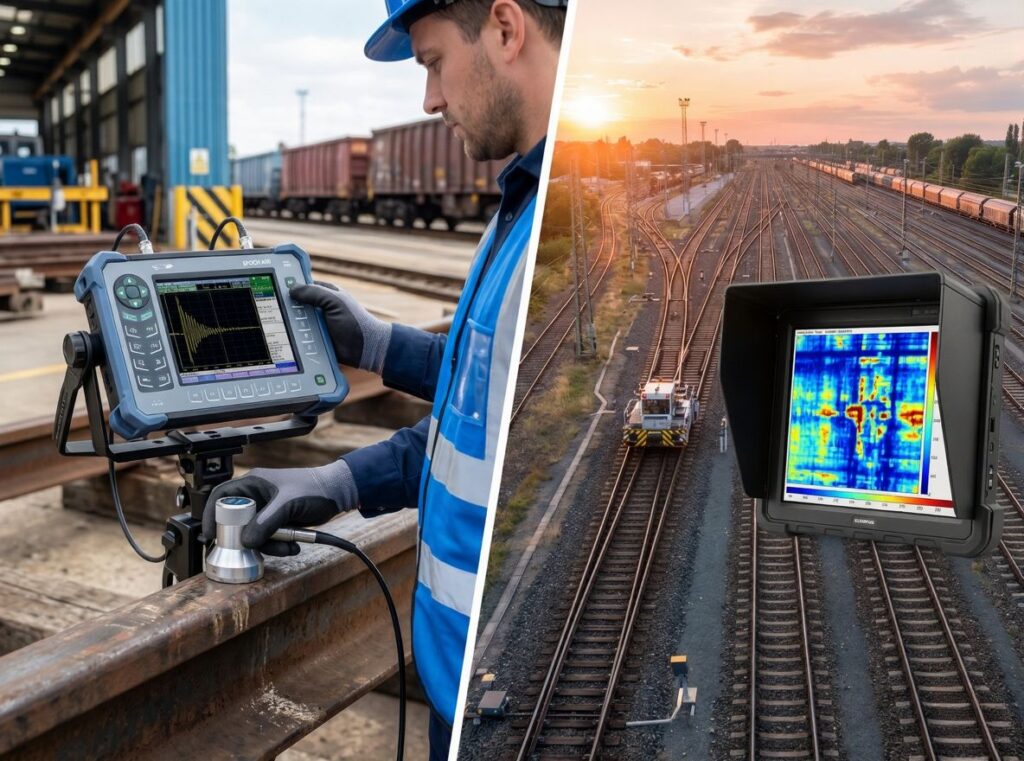
Ultrasonic rail inspection depends heavily on UT Fundamentals to ensure accurate defect detection and reliable interpretation. UT Fundamentals form the backbone of every successful ultrasonic testing process in modern rail systems. Without UT Fundamentals, even advanced scanning technologies can fail to deliver meaningful insights.
Railway infrastructure continues to expand across regions, and safety remains a top priority. Ultrasonic rail testing plays a critical role in identifying hidden flaws before they escalate into serious failures. Engineers and inspection teams rely on multiple scan types to analyze internal rail conditions effectively.
Among these, A-Scan, B-Scan, and C-Scan stand as the most widely used data formats. Each scan offers a different perspective, helping professionals build a complete picture of rail integrity. Accurate interpretation of these scans requires not only technical tools but also a strong understanding of underlying principles rooted in UT Fundamentals.
The importance of data interpretation goes beyond detection. It influences maintenance decisions, prevents costly breakdowns, and ensures passenger safety. Rail networks operate under constant stress, and even minor defects can lead to significant consequences if left undetected. That is why ultrasonic testing has become a standard practice across global railway systems.
What Is Ultrasonic Rail Testing?
Ultrasonic rail testing is a non-destructive method that uses high-frequency sound waves to detect internal defects in railway tracks. This technique allows inspection teams to identify cracks, voids, and inclusions without damaging the rail structure.
The process relies on transmitting sound waves into the rail material and analyzing the returning echoes. When these waves encounter a discontinuity, they reflect back differently. This variation helps technicians locate and assess defects accurately. UT Fundamentals explain how these reflections behave under different conditions, making interpretation more reliable.
How Sound Waves Detect Rail Defects
The pulse-echo method remains the most commonly used approach in ultrasonic testing. A transducer sends sound waves into the rail, and the same device receives the reflected signals. The time taken for the echo to return indicates the depth of the defect.
Different transducers operate at varying frequencies depending on inspection needs. Higher frequencies provide better resolution but reduce penetration depth. Lower frequencies penetrate deeper but offer less detail. Selecting the correct frequency requires a strong understanding of UT Fundamentals and the material properties of rails.
A typical ultrasonic rail testing system includes several essential components:
- Transducer or probe
- Pulser-receiver unit
- Data acquisition system
- Display unit
Each component works together to ensure accurate signal generation and interpretation. The transducer plays a critical role by converting electrical energy into sound waves and back again. The pulser-receiver controls signal transmission and amplification, while the data acquisition system records and processes results.
Rail operators depend on this method to maintain safety standards and extend asset life. According to industry estimates, early detection of rail defects can reduce maintenance costs by up to 30 percent. Such efficiency highlights the importance of mastering UT Fundamentals for consistent inspection quality.
Now that the basic mechanism is clear, how does this raw data appear on inspection screens? The answer unfolds in the next section.
Understanding A-Scan Results in Rail Inspection
A-Scan represents ultrasonic data as a simple waveform, displaying signal amplitude against time. This format provides a direct view of how sound waves travel through the rail and reflect back to the transducer. It serves as the foundation of ultrasonic data interpretation.
Technicians analyze three main elements in an A-Scan display. The initial pulse indicates the transmitted signal. The back wall echo shows the reflection from the opposite side of the rail. Any additional echoes between these points may signal a defect. Understanding these elements depends heavily on UT Fundamentals.
How to Read an A-Scan Display
Interpreting an A-Scan requires attention to specific indicators:
- Amplitude spikes reveal the strength of reflected signals
- Echo position helps estimate defect depth
- Time-of-flight determines how far the wave traveled
- Signal patterns indicate material continuity or disruption
A clear waveform usually suggests a defect-free rail section. However, unexpected spikes often point to internal flaws. For instance, a crack located at a depth of 30 mm produces an echo between the initial pulse and the back wall signal.
Technicians rely on calibration blocks to validate readings. These blocks simulate known defects and help adjust the equipment for accurate measurements. Without proper calibration, even the best equipment can produce misleading results.
A-Scan interpretation requires both technical knowledge and practical experience. UT Fundamentals provide the theoretical base, while field experience sharpens the ability to distinguish real defects from noise.
Despite its usefulness, A-Scan has limitations. It offers precise point-based data but does not provide a visual representation of defect shape. This limitation often makes it difficult to assess defect size and orientation.
As inspection demands grow, professionals seek more detailed imaging. This need leads to the next level of ultrasonic data representation. But how does this transition improve accuracy and visualization? The answer lies ahead.
What Is the B-Scan in Ultrasonic Testing?
B-Scan in ultrasonic testing provides a cross-sectional view of the rail, allowing technicians to visualize defects along a plane. Unlike A-Scan, which shows a single waveform, B-Scan combines multiple A-Scan readings to create an image.
As the probe moves along the rail, it collects continuous data. This data is then stacked to form a two-dimensional representation. The result is a clearer picture of defect size, depth, and orientation. UT Fundamentals help interpret how these stacked signals translate into meaningful images.
The differences between A-Scan and B-Scan become evident when comparing their features:
| Feature | A-Scan | B-Scan |
| Display type | Waveform | Cross-section image |
| Shows depth | Yes (interpreted) | Yes (visual) |
| Best use | Point defect detection | Defect profiling |
| Data output | Amplitude vs. time | Position vs. depth |
B-Scan improves inspection accuracy by offering a visual interpretation of internal structures. It allows technicians to assess defect shape and continuity more effectively. This capability proves especially useful when evaluating fatigue cracks and inclusions.
In modern rail inspection systems, automated scanners generate B-Scan images in real time. These systems reduce manual effort and improve consistency. However, technology alone cannot guarantee accuracy. Proper interpretation still depends on UT Fundamentals and skilled operators.
B-Scan also supports better decision-making. Maintenance teams can prioritize repairs based on defect size and severity. This approach helps optimize resources and reduce downtime.
Yet, even with improved visualization, challenges remain. Interpreting complex patterns requires experience and attention to detail. Misreading these patterns can lead to incorrect conclusions.
Decoding B-Scan Images: What the Patterns Mean
B-Scan images display various patterns that indicate different types of defects. Recognizing these patterns helps technicians make accurate assessments and avoid costly mistakes.
Common B-Scan Patterns in Rail Defects
- Horizontal bands often indicate planar defects within the rail
- Angled echo lines suggest transverse cracks
- Irregular shadows may point to internal voids or inclusions
- Discontinuous signals may reveal material inconsistencies
Each pattern carries specific meaning. For example, a transverse crack can grow rapidly under repeated loading. Early detection allows maintenance teams to address the issue before it becomes critical.
Industry standards such as AREMA and EN 13674 emphasize accurate interpretation of these patterns. These standards provide guidelines for defect classification and acceptance criteria. UT Fundamentals support compliance with these standards by ensuring consistent interpretation.
Real-world inspection scenarios highlight the importance of pattern recognition. In several cases, missed B-Scan indications have led to unexpected rail failures. These incidents underline the need for continuous training and skill development.
Advanced software tools now assist in pattern recognition by highlighting anomalies. However, human expertise remains essential. Software can identify irregularities, but only trained professionals can interpret their significance accurately.
Understanding B-Scan patterns represents a critical step in ultrasonic rail testing. It bridges the gap between raw data and actionable insights. Combined with A-Scan analysis, it provides a strong foundation for defect detection and evaluation.
At this stage, the inspection process has evolved from simple waveforms to detailed cross-sectional imaging. Yet, a broader perspective is still needed to complete the picture.
What Is a C-Scan in Ultrasonic Testing?
C-Scan in ultrasonic testing provides a top-down, plan view image of the inspected rail section, allowing inspectors to visualize defect distribution across a defined area. This method converts ultrasonic signals into a mapped image that reflects variations in amplitude and depth across the rail surface. Unlike A-Scan and B-Scan, which focus on signal behavior and cross-sectional imaging, C-Scan delivers a broader spatial understanding.
Modern rail inspection systems generate C-Scan images using automated scanners equipped with encoders. These encoders track probe movement and record positional data alongside ultrasonic signals. The system then processes this information into a grid-like image. UT Fundamentals explain how variations in signal amplitude translate into visual patterns, helping technicians interpret these maps correctly.
What C-Scan Data Reveals
C-Scan imaging plays a critical role in advanced defect analysis. It provides multiple layers of information that support decision-making:
- Color-coded amplitude mapping highlights variations in signal strength
- Defect area coverage helps estimate size and severity
- Precise positional data enables accurate localization
- Correlation with A-Scan and B-Scan improves validation
For example, a high-amplitude region in a C-Scan image often indicates a significant discontinuity. However, interpreting such signals requires careful analysis. UT Fundamentals help differentiate between actual defects and harmless variations caused by geometry or surface conditions.
Industries rely on C-Scan in scenarios where detailed mapping is essential. High-speed rail networks use this method to monitor long track sections efficiently. Weld inspections benefit from C-Scan because it reveals inconsistencies that may not appear clearly in other scans. Pre-service rail qualification also depends on this technology to ensure quality before installation.
C-Scan offers a powerful perspective, but it does not replace other scan types. Instead, it complements them. The real advantage appears when all three scan methods work together. But how do inspection teams combine these data sources effectively? The answer reveals a more advanced approach.
Integrating A-Scan, B-Scan, and C-Scan Data for Accurate Defect Assessment
Rail inspection has evolved into a multi-layered process that relies on integrating different scan types. Each scan provides unique insights, but none offers a complete picture on its own. By combining A-Scan, B-Scan, and C-Scan, inspection teams achieve a higher level of accuracy and reliability.
A Practical Workflow for Multi-Scan Interpretation
A structured workflow helps inspection teams manage complex data effectively:
- A-Scan identifies potential defects through waveform analysis
- B-Scan profiles the defect to determine its shape and depth
- C-Scan maps the defect across the rail surface
- Results are cross-checked against industry standards
- Findings are documented for maintenance planning
This workflow ensures consistency and accuracy. Each step builds on the previous one, reducing uncertainty in interpretation. UT Fundamentals guide technicians through this process by explaining how signals behave across different scan types.
Experts in non-destructive testing often stress the importance of correlation. A signal detected in A-Scan must align with patterns in B-Scan and C-Scan. If discrepancies appear, technicians must investigate further. This verification process prevents false positives and false negatives.
Integration also improves efficiency. Maintenance teams can prioritize repairs based on accurate data. This approach reduces downtime and optimizes resource allocation.
However, even with structured workflows, interpretation challenges remain. Data complexity can sometimes lead to errors. What happens when these errors occur? The consequences may be more serious than expected.
Consequences of Misinterpreting Ultrasonic Rail Testing Data
Misinterpreting ultrasonic data can lead to severe operational and safety risks. Rail defects that go undetected may grow under repeated stress. Over time, these defects can cause rail fractures and disrupt operations.
Global railway reports indicate that defect-related failures contribute significantly to maintenance costs. In extreme cases, misinterpretation has led to derailments. These incidents highlight the importance of accurate data analysis supported by UT Fundamentals.
Most Common Interpretation Errors
Several common errors occur during ultrasonic data interpretation:
- Confusing geometric reflections with actual defect signals
- Underestimating defect depth when relying only on A-Scan
- Ignoring low-amplitude indications in B-Scan images
- Over-reliance on a single scan type without validation
- Misreading C-Scan color variations as defects
These mistakes often result from inadequate training or lack of experience. Even advanced equipment cannot compensate for poor interpretation skills.
Training programs focus on strengthening UT Fundamentals among inspection personnel. Regular calibration and validation procedures further improve accuracy.
Organizations that invest in proper training achieve better outcomes. They detect defects early and take preventive action. This approach reduces risks and ensures smoother operations.
Final Thoughts
Ultrasonic rail testing plays a vital role in maintaining the safety and reliability of modern railway systems. A-Scan, B-Scan, and C-Scan each contribute unique insights, from waveform analysis to cross-sectional and surface mapping. When used together, these methods create a comprehensive inspection framework that improves defect detection and evaluation.
The accuracy of this process depends heavily on strong technical knowledge and consistent application of UT Fundamentals. These principles guide technicians in understanding signal behavior, identifying flaws, and making informed maintenance decisions. Without UT Fundamentals, even advanced equipment cannot guarantee dependable results.
As railway networks continue to expand and operate under increasing demands, the need for precise inspection methods becomes more critical. Organizations that prioritize UT Fundamentals in training and operations achieve better safety outcomes, reduce risks, and ensure long-term infrastructure reliability.
Key Takeaways
- A-Scan provides precise waveform data that helps detect point-based rail defects accurately.
- B-Scan offers cross-sectional imaging, allowing better visualization of defect depth and orientation.
- C-Scan delivers a top-down mapping view, improving understanding of defect distribution across rails.
- Combining all three scan types significantly enhances the overall accuracy of rail inspection processes.
- UT Fundamentals play a crucial role in interpreting ultrasonic data across all scan formats.
- Proper training in UT Fundamentals helps technicians avoid common misinterpretation errors during inspections.
- Multi-scan integration ensures defects are validated through multiple perspectives before final reporting.
- Advanced ultrasonic systems improve efficiency but still depend heavily on skilled human interpretation.
- Adhering to global standards ensures consistent, reliable, and safe ultrasonic rail testing practices.
- Accurate data interpretation supports timely maintenance decisions and reduces long-term operational risks.
