

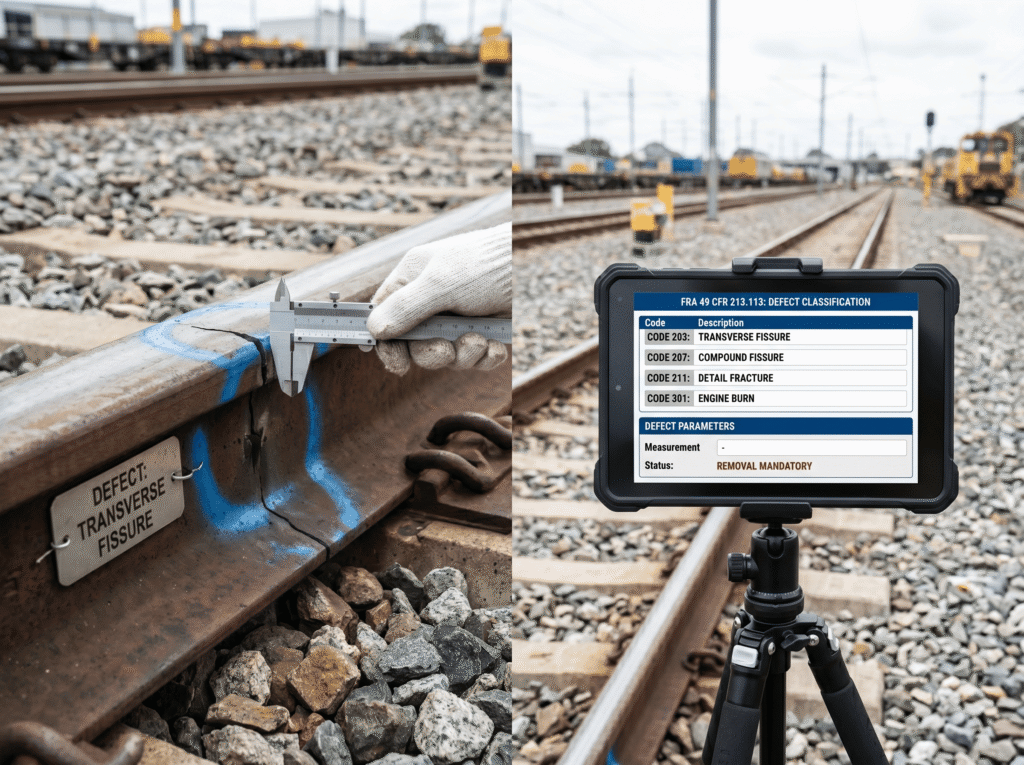
FRA Defect Codes Explained: Rail Defect Classification (49 CFR 213.113)
FRA defect codes play a critical role in maintaining rail safety across the United States. These FRA defect codes help inspectors identify, classify, and document rail defects before they develop into serious failures. By using standardized FRA defect codes, railroads can make informed maintenance decisions and comply with federal safety regulations.
Rail infrastructure experiences constant stress from heavy loads, changing weather conditions, and repeated train movements. Even small defects can grow into significant hazards if maintenance teams fail to detect them early. To address this challenge, the Federal Railroad Administration (FRA) established a standardized system for identifying and tracking rail defects.
Under 49 CFR 213.113, railroads must inspect tracks regularly and respond appropriately when defects are discovered. FRA defect codes provide a common language that allows inspectors, maintenance personnel, and railroad operators to communicate accurately about rail conditions.
A single defect classification can determine whether a rail remains in service, requires immediate repair, or must be removed entirely. Understanding FRA defect codes therefore remains essential for anyone involved in track inspection, maintenance planning, or railroad safety management.
What Are FRA Defect Codes?
FRA defect codes are standardized numerical identifiers used to classify specific rail defects found during inspections. These codes create consistency throughout the railroad industry and help ensure that inspectors evaluate defects using the same criteria.
The Federal Railroad Administration developed FRA defect codes to support effective monitoring of rail conditions. Instead of relying on descriptive language that may vary between inspectors, railroads use designated codes to identify precise defect types.
For example, a detail fracture receives a different classification than a bolt hole crack. This distinction allows maintenance teams to understand the severity and nature of a defect quickly.
FRA defect codes serve several important purposes:
- Standardize rail defect reporting
- Improve maintenance planning
- Support regulatory compliance
- Enhance communication between departments
- Enable trend analysis and risk assessment
Track inspectors encounter numerous rail conditions during routine inspections. FRA defect codes help them record findings accurately and consistently. Railroad operators then use these records to prioritize repairs and allocate maintenance resources effectively.
Maintenance crews also depend on FRA defect codes when planning corrective actions. Since each code corresponds to a specific defect type, crews can prepare appropriate repair strategies before arriving on site.
Another significant advantage of FRA defect codes involves data management. Railroads maintain extensive inspection records, and coded defect classifications make it easier to track recurring issues and identify long-term patterns.
As rail networks continue to expand and traffic volumes increase, the importance of FRA defect codes becomes even more evident. These classifications form the foundation of modern rail inspection programs and help prevent failures before they occur.
The Regulatory Framework: Understanding 49 CFR 213.113
Rail safety regulations in the United States fall under 49 CFR Part 213, commonly known as the Track Safety Standards. These regulations establish minimum safety requirements for railroad track infrastructure.
Within this framework, FRA defect codes support compliance efforts by helping railroads identify and classify defects according to federal standards.
49 CFR Part 213 covers several critical areas, including:
- Track geometry
- Rail integrity
- Inspection frequency
- Maintenance requirements
- Defect management procedures
Among these regulations, Section 213.113 specifically addresses rail defects. This section outlines how railroads must evaluate, monitor, and respond to various rail conditions that may compromise safety.
The regulation recognizes that not all defects pose the same level of risk. Some conditions require immediate action, while others may permit continued operation under specific restrictions. FRA defect codes help determine which response applies.
When inspectors discover a defect, they assign the appropriate FRA defect code based on its characteristics. The classification then guides the railroad’s maintenance decision-making process.
For example, certain FRA defect codes may require immediate rail replacement. Others may permit temporary monitoring until scheduled maintenance occurs. The code assigned directly influences the corrective action taken.
The relationship between FRA defect codes and regulatory compliance cannot be overstated. Accurate classification helps railroads demonstrate compliance with federal requirements and maintain safe operating conditions.
Industry experts often describe defect classification as one of the most important components of preventive maintenance. A properly classified defect enables faster decision-making and reduces the likelihood of service disruptions.
The use of FRA defect codes also supports risk-based maintenance programs. Railroads can analyze inspection data, identify recurring defect trends, and allocate resources to higher-risk areas before failures occur.
As inspection technologies continue evolving, the value of standardized FRA defect codes remains unchanged. Whether defects are detected visually or through advanced testing equipment, proper classification remains essential.
But how exactly are these defects organized, and what categories do inspectors use when assigning FRA defect codes? The answer reveals the structure behind the entire classification system.
What Are the Categories of Rail Defects?
Rail defects fall into several categories based on their location, appearance, and failure mechanism. FRA defect codes help inspectors classify these defects consistently across the railroad network.
Each category presents unique risks and requires specific inspection and maintenance approaches.
Transverse and Compound Fissures
Transverse fissures represent internal fractures that develop across the rail head. These defects often originate from material imperfections or fatigue-related stresses.
As train loads repeatedly pass over the rail, small cracks can grow gradually until they threaten structural integrity.
Compound fissures involve multiple crack formations that may intersect or expand through different sections of the rail. These defects can become particularly dangerous because they often remain hidden beneath the rail surface.
Inspectors use designated FRA defect codes to identify and document these conditions accurately.
Detail Fractures
Detail fractures rank among the most closely monitored rail defects in the industry.
These defects usually originate near the gauge corner of the rail head. Repeated wheel loading creates microscopic cracks that expand over time.
If maintenance teams fail to address detail fractures promptly, they can eventually cause rail failure.
Many FRA defect codes specifically address detail fracture variations because of their significance in rail safety programs.
Advanced ultrasonic testing frequently identifies detail fractures before they become visible during routine inspections.
Bolt Hole Cracks
Bolt hole cracks develop around openings drilled for joint bars and fastening systems.
The presence of holes creates localized stress concentrations within the rail. Over time, these stress concentrations may initiate cracking.
Environmental conditions, vibration, and repeated train loads can accelerate crack growth around bolt holes.
Railroads use FRA defect codes to classify the severity and location of these cracks, helping maintenance teams determine appropriate corrective actions.
Regular inspection of rail joints remains essential because bolt hole cracks often develop in high-stress areas.
Piped Rail
Piped rail refers to internal manufacturing defects that originate during steel production.
These defects form when gas pockets or voids remain trapped within the steel structure. Although modern manufacturing processes have reduced their occurrence, piped rail can still appear in older infrastructure.
Because piped rail affects the internal composition of the rail, detection often requires specialized testing methods.
Inspectors assign appropriate FRA defect codes when these conditions are identified, ensuring accurate documentation and risk assessment.
The following table provides a simplified overview of several common defect categories.
| Defect Category | FRA Defect Code | Risk Level |
| Transverse Fissure | 101 | High |
| Detail Fracture | 109 | High |
| Bolt Hole Crack | 132 | Medium to High |
| Piped Rail | 203 | Medium |
Although these categories provide a useful starting point, they represent only part of the broader classification system. Rail defects can also be grouped according to how and where they develop. That distinction introduces another important way inspectors analyze FRA defect codes.
What Are the Three Types of Rail Defects?
Rail defects generally fall into three primary types. Understanding these classifications helps explain how FRA defect codes support inspection and maintenance decisions.
1. Surface Defects
Surface defects appear on visible portions of the rail.
Inspectors can often identify these conditions through visual examinations. Surface defects include wear patterns, shelling, spalling, and visible cracking.
Because they occur on exposed rail surfaces, these defects are usually easier to detect than internal flaws.
Many FRA defect codes address surface-related conditions that may affect operational safety.
2. Internal or Subsurface Defects
Internal defects develop beneath the rail surface and often remain invisible during routine inspections.
Examples include:
- Transverse fissures
- Detail fractures
- Internal fatigue cracks
- Manufacturing discontinuities
Railroads rely heavily on ultrasonic testing and other non-destructive evaluation methods to detect these defects.
Several FRA defect codes specifically classify internal conditions because of their potential to cause sudden failures.
Internal defects frequently present greater risks than visible surface conditions because they can progress unnoticed for extended periods.
3. Geometric or Structural Defects
Geometric and structural defects affect the rail’s shape, alignment, or load-bearing capability.
These conditions may include:
- Misalignment
- Excessive deformation
- Structural instability
- Track-related stress issues
While some geometric defects involve track structure rather than rail integrity, they still influence overall safety performance.
Inspectors use FRA defect codes alongside other track condition classifications to evaluate these issues comprehensively.
Each type of defect requires different inspection methods, maintenance strategies, and response timelines. Accurate classification enables railroads to address problems before they escalate into operational hazards.
Modern inspection programs combine visual assessments, advanced testing technologies, and standardized FRA defect codes to create a comprehensive approach to rail safety.
However, knowing the categories and types of defects only tells part of the story. The next step involves understanding the specific FRA defect codes inspectors encounter most often and what those codes actually mean in real-world railroad operations.
Common FRA Defect Codes and What They Mean
While inspectors encounter many rail conditions during routine inspections, some FRA defect codes appear more frequently than others. Understanding these classifications helps railroad operators prioritize maintenance activities and manage risk effectively.
Each FRA defect code represents a specific defect type with unique characteristics and safety implications. When inspectors assign FRA defect codes correctly, maintenance teams can respond faster and more accurately.
Below are some commonly referenced FRA defect codes and their general meanings.
| FRA Defect Code | Defect Description | Typical Concern |
| 101 | Transverse Fissure | Internal crack growth |
| 109 | Detail Fracture | Fatigue-related failure |
| 132 | Bolt Hole Crack | Joint weakness |
| 203 | Piped Rail | Manufacturing defect |
| 216 | Head-Web Separation | Structural instability |
| 260 | Engine Burn Fracture | Thermal damage |
| 309 | Vertical Split Head | Rail head separation |
| 311 | Horizontal Split Head | Internal rail weakness |
Railroads monitor these FRA defect codes closely because many of them indicate progressive deterioration.
Some of the most frequently cited FRA defect codes include:
- Code 101 – Transverse fissure within the rail head
- Code 109 – Detail fracture caused by rolling fatigue
- Code 132 – Crack formation around bolt holes
- Code 216 – Separation between rail head and web
- Code 260 – Rail damage caused by engine burns
- Code 309 – Vertical split head defect
- Code 311 – Horizontal split head defect
Code 309 and Code 311 often receive significant attention because they involve major structural defects within the rail head. These FRA defect codes can indicate severe deterioration and frequently require immediate corrective action.
Similarly, Code 260 addresses engine burn fractures. These defects develop when electrical current damages rail steel, creating localized weaknesses that may later develop into larger fractures.
Another important category involves head-web separation defects. These FRA defect codes identify situations where the connection between the rail head and web begins to fail. Such conditions can rapidly compromise rail integrity if left untreated.
Many railroads use defect management software to track FRA defect codes across their networks. Historical analysis of FRA defect codes helps identify recurring problem areas and supports predictive maintenance programs.
Industry studies consistently show that early detection reduces repair costs significantly. By identifying FRA defect codes during routine inspections, railroads can often address problems before they escalate into expensive emergency repairs.
However, many modern defects share a common root cause that continues to challenge railroad operators worldwide. That cause is known as Rolling Contact Fatigue, and its impact extends across nearly every major rail network.
What Is RCF in Rail?
Rolling Contact Fatigue (RCF) is a form of rail deterioration caused by repeated wheel-to-rail contact under heavy loads.
RCF develops gradually as trains pass over the same rail surfaces thousands of times. The repeated stress creates microscopic cracks that eventually grow into larger defects requiring attention.
Many FRA defect codes are directly associated with damage originating from Rolling Contact Fatigue.
When wheels interact with rail surfaces, tremendous pressure concentrates within a small contact area. Although rails are designed to withstand these forces, repeated loading eventually causes material fatigue.
Common signs of RCF include:
- Surface cracking
- Gauge corner cracking
- Shelling
- Spalling
- Internal fatigue fractures
As these conditions progress, inspectors may assign specific FRA defect codes depending on the severity and location of the damage.
RCF presents a growing challenge because modern railroads carry heavier loads and operate at higher frequencies than ever before. Increased traffic accelerates fatigue development and increases the likelihood of defect formation.
Many detail fractures classified under FRA defect codes begin as small RCF-related cracks. Over time, these cracks propagate deeper into the rail structure and create serious safety concerns.
Advanced inspection technologies now play a critical role in identifying RCF before visible damage appears. Railroads increasingly rely on ultrasonic testing, eddy current testing, and automated inspection vehicles to detect early-stage fatigue.
Maintenance strategies such as rail grinding also help control Rolling Contact Fatigue. By removing small surface imperfections, railroads can reduce stress concentrations and slow crack growth.
The relationship between RCF and FRA defect codes continues to shape modern rail maintenance programs. As traffic volumes increase, understanding this connection becomes increasingly important.
Knowing how defects develop is only part of the equation. The next question involves how inspectors identify these issues in the field and determine which FRA defect codes apply.
How Rail Inspectors Use FRA Defect Codes in the Field
Rail inspectors rely on FRA defect codes throughout the inspection process. These classifications help standardize findings and ensure consistent reporting across the industry.
Every inspection aims to identify potential safety concerns before they develop into operational hazards.
Visual Inspection Methods
Visual inspection remains one of the most common rail assessment techniques.
Inspectors walk track sections and examine rails for visible signs of damage. They look for:
- Surface cracks
- Wear patterns
- Corrosion
- Joint deterioration
- Alignment issues
When inspectors discover a defect, they determine the appropriate FRA defect code and record the condition.
Although visual inspections provide valuable information, many critical defects remain hidden beneath the rail surface. This limitation makes additional testing methods essential.
Ultrasonic Testing and NDE
Non-Destructive Evaluation (NDE) technologies help inspectors detect defects that cannot be seen visually.
Ultrasonic testing remains one of the most effective methods for identifying internal rail defects.
The process works by sending high-frequency sound waves through the rail. Reflections from internal discontinuities reveal the presence of cracks or structural flaws.
Many FRA defect codes originate from findings obtained through ultrasonic inspections.
Other NDE methods include:
- Eddy current testing
- Magnetic particle inspection
- Automated rail flaw detection systems
These technologies improve defect detection accuracy and support proactive maintenance strategies.
Once inspectors identify a defect, the assigned FRA defect code determines the required response. Some conditions allow continued operation under monitoring, while others demand immediate action.
For example, a significant internal fracture identified during ultrasonic testing may trigger an urgent rail replacement order.
Consider a busy freight corridor where inspectors detect a large transverse fissure during routine testing. The assigned FRA defect code indicates a high-risk condition. Maintenance crews receive immediate notification, and the affected rail section is removed before a failure occurs.
Without accurate FRA defect codes, coordinating such responses would become significantly more difficult.
Why FRA Defect Codes Matter for Railroad Operators
FRA defect codes influence nearly every aspect of railroad safety management.
From inspection programs to maintenance planning, these classifications provide the foundation for informed decision-making.
One of the primary benefits of FRA defect codes involves regulatory compliance. Federal regulations require railroads to inspect infrastructure regularly and address identified defects appropriately.
Accurate classification demonstrates that railroads follow established safety standards and maintain proper inspection records.
Ignoring FRA defect codes can lead to serious consequences, including:
- Regulatory penalties
- Increased maintenance costs
- Service disruptions
- Equipment damage
- Safety incidents
Beyond compliance, FRA defect codes support proactive asset management.
Railroads generate extensive inspection data each year. By analyzing trends within FRA defect codes, maintenance teams can identify recurring issues and focus resources where they provide the greatest benefit.
This data-driven approach improves reliability while reducing unexpected failures.
Strong safety cultures also depend on effective communication. FRA defect codes provide a common language that inspectors, engineers, maintenance personnel, and management teams can use consistently.
As rail infrastructure ages and traffic volumes continue increasing, the value of standardized FRA defect codes becomes even more significant.
Final Thoughts
Rail safety depends on the early identification and proper classification of defects. FRA defect codes provide the standardized framework that allows inspectors, maintenance teams, and railroad operators to evaluate rail conditions consistently and respond appropriately.
Throughout the industry, FRA defect codes support compliance with 49 CFR 213.113, improve communication, and guide maintenance decisions. From transverse fissures and detail fractures to Rolling Contact Fatigue-related damage, FRA defect codes help transform inspection findings into actionable safety measures.
As rail networks become more complex and traffic demands continue to grow, the importance of FRA defect codes will only increase. Organizations that prioritize accurate inspection, defect monitoring, and proactive maintenance place themselves in a stronger position to enhance safety, improve reliability, and reduce long-term costs.
Key Takeaways
- FRA defect codes provide a standardized system for identifying, recording, and managing rail defects across the industry.
- Accurate use of FRA defect codes helps inspectors communicate findings consistently and efficiently.
- 49 CFR 213.113 establishes federal requirements for detecting and responding to rail defects.
- Rail defects can be categorized into transverse fissures, detail fractures, bolt hole cracks, and more.
- Surface, internal, and structural defects each require different inspection methods and maintenance strategies.
- Common FRA defect codes help railroads prioritize repairs and prevent costly infrastructure failures.
- Rolling Contact Fatigue is a major contributor to many serious rail defects today.
- Advanced inspection technologies improve defect detection and support proactive maintenance decision-making processes.
- Proper defect classification enhances regulatory compliance, operational reliability, and overall railroad safety performance.
- Understanding FRA defect codes enables railroad operators to reduce risks and improve asset management.
