

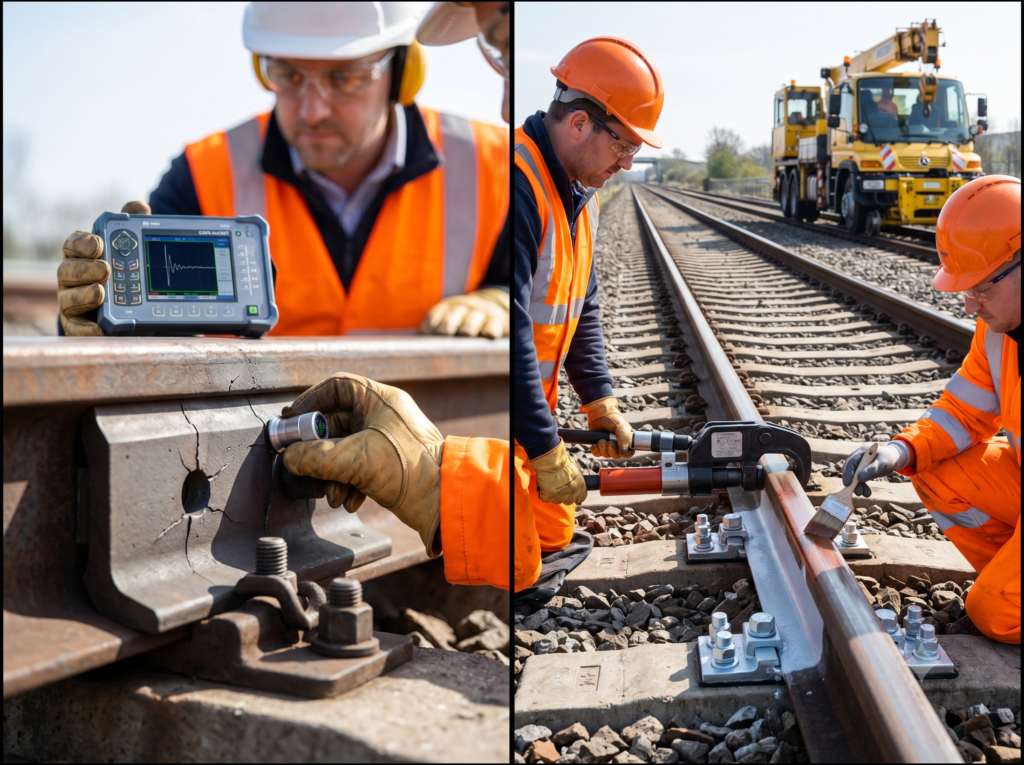
Railway infrastructure depends on thousands of interconnected components working in perfect harmony. Among the most critical connections are rail joints, where individual rail sections meet and connect through bolt holes that experience tremendous stress daily. Bolt hole cracks rail connections stand as one of the most significant challenges facing railway maintenance teams worldwide, and bolt hole cracks rail failures have triggered countless derailments and service disruptions over the past decades. Understanding how to detect and prevent these structural failures has become essential for every railway operator concerned with safety and operational reliability.
Rail joints represent vulnerable points in the track infrastructure. The bolts fastening rail sections together experience continuous cycling loads from passing trains, environmental temperature changes, and ground vibrations. Over time, this relentless stress initiates microscopic fractures that gradually propagate through the metal at bolt hole locations. When left undetected, these fractures compromise the entire rail joint’s integrity and create hazardous conditions for trains traveling at high speeds.
Understanding Bolt Hole Cracks in Rail Joints
Bolt hole cracks rail defects develop through a complex process of metal fatigue and structural stress concentration. The bolt holes themselves create stress concentration points where mechanical forces concentrate rather than distribute evenly across the rail section. Each time a train passes over a joint, the rail experiences bending loads that transmit directly through the bolt holes.
The process begins subtly. Small surface cracks form at the bolt hole perimeter, typically where the circular opening creates the sharpest stress concentration. These initial bolt hole cracks rail defects measure only millimeters in length and remain invisible to casual inspection. However, the cumulative effect of millions of train passages causes progressive crack growth. Material fatigue accelerates the failure process significantly.
Bolt hole cracks rail failures manifest in several distinct patterns:
- Radial cracks extending from the bolt hole center outward
- Circumferential cracks forming around the bolt hole perimeter
- Longitudinal cracks running parallel to the rail length through bolt areas
- Shear cracks developing at oblique angles through the joint
- Multiple crack systems where several fracture patterns exist simultaneously
Each crack type indicates different stress conditions and load histories at that specific location.
Why Bolt Hole Cracks Rail Pose Serious Safety Risks
Bolt hole cracks rail failures represent catastrophic safety hazards that demand immediate attention from railway professionals. The consequences of undetected cracks extend far beyond simple maintenance inconveniences. They threaten passenger safety, cargo integrity, and operational continuity.
Railway derailments caused by bolt hole cracks rail failures occur with frightening regularity when detection systems fail. A crack propagating through a rail joint eventually causes the two rail sections to separate or shift laterally. Wheel flanges of passing trains engage the rail misalignment, forcing wheels upward and outward from the track. Within seconds, a high-speed train can derail, causing catastrophic consequences including injuries, fatalities, and environmental damage.
The structural integrity breakdown proceeds with alarming speed once bolt hole cracks rail defects reach critical dimensions. A hairline fracture can expand from millimeters to inches in just weeks under heavy traffic conditions. The expanded crack weakens the rail’s load-carrying capacity exponentially rather than linearly.
Critical risks associated with bolt hole cracks rail defects include:
- Immediate derailment hazards for trains of all types
- Passenger injuries and potential fatalities from violent derailments
- Cargo spillage and environmental contamination from freight cars
- Massive financial losses from accident response and infrastructure repair
- Extended service disruptions affecting thousands of commuters daily
- Legal liability exposure for railway operators and maintenance companies
- Regulatory penalties and federal investigation requirements
The Cost of Ignoring Bolt Hole Cracks Rail Problems
Economic pressures often tempt railway operators to delay necessary maintenance activities. However, the true cost of ignoring bolt hole cracks rail issues far exceeds any short-term savings from deferred inspections. A single derailment event costs railways millions of dollars in emergency response, repairs, and litigation expenses.
Insurance claims for bolt hole cracks rail failure accidents have exceeded twenty million dollars in documented cases. Beyond insurance payments, railways face substantial reconstruction expenses and extended service suspensions. Additionally, regulatory agencies impose significant fines for negligent maintenance practices that allow preventable bolt hole cracks and rail failures to cause accidents.
Reputational damage compounds the financial impacts substantially. Railway operators known for safety failures experience reduced passenger ridership and shipper confidence. Businesses and individuals choose alternative transportation methods when concerned about safety records. This revenue loss continues long after infrastructure repairs are complete.
Now that we understand the serious consequences of negligent maintenance, how can railway professionals actually detect bolt hole cracks rail defects before they cause catastrophic failures? The answer lies in systematic inspection protocols and advanced testing methodologies.
Fundamentals of Rail Joint Inspection Systems
Successful bolt hole cracks rail detection depends on comprehensive inspection systems combining visual assessments with advanced technology. No single inspection method captures all possible defects. Railway maintenance teams employ multiple inspection approaches simultaneously to ensure maximum detection reliability.
Bolt hole cracks rail inspection systems evolved significantly over the past fifty years as technology advanced. Early inspection methods relied entirely on visual examination by experienced inspectors walking the trackbed. Modern systems incorporate ultrasonic equipment, eddy current devices, and electromagnetic scanning tools that detect subsurface defects invisible to human eyes.
Effective inspection protocols establish regular schedules rather than reactive approaches. Preventive inspection identifies bolt hole cracks rail defects before they reach dangerous proportions. Reactive inspection occurs only after accidents happen, representing a failure of preventive maintenance philosophy.
How to Detect Cracks in Railway Track?
Railway professionals employ multiple detection methods tailored to different crack types and locations. Understanding these detection approaches helps railway operators implement effective inspection programs for bolt hole cracks rail prevention.
Comprehensive detection protocols for bolt hole cracks rail include:
- Visual inspection and surface examination – Inspectors examine bolt holes for visible cracks, discoloration, and deformation signs
- Ultrasonic testing methods – Sound waves detect subsurface bolt hole cracks rail defects invisible to human sight
- Magnetic particle inspection – Magnetism reveals surface and near-surface cracks in bolt hole cracks rail areas
- Eddy current testing – Electromagnetic induction identifies subsurface bolt hole cracks rail flaws
- Radiographic examination – X-ray imaging penetrates the entire rail section to reveal internal bolt hole cracks rail damage
- Thermal imaging technology – Infrared cameras detect temperature variations indicating structural anomalies in bolt hole cracks rail locations
Initial Assessment and Visual Examination Procedures
Bolt hole cracks rail inspection begins with careful visual examination before deploying expensive technical equipment. Trained inspectors walk affected rail sections systematically, documenting observations of all suspicious conditions. This initial assessment establishes baseline information and prioritizes sections requiring advanced testing.
Visual inspection for bolt hole cracks rail defects focuses on several key indicators. Visible cracks appear as dark lines radiating from bolt holes or surrounding the bolt perimeter. Rust accumulation marks areas where moisture has penetrated cracks, indicating ongoing corrosion progression.
The inspection process requires meticulous attention to detail and consistent methodology across all rail sections. Different inspectors might notice different details, so standardized inspection procedures ensure comprehensive coverage. Bolt hole cracks rail assessment forms document specific findings including crack location, orientation, estimated length, and severity classification.
| Inspection Element | Frequency | Detection Method |
| Visual surface examination | Every 2 weeks | Direct observation |
| Ultrasonic testing | Every 4 weeks | Sound wave analysis |
| Eddy current scanning | Every 8 weeks | Electromagnetic sensing |
| Comprehensive assessment | Every 6 months | Multiple technique combination |
Early Warning Signs of Bolt Hole Cracks Rail Deterioration
Bolt hole cracks rail problems rarely develop suddenly without preliminary warning signs. Observant inspectors detect subtle indicators long before critical failure occurs. Understanding these early warning signs enables preventive action before catastrophic failure becomes inevitable.
Surface discoloration marks one of the earliest detectable warning signs of bolt hole cracks rail issues. The rail surface around bolt holes may display a slightly darker shade where microscopic cracks have initiated. This discoloration results from oxidation of fresh metal surfaces exposed by crack initiation. Inspectors trained to recognize these subtle color variations can identify bolt hole cracks rail problems weeks or months before structural failure occurs.
Wear pattern changes indicate developing bolt hole cracks rail stress conditions. Normal wear distributes evenly across the rail crown surface where wheels contact the rail. Abnormal wear concentrations around bolt holes suggest structural instability and stress redistribution through defects.
Surface Rust and Corrosion Indicators
Rust formations concentrated around bolt holes provide excellent bolt hole cracks rail crack indicators. When moisture enters developing cracks, it initiates corrosion processes that produce visible rust staining. The rust pattern often follows the crack geometry, visually revealing the fracture orientation and extent.
Bolt hole cracks rail corrosion appears as orange or brown discoloration spreading outward from the bolt hole center. Heavy rust accumulation suggests long-standing bolt hole cracks rail cracks that have harbored moisture for extended periods. This indicates the structural problem has progressed significantly and requires immediate advanced testing.
Metal Fatigue and Joint Deterioration Signs
Joint looseness represents a critical indicator of developing bolt hole cracks rail problems. Inspectors physically test bolt tightness using calibrated wrenches. Bolts that rotate easily or fail to maintain tension suggest underlying bolt hole cracks rail cracks have compromised joint integrity.
Vertical or lateral displacement of rail sections indicates severe bolt hole cracks rail failure progression. The two connected rail sections may separate vertically or shift laterally relative to each other. This misalignment creates a hazard for train wheels and demands immediate corrective action.
Now that we’ve examined early detection methods and warning signs, what advanced technological approaches enable railway professionals to identify subsurface bolt hole cracks rail defects that escape visual detection? The sophisticated methods answer that question and form the foundation of modern railway inspection protocols.
Understanding Bolt Hole Cracks in Rail Joints
Bolt hole cracks rail defects develop through a complex process of metal fatigue and structural stress concentration. The bolt holes themselves create stress concentration points where mechanical forces concentrate rather than distribute evenly across the rail section. Each time a train passes over a joint, the rail experiences bending loads that transmit directly through the bolt holes.
The process begins subtly. Small surface cracks form at the bolt hole perimeter, typically where the circular opening creates the sharpest stress concentration. These initial bolt hole cracks rail defects measure only millimeters in length and remain invisible to casual inspection. However, the cumulative effect of millions of train passages causes progressive crack growth.
Bolt hole cracks rail failures manifest in several distinct patterns:
- Radial cracks extending from the bolt hole center outward
- Circumferential cracks forming around the bolt hole perimeter
- Longitudinal cracks running parallel to the rail length through bolt areas
- Shear cracks developing at oblique angles through the joint
- Multiple crack systems where several fracture patterns exist simultaneously
Why Bolt Hole Cracks Rail Pose Serious Safety Risks
Bolt hole cracks rail failures represent catastrophic safety hazards demanding immediate attention from railway professionals. The consequences of undetected cracks extend far beyond simple maintenance inconveniences. They threaten passenger safety, cargo integrity, and operational continuity.
Railway derailments caused by bolt hole cracks rail failures occur with frightening regularity when detection systems fail. A crack propagating through a rail joint eventually causes the two rail sections to separate or shift laterally. Wheel flanges of passing trains engage the rail misalignment, forcing wheels upward and outward from the track. Within seconds, a high-speed train can derail, causing catastrophic consequences.
Critical risks associated with bolt hole cracks rail defects include:
- Immediate derailment hazards for trains of all types
- Passenger injuries and potential fatalities from violent derailments
- Cargo spillage and environmental contamination from freight cars
- Massive financial losses from accident response and infrastructure repair
- Extended service disruptions affecting thousands of commuters daily
- Legal liability exposure for railway operators and maintenance companies
The true cost of ignoring bolt hole cracks rail issues far exceeds any short-term savings from deferred inspections. A single derailment event costs railways millions of dollars. Insurance claims for bolt hole cracks rail failure accidents have exceeded twenty million dollars in documented cases. Beyond insurance payments, railways face substantial reconstruction expenses and extended service suspensions.
How to Detect Cracks in Railway Track?
Railway professionals employ multiple detection methods tailored to different bolt hole cracks rail types and locations. Successful bolt hole cracks rail detection depends on comprehensive inspection systems combining visual assessments with advanced technology. No single inspection method captures all possible defects.
Comprehensive detection protocols for bolt hole cracks rail include:
- Visual inspection and surface examination – Inspectors examine bolt holes for visible cracks, discoloration, and deformation signs
- Ultrasonic testing methods – Sound waves detect subsurface bolt hole cracks rail defects invisible to human sight
- Eddy current testing – Electromagnetic induction identifies subsurface bolt hole cracks rail flaws
- Magnetic particle inspection – Magnetism reveals surface and near-surface cracks in bolt hole cracks rail areas
- Radiographic examination – X-ray imaging penetrates the entire rail section to reveal internal bolt hole cracks rail damage
Early Warning Signs of Bolt Hole Cracks Rail Deterioration
Bolt hole cracks rail problems rarely develop suddenly without preliminary warning signs. Observant inspectors detect subtle indicators long before critical failure occurs. Understanding these early warning signs enables preventive action before catastrophic failure becomes inevitable.
Surface discoloration marks one of the earliest detectable warning signs of bolt hole cracks rail issues. The rail surface around bolt holes may display a slightly darker shade where microscopic cracks have initiated. This discoloration results from oxidation of fresh metal surfaces exposed by crack initiation.
Wear pattern changes indicate developing bolt hole cracks rail stress conditions. Normal wear distributes evenly across the rail crown surface where wheels contact the rail. Abnormal wear concentrations around bolt holes suggest structural instability and stress redistribution through defects.
Rust formations concentrated around bolt holes provide excellent bolt hole cracks rail crack indicators. When moisture enters developing cracks, it initiates corrosion processes that produce visible rust staining. The rust pattern often follows the crack geometry, visually revealing the fracture orientation and extent.
Joint looseness represents a critical indicator of developing bolt hole cracks rail problems. Inspectors physically test bolt tightness using calibrated wrenches. Bolts that rotate easily or fail to maintain tension suggest underlying bolt hole cracks rail cracks have compromised joint integrity.
What are the NDT Methods for Rail Defect Detection?
Non-Destructive Testing represents the gold standard for identifying hidden bolt hole cracks rail defects without damaging rail infrastructure. NDT methods examine rail integrity without requiring destructive cutting or removal processes. These technologies revolutionized railway maintenance by enabling accurate detection of internal bolt hole cracks rail problems before catastrophic failures occur.
Bolt hole cracks rail defects often initiate subsurface, where visual inspection cannot reach them. NDT methods penetrate beneath the rail surface to reveal internal structural conditions. The combination of multiple NDT approaches provides comprehensive bolt hole cracks rail detection capability across various crack types and orientations.
Ultrasonic Testing for Bolt Hole Cracks Rail Detection
Ultrasonic testing represents the most widely deployed NDT method for identifying bolt hole cracks rail defects across global railway networks. This technology transmits high-frequency sound waves through the rail material. The sound waves reflect from defects and boundaries, creating electronic signals that technicians interpret.
A transducer attached to the rail surface emits sound waves at frequencies between 500 kilohertz and 10 megahertz. These sound waves travel through the rail material and reflect from internal surfaces, cracks, and defects. The reflected signals return to the transducer, where electronic equipment measures signal strength and arrival time.
Ultrasonic equipment can detect bolt hole cracks rail defects as small as two millimeters in length. The technology identifies both radial and circumferential cracks emanating from bolt holes.
Advantages of ultrasonic testing for bolt hole cracks rail inspection:
- High sensitivity to small subsurface cracks
- Rapid scanning capabilities covering large rail sections efficiently
- Portable equipment enabling field deployment without special infrastructure
- Clear electronic records documenting inspection findings
- Non-destructive operation preserving rail integrity during testing
Eddy Current Testing Methods
Eddy current testing provides complementary detection capability to ultrasonic methods, excelling at identifying bolt hole cracks rail surface and near-surface defects. This electromagnetic technique generates electrical currents in the rail material that respond to structural discontinuities.
A coil carrying alternating electrical current creates an electromagnetic field that penetrates the rail surface. This field induces circular electrical currents in the rail material. Cracks and defects in the rail disrupt these eddy current patterns, causing measurable changes in the coil’s electrical properties.
Bolt hole cracks rail defects produce distinctive eddy current signatures enabling reliable defect identification. The equipment detects changes in impedance, resistance, and inductance caused by structural anomalies. Electronic processing converts these measurements into visual displays showing defect locations and severity.
Final Thoughts
Bolt hole cracks rail defects represent serious threats to railway safety and operational reliability. The comprehensive inspection methods described throughout this article provide railway professionals with proven tools for detecting defects before catastrophic failures occur. From visual inspection identifying early warning signs through advanced ultrasonic and eddy current testing revealing subsurface cracks, multiple detection approaches enable thorough assessment of rail joint conditions.
Prevention strategies combining regular maintenance, proper lubrication, and systematic inspections successfully arrest bolt hole cracks rail crack progression. Railway operators implementing these comprehensive approaches significantly reduce derailment risks and service disruptions. The investment in proper bolt hole cracks rail management pays continuous dividends through improved safety records and extended infrastructure life.
Railway organizations must recognize that effective bolt hole cracks rail prevention requires sustained commitment and adequate resource allocation. Railway leaders must prioritize safety and infrastructure preservation through comprehensive bolt hole cracks rail management programs ensuring reliable, safe transportation for passengers and freight.
Key Takeaways
- Bolt hole cracks rail defects develop through predictable metal fatigue.
- Early detection through regular inspection prevents catastrophic failures and derailments.
- Multiple non destructive testing methods effectively detect bolt hole cracks.
- Ultrasonic testing and eddy current methods excel at crack detection.
- Regular maintenance and proper joint lubrication extends rail service life.
- Investment in modern rail technology eliminates bolt hole crack problems.
- Railway safety depends on comprehensive bolt hole cracks management programs.
- Surface discoloration, rust accumulation and wear patterns indicate bolt cracks.
- Systematic inspection schedules combined with preventive maintenance identify developing defects.
- Railway operators investing in crack prevention programs achieve superior safety.
FAQs
What NDT method is used for detection of cracks?
Ultrasonic testing, eddy current testing, and magnetic particle inspection detect bolt cracks.
What are the 7 NDT methods?
Seven NDT methods include ultrasonic eddy current magnetic particle radiography thermography visual.
What are the 4 types of lubricants?
Four lubricant types are mineral oil synthetic oil grease and solid film.
What are the 5 R’s of lubrication?
The five Rs of lubrication are right lubricant quantity frequency method condition.
What are the four types of defects?
Four types of rail defects are radial circumferential longitudinal and shear cracks.
