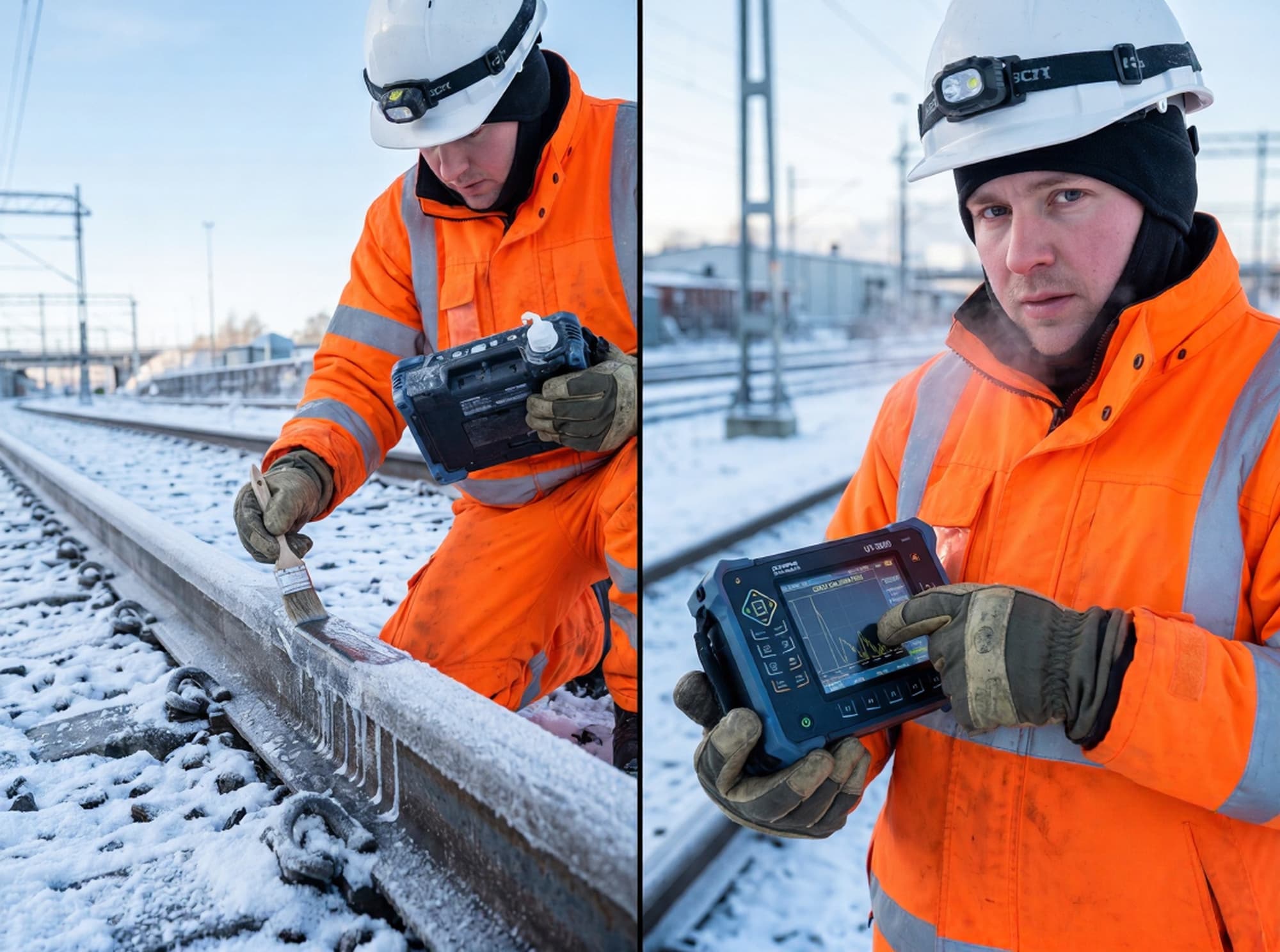
Cold Weather UT Testing becomes far more complex when freezing temperatures begin to affect equipment, materials, and inspection surfaces. Cold Weather UT Testing also demands tighter calibration control because sound waves behave differently in low-temperature environments. Cold Weather UT Testing often exposes hidden flaws in inspection routines that remain unnoticed during normal weather conditions.
Winter environments create serious challenges for ultrasonic inspections across rail, pipeline, structural steel, and industrial facilities. Temperature drops can alter sound velocity, while moisture and frost interfere with probe coupling. Even experienced technicians face difficulties when ice, wind chill, and condensation enter the equation.
Inspection accuracy matters because industries rely on ultrasonic testing to protect critical assets and maintain operational safety. A small reading error in freezing conditions can lead to costly downtime or overlooked structural defects. The environmental factors behind these failures may appear minor at first, but the next section explains why cold conditions completely change the way ultrasonic testing behaves.
Why Cold Weather UT Testing Demands a Different Approach
Cold temperatures directly influence how ultrasonic waves travel through metal. As temperatures decrease, sound velocity inside steel changes slightly, affecting measurement accuracy and defect interpretation. In Cold Weather UT Testing, even minor velocity shifts can create thickness deviations that lead to incorrect evaluations.
Metal contraction also becomes a significant factor during winter inspections. Steel contracts as temperatures fall, which changes material dimensions and influences thickness readings. These changes may seem minimal, but ultrasonic testing relies on precision measured in fractions of millimeters.
Transducers also struggle in harsh cold environments. Piezoelectric crystals inside probes may respond more slowly in freezing temperatures. Reduced responsiveness weakens signal clarity and increases the possibility of missed indications.
Cold environments create additional stress on inspection systems. Batteries drain faster, display screens become sluggish, and cables lose flexibility. All these issues combine to make Cold Weather UT Testing more demanding than standard inspections performed at room temperature.
Technicians often underestimate how quickly environmental conditions affect inspection reliability. A calibration performed indoors may no longer remain accurate outside in sub-zero temperatures. The shift can happen within minutes.
How Does Cold Weather Affect Ultrasonic Testing (UT) Accuracy?
Cold weather affects ultrasonic testing accuracy by changing sound velocity, material dimensions, and transducer responsiveness. These factors influence calibration stability and flaw detection reliability during inspections.
The velocity of sound inside steel varies depending on temperature. Lower temperatures slightly increase sound velocity, while warmer conditions reduce it. In Cold Weather UT Testing, these changes require technicians to compensate readings carefully.
The effect becomes more noticeable during high-precision inspections. Rail inspections, pressure vessel examinations, and pipeline assessments often depend on exact thickness calculations. Even a small calibration shift can distort the final reading.
The following table shows how sound velocity changes in carbon steel at different temperatures:
| Temperature | Approximate Sound Velocity in Carbon Steel |
| -20°C | 5,970 m/s |
| 0°C | 5,930 m/s |
| 20°C | 5,900 m/s |
These differences may appear small, but ultrasonic testing systems amplify minor variations during long-distance wave travel. A defect positioned deep within thick steel may produce misleading echoes if calibration fails to account for temperature.
Another concern involves uneven temperatures across the test material itself. A partially frozen component may create inconsistent wave behavior between different sections. This issue complicates defect interpretation and increases inspection uncertainty.
Field technicians often rely on reference blocks calibrated at controlled temperatures. However, outdoor winter conditions rarely remain stable. Wind exposure, ice buildup, and sudden temperature drops continuously affect inspection surfaces.
Modern digital UT systems provide temperature compensation features, but they still require experienced interpretation. Automated compensation alone cannot eliminate every environmental variable during Cold Weather UT Testing.
Temperature is only one side of the challenge. Once frost and moisture enter the inspection surface, signal quality becomes even more unpredictable. The next section explores how hidden moisture quietly disrupts ultrasonic inspections in winter environments.
The Moisture Problem: Frost, Ice, and Condensation on Test Surfaces
Moisture creates one of the biggest reliability issues during Cold Weather UT Testing. Ultrasonic waves require stable acoustic coupling between the transducer and the test surface. Frost, condensation, and thin ice layers interrupt this connection and distort signal transmission.
Surface moisture often remains invisible during winter inspections. A metal surface may appear dry while still holding microscopic condensation caused by temperature differences between air and steel. This hidden moisture weakens coupling efficiency and introduces inconsistent readings.
Frost creates another serious problem. Even a thin frost layer traps air pockets between the probe and the material surface. Air blocks ultrasonic wave transmission, reducing signal strength and creating unreliable echoes.
Partially thawed surfaces can become even more dangerous for inspection accuracy. As frozen surfaces warm slightly, condensation rapidly forms across the metal. Many technicians focus on visible ice while overlooking this thin moisture film.
Cold Weather UT Testing becomes particularly difficult when inspections occur outdoors during changing weather conditions. Morning frost may disappear by midday, but residual moisture continues affecting signal stability.
Wind-driven snow also contaminates inspection surfaces. Snow particles melt under warm probes and form uneven moisture patches. These patches create inconsistent coupling across the inspection area.
What Problems Do Moisture, Frost, and Condensation Cause During UT Inspections?
Moisture, frost, and condensation reduce signal quality, distort readings, and increase the risk of inaccurate flaw detection during ultrasonic testing.
Several problems commonly appear during Cold Weather UT Testing:
- Signal attenuation
Moisture layers weaken ultrasonic wave transmission and reduce signal clarity. - False readings from ice pockets
Thin ice formations may create misleading echoes that resemble internal defects. - Couplant freezing on contact
Standard couplants can freeze instantly on extremely cold surfaces. - Probe slippage and inconsistent contact
Frost-covered surfaces reduce probe stability during manual scanning. - Trapped air causing echo artifacts
Air pockets beneath frost or condensation distort reflected signals.
These issues often occur simultaneously during field inspections. A frozen surface may contain frost, trapped moisture, and temperature gradients all at once. Together, these conditions severely reduce inspection reliability.
Experienced inspectors understand that proper surface preparation becomes essential during Cold Weather UT Testing. Cleaning alone is not enough. Surfaces must remain dry and stable throughout the inspection process.
Environmental conditions can also change rapidly during long inspection shifts. A component inspected successfully in the morning may develop condensation later in the day as temperatures fluctuate.
Moisture problems do not stop at the surface level. Once couplants begin freezing or thickening in low temperatures, another layer of complexity appears. Choosing the wrong couplant can compromise the entire inspection process, and the next section explains why couplant selection matters more in winter than most facilities realize.
Choosing the Right Couplant for Cold Weather UT Testing
Couplants play a critical role in Cold Weather UT Testing because ultrasonic waves cannot travel efficiently through air gaps. Standard couplants used in normal environments often fail once temperatures drop below freezing.
Many conventional water-based couplants thicken rapidly in cold conditions. Some freeze directly on contact with icy surfaces, preventing stable acoustic transmission. When this happens, signal consistency drops and inspection accuracy suffers.
Winter-grade couplants require several important properties. They must maintain stable viscosity at low temperatures while resisting freezing during extended inspections. They also need proper acoustic impedance to support strong wave transmission.
Technicians performing Cold Weather UT Testing often select couplants based on environmental severity and inspection duration. Outdoor rail inspections may require different solutions than indoor cold-storage facility inspections.
Common couplants used in freezing conditions include:
- Glycerin-based couplants
- Propylene glycol solutions
- High-viscosity gel couplants
- Specially formulated winter couplants from manufacturers like Sonotech
Glycerin-based products remain popular because they resist freezing while maintaining good acoustic performance. Propylene glycol solutions also perform well in sub-zero environments and provide smoother probe movement.
High-viscosity gel couplants help maintain stable contact on vertical or uneven surfaces. Specialized winter couplants offer enhanced low-temperature performance for extreme industrial conditions.
Some technicians attempt to pre-heat inspection surfaces before applying couplant. While this method improves temporary coupling, it introduces another challenge. Rapid temperature changes can create condensation immediately after warming the surface.
Cold Weather UT Testing requires a careful balance between surface preparation, couplant behavior, and inspection timing. Using the correct couplant often determines whether signal quality remains stable throughout the inspection.
Couplants alone cannot solve every winter inspection problem. The equipment itself also reacts differently in freezing environments, and those hidden equipment failures often appear when inspections matter most.
Equipment and Transducer Behavior in Cold Environments
Inspection equipment experiences significant stress during Cold Weather UT Testing. Low temperatures reduce battery efficiency, weaken display responsiveness, and affect transducer sensitivity.
Battery performance drops sharply in freezing environments. Portable UT devices may lose power much faster outdoors than in controlled indoor settings. Some batteries experience sudden voltage drops that interrupt inspections unexpectedly.
Transducers also behave differently in cold conditions. Piezoelectric crystals inside probes become less responsive at low temperatures. Reduced responsiveness affects signal generation and damping performance.
Cable systems face additional strain during Cold Weather UT Testing. Flexible cables become brittle in extreme cold, increasing the risk of cracking or internal wire damage. Connector points may also accumulate frost or moisture that disrupts signal transmission.
Calibration drift becomes another major concern. Equipment calibrated indoors may produce inaccurate readings after exposure to freezing temperatures. This drift occurs because electronic components and wave behavior change as temperatures fluctuate.
Digital screens often respond slowly in harsh winter environments. Display lag may delay waveform interpretation and reduce inspection efficiency. Gloves worn for protection can also limit fine control during manual adjustments.
Environmental exposure creates cumulative stress across the entire inspection system. Wind chill intensifies cooling effects, while repeated temperature transitions increase condensation risks inside equipment housings.
Warming Up Equipment: Best Practices Before Starting Cold Weather UT Testing
Proper equipment warm-up procedures improve stability and reduce inspection errors during Cold Weather UT Testing.
Technicians should allow equipment to adjust gradually to outdoor temperatures before beginning inspections. Sudden exposure to freezing air can shock sensitive electronic components and affect transducer performance.
Controlled storage conditions also help maintain equipment reliability. Keeping probes, batteries, and calibration blocks in temperature-managed cases reduces thermal stress before deployment.
Rapid heating methods should be avoided because they may create internal condensation. Slow acclimatization protects both electronic systems and piezoelectric elements.
Many experienced inspectors also perform verification calibrations after equipment reaches outdoor operating temperature. This extra step helps maintain reliable readings during Cold Weather UT Testing and reduces the risk of hidden calibration drift.
Environmental Challenges in Cold Weather UT Rail Testing
Cold Weather UT Testing in rail environments becomes exceptionally difficult because rail systems face constant exposure to harsh winter conditions. Snow, ice, wind, and fluctuating temperatures all interfere with inspection reliability and technician performance.
Rail contraction creates one of the biggest challenges during winter inspections. As temperatures drop, rails shrink slightly and alter normal wave propagation paths. These dimensional changes influence ultrasonic signal travel and affect flaw interpretation.
Snow and ice accumulation on rail heads also disrupts probe contact. Even thin ice layers can interrupt acoustic coupling and reduce signal clarity. In Cold Weather UT Testing, inconsistent coupling often leads to missed defects or distorted readings.
Wind chill creates additional complications. Extreme wind exposure affects technician concentration and accelerates equipment cooling. Portable UT devices lose battery power faster, while cables stiffen and become harder to manage.
Rail inspections often occur in remote outdoor environments where conditions change rapidly. A section of track inspected during clear weather may become snow-covered within hours. These environmental shifts demand constant inspection adjustments.
Cold Weather UT Testing also becomes more difficult because rail surfaces rarely remain uniform during winter. Some areas may stay frozen while others partially thaw under sunlight or friction from rail traffic.
Key site conditions that compromise rail inspections include:
- Snow accumulation on rail surfaces
- Ice formation near weld zones
- Wind chill affecting equipment stability
- Temperature fluctuations across rail sections
- Condensation forming during thaw cycles
- Reduced technician visibility during snowfall
Winter rail inspections require far more than standard ultrasonic procedures. Environmental awareness becomes just as important as technical skill.
The challenge does not end with weather exposure alone. Even the best equipment can fail if field protocols are not adjusted properly. The next section explains the inspection practices that separate reliable winter testing from inaccurate results.
Field Protocols That Make or Break Cold Weather UT Testing
Field protocols determine whether Cold Weather UT Testing produces reliable results or costly inspection errors. Winter conditions introduce unpredictable variables that demand stricter preparation and continuous monitoring throughout the inspection process.
Surface preparation becomes the first critical step. Technicians must remove snow, frost, moisture, and ice completely before applying couplant. Even small contamination layers reduce signal quality and distort ultrasonic readings.
Cold Weather UT Testing also requires controlled couplant application. Standard methods used during warm weather often fail because cold surfaces freeze couplants rapidly or create uneven distribution.
Inspection teams typically follow several key procedures during winter operations:
- Surface cleaning and drying methods
Technicians remove frost, snow, and condensation using dry cloths, heaters, or approved cleaning systems. - Couplant application technique in cold conditions
Winter-grade couplants are applied carefully to maintain consistent acoustic contact. - Equipment warm-up and calibration verification
UT systems must stabilize at outdoor operating temperatures before inspections begin. - Re-calibration intervals during long cold-weather inspections
Frequent verification checks help identify calibration drift caused by changing temperatures. - Documentation adjustments for temperature-corrected readings
Temperature data is recorded alongside inspection results for accurate interpretation.
Inspection timing also matters during Cold Weather UT Testing. Early morning inspections often encounter frost-covered surfaces, while midday inspections may face condensation caused by partial thawing.
Long-duration inspections create additional complications. Equipment performance may degrade gradually as batteries cool and cables stiffen. Technicians must continuously monitor signal stability throughout the process.
Communication between inspection crews becomes increasingly important in winter conditions. Environmental changes can happen quickly, especially during rail inspections or outdoor structural assessments.
Cold Weather UT Testing succeeds when protocols adapt to environmental realities instead of relying solely on standard inspection routines. Small procedural failures often create the largest accuracy problems.
Accurate calibration remains one of the most important winter inspection requirements. Without temperature-corrected calibration methods, even advanced UT systems can produce misleading results.
Calibration Adjustments for Temperature-Corrected Readings
Calibration adjustments help maintain inspection accuracy during Cold Weather UT Testing by compensating for temperature-related wave behavior changes.
Calibration blocks should match the approximate temperature of the material being inspected. Using warm calibration blocks on frozen steel creates incorrect velocity references and unreliable measurements.
Temperature-compensated DAC curves also improve inspection consistency. These adjusted reference curves account for sound velocity shifts caused by cold environments.
Technicians performing Cold Weather UT Testing often re-zero equipment multiple times during long inspections. Outdoor temperatures rarely remain stable, especially during changing winter weather conditions.
Calibration drift may occur gradually as transducers, cables, and electronic components cool further throughout the inspection. Frequent verification checks help identify these shifts before they affect final readings.
Environmental exposure creates another challenge. A calibration completed successfully during setup may become inaccurate after equipment remains exposed to freezing wind for extended periods.
Experienced inspectors understand that winter calibration requires constant attention rather than a one-time adjustment. Reliable Cold Weather UT Testing depends heavily on maintaining stable reference conditions throughout the inspection process.
Inspection accuracy alone does not guarantee safe operations. Winter environments also create safety risks that regulatory standards attempt to address, and the next section explores how industry guidelines influence cold-weather ultrasonic testing practices.
Safety Standards and Regulatory Considerations
Industry standards recognize that environmental conditions directly affect ultrasonic inspection reliability. Cold Weather UT Testing must follow strict procedures to ensure accurate flaw detection and safe operation.
Standards such as ASTM E317 and AWS D1.1 provide guidance for ultrasonic inspection practices under varying environmental conditions. These standards emphasize proper calibration, equipment verification, and surface preparation requirements.
Some codes also recommend minimum temperature thresholds for inspections. Extremely cold environments may require delayed testing, additional controls, or specialized procedures to maintain accuracy.
Cold Weather UT Testing often demands extra documentation as well. Inspectors may need to record surface temperature, ambient conditions, calibration adjustments, and couplant types during inspections.
The following table summarizes several commonly referenced standards and their winter inspection considerations:
| Standard | Cold-Weather Considerations |
| ASTM E317 | Emphasizes calibration accuracy and equipment verification |
| AWS D1.1 | Requires suitable environmental conditions for reliable inspections |
| ASME Section V | Supports temperature-corrected calibration practices |
| EN ISO 17640 | Addresses coupling conditions and surface preparation |
Regulatory compliance becomes especially important in industries such as rail, oil and gas, aerospace, and structural steel fabrication. Inspection failures in these sectors may lead to severe safety risks and operational disruptions.
Cold Weather UT Testing also requires trained personnel capable of interpreting environmentally affected signals correctly. Standards alone cannot eliminate errors if technicians lack winter inspection experience.
Modern inspection programs increasingly integrate environmental risk assessments into winter UT procedures. This proactive approach helps organizations maintain both compliance and operational reliability.
Meeting standards is only part of the equation. Real-world inspection success depends on how companies apply these requirements under difficult field conditions, and that practical execution often defines inspection quality.
Final Thoughts
Cold Weather UT Testing introduces challenges that extend far beyond normal ultrasonic inspection conditions. Temperature shifts alter sound velocity, metal contraction affects readings, and freezing environments create constant calibration concerns.
Moisture, frost, and condensation also interfere with acoustic coupling and signal stability. At the same time, batteries, cables, probes, and electronic systems experience additional stress during prolonged winter exposure.
Proper couplant selection, equipment preparation, and temperature-corrected calibration procedures remain essential for reliable Cold Weather UT Testing. Without these controls, inspections become vulnerable to inaccurate readings and missed defects.
Industries that operate in harsh winter environments must treat Cold Weather UT Testing as a specialized process rather than a routine inspection task. Reliable procedures, trained personnel, and environmentally prepared equipment help protect critical infrastructure and maintain long-term operational safety.
As industries continue operating in increasingly demanding climates, the importance of precise and dependable Cold Weather UT Testing will only continue to grow.
Key Takeaways
- Cold Weather UT Testing requires temperature-adjusted calibration to maintain accurate ultrasonic inspection readings.
- Freezing temperatures change sound wave velocity and directly influence flaw detection reliability.
- Frost, condensation, and ice layers often disrupt acoustic coupling during winter inspections.
- Winter-grade couplants help maintain stable signal transmission on extremely cold inspection surfaces.
- Rail inspections become more difficult because cold weather changes rail dimensions and wave paths.
- Ultrasonic testing equipment experiences faster battery drain and calibration drift during freezing conditions.
- Proper surface cleaning and drying significantly reduce false echoes and inconsistent ultrasonic readings.
- Technicians must frequently verify calibration during extended Cold Weather UT Testing field operations.
- Wind chill, snow accumulation, and moisture create serious environmental challenges for outdoor inspections.
- Successful Cold Weather UT Testing depends on trained inspectors following strict winter inspection protocols.
FAQs
Can ultrasonic testing be performed in freezing temperatures?
Yes, ultrasonic testing can be performed in freezing temperatures when inspectors use proper winter-grade equipment, couplants, and calibration procedures. Cold Weather UT Testing requires additional precautions because low temperatures affect sound velocity, probe performance, and surface conditions.
How do temperature changes affect UT calibration results?
Temperature changes affect UT calibration by altering sound wave velocity and material dimensions. During Cold Weather UT Testing, calibration drift may occur as equipment and steel temperatures fluctuate, leading to inaccurate thickness readings or flaw interpretation if adjustments are not made.
What are the biggest winter challenges in ultrasonic rail testing?
The biggest winter challenges include rail contraction, snow buildup, ice formation, moisture contamination, and unstable coupling conditions. Wind chill and rapidly changing outdoor temperatures also affect equipment performance and inspection accuracy during rail inspections.
Why is couplant selection important in cold weather UT inspections?
Couplant selection is critical because standard couplants may freeze or thicken in low temperatures. Cold Weather UT Testing requires winter-grade couplants that maintain proper viscosity and acoustic transmission to ensure stable probe contact and reliable signal quality.
What precautions should inspectors take during cold weather UT testing?
Inspectors should clean and dry inspection surfaces thoroughly, warm equipment gradually, verify calibration frequently, and use cold-resistant couplants. Proper environmental monitoring and temperature-corrected readings also help maintain reliable Cold Weather UT Testing results.