

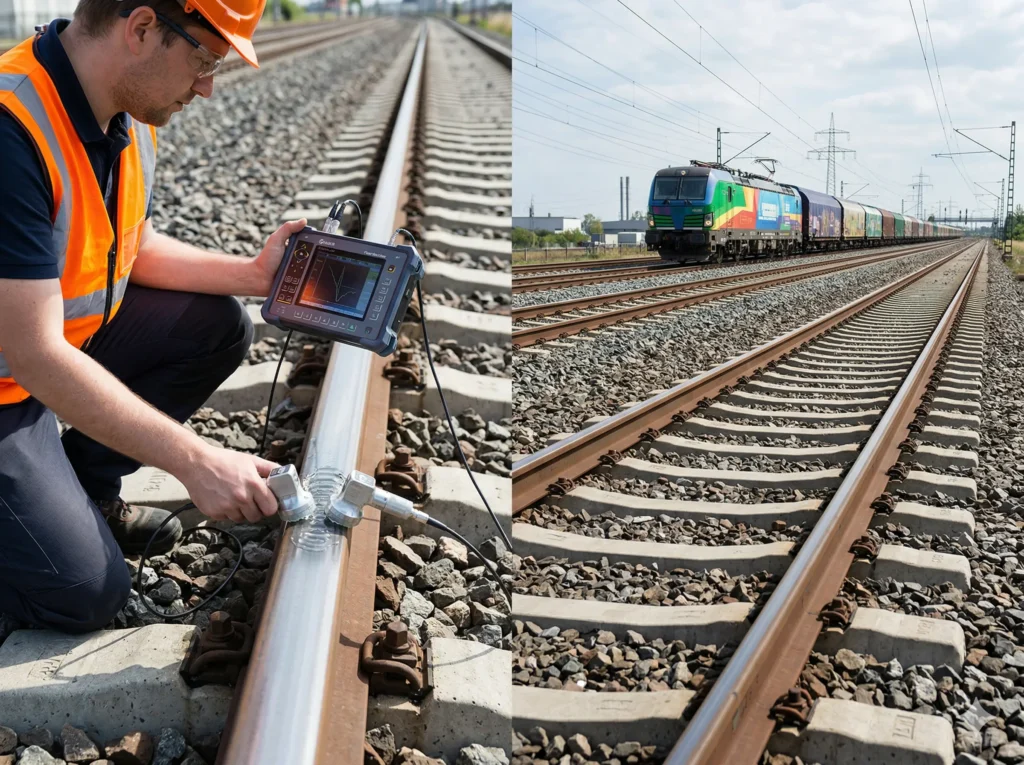
How Ultrasonic Rail Flaw Detection Works determines whether hidden internal defects are detected early or allowed to grow into serious failures.
Railway tracks often appear strong and flawless. However, internal damage can develop silently beneath the surface. These defects grow over time due to stress, fatigue, and environmental exposure. Without proper inspection, even a small flaw can evolve into a dangerous situation.
Rail networks carry millions of passengers and heavy freight daily. Any unnoticed defect can disrupt operations or cause accidents. This makes advanced inspection technologies essential for maintaining safety and efficiency.
Our guide explores the complete working mechanism of ultrasonic rail flaw detection. It explains the science, importance, and practical applications of this method. It also highlights why industries rely on this technology for accurate and reliable inspection.
What Is Ultrasonic Rail Flaw Detection?
How Ultrasonic Rail Flaw Detection Works starts with understanding the concept itself. Ultrasonic rail flaw detection is a non-destructive testing method that uses high-frequency sound waves to identify internal defects in railway tracks.
This technique belongs to the non-destructive testing (NDT) family. NDT methods allow inspection without damaging the material. This makes them ideal for infrastructure like railways, where continuous operation is necessary.
The technology gained importance during the expansion of rail networks in the 20th century. As trains became faster and heavier, the risk of rail failure increased. Engineers needed a method that could detect hidden flaws without dismantling the track.
Ultrasonic testing provided that solution. It allowed inspectors to examine the internal condition of rails quickly and accurately. Over time, the technology evolved with better sensors and digital systems.
The method works by sending ultrasonic waves into the rail using a probe. These waves travel through the metal until they encounter a defect. When this happens, part of the wave reflects back to the probe.
The reflected signals are then analyzed to determine the size and location of the flaw. This process allows inspectors to detect issues that cannot be seen on the surface.
Modern systems use both manual devices and automated inspection vehicles. These tools can scan long stretches of track efficiently. They also provide real-time data for faster decision-making.
Why Rail Flaw Detection Matters
How Ultrasonic Rail Flaw Detection Works becomes more meaningful when the risks of undetected flaws are understood. Railway failures often occur due to internal defects that remain invisible until it is too late.
Studies show that a significant number of rail accidents originate from internal cracks. These cracks develop gradually under repeated loads and stress cycles. Over time, they weaken the structure of the rail.
Some of the most common defects include:
- Transverse cracks
- Horizontal split heads
- Shelling and spalling
- Internal inclusions
Each of these defects can compromise the integrity of the rail. For example, transverse cracks can grow quickly and lead to sudden breakage. Shelling causes surface damage that eventually spreads inward.
Environmental conditions also contribute to defect formation. Temperature changes cause expansion and contraction. Moisture and corrosion further weaken the material.
The consequences of undetected flaws are severe. Rail breaks can lead to derailments, equipment damage, and service delays. In extreme cases, they can result in injuries or fatalities.
Rail operators aim to prevent such incidents through regular inspection. Ultrasonic testing enables early detection of internal defects. This allows maintenance teams to take corrective action before the problem worsens.
Preventive maintenance also reduces long-term costs. Fixing a small defect is far less expensive than repairing a damaged rail line. It also minimizes downtime and improves operational efficiency.
What Are the 4 Types of NDT?
How Ultrasonic Rail Flaw Detection Works is closely connected to the broader field of non-destructive testing. NDT includes several techniques designed to evaluate materials without causing damage.
The four main types of NDT include ultrasonic testing, magnetic particle testing, radiographic testing, and eddy current testing.
Ultrasonic Testing (UT)
Ultrasonic testing uses high-frequency sound waves to detect internal defects. It provides detailed information about flaw size and location. This method is widely used in rail inspection due to its depth penetration.
Magnetic Particle Testing (MT)
Magnetic particle testing detects surface and near-surface defects. It works by applying a magnetic field and observing the behavior of magnetic particles. This method is effective but limited to surface-level inspection.
Radiographic Testing (RT)
Radiographic testing uses X-rays or gamma rays to create images of internal structures. It is highly accurate but involves safety risks due to radiation exposure.
Eddy Current Testing (ET)
Eddy current testing uses electromagnetic fields to detect surface defects. It is fast and efficient, but cannot detect deep internal flaws.
Among these methods, ultrasonic testing stands out for railway applications. It offers a balance of safety, accuracy, and depth penetration. Unlike radiographic testing, it does not require strict radiation controls.
It also detects internal defects more effectively than magnetic or eddy current methods. This makes it the preferred choice for rail inspection worldwide.
But knowing the types of NDT only scratches the surface, what actually happens inside the rail when ultrasonic waves are used? The answer lies in the science behind the technology.
The Core Science Behind How Ultrasonic Rail Flaw Detection Works
How Ultrasonic Rail Flaw Detection Works depends on the behavior of sound waves inside solid materials. Ultrasonic waves travel through metals and interact with internal structures.
A transducer generates these waves at high frequencies. The waves then enter the rail and propagate through its structure. When they encounter a discontinuity, part of the energy reflects back.
This reflection forms the basis of defect detection. The technique used is called the pulse-echo method. It measures the time taken for the wave to return after hitting a flaw.
The system calculates the distance of the defect based on this time. It also analyzes the strength of the reflected signal to estimate the size of the flaw.
Several components work together in this process:
- Transducer: Produces and receives ultrasonic waves
- Couplant: Ensures efficient transmission between probe and rail
- Receiver: Captures reflected signals
- Display unit: Visualizes the data
Different display formats help interpret the signals effectively.
A-Scan Display
The A-scan shows signal amplitude against time. It helps determine the depth of a defect.
B-Scan Display
The B-scan provides a cross-sectional view of the rail. It shows the position of defects along the track.
C-Scan Display
The C-scan offers a top view of the inspected area. It creates a detailed map of internal flaws.
How Ultrasonic Rail Flaw Detection Works becomes clearer when analyzing these visual outputs. Each signal represents an interaction between sound waves and the material.
Advanced systems use digital processing to improve accuracy. They can filter noise and highlight critical defects. Some systems even integrate software for automated analysis.
Engineers interpret these signals to decide whether a defect is harmless or dangerous. This decision plays a crucial role in maintenance planning.
How to Use an Ultrasonic Flaw Detector on Rails
How Ultrasonic Rail Flaw Detection Works becomes practical when applied in real inspection environments. Using an ultrasonic flaw detector on rails involves careful preparation, precise calibration, and skilled interpretation of signals.
The process begins with equipment setup. Inspectors select the appropriate transducer angle based on the type of defect they expect. Angled probes help detect cracks that are not perpendicular to the surface. A couplant, usually a liquid gel, is applied to ensure proper transmission of sound waves into the rail.
Calibration is the next critical step. Inspectors use reference blocks with known defects to adjust the device. This ensures accurate readings during the actual inspection. Without calibration, the results may become unreliable.
Once the setup is complete, the scanning process begins. The transducer moves along the rail surface while continuously sending ultrasonic waves. The device captures reflected signals in real time. These signals appear on the display as waveforms.
Inspectors analyze these waveforms to identify irregularities. A sudden change in signal pattern often indicates a defect. The position and intensity of the signal help determine the size and depth of the flaw.
Modern inspection methods include both manual and automated approaches. Manual testing allows detailed examination of specific sections. However, automated rail inspection vehicles can scan long distances efficiently. These vehicles use multiple sensors and advanced software to detect defects at high speeds.
How Ultrasonic Rail Flaw Detection Works in these systems combines precision with speed. It allows railway operators to monitor track conditions continuously.
But even with advanced tools, different techniques are required to detect various types of flaws, so what are these specialized methods, and how do they differ? Let’s explore that next.
Types of Ultrasonic Techniques Used in Rail Inspection
How Ultrasonic Rail Flaw Detection Works varies depending on the technique used. Different methods are designed to detect specific types of defects with greater accuracy.
Pulse-Echo Method
The pulse-echo method is the most widely used technique. It sends a single ultrasonic pulse into the rail and measures the reflected signal. This method is effective for detecting internal flaws such as cracks and voids.
It provides clear information about defect location and depth. However, it requires skilled interpretation to distinguish between harmless reflections and critical defects.
Phased Array Ultrasonic Testing (PAUT)
Phased Array Ultrasonic Testing uses multiple transducer elements. These elements can be controlled electronically to steer and focus the sound beam.
This technique offers high precision and flexibility. It can scan different angles without changing the probe position. PAUT also produces detailed images, making it easier to identify complex defects.
Rail inspection systems increasingly use PAUT for advanced diagnostics. It improves detection accuracy and reduces inspection time.
Time-of-Flight Diffraction (TOFD)
TOFD measures the time it takes for ultrasonic waves to diffract around a defect. This method provides highly accurate sizing of cracks.
It is especially useful for detecting vertical cracks and monitoring their growth. However, it often works best when combined with other techniques.
How Ultrasonic Rail Flaw Detection Works across these methods highlights the adaptability of ultrasonic testing. Each technique offers unique advantages depending on the inspection requirements.
What Is Ultrasonic Rail Flaw Detection Used For?
How Ultrasonic Rail Flaw Detection Works serves a clear purpose in railway maintenance. It is used to inspect different parts of the rail and detect internal defects before they become dangerous.
The rail consists of three main sections:
- Rail head
- Rail web
- Rail foot
Each section experiences different types of stress. The rail head faces direct contact with train wheels. The web supports structural load. The foot stabilizes the rail on the track.
Ultrasonic testing examines all these sections for defects. It detects transverse cracks, horizontal split heads, and detail fractures. These defects often develop due to repeated loading and fatigue.
How Ultrasonic Rail Flaw Detection Works allows inspectors to identify these issues at an early stage. Early detection helps prevent sudden rail failure.
The results of inspections guide maintenance decisions. Engineers use the data to schedule repairs or replacements. This approach reduces downtime and improves safety.
Rail operators also use ultrasonic testing for quality control during manufacturing. It ensures that rails meet safety standards before installation.
The ability to detect hidden flaws makes this technology essential for modern rail systems. However, even the most advanced methods have limitations. What challenges does ultrasonic testing face in real-world conditions? The next section uncovers these realities.
Limitations and Challenges
How Ultrasonic Rail Flaw Detection Works is highly effective, but it is not without challenges. Certain conditions can affect the accuracy of ultrasonic testing.
One major limitation is the near-surface dead zone. Ultrasonic waves may not detect defects very close to the surface. This creates a small blind area where flaws can go unnoticed.
Surface conditions also play a role. Rough or corrugated rail surfaces can interfere with wave transmission. This reduces signal quality and makes interpretation more difficult.
Coupling issues can also arise. If the couplant is not applied properly, the sound waves may not enter the rail effectively. This can lead to inaccurate readings.
Environmental factors further complicate the process. Temperature changes can affect material properties and wave behavior. Rail geometry and alignment can also influence results.
Despite these challenges, continuous advancements improve the reliability of ultrasonic testing. Engineers develop better probes, software, and inspection techniques to overcome these limitations.
Understanding these constraints helps inspectors make informed decisions. It also highlights the need for skilled professionals in rail inspection.
The Future of Ultrasonic Rail Flaw Detection
How Ultrasonic Rail Flaw Detection Works continues to evolve with technological advancements. The future of this field lies in automation, data analytics, and artificial intelligence.
Modern systems are integrating AI to analyze ultrasonic data. These systems can identify patterns and detect defects more accurately. They also reduce human error in interpretation.
Autonomous inspection vehicles are becoming more common. These vehicles can scan railway tracks without manual intervention. They provide real-time data and improve inspection efficiency.
Drones are also being explored for rail inspection. They can access difficult areas and complement ground-based systems.
Data analytics plays a crucial role in predictive maintenance. By analyzing historical data, engineers can predict when a rail is likely to fail. This allows proactive maintenance and reduces unexpected breakdowns.
The future promises faster, smarter, and more reliable inspection systems. These advancements will further enhance railway safety worldwide.
Final Thoughts
How Ultrasonic Rail Flaw Detection Works remains essential for maintaining the safety and reliability of railway systems. It provides a powerful method for detecting hidden defects that could otherwise lead to serious failures. How Ultrasonic Rail Flaw Detection Works ensures that railway infrastructure remains strong, efficient, and secure.
This technology combines scientific principles with practical application. It allows early detection, reduces maintenance costs, and prevents accidents. Its role in modern rail systems cannot be overstated.
As advancements continue, ultrasonic testing will become even more accurate and efficient. Railway operators depend on this technology to ensure safe journeys every day. Investing in advanced inspection methods is not just a choice; it is a necessity.
Key Takeaways
- Ultrasonic rail flaw detection uses high-frequency sound waves to identify internal rail defects accurately.
- This method belongs to non-destructive testing, ensuring rails remain undamaged during inspection processes.
- Early detection of internal flaws significantly reduces the risk of derailments and accidents.
- Ultrasonic testing provides precise data about defect size, depth, and exact location.
- Different ultrasonic techniques enhance detection capabilities for various types of rail defects.
- Automated inspection vehicles allow faster scanning of long railway tracks efficiently.
- Environmental conditions and surface irregularities can influence the accuracy of ultrasonic readings.
- Proper calibration and skilled interpretation are essential for obtaining reliable inspection results.
- Advanced technologies like AI improve defect detection and reduce human error significantly.
- Ultrasonic rail flaw detection plays a critical role in ensuring safe and reliable railway operations.
FAQs
What is the basic principle of UT?
The basic principle of ultrasonic testing relies on high-frequency sound waves traveling through a material. When these waves encounter a defect, they reflect back to the source. The system analyzes these reflections to identify the location and size of flaws.
How to calibrate an ultrasonic flaw detector?
Calibration involves using a reference block with known defects to set accurate measurement standards. The operator adjusts sensitivity, range, and time settings based on this reference. Proper calibration ensures reliable and consistent inspection results during testing.
What are the 4 types of ultrasonic waves?
The four main types include longitudinal waves, shear waves, surface waves, and plate waves. Each wave type behaves differently and suits specific inspection requirements. In rail testing, longitudinal and shear waves are commonly used for deeper penetration.
What is the difference between NDT and UT?
NDT is a broad category of testing methods used to inspect materials without causing damage. Ultrasonic testing is one specific method within NDT that uses sound waves. UT focuses mainly on detecting internal defects with high accuracy.
What are the 5 most common tests in NDT?
The most common NDT methods include ultrasonic testing, radiographic testing, magnetic particle testing, eddy current testing, and liquid penetrant testing. Each method serves different inspection needs depending on the material and defect type. Ultrasonic testing remains the preferred choice for detecting internal rail defects.
