

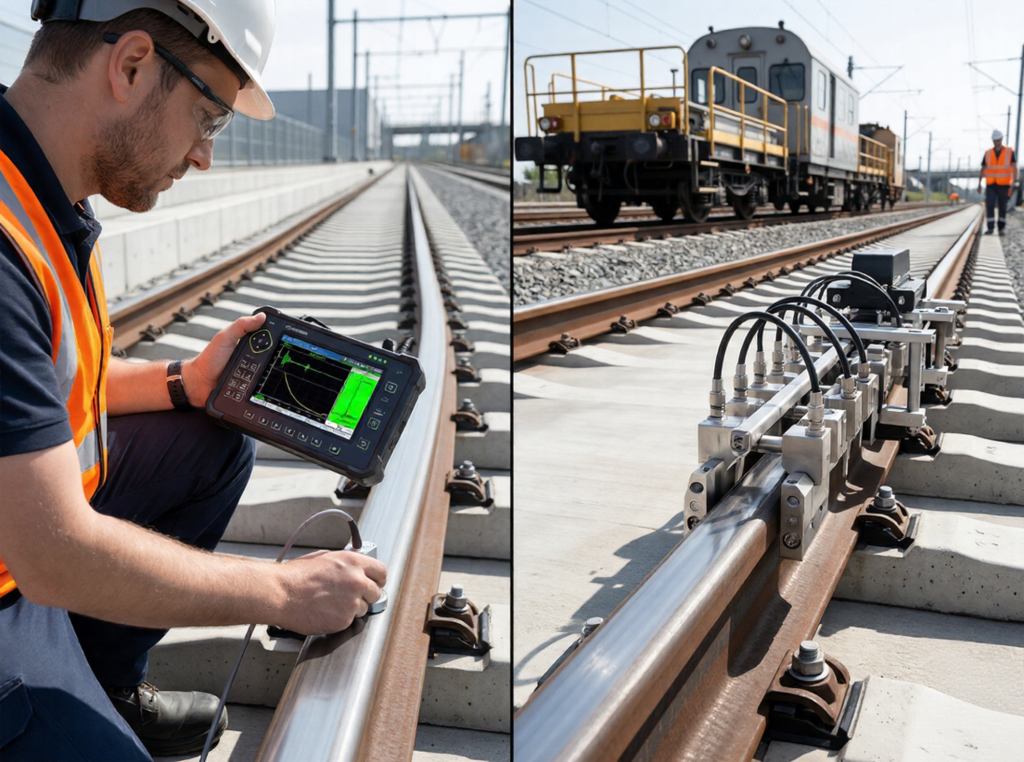
Rail failures continue to challenge railway operators across the world. Reports from authorities such as the Federal Railroad Administration show that rail defects contribute to a notable percentage of derailments every year. Internal rail defect detection methods have become essential in preventing these failures before they lead to serious consequences. Internal rail defect detection methods play a crucial role in identifying hidden flaws that traditional inspections often miss. Internal rail defect detection methods are now at the center of modern rail safety strategies as networks grow and traffic intensifies.
Unlike visible damage, internal defects develop beneath the rail surface. They remain undetected until they reach a critical stage. This makes them far more dangerous than surface-level issues. A rail can appear structurally sound while a crack silently expands within it.
Rail infrastructure faces constant stress from heavy loads and environmental factors. Over time, these forces create microscopic flaws that grow into serious defects. Detecting them early ensures operational safety and reduces maintenance costs.
Modern railway systems now rely on advanced technologies to uncover these hidden threats. These solutions provide deeper insights into rail health and improve decision-making. Yet, understanding the nature of these defects remains the first step toward effective detection.
What Are Internal Rail Defects and Why Do They Matter?
Internal rail defects are structural irregularities that form within the rail material. Common examples include transverse cracks, detail fractures, shelling, and inclusions. Each of these defects weakens the rail from within, making it prone to sudden failure.
These defects are invisible during standard visual inspections. They develop due to repeated stress cycles, thermal expansion, and material fatigue. Even a small flaw can grow rapidly under continuous loading.
The consequences of undetected defects can be severe. Rail breaks often result in derailments, which disrupt operations and cause financial losses. More importantly, they pose serious safety risks to passengers and cargo.
Statistical data highlights the seriousness of the issue. Rail defects account for a significant portion of track-related derailments globally. In heavy-haul operations, transverse defects alone contribute to a large number of failures.
The unpredictable nature of these defects makes them even more dangerous. Some remain stable for long periods, while others expand quickly without warning. This uncertainty demands reliable detection methods that can identify flaws early.
Rail operators cannot rely solely on visual inspections anymore. They require technologies that can penetrate beneath the surface and provide accurate results.
How Internal Rail Defect Detection Methods Have Evolved
Rail inspection began with simple, manual techniques. Inspectors relied on visual checks and hammer testing to detect defects. These methods worked for obvious damage but failed to identify internal flaws.
As railway networks expanded, the need for better inspection methods became clear. Increased traffic and heavier loads demanded more reliable solutions. This led to the development of non-destructive testing technologies.
Ultrasonic testing marked a turning point in rail inspection. It allowed inspectors to detect internal defects using sound waves. This innovation significantly improved detection accuracy.
Over time, inspection systems became more advanced. Automated rail-bound vehicles replaced manual inspections in many regions. These systems scan tracks continuously, providing real-time data.
The shift from reactive maintenance to proactive monitoring transformed the industry. Instead of waiting for failures, operators now identify potential issues early.
EMA Quality Industries plays a key role in this transformation. The company provides advanced inspection solutions designed to meet modern safety standards. Its approach focuses on accuracy, efficiency, and compliance.
Despite these advancements, the effectiveness of inspection depends on the methods used. Different technologies offer different capabilities, making it important to understand each one.
So, which methods stand out as the most effective in detecting internal rail defects?
Top Internal Rail Defect Detection Methods
Ultrasonic Testing (UT)
Ultrasonic testing remains one of the most widely used internal rail defect detection methods. It uses high-frequency sound waves to identify flaws within the rail. When these waves encounter a defect, they reflect back and reveal its location.
There are two main types of ultrasonic testing. Manual UT involves handheld devices used during field inspections. Automated UT systems are mounted on rail vehicles for continuous scanning.
This method offers high accuracy in detecting deep internal defects. It can identify cracks that are not visible on the surface, making it essential for preventive maintenance.
However, ultrasonic testing requires proper calibration and skilled operation. Surface conditions, such as dirt or corrosion, can affect the results. Despite these limitations, UT remains a reliable and widely adopted method.
Magnetic Flux Leakage (MFL)
Magnetic Flux Leakage is another important technique among internal rail defect detection methods. It works by magnetizing the rail and detecting disruptions in the magnetic field caused by defects.
When a flaw exists, the magnetic field leaks out of the rail. Sensors capture this leakage and help identify the defect location.
MFL is particularly effective for detecting surface and near-surface defects. It provides fast inspection speeds, making it suitable for large-scale operations.
Compared to ultrasonic testing, MFL performs better in harsh environments. However, it has limitations in detecting deeper internal defects.
This makes it a complementary method rather than a replacement for ultrasonic testing.
Eddy Current Testing (ECT)
Eddy Current Testing uses electromagnetic induction to detect flaws in conductive materials. It generates currents within the rail and monitors changes caused by defects.
This method is highly sensitive to near-surface defects. It provides quick results and does not require direct contact with the rail surface.
ECT works well in environments where speed and precision are important. It helps detect small cracks before they grow into larger issues.
However, its ability to detect deep internal defects is limited. This restricts its use as a standalone method.
Despite this limitation, ECT plays a valuable role in comprehensive inspection systems. It works best when combined with other technologies.
Radiographic Testing (RT)
Radiographic Testing uses X-rays or gamma rays to examine the internal structure of rails. It produces detailed images that reveal defects such as cracks and voids.
This method is particularly useful for inspecting welds and critical joints. It provides precise information about defect size and shape.
However, radiographic testing requires strict safety measures due to radiation exposure. It also requires controlled conditions, which limit its use in field inspections.
As a result, RT is typically used for specific applications rather than routine inspections.
With several methods available, understanding their strengths and limitations becomes essential, but how do they compare when evaluated together?
Comparing Internal Rail Defect Detection Methods
| Method | Defect Type Detected | Depth Capability | Inspection Speed | Best Use Case |
| Ultrasonic Testing (UT) | Internal cracks, fractures | Deep | Moderate | Comprehensive rail inspection |
| Magnetic Flux Leakage | Surface, near-surface | Medium | High | Rapid scanning and surface defects |
| Eddy Current Testing | Near-surface defects | Shallow | High | Detailed surface inspection |
| Radiographic Testing | Internal imaging | Deep | Low | Weld and joint inspection |
Each method offers distinct advantages. No single technique can detect all types of defects effectively. This is why modern rail inspection systems combine multiple methods.
The integration of these technologies improves detection accuracy and reduces the risk of failure. Operators can make informed decisions based on comprehensive data.
Internal rail defect detection methods continue to evolve as new technologies emerge. These advancements promise even greater efficiency and precision in the future.
Advanced Technology-Driven Internal Rail Defect Detection Methods
Modern rail inspection continues to evolve beyond conventional approaches. While earlier internal rail defect detection methods focused on identifying existing flaws, newer technologies aim to detect damage as it forms. This shift allows operators to act earlier and prevent failures before they escalate.
Acoustic Emission Testing (AET)
Acoustic Emission Testing detects stress waves generated by material deformation. When a crack forms or grows, it releases energy in the form of acoustic signals. Sensors placed along the rail capture these signals and help identify defect locations.
This method enables real-time monitoring of rail conditions. Instead of waiting for scheduled inspections, operators can track defects continuously. This provides a major advantage in high-traffic rail networks where conditions change rapidly.
AET works best in scenarios where rails experience heavy loads and repeated stress cycles. It allows early detection of crack initiation, which traditional methods may miss.
However, interpreting acoustic data requires advanced analysis. External noise and environmental factors can affect signal accuracy. Despite these challenges, AET adds a valuable layer to internal rail defect detection methods by offering continuous monitoring capabilities.
Ground Penetrating Radar (GPR)
Ground Penetrating Radar uses electromagnetic waves to analyze subsurface conditions. While it primarily focuses on the rail bed, it also supports internal rail defect detection methods by identifying issues that affect rail stability.
GPR sends signals into the ground and measures reflections from different layers. This helps detect voids, moisture, and structural inconsistencies beneath the track.
Although GPR does not directly detect internal rail cracks, it complements other methods such as ultrasonic testing and magnetic flux leakage. Together, they provide a complete picture of rail and track health.
This method proves especially useful in areas with complex geological conditions. It helps operators understand how external factors influence rail integrity.
Now that advanced sensing technologies are in place, another question emerges: how can vast amounts of inspection data be processed efficiently? The answer lies in intelligent systems that go beyond traditional analysis.
How AI and Machine Learning Are Reshaping Internal Rail Defect Detection Methods
Artificial intelligence has introduced a new dimension to rail inspection. Traditional internal rail defect detection methods generate large volumes of data. Analyzing this data manually can be time-consuming and prone to error.
AI and machine learning algorithms process this data at scale. They identify patterns, detect anomalies, and predict potential failures. This enables a shift from reactive inspection to predictive maintenance.
Machine learning models learn from historical inspection data. Over time, they improve their accuracy and provide more reliable predictions. This reduces false positives and enhances decision-making.
For example, several European rail networks have implemented AI-driven inspection systems. These systems analyze ultrasonic and sensor data to detect defects with higher precision. Reports indicate that predictive maintenance can reduce maintenance costs by up to 20 percent while improving safety outcomes.
In the United States, initiatives supported by the Federal Railroad Administration explore similar technologies. These efforts aim to improve inspection efficiency and reduce derailment risks.
AI also enables faster processing of inspection results. Operators can receive real-time insights and take immediate action. This reduces downtime and improves operational efficiency.
Despite these benefits, integrating AI into rail systems requires careful planning. Data quality, system compatibility, and regulatory compliance must be considered.
Internal rail defect detection methods now rely not only on advanced sensors but also on intelligent analysis. This combination creates a powerful system for ensuring track safety.
As technology advances further, another critical aspect comes into focus: how do industry standards ensure these methods remain reliable and consistent?
Industry Standards and Regulations Governing Rail Defect Detection
Rail inspection operates under strict standards to ensure safety and consistency. These regulations define how internal rail defect detection methods should be applied and evaluated.
The American Railway Engineering and Maintenance-of-Way Association (AREMA) provides guidelines for track inspection and maintenance. These standards help ensure that inspection methods meet industry requirements.
In Europe, the EN 13674 standard governs rail specifications and quality requirements. It outlines criteria for detecting and managing rail defects.
The Federal Railroad Administration (FRA) in the United States enforces Track Safety Standards. These regulations require regular inspections and define acceptable limits for defects.
Compliance with these standards is essential. It ensures that inspection methods remain reliable and effective. Non-compliance can lead to safety risks and legal consequences.
Standardization also promotes consistency across different rail networks. Operators can adopt proven practices and maintain high safety levels.
As internal rail defect detection methods continue to evolve, standards adapt to include new technologies. This ensures that innovation aligns with safety requirements.
Understanding these regulations highlights the importance of working with experienced partners, but who ensures that these advanced methods are applied effectively in real-world scenarios?
How EMA Quality Industries Supports Rail Track Safety
EMA Quality Industries plays a significant role in advancing rail inspection practices. The company focuses on delivering reliable solutions that align with modern safety standards.
Through its expertise, EMA supports the implementation of advanced internal rail defect detection methods. Its solutions integrate multiple technologies to provide accurate and comprehensive inspection results.
EMA emphasizes precision in every inspection process. By combining ultrasonic testing, magnetic flux leakage, and other techniques, the company ensures thorough defect detection.
The company also prioritizes compliance with global standards. This ensures that its solutions meet regulatory requirements across different regions.
Efficiency remains another key focus. EMA’s inspection systems are designed to cover large rail networks quickly without compromising accuracy.
Rail operators trust EMA for its commitment to safety and innovation. Its approach helps reduce risks and improve long-term infrastructure reliability.
By adopting advanced technologies and maintaining strict quality standards, EMA contributes to safer rail operations worldwide.
Final Thoughts
Rail safety depends heavily on the ability to detect hidden defects before they lead to failure. Internal rail defect detection methods have transformed from basic manual inspections to advanced, technology-driven systems. Internal rail defect detection methods now combine ultrasonic testing, magnetic analysis, and intelligent data processing to deliver accurate results. Internal rail defect detection methods continue to evolve with the integration of AI and real-time monitoring technologies.
These advancements enable operators to move from reactive maintenance to predictive strategies. This shift improves safety, reduces costs, and enhances operational efficiency.
However, no single method can address all challenges. A combination of technologies, supported by regulatory standards, ensures the best results.
EMA Quality Industries stands at the forefront of this transformation. Its commitment to precision, compliance, and innovation makes it a trusted partner in rail inspection.
As rail networks continue to expand, the importance of reliable detection methods will only grow. Investing in advanced inspection solutions today ensures safer and more efficient rail systems for the future.
Key Points
- Internal rail defects develop beneath the surface, making them difficult to detect using standard visual inspection methods alone.
- Internal rail defect detection methods are essential for identifying hidden flaws before they evolve into critical structural failures.
- Ultrasonic testing remains one of the most reliable techniques for detecting deep internal cracks within rail structures.
- Magnetic Flux Leakage provides fast and efficient detection of surface and near-surface rail defects in large networks.
- Eddy Current Testing enhances detection accuracy for small, near-surface defects that may not be visible externally.
- Radiographic testing delivers highly detailed internal images but is typically limited to controlled inspection environments.
- Advanced technologies like Acoustic Emission Testing enable real-time monitoring of crack formation under operational stress conditions.
- Artificial intelligence improves internal rail defect detection methods by analyzing large datasets and predicting potential failures early.
- Compliance with global rail safety standards ensures consistent inspection quality and reduces the risk of operational hazards.
- Combining multiple inspection methods provides a comprehensive approach that significantly improves rail safety and maintenance efficiency.
FAQs
How do weather conditions affect internal rail defect formation?
Extreme temperature changes cause rail expansion and contraction, which increases internal stress. Over time, this stress can accelerate crack formation and growth within the rail structure.
Can internal rail defects be repaired once detected?
Yes, some internal rail defects can be managed through grinding or temporary fixes. However, severe defects usually require rail replacement to ensure long-term safety.
What factors influence the accuracy of rail defect detection technologies?
Detection accuracy depends on equipment calibration, operator expertise, environmental conditions, and the type of defect being inspected within the rail.
Are internal rail defects more common in high-speed rail systems?
High-speed rail systems experience greater stress and dynamic forces. This increases the likelihood of internal defects forming if proper maintenance and monitoring are not maintained.
What role does data integration play in modern rail inspection systems?
Data integration combines information from multiple detection methods. This provides a clearer and more accurate assessment of rail condition, improving decision-making and maintenance planning.
