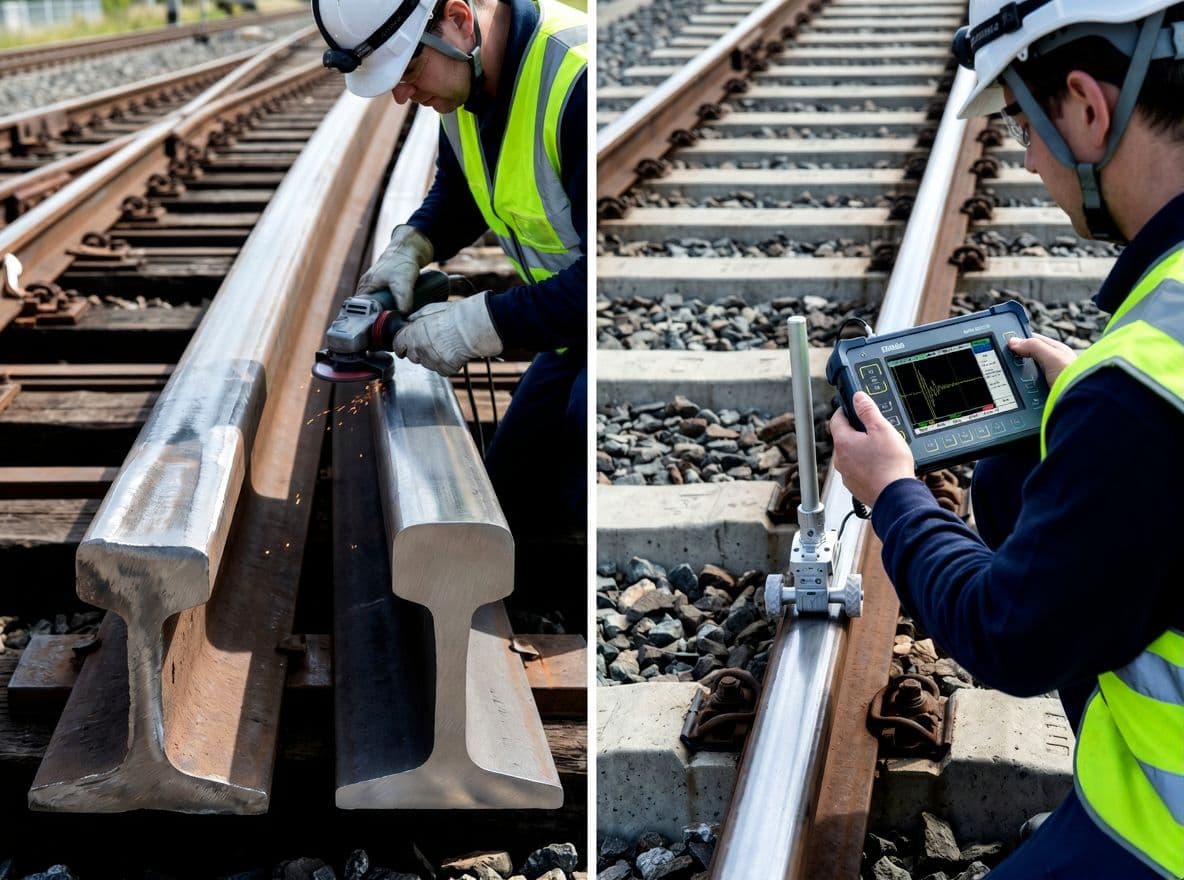
Rail profile types play a defining role in how railway systems maintain safety and operational efficiency across modern networks. Rail profile types influence not only how rails perform under load but also how accurately internal defects can be detected using advanced inspection methods. Rail profile types remain a critical factor when evaluating the reliability of ultrasonic inspection in preventing catastrophic rail failures.
Railway infrastructure operates under constant mechanical stress, temperature variation, and environmental exposure. Even the smallest internal crack can escalate into a serious hazard if left undetected. Industry studies have consistently shown that internal rail defects account for a significant percentage of derailments worldwide. This makes inspection technologies, particularly ultrasonic testing, an essential component of railway maintenance strategies.
However, the effectiveness of ultrasonic inspection does not depend solely on the technology itself. It also depends on how well the inspection method aligns with the geometry of the rail. Rail profile types determine how ultrasonic waves travel, reflect, and reveal hidden flaws. This connection between structure and detection creates a deeper engineering challenge that goes far beyond surface-level inspection. To fully understand this relationship, it becomes necessary to explore how rail profiles are defined and categorized.
What Are Rail Profile Types?
Rail profile types refer to the standardized cross-sectional shapes of rails used in railway tracks. These profiles define how rails distribute loads, resist wear, and maintain stability under continuous operation. Engineers design each rail profile type to meet specific performance requirements based on traffic load, speed, and environmental conditions.
Rail profile types consist of three primary components: the head, the web, and the foot. Each component contributes to the overall strength and function of the rail. Over decades, organizations such as American Railway Engineering and Maintenance-of-Way Association and International Union of Railways have developed standards to ensure uniformity and compatibility across railway systems.
The significance of rail profile types extends beyond mechanical strength. These profiles also influence how inspection tools interact with the rail surface. Even minor variations in geometry can affect the accuracy of defect detection, especially when using ultrasonic techniques.
Rail profile types also determine how rails respond to long-term wear and fatigue. As trains repeatedly pass over the tracks, the rail head undergoes gradual deformation. This wear alters the original profile, creating additional challenges for inspection systems that rely on consistent geometry.
The Anatomy of a Rail Cross-Section
A closer look at a rail cross-section reveals how rail profile types are engineered for performance and durability. Each section plays a distinct role:
- Rail Head – The top portion that comes into direct contact with train wheels and absorbs the highest stress
- Rail Web – The vertical section that connects the head and foot while maintaining structural integrity
- Rail Foot/Base – The bottom portion that distributes load evenly to the sleepers and stabilizes the rail
Several geometric factors define rail profile types and influence their behavior:
- Head width, which affects load distribution and wear resistance
- Rail height, which determines structural strength and flexibility
- Head radius, which influences wheel contact and ultrasonic signal interaction
These geometric characteristics directly affect how ultrasonic waves propagate through the rail. A slight variation in curvature or thickness can alter wave reflection patterns, making defect detection more complex. This complexity becomes more apparent when examining the different types of rail sections used worldwide.
What Are the Different Types of Rail Sections?
Different rail sections represent variations in rail profile types designed to meet diverse operational requirements. Each section offers unique advantages depending on the application, whether it involves high-speed travel, heavy freight, or urban transit systems.
Flat-Bottom (Vignole) Rail
Flat-bottom rails are the most widely used rail profile types across global railway networks. Their design includes a broad base that provides excellent stability and simplifies installation. Engineers prefer this profile for high-speed and heavy-haul operations due to its strength and ease of maintenance.
Flat-bottom rail profile types also allow better load distribution, reducing stress concentrations. This makes them ideal for long-distance railways where durability and reliability are essential.
Grooved (Girder) Rail
Grooved rails serve urban transit systems, particularly tramways. This rail profile type features a groove that accommodates the wheel flange, enabling smooth integration with road surfaces. Cities rely on these rail profile types to maintain both transportation efficiency and urban aesthetics.
However, the groove introduces additional inspection challenges. Dirt accumulation and wear patterns can interfere with ultrasonic signal transmission, making defect detection more complex.
Crane and Bridge Rail
Industrial environments demand specialized rail profile types that can withstand extreme loads. Crane rails support heavy lifting equipment in ports, factories, and warehouses. Their design prioritizes strength and durability over speed.
These rail profile types often feature thicker heads and robust structures. While this improves load capacity, it also affects how ultrasonic waves penetrate the material.
Bullhead Rail
Bullhead rails represent an older generation of rail profile types. Historically used in the United Kingdom, this design features a symmetrical head that allows reversal after wear. Although largely replaced by modern profiles, bullhead rails still exist in legacy systems.
Their unique shape creates distinct challenges for ultrasonic inspection. The symmetry and mounting method can influence signal paths, requiring specialized inspection techniques.
| Rail Section Type | Common Application | Head Width | Typical Standard |
| Flat-Bottom Rail | Freight & High-Speed Lines | Wide | UIC, AREMA |
| Grooved Rail | Tramways & Urban Rail | Narrow with Groove | EN Standards |
| Crane Rail | Industrial Use | Thick & Heavy | DIN Standards |
| Bullhead Rail | Legacy Systems | Symmetrical | BS Standards |
Each of these rail profile types presents unique inspection considerations. Differences in curvature, thickness, and wear patterns directly influence ultrasonic performance.
The Basics of Ultrasonic Rail Inspection
Ultrasonic inspection is a non-destructive testing method that uses high-frequency sound waves to detect internal flaws in materials. In railway applications, this method plays a vital role in identifying defects such as cracks, inclusions, and fatigue damage.
The technique operates on the pulse-echo principle. A transducer generates sound waves that travel through the rail. When these waves encounter a discontinuity, they reflect back to the receiver. The system then analyzes these reflections to determine the location and size of the defect.
Railways rely on ultrasonic inspection because it provides insights that visual inspection cannot achieve. Internal defects often develop long before they become visible on the surface. Ultrasonic testing allows maintenance teams to detect these issues early, preventing potential failures.
Key components of ultrasonic inspection include:
- Transducer for generating ultrasonic waves
- Couplant to ensure efficient transmission of sound into the rail
- Signal processing system for interpreting reflected waves
The advantages of ultrasonic testing in railway systems include:
- Ability to detect internal defects without damaging the rail
- High sensitivity to small flaws
- Real-time data analysis capabilities
- Compatibility with automated inspection systems
Despite these advantages, the effectiveness of ultrasonic inspection varies depending on rail profile types. Surface curvature, wear conditions, and structural variations can all influence how sound waves travel through the rail.
Understanding the method alone does not provide the full picture the real challenge lies in selecting the right inspection approach for different rail profile types.
What Are the Two Types of Ultrasonic Inspection?
There are two primary types of ultrasonic inspection used in railway systems: contact ultrasonic testing and immersion-based ultrasonic testing. Each method offers distinct advantages and interacts differently with rail profile types.
Contact (Pulse-Echo) Ultrasonic Testing
Contact ultrasonic testing involves placing the transducer directly on the rail surface. A couplant ensures effective transmission of sound waves into the material. This method provides high accuracy for localized inspections.
Rail profile types with smoother and consistent surfaces enable better coupling, resulting in clearer signals. However, worn or irregular surfaces can disrupt contact, reducing signal quality and accuracy.
Immersion or Wheel Probe Testing
Immersion-based ultrasonic testing uses a liquid medium or specialized probes to transmit sound waves. In railway applications, wheel probes simulate immersion conditions, allowing continuous inspection at higher speeds.
This method adapts more effectively to varying rail profile types. It maintains consistent signal transmission even when surface conditions change, making it suitable for large-scale inspections.
A comparison of these two methods highlights their differences:
- Speed: Immersion testing supports faster, continuous inspections
- Accuracy: Contact testing offers higher precision in specific areas
- Application: Contact suits detailed inspections; immersion suits network-wide monitoring
- Cost: Immersion systems require higher initial investment but improve efficiency
The choice between these methods depends heavily on rail profile types. Each profile interacts differently with ultrasonic waves, influencing inspection outcomes.
How Rail Profile Types Influence Ultrasonic Signal Behavior
Rail profile types play a direct role in determining how ultrasonic signals behave within the rail structure. The physics behind this interaction involves wave propagation, reflection, refraction, and attenuation.
When ultrasonic waves enter the rail, they travel along specific paths based on the angle of incidence. Rail profile types with curved surfaces can refract these waves, altering their direction. This makes defect detection more challenging, especially in areas with complex geometry.
Surface wear introduces additional complications. As rail profile types degrade over time, their geometry changes. This affects how ultrasonic waves reflect within the material. In some cases, signals scatter, reducing detection reliability.
The head radius of rail profile types significantly influences transducer coupling. Larger radii allow better wave penetration and clearer signal transmission. In contrast, sharper or worn profiles can distort signals, making interpretation difficult.
Asymmetric wear further complicates inspection. Uneven surfaces create inconsistent signal paths, leading to potential blind spots. Industry data suggests that inspection accuracy can vary depending on rail profile types and their condition.
Engineers must account for these variations when designing inspection protocols. Failure to consider rail profile types can result in missed defects, increasing the risk of rail failure.
As the relationship between rail geometry and ultrasonic inspection becomes clearer, a deeper challenge begins to emerge how can inspection systems adapt to constantly changing rail profile types over time? The answer lies beyond basic inspection methods and moves into advanced calibration and adaptive technologies, which will be explored further in the next section.
Adapting Ultrasonic Inspection Protocols to Specific Rail Profile Types
Rail profile types demand customized ultrasonic inspection protocols because uniform inspection strategies fail to address geometric diversity. Engineers analyze rail profile types before selecting inspection parameters to ensure reliable defect detection across different railway systems.
Each of the rail profile types introduces unique challenges in wave propagation. For instance, flat-bottom rail profile types allow easier probe positioning, while grooved rail profile types require careful alignment due to their embedded geometry. This difference directly affects how ultrasonic beams enter and travel through the rail.
Calibration remains a critical step when adapting inspection systems to rail profile types. Technicians use reference calibration blocks that replicate actual rail profile types to fine-tune equipment. Without this step, ultrasonic systems may misinterpret signal reflections, leading to inaccurate readings.
Rail profile types also determine inspection frequency. High-speed rail profile types require more frequent monitoring due to increased stress cycles, while industrial rail profile types may require targeted inspections based on load conditions.
Transducer Positioning for Different Rail Profiles
Effective transducer positioning ensures accurate signal transmission across different rail profile types. Inspectors follow systematic steps to achieve optimal results:
- Identify the specific rail profile type in use
- Select the appropriate beam angle for the profile geometry
- Position the transducer to cover critical defect zones
- Validate signal quality using calibration references
Rail profile types with irregular surfaces often require multiple probes to cover all inspection angles. This increases inspection complexity but improves defect detection accuracy.
Knowing how to position the transducer is critical but what happens when rail profile types no longer match their original design due to wear and deformation? That question leads directly into the next challenge.
Rail Wear and Its Effect on Ultrasonic Inspection Accuracy
Rail profile types evolve over time due to continuous mechanical stress and environmental exposure. This gradual change, known as profile drift, alters the geometry of the rail and affects inspection accuracy.
Different wear mechanisms impact rail profile types in specific ways. Side wear reduces the width of the rail head, while vertical wear decreases its height. Corrugation creates repetitive surface patterns that disrupt smooth wave transmission.
These changes influence how ultrasonic waves travel through rail profile types. Altered geometry causes signal refraction and scattering, which can reduce detection sensitivity. As a result, inspectors must adjust their approach based on the current condition of the rail.
Technicians measure rail profile types before inspection to account for wear-related deviations. This step ensures that ultrasonic equipment is calibrated to the actual geometry rather than the original design.
| Rail Wear Type | Profile Deviation | Ultrasonic Impact | Recommended Action |
| Side Wear | Narrowed head | Signal deflection | Modify probe angle |
| Vertical Wear | Reduced height | Lower penetration | Adjust frequency |
| Corrugation | Uneven surface | Signal noise | Use multiple scans |
Rail profile types with significant wear may require slower inspection speeds. This allows inspectors to capture more accurate data and compensate for irregular signal behavior.
What Are the 4 Types of NDT?
The four main types of non-destructive testing include ultrasonic testing, magnetic particle testing, radiographic testing, and eddy current testing. Each method plays a role in material inspection, but ultrasonic testing stands out for railway applications.
- Ultrasonic Testing (UT) uses sound waves to detect internal defects
- Magnetic Particle Testing (MPT) identifies surface cracks in magnetic materials
- Radiographic Testing (RT) uses X-rays to reveal internal structures
- Eddy Current Testing (ECT) detects surface-level flaws using electromagnetic fields
Rail profile types strongly influence the effectiveness of these methods. Ultrasonic testing remains the preferred choice because it penetrates deep into the rail, regardless of external geometry.
Magnetic particle testing works well for surface cracks but cannot detect internal defects in rail profile types. Radiographic testing provides detailed images but becomes impractical for large-scale rail networks. Eddy current testing offers precision for surface flaws but lacks depth penetration.
Ultrasonic testing adapts to varying rail profile types more effectively than other methods. This adaptability makes it essential for maintaining railway safety.
While ultrasonic testing continues to dominate, innovation is reshaping how inspection systems respond to complex rail profile types.
Emerging Technologies in Ultrasonic Rail Inspection
Technological advancements are enhancing how ultrasonic systems interact with rail profile types. Engineers are developing solutions that improve flexibility, accuracy, and efficiency in inspection processes.
Phased array ultrasonic testing (PAUT) represents a major breakthrough. This method uses multiple transducer elements to control beam angles electronically. It allows inspectors to adapt to different rail profile types without repositioning equipment.
Time of Flight Diffraction (TOFD) offers another advancement. It measures the travel time of diffracted waves around defects, providing precise sizing regardless of rail profile types. This improves reliability in detecting critical flaws.
Artificial intelligence is transforming data interpretation. AI systems analyze ultrasonic signals and identify patterns that indicate defects. This reduces human error and enhances detection accuracy across diverse rail profile types.
Key innovations shaping modern inspection include:
- Phased array systems for adaptable beam control
- TOFD for precise defect measurement
- AI-assisted signal analysis
- Automated inspection vehicles for continuous monitoring
These technologies enable inspectors to handle complex rail profile types more effectively. They also improve efficiency and reduce inspection time.
Industry Standards Governing Rail Profile Inspection
Rail profile types and inspection procedures are governed by international standards. Organizations such as American Railway Engineering and Maintenance-of-Way Association and International Union of Railways establish guidelines to ensure consistency and safety.
Standards like EN 13674 define acceptable dimensions and tolerances for rail profile types. They also specify inspection intervals based on traffic conditions and rail usage.
Railway operators maintain detailed records of rail profile types to track changes over time. This information helps determine inspection schedules and identify areas requiring maintenance.
Compliance with these standards ensures that inspection processes remain consistent across different railway systems. It also reduces the risk of undetected defects.
The Role of Data and Monitoring in Managing Rail Profile Types
Modern railway systems rely heavily on data to manage rail profile types effectively. Continuous monitoring allows operators to track changes in geometry and predict potential issues before they escalate.
Digital profiling tools measure rail profile types with high precision. These tools create detailed models that help engineers understand wear patterns and plan maintenance activities.
Integration of monitoring systems with ultrasonic inspection improves overall efficiency. Data collected from inspections can be used to refine inspection protocols and adapt to changing rail profile types.
Predictive maintenance strategies use this data to identify trends. This allows operators to address issues proactively rather than reacting to failures.
Final Thoughts
Rail profile types shape the foundation of effective ultrasonic inspection in modern railway systems. From their geometric design to their behavior under long-term wear, rail profile types directly influence how ultrasonic waves travel, reflect, and reveal internal defects. This relationship highlights the importance of understanding rail geometry before selecting or applying any inspection method.
As railway networks continue to expand and operate under increasing loads, maintaining inspection accuracy becomes even more critical. Variations in profile shape, surface condition, and wear patterns can significantly affect detection reliability. Engineers must adapt inspection techniques, calibration methods, and technologies to match these evolving conditions.
Advanced ultrasonic methods and data-driven monitoring are helping overcome these challenges, but the core principle remains unchanged. Accurate inspection begins with a clear understanding of rail structure. By aligning inspection strategies with specific rail profile types, railway operators can improve safety, reduce failure risks, and ensure long-term infrastructure performance.
Key Takeaways
- Rail profile types significantly influence how ultrasonic waves travel and reflect within rail structures during inspections.
- Different rail profile types require customized ultrasonic inspection setups to ensure accurate and reliable defect detection outcomes.
- Surface wear and deformation gradually change rail profile types, affecting inspection accuracy and signal interpretation consistency.
- Ultrasonic testing remains the most effective non-destructive testing method for evaluating internal defects in rail profile types.
- Proper calibration using reference blocks matched to rail profile types ensures consistent and precise inspection results.
- Advanced technologies like phased array systems improve adaptability when inspecting complex and varying rail profile types.
- Inspection frequency must be adjusted based on traffic load and the specific rail profile types used in operations.
- Data-driven monitoring systems help track changes in rail profile types and support predictive maintenance strategies effectively.
- Industry standards define acceptable rail profile types and ensure consistent inspection practices across global railway systems.
- Understanding rail profile types is essential for improving safety, reducing failures, and enhancing long-term railway performance.