
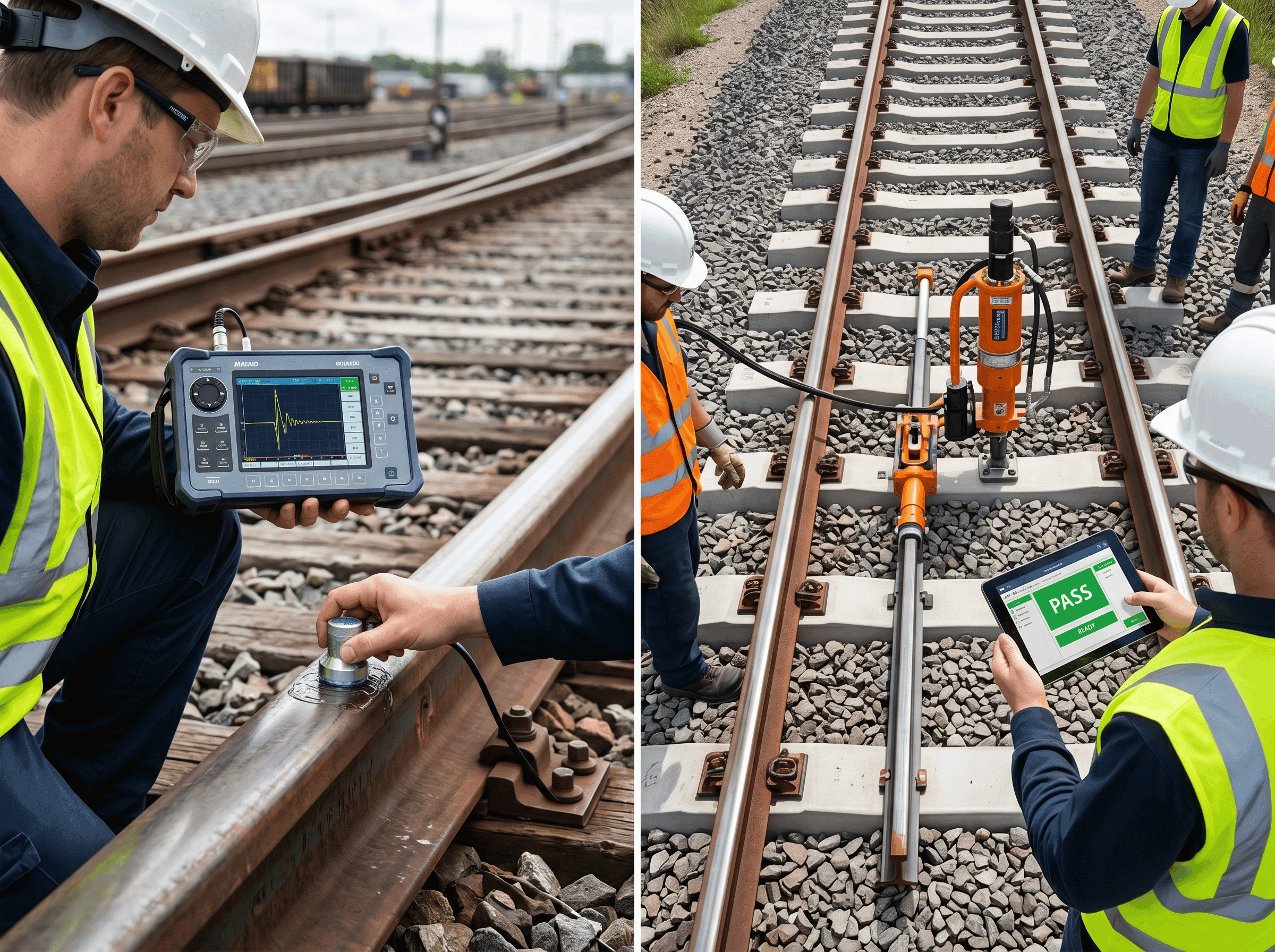
Every year, thousands of derailments occur on railroad networks, causing deaths and billions in damages. Railroad failure analysis represents the critical turning point in preventing these catastrophic events. Modern railroad failure analysis combines advanced technology with preventative strategies that save lives and protect infrastructure.
Understanding how these systems work is essential for rail safety professionals. This guide explores ultrasonic testing, defect detection, and prevention strategies that modern railroads depend on. By examining railroad failure analysis in depth, readers discover how innovation transforms safety outcomes across the entire industry.
What Causes Catastrophic Rail Failures and Derailments
Over 2,000 derailments occur annually in the United States. Railroad failure analysis reveals diverse root causes behind these accidents. Environmental conditions including temperature extremes and corrosion attack rail steel continuously. Heavy freight loads exceeding 100 tons stress rail systems beyond design specifications. Frequent train passage creates cumulative fatigue that weakens steel structures over decades.
Manufacturing defects sometimes remain dormant for years before manifesting problems. Age represents another critical factor, rails installed sixty years ago experience accumulated wear. Modern railroad failure analysis addresses these interconnected causes systematically.
Why Traditional Inspection Fails
Traditional maintenance approaches respond to failures after accidents occur, often too late to prevent catastrophes. Railroad failure analysis shifts this paradigm by identifying defects before they cause derailments. Early detection enables planned repairs during scheduled maintenance windows rather than emergency responses.
The hidden danger within rail steel poses the greatest challenge for inspectors. Surface cracks visible to inspectors represent just one failure category. Subsurface defects, cracks inside the steel, remain invisible to naked eyes and traditional methods. These internal flaws develop silently for months before sudden catastrophic failure. A 2012 derailment caused by an undetected internal crack killed five passengers and injured forty others.
But how can inspection teams identify these microscopic cracks before they become catastrophic failures? The answer lies in advanced technology that penetrates steel and reveals hidden dangers.
The Main Types of Railroad Rail Defects
Rail defects fall into two distinct categories that railroad failure analysis must address. Surface defects develop visibly and progressively over time. Subsurface defects hide within steel structures and pose greater danger.
Surface-initiated defects develop on the rail head where steel contacts wheels. Shelling involves small material loss creating rough patches. Spalling describes larger surface chunks breaking away. Corrugation produces rippled patterns from repeated wheel impacts. Head checking creates fine crack networks on running surfaces. While visible, these defects progress gradually and often receive attention before causing accidents.
Subsurface defects originate beneath the rail head and propagate inward dangerously. Internal shelling forms when material inside the rail separates from outer layers. Transverse cracks develop perpendicular to rail length, caused by fatigue stress. Head-web separation occurs where rail head connects to the vertical stem. These defects remain hidden until sudden failure occurs without warning.
Why Subsurface Defects Are Most Critical
Subsurface defects present the greatest risk in railroad failure analysis work. They develop silently without warning signs or visible indicators. Inspection teams cannot spot these problems through visual observation alone. A rail may appear perfect while internally failing catastrophically.
Defect Types Addressed by Railroad Failure Analysis:
- Surface-initiated defects (shelling, spalling, corrugation)
- Internally-initiated defects (internal shelling, head-web separation)
- Fatigue cracks from repeated stress cycles
- Manufacturing defects present at installation
- Corrosion-based degradation from environmental exposure
- Thermal-induced damage from temperature changes
Statistical data demonstrates the detection gap clearly. Manual visual inspection catches only 60% of surface defects. Ultrasonic technology catches 99% of both surface and subsurface defects. This massive gap explains why railroad failure analysis technology represents critical safety investment.
These invisible cracks pose the greatest risk that railroad failure analysis must address. So what technology can penetrate steel to reveal what eyes cannot see? Advanced ultrasonic testing offers the answer, transforming how the industry approaches safety.
How Does Ultrasonic Testing Detect Rail Defects
Ultrasonic testing forms the cornerstone of modern railroad failure analysis technology. High-frequency sound waves penetrate steel and create detailed images of internal structures. These waves operate at frequencies between 20 kilohertz and 100 megahertz, beyond human hearing. This revolutionary technology transformed railroad failure analysis from guesswork into precision engineering.
The ultrasonic testing process within railroad failure analysis follows consistent steps. Couplant gel applied to rail surface helps sound wave transmission. Specialized transducers send ultrasonic pulses into steel at precise angles. These waves travel downward through rail structure. Upon encountering defects or boundaries, waves reflect upward. Receiver equipment captures returning signals. Computer systems analyze signal timing and amplitude. Software creates visual images showing defect location, size, and depth. Modern railroad failure analysis generates real-time data on portable screens.
The Science Behind Detection
Phased array ultrasonic testing represents the most advanced railroad failure analysis method. Multiple transducers work simultaneously, sending waves at different angles. This creates three-dimensional images impossible with single-angle testing. Frequency selection determines detection capabilities in railroad failure analysis. Higher frequencies provide better resolution but penetrate less deeply. Modern systems use multiple frequencies simultaneously for comprehensive coverage.
How Ultrasonic Equipment Operates:
- Couplant gel applied to rail surface
- Transducer array activates at precise angles
- Multiple frequency ranges scan simultaneously
- Data collection occurs in seconds
- Software interprets wave patterns automatically
- Defect location calculated with millimeter accuracy
- Defect size and depth measurements recorded
- Digital reports generated automatically
Ultrasonic technology detects defects two inches below rail surface. This penetration depth captures subsurface defects that manual inspection cannot address. Exact defect location enables targeted repairs instead of replacing entire sections. Unlike visual inspections that miss 70% of defects, ultrasonic technology catches problems early.
Comparing detection methods reveals why railroad failure analysis industry standards favor ultrasonic. Visual inspection provides surface assessment with 60% accuracy. Eddy current testing shows limited depth penetration and inconsistent results. Ultrasonic testing achieves 99% accuracy with full internal analysis capability. This superiority explains the global shift toward ultrasonic-based railroad failure analysis.
Dr. James Morrison from the Transportation Safety Institute stated: "Ultrasonic testing has revolutionized railroad failure analysis in ways manual inspection never achieved."
Railroad Failure Analysis Equipment and Operation
Modern railroad failure analysis equipment combines multiple technologies into integrated systems. The pulser-receiver unit generates electrical signals that transducers convert into ultrasonic waves. Different transducer types operate at specific frequencies optimized for different defects. Display monitors show A-scan, B-scan, and C-scan imaging modes.
A-scan displays amplitude versus time, indicating defect presence and depth. B-scan creates two-dimensional cross-section images of rail structure. C-scan produces top-down visualizations showing defect distribution across the rail.
Understanding Test Results
Railroad failure analysis systems exist in portable and stationary configurations. Mobile units mounted on vehicles scan track while moving. Stationary systems inspect rails at facilities. Handheld devices enable emergency inspections at specific locations.
Understanding A-scan results proves critical in railroad failure analysis interpretation. The baseline represents sound traveling to rail back. Peak heights indicate defect presence with larger peaks showing bigger defects. Signal timing reveals exact defect depth below surface. Trained operators must recognize normal patterns versus abnormal indications.
Certified ultrasonic technicians perform railroad failure analysis work requiring specialized expertise. American Society for Nondestructive Testing (ASNT) Level III certification ensures competency. Training programs require hundreds of hours covering equipment operation and metallurgy. Understanding rail steel composition affects how sound waves propagate through material.
Technological advances continue improving railroad failure analysis capabilities. Automated scanning systems reduce human error by following consistent protocols. Artificial intelligence assists in defect recognition and classification. Cloud-based data storage enables remote analysis by specialized experts. Real-time alerts notify operators of critical defects requiring immediate attention.
Why Ultrasonic Testing Surpasses Manual Inspection
Accuracy differences between ultrasonic testing and manual inspection define modern railroad failure analysis. Ultrasonic testing achieves 99% detection accuracy compared to 60% for manual inspection. This forty-point accuracy gap explains why railroads worldwide convert to ultrasonic-based systems. The technology detects defects as small as one millimeter.
Multiple defects within single locations get identified and measured separately. Results remain consistent regardless of inspector experience level. Human fatigue never degrades ultrasonic detection capabilities, a major advantage over manual methods.
Speed and Cost-Effectiveness
Speed advantages transform railroad failure analysis efficiency dramatically. Modern equipment inspects five to ten miles of track daily. Traditional manual inspection covers less than one mile daily. This tenfold speed improvement enables comprehensive network assessment with minimal service disruptions.
Key Advantages of Ultrasonic Testing:
- Non-destructive testing preserving rail integrity
- Precise defect location and measurement data
- Permanent digital records enabling documentation
- Early warning system for progressive defects
- Reduced maintenance and emergency repair costs
- Enhanced worker safety during inspection
- Full compliance with federal rail safety standards
- Capability for 24/7 automated monitoring
Statistical data from federal sources proves compelling. The Federal Railroad Administration documents that ultrasonic inspection saves approximately one life every three to four years. Investment payback typically occurs within eighteen to twenty-four months. Accident reduction reaches documented 78% decreases. Cost per mile drops to $150 with ultrasonic versus $300 manual inspection.
Long-term strategic benefits extend beyond immediate safety gains. Predictive maintenance planning becomes possible with detailed defect data. Asset management optimization follows from understanding rail conditions. Network-wide trend analysis reveals systemic problems affecting multiple locations. Data-driven repair prioritization ensures resources target highest-risk areas first.
How Railroads Implement Programs
Railroad failure analysis programs integrate into existing maintenance schedules through careful planning. Scheduled inspection intervals depend on track age and usage intensity. High-risk mainline sections receive priority testing before branch lines. Federal standards mandate minimum inspection frequencies by track classification.
Implementation Steps:
- Assessment of current inspection practices
- Identification of high-risk track segments
- Selection of appropriate equipment
- Training of qualified technicians
- Development of testing protocols
- Integration with existing systems
- Pilot program operation
- Full network rollout
Staffing railroad failure analysis teams requires diverse expertise. Typical teams include three to five people: certified technicians, engineers, and data analysts. Shift work enables continuous coverage for critical mainline sections. Regular training keeps personnel current with evolving technology.
How Rail Grinding Helps Prevent Rail Failures
Railroad failure analysis identifies problems, but grinding prevents detected defects from worsening. Rail grinding represents a mechanical process removing the top steel layer. This restoration process returns rail profile to original specifications. Grinding eliminates surface defects before they propagate into subsurface cracks. Modern railroad failure analysis integrates ultrasonic testing with strategic grinding programs.
The synergy between ultrasonic testing and grinding creates powerful prevention. Testing identifies candidates for grinding based on defect severity. Grinding restores rails before defects threaten safety. Combined approach maximizes rail lifespan and reliability. Data from ultrasonic inspection guides grinding priority decisions. High-defect sections receive immediate attention while minor areas wait. This systematic approach prevents emergency failures while managing budgets effectively.
Grinding Technology Advances
Modern grinding machines cover more track with greater precision than earlier equipment. Automated systems reduce human error in removal amounts. Millimeter-level accuracy ensures proper rail profile restoration. Environmental advantages of modern equipment reduce grinding dust and noise pollution. Railroad failure analysis data now directs grinding scheduling for maximum effectiveness.
Prevention Methods Integrated with Railroad Failure Analysis:
- Regular ultrasonic inspection on scheduled intervals
- Strategic rail grinding at identified problem areas
- Prompt repair of detected critical defects
- Track geometry maintenance and adjustment
- Lubrication programs for curve sections
- Drainage improvements to reduce corrosion
- Load monitoring on problematic sections
- Regular visual inspections between ultrasonic tests
Predictive maintenance frameworks emerge from comprehensive railroad failure analysis programs. Data from inspections predict when maintenance becomes necessary. Operators avoid reactive emergency repairs that disrupt service. Maintenance scheduling happens during planned downtime windows. Resource allocation becomes optimized through data-driven decisions. Networks identify systemic problems affecting multiple locations.
Network-wide analysis reveals trends impossible to detect individually. Comparing performance across different rail sections identifies patterns. Investment allocation targets highest-risk areas first. Strategic decision making becomes informed by comprehensive data. Railroad failure analysis enables railroads to maximize safety per dollar spent.
Railroad Failure Analysis: Case Studies in Prevention
Real-world examples demonstrate that comprehensive railroad failure analysis truly works. Case Study 1 examined a major freight railroad network covering eight thousand five hundred miles. Northeast corridor implementation began in 2015. Initial investment reached eight million dollars with annual costs of two point five million dollars. Baseline data showed forty-five derailments yearly. After five years of railroad failure analysis, derailments dropped to eight-twelve incidents yearly. Safety improvement reached eighty percent reduction. Additional benefit included thirty-five percent reduction in train delays improving operational efficiency.
Implementation Lessons Learned
Case Study 2 analyzed a commuter rail authority operating five hundred miles of urban transit. High-frequency passenger service meant two hundred plus trains daily. Safety priority established zero tolerance for failures. Comprehensive railroad failure analysis implementation used mobile units with automated scanning. Result achieved zero derailments in eight years versus previous three yearly average. Public confidence increased forty percent. Employee safety incidents reduced twenty-five percent demonstrating comprehensive safety culture improvement.
Case Study 3 examined a regional freight operator managing twelve hundred miles. Older rail infrastructure averaged thirty-five years old. High defect rates existed before inspection programs. Targeted ultrasonic testing deployment occurred three years ago. Focus targeted aging mainline segments where problems concentrated. Inspection findings revealed forty percent of rails had significant subsurface defects. Repairs implemented included three hundred plus miles of grinding and replacement. Safety incidents dropped from twelve yearly to two yearly. Operational costs reduced eighteen percent through efficiency gains.
Common Success Factors in Railroad Failure Analysis Implementation:
- Executive leadership commitment to comprehensive safety programs
- Adequate long-term funding allocation and support
- Qualified personnel recruitment and retention
- Regular technology updates and advanced training
- Integration with existing maintenance management systems
- Comprehensive data analysis and trend reporting
- Rapid response protocols for findings implementation
- Continuous program improvement and adaptation mindset
Industry-wide trends show growing adoption across freight and passenger operators. FRA incentive programs reward safety improvements. Insurance companies offer premium reductions to program participants. Technology costs decline annually, fifteen percent reduction over past three years. More railroads recognize railroad failure analysis as essential strategic investment.
Emerging Technologies in Rail Inspection
Future technologies promise even better railroad failure analysis capabilities. Artificial intelligence integration enables machine learning to identify defect patterns. Predictive algorithms estimate defect growth rates and failure timelines. AI analyzes images faster than human experts while reducing subjective variation. Automated alert systems notify operators of critical findings requiring immediate attention.
Automation and robotics transform railroad failure analysis operations dramatically. Automated ultrasonic trains conduct scanning continuously 24/7. Robotic arms perform inspections without human trackside exposure. Human safety improves while inspection frequency increases substantially. Data streams directly to central analysis centers for immediate review.
Advanced Sensing Technologies
Phased array ultrasonic with 3D imaging provides superior defect visualization. Guided wave testing enables longer-range detection across rail networks. Thermal imaging identifies temperature anomalies indicating potential problems. Laser scanning measures rail geometry with millimeter accuracy. Multi-modal sensor fusion combines multiple technologies for comprehensive analysis.
Cloud-based data management enables real-time information sharing across networks. Predictive maintenance algorithms analyze massive datasets identifying trends. Mobile applications provide field technicians with instant specification access. Enterprise asset management integration streamlines coordination. Blockchain technology creates immutable inspection records.
Implementing Effective Railroad Failure Analysis Programs
Successful railroad failure analysis implementation requires systematic approach. Assessment phase audits current practices and capabilities. High-risk track identification establishes testing priorities. Technology selection matches equipment to network characteristics. Financial projections demonstrate return on investment to stakeholders.
Personnel transformation proves essential in railroad failure analysis success. Recruit certified ultrasonic technicians with proper qualifications. Establish continuous training programs keeping staff current. Build data-driven decision-making culture throughout organization. Reward safety improvements and proactive findings discovery. Promote collaboration between inspection and maintenance teams.
Monitoring and continuous improvement sustain railroad failure analysis program effectiveness. Regular reviews track safety metrics and cost savings. Benchmarking against industry standards guides improvements. Field personnel feedback informs procedural adjustments. Technology updates maintain competitive advantage. Long-term funding secures program sustainability.
Final Thoughts
Railroad failure analysis represents the complete system integrating detection and prevention strategies. Ultrasonic technology identifies defects with ninety-nine percent accuracy. Strategic maintenance and grinding prevent detected problems from worsening. Comprehensive railroad failure analysis programs achieve seventy-five to eighty percent accident reductions. Cost-benefit analysis proves remarkable financial justification. Real-world case studies demonstrate proven success across diverse railroad networks.
Safety impacts include lives saved and accidents prevented. Economic benefits deliver millions in cost savings. Environmental and social responsibility improve with comprehensive railroad failure analysis. Regulatory compliance and liability reduction follow. Railroad failure analysis technology continues improving annually. Costs decline as adoption increases industry-wide. The future of rail transport depends on comprehensive railroad failure analysis implementation. Modern technology makes rail transport safer than ever before. Every railroad operator should evaluate current practices and implement comprehensive railroad failure analysis programs.
Key Takeaways
- Railroad failure analysis detects 99% of defects versus 60% manual inspection rate
- Ultrasonic testing identifies subsurface defects that are completely invisible to visual inspection
- Integration of detection with grinding and repairs creates a comprehensive prevention strategy
- Cost-benefit analysis shows that programs pay back investment within eighteen to thirty-six months
- Real case studies prove that mature programs achieve seventy-five to eighty percent accident reduction
- Network-wide railroad failure analysis identifies systemic problems that affect multiple track locations efficiently
- Predictive maintenance planning becomes possible when engineers have access to detailed defect data
- Return on investment for comprehensive programs reaches three hundred to five hundred percent over five years
- Emerging technologies like artificial intelligence and robotics enhance detection and inspection capabilities significantly
- Long-term safety and economic benefits clearly justify implementing comprehensive railroad failure analysis programs
FAQs
What is non-destructive testing (NDT) in railroad maintenance?
Non-destructive testing examines rail condition using ultrasonic sound waves without damaging the material. This technology detects internal cracks and defects invisible to the naked eye. Early detection through NDT prevents catastrophic failures, saves lives, and enables cost-effective preventative maintenance.
What preventative measures extend the life of railroad rails?
Several preventative measures significantly extend railroad rail lifespan and enhance safety. Regular ultrasonic inspection identifies defects before failure occurs. Strategic rail grinding removes surface damage and restores proper profile. Adequate drainage prevents water accumulation and corrosion. Lubrication programs reduce friction and wear.
What data does ultrasonic rail testing provide to engineers?
Ultrasonic rail testing provides comprehensive data critical for railroad failure analysis and planning. Technicians obtain precise defect location, size, and depth measurements with millimeter accuracy. The technology calculates how quickly defects grow over time. Engineers receive information about rail metallurgy quality.
What is the economic impact of broken rails on railroads?
Broken rails create enormous economic consequences extending far beyond immediate repair costs. Single catastrophic derailments cost five to fifty million dollars in damages and liability. Service disruptions affect freight schedules and passenger operations significantly. Emergency response expenses multiply quickly.