

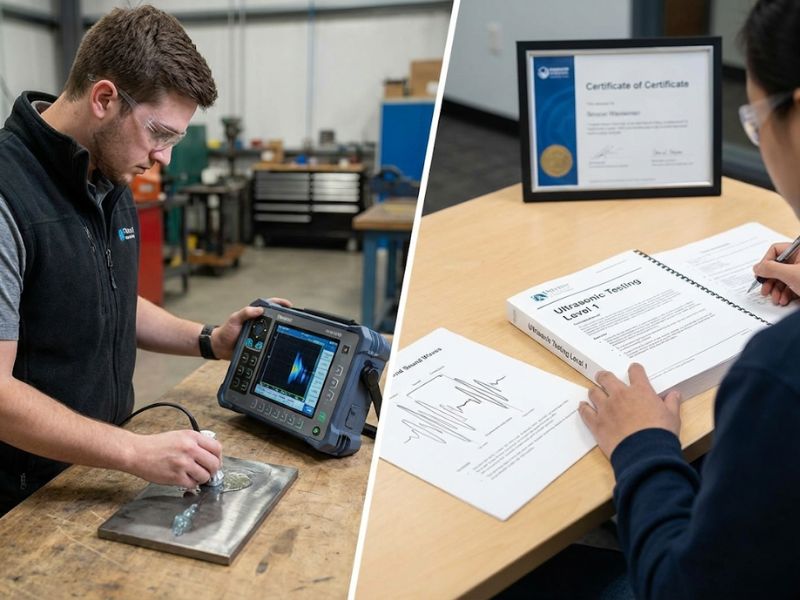
Ultrasonic Testing plays a critical role in finding hidden defects before they turn into serious failures. Ultrasonic Testing Level 1 is often the first step for technicians entering the field of non-destructive testing and industrial inspection.
This article explains what Ultrasonic Testing Level 1 is, how the testing process works, and where it is commonly used. It also covers certification requirements, training, exams, and the steps needed to get certified, giving you a clear path to start or advance your NDT career.
What Is Ultrasonic Testing Level 1?
Ultrasonic Testing Level 1 is the entry-level qualification for technicians working in ultrasonic non-destructive testing. It confirms that a technician can carry out ultrasonic inspections by strictly following approved written procedures, while working under supervision from higher-level personnel.
At this level, the focus is on developing strong hands-on skills rather than judgement or analysis. Ultrasonic Testing Level 1 technicians play a key role in inspection reliability because they are responsible for accurate equipment setup and data collection, which forms the basis for later evaluation.
Role of a UT Level 1 Technician
A UT Level 1 technician performs practical inspection tasks as instructed. The role is structured and controlled to ensure consistency and safety across inspection activities.
Common duties include:
- Setting up ultrasonic testing equipment
- Performing basic calibration checks
- Carrying out inspections according to written instructions
- Recording test readings and indications
- Reporting results to Level 2 or Level 3 technicians
These responsibilities ensure inspections are performed correctly and repeatedly, especially in safety-critical industries.
Work Limits Under Supervision
Although Ultrasonic Testing Level 1 involves hands-on testing, there are clear limits. Level 1 technicians cannot select test methods, modify procedures, or interpret inspection results. All findings must be reviewed by certified supervisors.
This defined scope protects inspection quality while allowing technicians to gain experience. With these limits in place, the next step is understanding how ultrasonic testing actually detects flaws beneath the surface.
How Does Ultrasonic Testing Work?
Ultrasonic testing works by sending high-frequency sound waves into a material to identify internal defects. These sound waves travel through the component and reflect back when they encounter a flaw or the back wall. The returned signals are displayed on a screen for analysis.
In Ultrasonic Testing Level 1, technicians focus on correct probe handling, accurate positioning, and clear signal capture. Precision at this stage is critical, as incorrect setup can lead to missed defects or false indications.
Basic Testing Principle
The process relies on sound wave reflection. When a sound wave hits a boundary, such as a crack or void, part of the wave returns to the probe. The time taken for the signal to return helps determine the location of the indication within the material.
Level 1 technicians are trained to recognise these signal patterns and record them accurately, rather than deciding their acceptance.
Equipment Used in Ultrasonic Testing
Ultrasonic testing requires specialised equipment designed for accuracy and repeatability.
Key equipment includes:
- Ultrasonic flaw detector
- Transducers or probes
- Couplant to aid sound transmission
- Calibration and reference blocks
Each component must be used correctly to ensure reliable results during inspections.
Types of Defects Detected
Ultrasonic testing is effective at identifying a wide range of internal defects, including:
- Cracks
- Lack of fusion
- Porosity
- Inclusions
- Wall thickness loss
For Ultrasonic Testing Level 1 technicians, the task is to detect and record these indications clearly. Final evaluation is left to higher certification levels.
With the testing process clear, the next logical question is where Ultrasonic Testing Level 1 is applied across real-world industries and inspection environments.
Industries That Use Ultrasonic Testing Level 1
Ultrasonic Testing Level 1 is widely used across industries where safety, reliability, and material integrity are critical. Entry-level technicians support inspection teams by carrying out routine ultrasonic checks under supervision, helping organisations detect defects before they lead to failures.
Many industries rely on UT Level 1 technicians because ultrasonic testing allows internal inspection without damaging components. This makes it suitable for both new manufacturing and in-service inspections.
Oil and Gas
The oil and gas industry depends heavily on ultrasonic testing to inspect pipelines, pressure vessels, storage tanks, and welded joints. UT Level 1 technicians assist with routine inspections during fabrication, installation, and maintenance to help prevent leaks and structural failures.
Power and Energy
In power generation, ultrasonic testing is used on boilers, turbines, heat exchangers, and piping systems. Ultrasonic Testing Level 1 technicians help ensure components remain safe under high temperature and pressure conditions by supporting regular inspection programmes.
Manufacturing
Manufacturing facilities use ultrasonic testing to check raw materials, welded structures, and finished products. UT Level 1 technicians commonly inspect metal plates, castings, and fabricated parts to confirm quality before components move to the next production stage.
Railways and Infrastructure
Railways and infrastructure projects use ultrasonic testing to inspect rails, bridges, and structural steel. Ultrasonic Testing Level 1 technicians support defect detection that helps reduce derailment risks and extend asset life through early fault identification.
Aerospace and Automotive
In aerospace and automotive sectors, ultrasonic testing is used to inspect high-value components where failure is not an option. UT Level 1 technicians assist with inspections of aircraft structures, engine components, and critical vehicle parts to support strict safety standards.
With such broad industry use, proper certification becomes essential. This leads directly to how Ultrasonic Testing Level 1 certification works and what is required to achieve it.
Ultrasonic Testing Level 1 Certification
Ultrasonic Testing Level 1 certification proves that a technician has the required training, knowledge, and practical skills to perform ultrasonic inspections under supervision. Certification ensures inspections meet recognised quality and safety standards across industries.
Certification Bodies
Several recognised organisations offer Ultrasonic Testing Level 1 certification. The most widely accepted include:
- ISO-based certification schemes
- ASNT certification programmes
- PCN certification schemes
These bodies follow structured assessment systems to ensure consistency and global recognition.
Eligibility Requirements
To qualify for Ultrasonic Testing Level 1 certification, candidates must meet specific criteria. These typically include:
- Minimum training hours in ultrasonic testing
- Documented practical experience
- Basic educational qualifications
- Satisfactory vision requirements
Exact requirements may vary depending on the certification body and industry.
Recognised Standards
Ultrasonic Testing Level 1 certification is based on international standards that define training, examination, and competence requirements. Common standards ensure that certified technicians can work across different regions and industries with confidence.
With certification requirements explained, the next step is understanding the training and exam process that prepares candidates for Ultrasonic Testing Level 1 approval.
Training and Exam Process
The training and exam process for Ultrasonic Testing Level 1 is designed to build practical skills and confirm technical competence. It ensures technicians can perform inspections correctly, safely, and in line with recognised standards before working in the field.
Training Topics Covered
Ultrasonic Testing Level 1 training focuses on core knowledge and hands-on ability. The emphasis is on following procedures accurately rather than interpretation or decision-making.
Training commonly covers:
- Basics of ultrasonic testing theory
- Sound wave behaviour and material response
- Equipment setup and operation
- Probe selection and handling
- Calibration using reference blocks
- Detection and recording of defects
- Health and safety practices
This structured approach ensures technicians are ready for real inspection environments.
Course Duration
Training duration varies by certification body and standard. Most Ultrasonic Testing Level 1 courses range from a few days to one week, depending on training hours and practical requirements. Some programmes also require additional supervised work experience before the exam.
Written Exam
The written exam tests fundamental knowledge. It typically includes multiple-choice or short-answer questions covering:
- Basic ultrasonic testing principles
- Equipment functions
- Terminology and symbols
- Safety requirements
A clear understanding of training material is essential to pass this stage.
Practical Exam
The practical exam assesses hands-on ability. Candidates must demonstrate correct equipment setup, calibration, probe handling, and defect detection. Accurate recording of results is critical, as this reflects real-world inspection work.
Once training and exams are complete, the next step is putting everything together to achieve full certification.
How to Get Ultrasonic Testing Level 1 Certified?
Getting certified in Ultrasonic Testing Level 1 follows a structured process. Each step ensures technicians meet industry and safety requirements before working independently at entry level.
Step-by-Step Certification Process
The typical process includes:
- Enrolling with a recognised training provider
- Completing required training hours
- Gaining supervised practical experience
- Passing the written and practical exams
- Applying for certification through an approved body
Following this sequence helps avoid delays or failed applications.
Certification Validity and Renewal
Ultrasonic Testing Level 1 certification is usually valid for a fixed period, often several years. Renewal may require proof of continued work experience, refresher training, or re-examination, depending on the certification scheme.
Career Path After Certification
Ultrasonic Testing Level 1 is the starting point for career progression in NDT. With experience and additional training, technicians can move to Level 2, where they gain responsibility for test selection, result interpretation, and reporting.
With certification complete, technicians are well-positioned to build long-term careers across multiple industries where ultrasonic testing remains essential.
Overall, getting certified in Ultrasonic Testing Level 1 opens doors to accurate and safe rail inspections. Our ultrasonic examination services demonstrate real-world applications, while our Level III services provide expert guidance to ensure proper technique and compliance. Advance your NDT career and strengthen rail safety with our professional support.
Conclusion
Ultrasonic Testing Level 1 is an essential starting point for anyone entering the field of ultrasonic non-destructive testing. It provides the practical skills, technical knowledge, and structured supervision needed to carry out inspections accurately and safely across a wide range of industries.
By understanding how ultrasonic testing works, where it is used, and how certification is achieved, candidates can make informed decisions about their training and career path. With recognised certification and hands-on experience, Ultrasonic Testing Level 1 opens the door to long-term growth, higher certification levels, and stable opportunities in safety-critical inspection roles.
Key points
- Ultrasonic Testing Level 1 is the entry-level certification for technicians working in ultrasonic non-destructive testing.
- UT Level 1 technicians perform inspections by following approved written procedures under supervision.
- Level 1 technicians are responsible for equipment setup, basic calibration, testing, and recording results.
- Ultrasonic testing uses high-frequency sound waves to detect internal defects without damaging materials.
- Common defects detected include cracks, porosity, inclusions, lack of fusion, and wall thickness loss.
- Ultrasonic Testing Level 1 is widely used in oil and gas, power, manufacturing, railways, aerospace, and infrastructure.
- Certification is offered through recognised bodies such as ISO-based schemes, ASNT, and PCN.
- Training covers ultrasonic theory, equipment handling, calibration, defect detection, and safety practices.
- Certification requires passing both a written exam and a practical hands-on assessment.
- Ultrasonic Testing Level 1 is the foundation for career progression to Level 2 and higher roles in NDT.
FAQs
Can I work independently after getting Ultrasonic Testing Level 1 certification?
No. Level 1 technicians must work under supervision of higher‑level technicians and cannot interpret results or choose test methods.
What industries require Ultrasonic Testing Level 1 certification?
UT Level 1 is used in oil & gas, power, manufacturing, railways, aerospace, infrastructure, and quality inspection roles.
Is practical experience needed for certification?
Yes. Most certification bodies require proof of practical experience in addition to training before exams and final certification.
How do I renew or maintain my Ultrasonic Testing Level 1 certification?
Most certification schemes require periodic renewal, often involving refresher training, proof of continued experience, or re‑examination depending on the certifying body’s rules
