

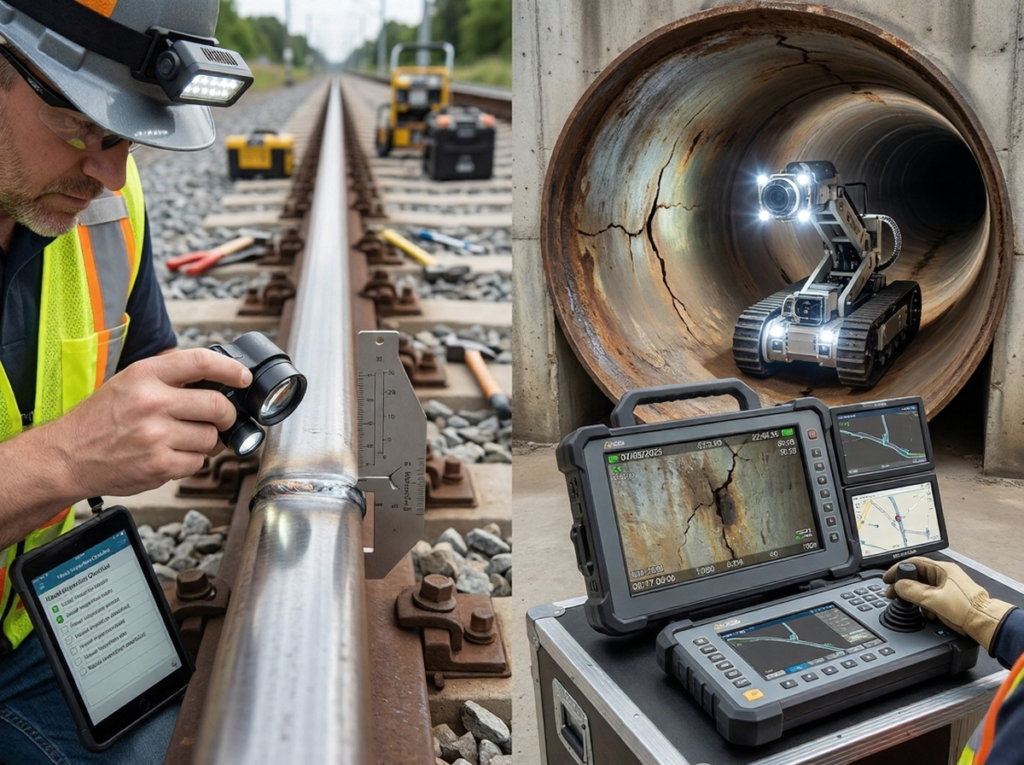
Visual Testing (VT) stands as the oldest and most widely used inspection technique in non-destructive testing. In many industries, Visual Testing (VT) acts as the first step before applying advanced inspection methods. Engineers and inspectors often begin with Visual Testing (VT) because it provides immediate insights into surface conditions without damaging the component.
Non-destructive testing (NDT) focuses on detecting flaws while preserving the integrity of materials and structures. Among all NDT techniques, visual inspection remains the simplest yet surprisingly powerful approach. A trained inspector can identify cracks, corrosion, misalignment, and surface defects within seconds.
Many modern inspection systems now combine traditional observation with digital technology. High-resolution cameras, borescopes, and drones extend the reach of inspection teams into tight or hazardous spaces. Despite these advancements, the foundation of the process still relies on careful observation and experience.
Industries like aerospace, oil and gas, manufacturing, and power generation rely on visual inspection to maintain safety and quality standards. A single overlooked crack could lead to equipment failure, financial loss, or serious safety hazards.
The value of this inspection method becomes clearer when its purpose and scope are understood. But what exactly does this method involve, and how does it fit within the broader NDT framework? The next section explores this question in detail.
What Is the VT Method in NDT?
The VT method in non-destructive testing refers to the systematic examination of a component’s surface using the human eye or optical devices. Inspectors observe the surface condition of materials to detect visible flaws like cracks, corrosion, deformation, or weld defects.
The process may appear simple, yet it requires careful preparation and professional training. Inspectors must ensure proper lighting conditions, appropriate viewing angles, and clean surfaces before performing the inspection. Even a small shadow or obstruction can hide a critical defect.
In many NDT procedures, visual inspection serves as the first stage of evaluation. Inspectors assess the condition of a structure before deciding whether advanced testing methods are necessary. For example, ultrasonic testing or radiography may follow if a visual inspection reveals suspicious areas.
This method also plays a major role in weld inspections. Engineers frequently examine weld beads to identify irregularities like undercutting, porosity, or incomplete fusion. Detecting these issues early prevents costly repairs and structural failures later.
Visual inspection is also cost-effective compared to other NDT techniques. It requires fewer resources, minimal equipment, and faster execution. Because of this efficiency, companies often integrate it into routine maintenance programs.
However, the effectiveness of this method depends heavily on the inspector’s skill and the conditions surrounding the inspection process. Lighting, surface preparation, and accessibility can greatly influence the accuracy of the results.
Understanding the definition is only the beginning. The real question lies in how the method actually works and what scientific principles support it. That leads directly to the mechanics behind the inspection process.
The Science Behind Visual Testing (VT)
Although the inspection process appears straightforward, it relies on several scientific principles. Visual Testing (VT) depends on the interaction between light, the human eye, and the surface being inspected.
Light plays a central role in detecting flaws. When light strikes a surface, it reflects in various directions depending on the surface texture. Smooth surfaces reflect light evenly, while rough or cracked areas scatter light irregularly. These irregular reflections reveal potential defects to the inspector.
Magnification also enhances detection accuracy. Optical devices like magnifying lenses or digital cameras allow inspectors to view tiny surface features that the naked eye may miss. Even a small increase in magnification can reveal subtle discontinuities.
The inspection environment also influences accuracy. Adequate lighting intensity, proper angles, and minimal glare help inspectors detect irregularities more effectively. Many standards recommend specific illumination levels for industrial inspections.
Another factor involves the human eye itself. Trained inspectors develop the ability to recognize patterns and anomalies quickly. Experience allows them to distinguish between harmless surface marks and serious structural defects.
Two main observation approaches exist in this inspection method. Direct observation occurs when inspectors view the object directly with their eyes. Remote observation uses devices like cameras or scopes when the inspection area is difficult to access.
Technology continues to expand the capabilities of visual inspection. Digital imaging systems, robotic cameras, and drones now assist inspectors in large or dangerous environments.
Types of Visual Testing Techniques
Several inspection techniques exist within this method. Each technique serves different inspection environments and accessibility conditions. Choosing the correct approach ensures accurate defect detection.
Direct Visual Testing
Direct inspection occurs when the inspector views the test surface without the use of advanced optical equipment. The inspector stands close enough to observe the surface clearly using the naked eye or basic magnification tools.
This technique works best when the inspection area is easily accessible. Weld seams, pipelines, and structural joints often undergo direct inspection during manufacturing and maintenance.
Lighting plays a crucial role in direct inspection. Proper illumination helps reveal cracks, corrosion, or surface irregularities. Inspectors may adjust the light angle to highlight subtle defects.
Remote Visual Testing (RVT)
Remote visual testing allows inspectors to examine areas that cannot be accessed directly. Specialized optical devices transmit images from confined spaces to the inspector.
Common tools used in remote inspection include borescopes, fiberscopes, and video probes. These devices contain miniature cameras or fiber-optic cables that transmit images through narrow openings.
Remote inspection proves extremely valuable in industries like aerospace and power generation. Inspectors can examine turbine blades, engines, and internal structures without dismantling equipment.
Translucent Visual Testing
Translucent inspection involves examining materials that allow light to pass through them partially. Inspectors place a light source behind the material to reveal internal imperfections.
This technique works particularly well for materials like plastics, glass, and certain composite components. Variations in light transmission often indicate defects or inconsistencies within the material.
Comparison of Visual Testing Techniques
| Technique | Access Method | Common Applications | Equipment Needed |
| Direct Visual Testing | Direct line of sight | Welds, structural joints | Eye, magnifier |
| Remote Visual Testing | Indirect access | Turbines, pipelines | Borescopes, cameras |
| Translucent Visual Testing | Backlighting method | Plastics, thin materials | Light source |
Each technique provides unique advantages depending on inspection conditions. Selecting the correct technique ensures reliable results and efficient inspections.
Yet techniques alone cannot guarantee success. The effectiveness of inspection also depends heavily on the tools used by inspectors. And some of these tools might be more advanced than expected.
The inspection techniques reveal how professionals approach different environments. But what instruments actually make these inspections possible? The next section uncovers the essential equipment used in modern inspection.
Key Equipment Used in Visual Testing
Inspection tools enhance visibility, reach, and accuracy during the inspection process. While basic inspections rely on the human eye, modern industries often require specialized equipment.
These tools allow inspectors to examine components located in confined or hazardous areas. They also improve documentation by capturing images and videos of defects.
Common equipment used in inspections includes the following:
- Borescopes – Flexible optical instruments used to inspect internal surfaces inside engines or pipelines.
- Fiberscopes – Fiber-optic devices that transmit images through narrow spaces.
- Inspection mirrors – Small mirrors used to view hidden surfaces.
- Magnifying lenses – Optical tools that enlarge small surface features.
- Digital inspection cameras – High-resolution cameras used for recording inspection results.
- Lighting equipment – Portable lights used to illuminate inspection areas.
Each tool serves a specific purpose. Borescopes and fiberscopes allow inspectors to reach inaccessible areas. Mirrors help inspect the backside of components without disassembly. Cameras provide documentation that supports maintenance records and quality control.
Technology continues to improve these inspection tools. Many modern devices now include digital zoom, image recording, and wireless connectivity. Inspectors can store images instantly and share them with engineering teams.
However, equipment alone cannot guarantee accurate inspections. Inspectors must also understand where and when to apply these tools. The real impact of inspection becomes visible when examining how different industries rely on it daily.
Industries That Rely on Visual Testing (VT)
Many industrial sectors rely heavily on Visual Testing (VT) to maintain safety, quality, and operational reliability. The method helps organizations detect defects early while minimizing inspection costs.
Several industries depend on this inspection approach during manufacturing, maintenance, and safety evaluations.
- Oil and Gas Industry
Pipelines, storage tanks, and drilling equipment require frequent inspection. Inspectors examine weld joints, corrosion, and structural damage to prevent leaks and equipment failures. - Aerospace Industry
Aircraft components undergo strict inspection procedures. Engineers examine turbine blades, fuselage structures, and landing gear to ensure safe flight operations. - Construction Industry
Bridges, buildings, and structural steel components require visual inspection during construction and maintenance. Inspectors evaluate weld quality and detect structural defects before they become serious hazards. - Manufacturing Industry
Production facilities rely on inspection to maintain product quality. Visual checks help identify surface defects, misalignment, and fabrication errors during assembly processes. - Power Generation Sector
Power plants inspect turbines, boilers, and pipelines regularly. Early defect detection ensures continuous operation and prevents costly shutdowns. - Railway Industry
Railway infrastructure requires regular inspections to maintain safety and operational reliability. Inspectors evaluate rails, weld joints, and structural components for cracks, corrosion, and deformation. Rail operators often rely on non-destructive testing techniques for this purpose.
Each of these industries uses inspection as part of broader safety and quality control programs. Maintenance teams often perform visual inspections during scheduled shutdowns or routine monitoring activities.
In many facilities, inspection results guide further testing decisions. Engineers may perform additional NDT methods if visual inspection reveals suspicious areas.
The reliability of this inspection method depends not only on equipment but also on the procedures and standards followed during inspection.
Inspection across industries highlights the usefulness of this method. However, like any technique, it carries both strengths and limitations. Understanding these factors helps organizations apply them effectively.
Advantages and Limitations of Visual Testing
Advantages
Several factors make Visual Testing (VT) one of the most widely used non-destructive testing methods.
- Cost-effective inspection – The method requires minimal equipment compared to other NDT techniques.
- Immediate results – Inspectors can identify visible defects quickly without complex analysis.
- Simple procedure – Inspection procedures are easy to implement in routine maintenance programs.
- Non-destructive process – The inspected component remains completely intact.
- Versatile applications – The method applies to many industries and materials.
Industry studies indicate that visual inspection identifies a large percentage of surface defects before advanced testing becomes necessary. In many maintenance programs, inspectors detect more than 70% of visible structural defects during initial inspections.
Limitations
Despite its advantages, visual inspection also presents certain limitations.
- Surface-only detection – The method cannot detect internal defects hidden beneath the surface.
- Human dependency – Results depend heavily on the inspector’s experience and attention.
- Lighting conditions – Poor lighting or restricted visibility can affect accuracy.
- Accessibility issues – Some components remain difficult to inspect without specialized equipment.
These limitations explain why visual inspection often works alongside other NDT techniques. Engineers combine different methods to achieve a complete evaluation of structural integrity.
Inspection professionals must also follow established standards to ensure accuracy and reliability. These standards guide inspectors in performing procedures correctly.
Standards and Codes Governing Visual Testing (VT)
International standards and industry codes regulate inspection procedures to ensure consistency and reliability. These standards define inspection methods, equipment requirements, and qualification criteria for inspectors.
Several organizations publish guidelines for inspection practices.
ASME (American Society of Mechanical Engineers) provides inspection rules for pressure vessels, boilers, and piping systems. The ASME Boiler and Pressure Vessel Code includes requirements for visual inspection during fabrication and maintenance.
AWS (American Welding Society) establishes welding inspection standards. These guidelines help inspectors evaluate weld quality and detect defects like cracks or incomplete fusion.
API (American Petroleum Institute) develops inspection standards for oil and gas equipment. API inspection codes guide the evaluation of pipelines, storage tanks, and refinery structures.
ISO (International Organization for Standardization) provides globally recognized inspection guidelines. ISO standards ensure consistency in inspection practices across different industries and countries.
Compliance with these standards ensures that inspection results remain reliable and repeatable. Organizations that follow these codes maintain higher safety levels and regulatory compliance.
However, visual inspection does not operate in isolation. Other non-destructive testing methods often complement it to provide a deeper understanding of material integrity.
Standards ensure reliability, but how does this inspection technique compare with other NDT methods? The next section provides a clearer perspective.
Visual Testing (VT) vs. Other NDT Methods
Although Visual Testing (VT) serves as the starting point for many inspections, other NDT techniques offer additional capabilities. Each method detects different types of defects.
| NDT Method | Detection Capability | Typical Use |
|---|---|---|
| Visual Testing | Surface defects | Initial inspection |
| Ultrasonic Testing (UT) | Internal flaws | Thick materials |
| Magnetic Particle Testing (MT) | Surface and near-surface cracks | Ferromagnetic materials |
| Dye Penetrant Testing (PT) | Surface cracks | Non-porous materials |
Visual inspection identifies visible defects quickly and efficiently. However, ultrasonic testing detects internal flaws that remain invisible to the human eye.
Magnetic particle testing reveals surface cracks in ferromagnetic materials. Dye penetrant testing highlights small cracks in non-porous materials.
Inspection professionals often combine these techniques to achieve a complete structural evaluation. Visual inspection identifies suspicious areas first. Other methods then provide deeper analysis.
Understanding the strengths of each method helps engineers design effective inspection strategies.
Final Thoughts
Inspection methods play a crucial role in maintaining safety, reliability, and structural integrity across many industries. Among these techniques, Visual Testing (VT) remains one of the most fundamental and widely used methods in non-destructive testing.
The inspection process allows professionals to detect visible defects quickly and efficiently. Engineers rely on Visual Testing (VT) to identify cracks, corrosion, misalignment, and weld defects before they escalate into serious problems.
Although the method appears simple, it requires trained inspectors, proper lighting, and suitable equipment to deliver accurate results. When combined with modern tools and digital inspection systems, Visual Testing (VT) becomes even more powerful.
Industries like aerospace, oil and gas, construction, and power generation continue to depend on this inspection technique for routine maintenance and safety evaluations.
As inspection technologies evolve, Visual Testing (VT) will likely remain the starting point of many NDT programs. Its simplicity, efficiency, and reliability ensure its continued importance in industrial safety and quality control.
Key Takeaways
- Visual inspection is one of the oldest and most widely applied methods in non-destructive testing practices.
- The inspection process helps engineers detect surface defects like cracks, corrosion, and structural deformation early.
- Visual Testing (VT) often serves as the first step before applying advanced non-destructive testing techniques.
- Proper lighting conditions, clean surfaces, and suitable viewing angles significantly improve inspection accuracy and reliability.
- Tools like borescopes, fiberscopes, and digital cameras expand inspection capabilities in confined spaces.
- Industries including aerospace, oil and gas, construction, and manufacturing rely heavily on routine visual inspections.
- Visual inspection methods help reduce maintenance costs by identifying defects before they cause equipment failure.
- International standards like ASME, AWS, API, and ISO regulate inspection procedures and practices.
- Visual Testing (VT) primarily detects surface defects and therefore often works alongside other NDT methods.
- Combining experienced inspectors with modern inspection technology improves the reliability and effectiveness of visual inspections.
FAQs
What are the defects of VT welding?
Visual inspection of welds helps detect several common surface defects that appear during welding. These defects include cracks, porosity, undercut, overlap, spatter, and incomplete fusion. Inspectors carefully examine weld beads to ensure they meet required quality standards. Detecting these defects early helps prevent structural failures and costly repairs in industrial applications.
What are the 5 methods of NDT?
The five commonly used non-destructive testing methods include visual testing, ultrasonic testing, magnetic particle testing, dye penetrant testing, and radiographic testing. Each method detects different types of defects in materials. Industries often combine these techniques to achieve a complete evaluation of structural integrity and safety.
What is 100% visual inspection?
100% visual inspection refers to the process of examining every component or weld within a structure rather than inspecting only a sample. Inspectors evaluate the entire surface area to ensure that no visible defects are present. This approach improves quality control and reduces the risk of overlooked structural issues.
What are the 4 types of inspections?
The four common types of inspections used in industrial quality control include visual inspection, dimensional inspection, non-destructive testing, and destructive testing. Each type serves a specific purpose in evaluating product quality, structural integrity, and manufacturing accuracy.
What is the ISO standard for weld visual inspection?
The most widely referenced international standard for weld visual inspection is ISO 17637. This standard provides guidelines for performing visual examinations of welded joints before, during, and after welding. It defines inspection procedures, lighting requirements, and qualification expectations for inspectors.
