

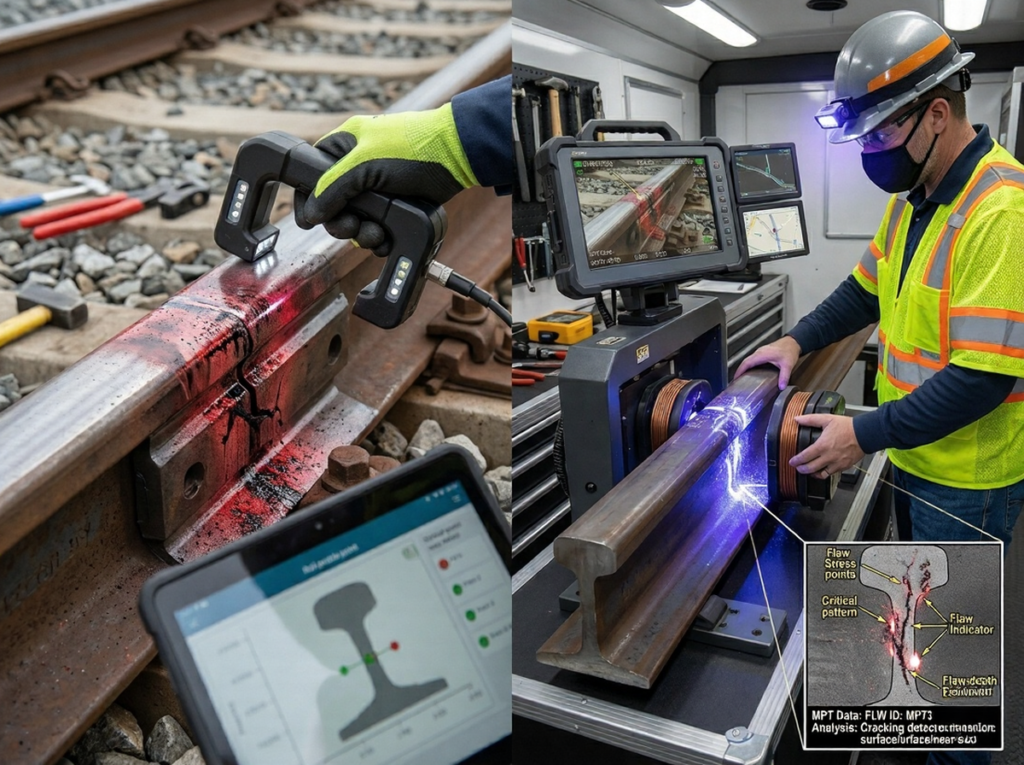
Magnetic Particle Testing (MPT) plays a critical role in modern industrial inspection. Magnetic Particle Testing (MPT) helps inspectors detect surface and near-surface defects in ferromagnetic materials. Magnetic Particle Testing (MPT) remains one of the most reliable non-destructive testing methods used across multiple industries.
Industries depend on reliable inspection techniques to maintain safety and quality. Structural failures can lead to financial loss, operational delays, and serious accidents. Because of these risks, engineers often rely on non-destructive testing methods that detect hidden defects before they become dangerous.
Magnetic particle inspection methods have gained strong adoption due to their ability to reveal cracks and discontinuities that may not appear during visual inspection. By using magnetic fields and specially designed particles, inspectors can quickly identify flaws in metals such as steel and iron.
Manufacturing, aerospace, automotive, and oil industries frequently use this technique to verify component integrity. The process works efficiently, produces fast results, and requires relatively simple equipment.
However, understanding how the method actually works requires a deeper look into the science behind it. Before exploring applications and variations, it is important to understand the concept itself.
The next section explains the fundamentals behind Magnetic Particle Testing (MPT) and why it is widely trusted in engineering inspections.
What Is Magnetic Particle Testing (MPT)?
Magnetic Particle Testing (MPT) is a non-destructive testing technique used to detect cracks, seams, or inclusions in ferromagnetic materials.
The method works by magnetizing a metal component and applying magnetic particles over the surface. When a defect exists, the magnetic field leaks from the discontinuity and attracts the particles. These particles then gather along the defect line, making the flaw visible to inspectors.
Magnetic Particle Testing (MPT) primarily identifies surface defects and slightly subsurface flaws. Because the process uses magnetic fields, it works only on materials that can be magnetized, such as iron, nickel, cobalt, and their alloys.
The technique has been widely used since the early twentieth century. Engineers began experimenting with magnetic fields to reveal cracks in railway components and heavy machinery parts. Over time, improvements in particle materials and inspection equipment significantly increased detection accuracy.
Today, Magnetic Particle Testing (MPT) serves as a key inspection tool in non-destructive testing programs. Many industries rely on it because it delivers reliable results without damaging the component under inspection.
Engineers also prefer the method because it provides immediate visual indications of defects. Unlike some advanced testing techniques, inspectors can often interpret results directly on the surface of the component.
Although the concept may appear simple, the effectiveness of the method depends on understanding the inspection process carefully. The next section explains how Magnetic Particle Testing (MPT) actually works step by step.
How Does Magnetic Particle Testing (MPT) Work?
Magnetic Particle Testing (MPT) follows a systematic process that allows inspectors to identify flaws in ferromagnetic components. Each stage plays a crucial role in ensuring accurate detection.
Surface Preparation
Before inspection begins, technicians clean the surface thoroughly. Oil, dirt, rust, and paint can interfere with particle movement and reduce inspection accuracy.
Clean surfaces allow particles to respond clearly to magnetic field leakage.
Magnetization
The inspector magnetizes the test object using electrical current or permanent magnets. This creates a magnetic field that flows through the material.
If the material contains a crack or discontinuity, the magnetic field becomes distorted at that location.
Application of Magnetic Particles
Technicians apply fine magnetic particles over the surface of the component. These particles may appear as dry powder or be suspended in liquid.
Magnetic particles move along the magnetic field lines and accumulate at leakage points.
Inspection and Interpretation
Once the particles gather, inspectors examine the surface under proper lighting conditions.
Accumulated particles reveal clear patterns that indicate possible defects. These patterns help inspectors determine the type, size, and location of the discontinuity.
Demagnetization and Cleaning
After inspection, technicians demagnetize the component to remove any residual magnetism.
The surface is then cleaned to restore the component to its original condition.
Magnetic Particle Testing (MPT) provides quick visual results, which makes it extremely useful in production environments. The inspection process usually takes only a short time compared to other testing methods.
However, the technique itself can be performed using different particle methods and detection styles. Some approaches work better in certain environments than others.
Types of Magnetic Particle Testing
Magnetic Particle Testing (MPT) includes several variations that adapt the technique for different inspection needs. Inspectors choose the appropriate method depending on component size, environment, and defect detection requirements.
Dry Magnetic Particle Testing
Dry magnetic particle inspection uses fine powder particles applied directly to the surface.
Technicians typically use this method for large components or rough surfaces. The powder flows easily across the metal and collects around leakage fields.
Dry particles work particularly well in outdoor inspections where liquid suspension may not be practical.
Because the particles move freely, inspectors can quickly identify cracks on heavy equipment parts and weld joints.
Wet Magnetic Particle Testing
Wet particle inspection uses magnetic particles suspended in liquid, usually oil or water.
This liquid suspension allows particles to flow smoothly across the component surface. As a result, even very small leakage fields attract particles more clearly.
Wet magnetic particle inspection often provides higher sensitivity than dry methods. For this reason, many manufacturing facilities use this technique during final product inspections.
Technicians typically apply the liquid using spray systems, immersion tanks, or flow methods.
Fluorescent vs. Visible Particle Testing
Magnetic particle inspection can also be categorized based on particle visibility.
Visible particle inspection uses colored magnetic particles that inspectors observe under normal lighting. These particles often appear black or red against the metal surface.
Fluorescent particle inspection uses particles that glow under ultraviolet light. The fluorescent particles create bright indications that reveal extremely small defects.
Many critical industries prefer fluorescent techniques because they improve detection sensitivity.
Magnetic Particle Testing (MPT) continues to evolve as technology improves particle design and inspection equipment. However, regardless of the variation used, the method remains part of a broader inspection category.
Understanding its place within the non-destructive testing family helps clarify its industrial importance.
Is MPI a Form of NDT?
Yes, MPI (Magnetic Particle Inspection) is a form of non-destructive testing.
Non-destructive testing, often abbreviated as NDT, includes inspection methods that evaluate materials without damaging them. These methods allow engineers to identify defects while keeping components usable.
Magnetic Particle Testing (MPT) falls directly within this category because it reveals defects without altering the material structure.
The terms MPI and Magnetic Particle Testing (MPT) are often used interchangeably. However, some industries prefer MPI when referring specifically to inspection procedures performed in maintenance or production environments.
Both terms describe the same fundamental technique that uses magnetic fields and particles to detect defects.
In most engineering documentation, MPI refers to the inspection process itself. Magnetic Particle Testing (MPT) often appears in technical standards and training materials describing the broader testing method.
Regardless of terminology, the purpose remains the same. Engineers use the method to locate cracks, seams, laps, and inclusions in ferromagnetic materials.
Magnetic Particle Testing (MPT) plays an essential role in maintaining structural safety across industries. The technique helps inspectors identify hidden flaws before they cause component failure.
However, while MPI and MPT are closely related, they are not always used in exactly the same way.
A deeper comparison between the two terms reveals subtle differences in terminology and industry usage. That distinction becomes clearer when examining their roles in inspection practices.
The next part explores that comparison in detail and explains how different industries interpret these terms.
What Is the Difference Between MPI and MPT Test?
The terms MPI and Magnetic Particle Testing (MPT) often appear together in technical documentation. In most situations, they describe the same inspection method. However, industries sometimes use the terms differently depending on context.
Magnetic Particle Testing (MPT) usually refers to the overall testing method or technique. MPI, or Magnetic Particle Inspection, often refers to the actual inspection procedure performed by technicians.
Despite this small difference, both involve the same scientific principle. The inspection uses magnetic fields and magnetic particles to detect defects in ferromagnetic materials.
Magnetic Particle Testing (MPT) remains the broader term in engineering standards and training manuals. Meanwhile, maintenance teams frequently use MPI when discussing practical inspections on equipment.
The distinction becomes clearer when comparing their usage side by side.
| Feature | MPI (Magnetic Particle Inspection) | Magnetic Particle Testing (MPT) |
| Meaning | Refers to the inspection activity | Refers to the testing method |
| Context | Used in field inspections | Used in standards and theory |
| Scope | Focuses on inspection results | Covers the entire testing technique |
| Application | Used by technicians | Used in engineering documentation |
| Principle | Uses magnetic particle indication | Same magnetic particle detection method |
Even though terminology differs slightly, the underlying process remains identical. Both rely on magnetic flux leakage and particle accumulation to reveal defects.
Magnetic Particle Testing (MPT), therefore, serves as the foundation behind MPI procedures used daily in industry.
Understanding this terminology helps professionals communicate more clearly about inspection programs. However, knowing the difference between terms raises another question.
Applications of Magnetic Particle Testing (MPT) Across Industries
Magnetic Particle Testing (MPT) plays a vital role in industrial safety and product reliability. Many industries depend on it to detect cracks before components fail.
Because the method quickly identifies surface defects, engineers often use it during manufacturing, maintenance, and quality assurance processes.
Aerospace Industry
Aircraft components must meet extremely strict safety standards. Even a small crack can cause catastrophic failure.
Aerospace engineers frequently use Magnetic Particle Testing (MPT) to inspect landing gear components, turbine shafts, and structural fittings.
Automotive Industry
Automotive manufacturers rely on magnetic particle inspection to maintain component strength.
Engine blocks, crankshafts, axles, and suspension parts often undergo Magnetic Particle Testing (MPT) during production.
The inspection ensures that parts leaving the factory do not contain hidden cracks.
Oil and Gas Industry
Oil and gas equipment operates under high pressure and harsh conditions.
Technicians use Magnetic Particle Testing (MPT) to inspect pipelines, drilling equipment, valves, and pressure vessels.
Detecting small flaws early helps prevent leaks and major equipment failures.
Manufacturing and Heavy Engineering
Manufacturing industries often use magnetic particle inspection during welding and fabrication.
Weld seams, forged parts, and heavy machinery components undergo Magnetic Particle Testing (MPT) to verify structural integrity.
Key Use Cases in Industry
Magnetic Particle Testing (MPT) commonly supports the following inspection tasks:
- Detecting surface cracks in steel components
- Inspecting weld joints for discontinuities
- Verifying forged and cast metal parts
- Evaluating maintenance wear in machinery
- Inspecting railway components and heavy equipment
The wide range of applications demonstrates why engineers trust this method. Magnetic Particle Testing (MPT) delivers fast, reliable results across multiple industries.
However, every inspection method carries both strengths and limitations. Understanding those characteristics helps engineers choose the right inspection approach.
The next section explores the major advantages that make this testing technique so popular.
Advantages of Magnetic Particle Testing (MPT)
Magnetic Particle Testing (MPT) offers several benefits that make it attractive for industrial inspection programs.
- Detects very small surface and near-surface cracks
- Provides immediate visual results for inspectors
- Requires relatively simple and affordable equipment
- Works quickly, allowing high inspection productivity
- Identifies defects that visual inspection cannot detect
- Works effectively on complex shapes and welded joints
- Suitable for both field inspections and manufacturing environments
Magnetic Particle Testing (MPT) also offers flexibility in inspection methods. Technicians can choose between dry powder, wet suspension, visible particles, or fluorescent particles depending on inspection needs.
The ability to adapt to different environments makes the technique highly practical for both production facilities and maintenance operations.
Despite these advantages, the method is not perfect. Certain conditions can limit its effectiveness.
Limitations of Magnetic Particle Testing
Magnetic Particle Testing (MPT) works only on ferromagnetic materials.
Metals such as aluminum, copper, and stainless steel cannot be inspected using this method. Engineers must use alternative NDT techniques for those materials.
Surface preparation also plays an important role. Dirt, paint, or grease can reduce inspection accuracy by preventing particles from responding correctly.
Magnetic Particle Testing (MPT) also struggles to detect deep internal defects. The technique mainly identifies surface or slightly subsurface discontinuities.
Another limitation involves demagnetization. After inspection, technicians often need to remove residual magnetism from the component.
Even with these limitations, industries continue to rely on the method because of its efficiency and accuracy for surface crack detection.
Understanding these strengths and weaknesses helps engineers decide when the technique should be applied.
However, a final question still appears frequently among professionals exploring this inspection method.
Why exactly do industries perform this test in the first place?
What Is the Purpose of MPT Test?
The primary purpose of Magnetic Particle Testing (MPT) is to detect surface and near-surface defects in ferromagnetic materials.
Engineers perform this inspection to ensure structural integrity and prevent unexpected failures. Identifying cracks early helps avoid costly repairs and dangerous accidents.
Magnetic Particle Testing (MPT) helps maintenance teams monitor the condition of critical components during service. Regular inspections allow technicians to detect developing cracks before they grow larger.
Manufacturers also use the method during quality control stages. Magnetic Particle Testing (MPT) ensures that newly produced parts meet safety and reliability standards before entering service.
Because the inspection does not damage the component, organizations can perform it repeatedly throughout a product’s lifecycle.
For industries dealing with high-stress machinery, pipelines, aircraft components, and structural equipment, the purpose becomes clear.
Magnetic Particle Testing (MPT) acts as an early warning system that reveals hidden defects before they cause failure.
Final Thoughts
Magnetic Particle Testing (MPT) remains one of the most widely used non-destructive testing techniques in modern industry. Magnetic Particle Testing (MPT) allows inspectors to detect cracks quickly without damaging the inspected component.
The method works by magnetizing a ferromagnetic material and applying magnetic particles that gather around defects. These visible indications reveal flaws that visual inspection alone cannot detect.
Industries such as aerospace, automotive, manufacturing, and oil and gas rely heavily on this inspection method. Magnetic Particle Testing (MPT) helps ensure that critical components meet strict safety and quality standards.
Although the technique has limitations, its speed, reliability, and cost-effectiveness make it an essential tool for defect detection.
For engineers and technicians responsible for structural safety, Magnetic Particle Testing (MPT) continues to provide a trusted solution for identifying hidden flaws before they become major failures.
Key Takeaways
- Magnetic Particle Testing (MPT) is a widely used non-destructive testing method for detecting surface cracks in ferromagnetic materials.
- The inspection process works by magnetizing the component and applying magnetic particles that gather around defects.
- Magnetic Particle Testing (MPT) helps industries detect cracks early and prevent costly equipment failures.
- The technique is most effective for identifying surface and slightly subsurface defects in iron-based materials.
- Industries such as aerospace, automotive, oil and gas, and manufacturing rely heavily on this inspection method.
- Magnetic Particle Testing (MPT) provides quick visual indications that allow inspectors to identify defects rapidly.
- The inspection can use either dry magnetic powder or liquid suspension depending on the testing environment.
- Fluorescent particle inspection improves visibility and helps detect very small cracks under ultraviolet light.
- Although effective, Magnetic Particle Testing (MPT) only works on ferromagnetic materials such as iron and steel.
- Regular inspections using Magnetic Particle Testing (MPT) improve equipment reliability and support long-term industrial safety.
FAQs
What is MPT used for?
Magnetic Particle Testing (MPT) is used to detect surface and near-surface defects in ferromagnetic materials. Industries apply it to find cracks, seams, and discontinuities in components such as welds, shafts, and pipelines. The method helps maintain safety and prevent equipment failure.
What is the basic principle of MPT?
The basic principle of Magnetic Particle Testing (MPT) involves magnetizing a metal component. Magnetic particles are applied to the surface during inspection. If a defect exists, particles gather around the leakage field and reveal the flaw.
How does MPT work?
Magnetic Particle Testing (MPT) works by creating a magnetic field within a ferromagnetic material. Inspectors apply magnetic particles in dry powder or liquid suspension form. The particles accumulate along defect lines and make cracks visible.
What are the advantages of MPT?
Magnetic Particle Testing (MPT) provides fast and reliable detection of surface defects. The method requires simple equipment and delivers immediate visual indications. It also works effectively on complex shapes and welded components.
