

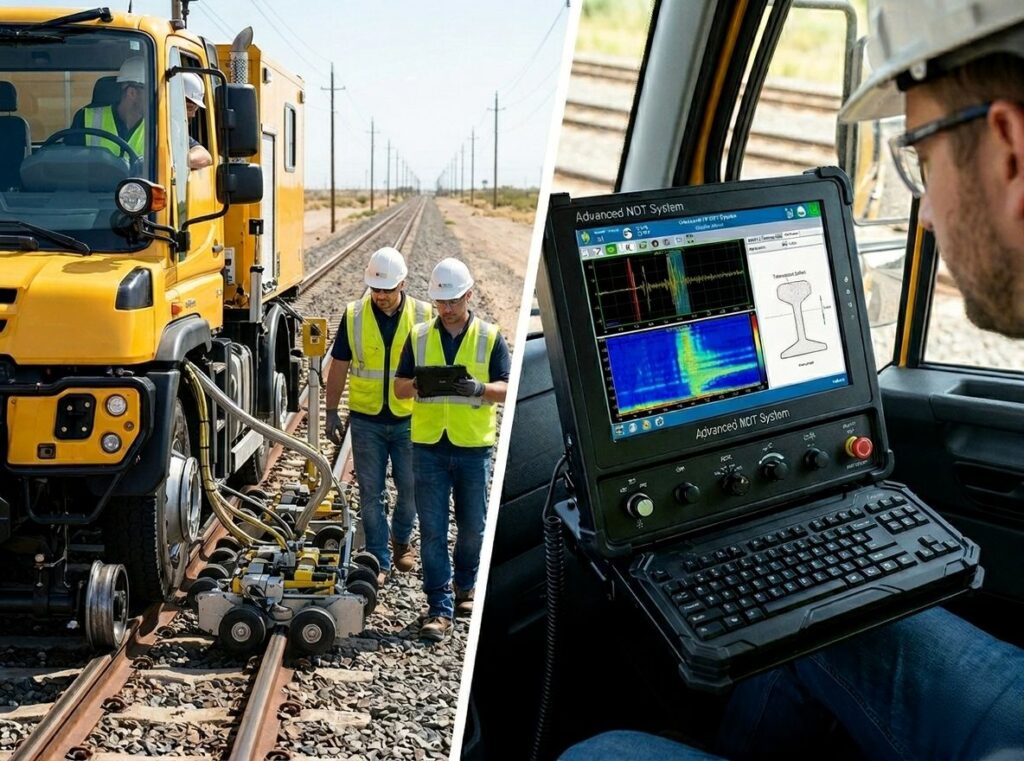
Railway infrastructure faces increasing pressure from heavy freight loads, high-speed operations, environmental conditions, and continuous daily usage. Detecting hidden rail defects early has become essential for maintaining railway safety, operational reliability, and long-term infrastructure performance. The mobile ultrasonic rail testing system plays a critical role in modern rail inspection by identifying internal cracks and structural flaws before they lead to serious failures or derailments.
Unlike traditional visual inspections, the mobile ultrasonic rail testing system uses high-frequency ultrasonic waves to inspect rail integrity with remarkable precision. This advanced technology enables railway operators to conduct faster inspections, gather real-time data, and reduce costly operational disruptions. As railway networks continue expanding globally, the demand for automated and accurate inspection technologies continues growing rapidly.
Today, the mobile ultrasonic rail testing system has become one of the most effective solutions for predictive rail maintenance, helping operators improve safety standards, minimize infrastructure risks, and extend rail asset lifespan efficiently.
The Problem with Conventional Rail Inspection Methods
Traditional rail inspection methods relied heavily on manual observation, basic measurement tools, and periodic maintenance checks. Although these methods formed the foundation of railway maintenance for many years, they carried major limitations that modern transportation systems could no longer ignore.
Visual inspection remains one of the oldest forms of track assessment. Inspectors walk rail lines searching for visible signs of wear, corrosion, misalignment, or surface cracking. While this method helps identify obvious defects, it cannot reveal hidden internal damage developing beneath the rail surface.
This limitation creates a serious problem. Many dangerous rail defects originate internally long before any visible signs appear. Tiny cracks caused by rolling contact fatigue can grow silently within the steel structure over time. By the time surface damage becomes visible, the defect may already pose a significant risk to rail operations.
Manual inspections also depend heavily on human judgment and environmental conditions. Fatigue, poor visibility, weather conditions, and inconsistent inspection routines can affect accuracy. In large rail networks covering thousands of kilometers, maintaining consistent inspection quality becomes increasingly difficult.
Another challenge involves inspection speed. Conventional methods often require slowing or stopping railway operations, creating costly delays and operational disruptions. High-traffic rail corridors cannot afford extended maintenance interruptions without affecting schedules and logistics performance.
Rail failures caused by undetected defects can produce devastating consequences. Derailments may lead to injuries, fatalities, cargo loss, infrastructure destruction, and environmental damage. Beyond the immediate impact, railway operators may also face legal consequences, compensation claims, and public trust issues.
Historically, railway maintenance evolved reactively rather than predictively. Early inspection systems focused on identifying damage after it became severe enough to observe directly. Over time, the industry recognized that preventive inspection strategies offered a far safer and more cost-effective approach.
This realization accelerated the adoption of non-destructive testing technologies. Engineers sought methods capable of identifying hidden flaws without cutting, dismantling, or damaging the rail itself. Among all available techniques, ultrasonic testing quickly emerged as one of the most effective solutions.
The mobile ultrasonic rail testing system brought a major advancement to this evolution. Instead of depending entirely on human observation, operators could now use sophisticated sound wave technology to inspect the internal condition of rails with extraordinary precision. Hidden fractures, inclusions, and fatigue cracks became detectable long before they turned into failures.
Rail infrastructure today operates under far greater pressure than previous decades. Faster trains, heavier loads, and tighter operational schedules leave little margin for inspection errors. Traditional methods alone simply cannot provide the level of reliability required for modern rail systems.
The industry’s transition toward advanced inspection technology did not happen overnight. It developed through years of engineering innovation and practical lessons learned from rail failures worldwide. But how exactly does ultrasonic testing uncover defects hidden deep inside steel rails? The answer lies in the science behind sound wave inspection.
What Is Ultrasonic Rail Testing?
Ultrasonic rail testing is a non-destructive inspection method that uses high-frequency sound waves to identify internal defects within railway tracks. The process allows inspectors to evaluate rail integrity without damaging the material itself, making it one of the most efficient and reliable inspection technologies available in the rail industry.
The principle behind ultrasonic testing is relatively straightforward yet highly effective. Specialized transducers generate ultrasonic sound waves that travel through the rail material. When these sound waves encounter discontinuities such as cracks, voids, or inclusions, they reflect back toward the sensor. The system then analyzes these reflections to determine the location, depth, and severity of the defect.
The mobile ultrasonic rail testing system applies this principle on a larger and more advanced scale. Mounted on specialized inspection vehicles or mobile platforms, the system scans long sections of railway track while collecting continuous real-time data. This enables operators to identify hidden rail defects quickly and accurately without disrupting normal rail traffic.
Two major ultrasonic testing approaches commonly support rail inspection operations:
- Pulse-Echo Testing
- Sends ultrasonic pulses into the rail
- Detects reflected signals from internal defects
- Identifies crack depth and position accurately
- Time of Flight Diffraction (TOFD)
- Measures diffraction patterns from crack tips
- Produces highly accurate sizing information
- Enhances detection of complex defects
Among these methods, pulse-echo inspection remains widely used in railway applications because it delivers fast and reliable results during high-speed scanning operations.
The mobile ultrasonic rail testing system significantly outperforms traditional inspection approaches because it can detect flaws invisible to the naked eye. Internal transverse cracks, bolt hole fractures, and fatigue-related defects become identifiable long before they threaten operational safety.
Compared to X-ray inspection methods, ultrasonic testing offers several advantages. X-ray systems often require strict safety precautions, controlled environments, and more complicated operational procedures. Ultrasonic systems, by contrast, provide safer field deployment, faster scanning capability, and greater portability.
Visual inspection methods also fall short when compared with ultrasonic technology. Surface examinations cannot penetrate steel to detect subsurface flaws, whereas ultrasonic waves travel through the rail structure and reveal internal discontinuities immediately.
Modern railway authorities increasingly depend on the mobile ultrasonic rail testing system because it improves inspection coverage while reducing maintenance downtime. The technology enables continuous monitoring strategies rather than isolated periodic checks, helping operators adopt more predictive maintenance models.
Digital integration further strengthens the system’s value. Advanced software platforms can analyze inspection data, generate defect maps, track deterioration trends, and support maintenance planning decisions. Rail operators gain deeper visibility into infrastructure health while improving long-term asset management strategies.
The importance of ultrasonic testing continues to grow as railway systems become faster and more complex. High-speed rail corridors especially require inspection technologies capable of identifying microscopic flaws before they expand under repetitive stress conditions.
Understanding the science behind ultrasonic inspection explains why the technology transformed rail maintenance globally. However, the real innovation becomes even clearer when examining how the mobile ultrasonic rail testing system actually operates in real-world railway environments.
How the Mobile Ultrasonic Rail Testing System Works
The mobile ultrasonic rail testing system combines advanced sensors, data acquisition technology, and intelligent software to inspect railway tracks efficiently and accurately. Designed for high-speed operation, the system enables continuous rail inspection without causing major interruptions to railway services.
Unlike traditional inspection methods that require extensive manual involvement, this system automates much of the testing and analysis process. The result is faster inspections, greater consistency, and improved defect detection reliability.
Core Components of the System
Several integrated components allow the mobile ultrasonic rail testing system to function with high precision and operational efficiency.
- Ultrasonic Transducer Array
- Generates and receives ultrasonic sound waves
- Detects internal rail discontinuities
- Supports multi-angle inspection coverage
- Data Acquisition Unit
- Captures ultrasonic signal data in real time
- Processes reflections and defect responses
- Stores inspection records digitally
- GPS and Positioning System
- Tracks exact inspection locations
- Maps detected defects accurately
- Supports maintenance planning
- Analysis Software
- Interprets ultrasonic signal patterns
- Classifies defect severity
- Generates automated inspection reports
- Mobile Inspection Platform
- Carries inspection equipment across rail networks
- Operates efficiently at controlled speeds
- Minimizes operational disruptions
Together, these components create a fully integrated inspection ecosystem capable of delivering highly reliable rail condition assessments.
The Inspection Process Step by Step
The operational workflow of the mobile ultrasonic rail testing system follows a structured process designed to maximize inspection accuracy and efficiency.
- System Deployment
- Inspection vehicles position ultrasonic sensors directly onto the rail surface.
- Calibration procedures verify signal accuracy before scanning begins.
- Ultrasonic Scanning
- High-frequency sound waves enter the rail structure continuously.
- Sensors monitor reflected wave patterns throughout the scan.
- Real-Time Data Capture
- Digital acquisition systems collect inspection signals instantly.
- Software filters noise and enhances defect visibility.
- Defect Identification
- Algorithms analyze signal responses for abnormalities.
- Inspectors review detected flaw indications in real time.
- Reporting and Documentation
- The system generates detailed inspection records.
- Maintenance teams receive actionable defect location data.
One of the greatest advantages of the mobile ultrasonic rail testing system lies in its ability to inspect tracks while maintaining operational continuity. Rail traffic often continues without major disruption during inspections, which significantly improves network efficiency.
Modern inspection systems also support faster scanning speeds than earlier ultrasonic technologies. This allows railway operators to cover larger track distances within shorter inspection windows while maintaining consistent detection performance.
As digital rail infrastructure evolves, the mobile ultrasonic rail testing system continues integrating artificial intelligence, predictive analytics, and cloud-based reporting tools. These advancements strengthen maintenance planning and reduce unexpected infrastructure failures even further.
The technology already demonstrates remarkable effectiveness, but ultrasonic inspection itself includes multiple testing approaches. Each method serves different inspection requirements and offers unique advantages depending on the rail condition being evaluated. The distinction between these inspection types reveals another critical layer of modern rail testing technology.
What Are the Two Types of Ultrasonic Inspection?
Ultrasonic inspection generally relies on two primary testing methods: pulse-echo inspection and through-transmission inspection. Both techniques use high-frequency sound waves to evaluate material integrity, but they operate differently and serve distinct inspection purposes.
The mobile ultrasonic rail testing system primarily uses pulse-echo inspection because it offers superior defect localization and real-time analysis capabilities for railway environments.
Pulse-Echo Inspection
Pulse-echo testing works by sending ultrasonic waves into the rail through a transducer. When the sound waves encounter an internal flaw, part of the signal reflects back toward the sensor. The system measures the return time and signal intensity to determine the defect’s location and size.
This method offers several advantages:
- Detects internal cracks precisely
- Supports single-side rail access
- Enables continuous mobile inspection
- Produces fast real-time results
Because railway tracks often require rapid large-scale inspection, pulse-echo testing remains the preferred method in most mobile ultrasonic rail testing system applications.
Through-Transmission Inspection
Through-transmission testing operates differently. Instead of measuring reflected signals, the method uses separate transmitting and receiving transducers positioned on opposite sides of the material. Defects interrupt sound wave transmission between the sensors, indicating potential flaws.
This approach can identify certain defect types effectively, but it has limitations in rail inspection environments because it requires access to multiple sides of the material and may provide less precise flaw localization.
| Inspection Method | Working Principle | Main Advantage | Limitation |
| Pulse-Echo | Measures reflected sound waves | Accurate defect location | Requires signal interpretation |
| Through-Transmission | Measures sound passing through material | Effective for large discontinuities | Limited location accuracy |
The mobile ultrasonic rail testing system depends heavily on pulse-echo technology because railway inspections demand speed, precision, and operational flexibility. Its ability to identify hidden flaws while trains continue operating makes it an indispensable tool in modern rail maintenance programs.
How Mobile Ultrasonic Rail Testing System Integrates Advanced NDT
The integration of multiple NDT technologies enables the mobile ultrasonic rail testing system to provide highly detailed rail condition assessments.
- Phased Array Ultrasonic Testing (PAUT)
- Improves scanning flexibility
- Produces detailed defect imaging
- Enhances crack detection accuracy
- Time of Flight Diffraction (TOFD)
- Measures crack depth precisely
- Supports advanced flaw sizing
- Reduces interpretation uncertainty
- Eddy Current Testing
- Detects surface and near-surface cracks
- Complements ultrasonic inspection
- Enhances fatigue crack identification
- Ground Penetrating Radar (GPR)
- Evaluates ballast and substructure conditions
- Identifies moisture-related deterioration
- Supports infrastructure stability analysis
When these technologies work together, railway operators gain a far more complete understanding of rail infrastructure health. The mobile ultrasonic rail testing system serves as the foundation of this integrated approach by delivering continuous internal rail inspection across extensive track networks.
Advanced analytics software further strengthens the process by combining inspection data from multiple NDT sources into centralized reporting platforms. Engineers can monitor defect trends, prioritize repairs, and predict maintenance needs before failures occur.
The increasing sophistication of rail inspection technology highlights another critical factor that operators cannot overlook: regulatory compliance and inspection standards. Detection accuracy alone is not enough unless inspection procedures also align with internationally recognized engineering standards.
ASME Standards and Compliance in Ultrasonic Rail Testing
Railway inspection procedures must follow strict engineering standards to ensure accuracy, consistency, and operational reliability. Among the most recognized frameworks in non-destructive testing is the ASME Boiler and Pressure Vessel Code, particularly ASME Section V, which establishes guidelines for ultrasonic testing procedures and personnel qualifications.
ASME Section V, Article 4 specifically addresses ultrasonic examination methods and provides detailed requirements for calibration, scanning procedures, sensitivity settings, and defect interpretation. Although rail inspection environments differ from pressure vessel applications, many ultrasonic testing principles remain directly applicable to railway infrastructure evaluation.
The mobile ultrasonic rail testing system aligns with these standards by implementing controlled inspection procedures, calibrated equipment, and validated testing methodologies. Compliance helps ensure that inspection results remain accurate, repeatable, and legally defensible.
In railway environments, additional industry-specific standards such as AREMA guidelines also influence inspection practices. The American Railway Engineering and Maintenance-of-Way Association establishes technical recommendations that support safe rail infrastructure maintenance across freight and passenger rail systems.
By aligning with both ASME and AREMA principles, the mobile ultrasonic rail testing system supports:
- Standardized inspection procedures
- Reliable defect evaluation criteria
- Improved maintenance documentation
- Consistent operator training
- Better regulatory compliance
Compliance carries both operational and legal significance. Railway operators must demonstrate that inspection programs follow recognized industry practices, especially after incidents involving infrastructure failures. Proper documentation and standards adherence can significantly reduce liability exposure during investigations or audits.
Calibration accuracy remains especially important in ultrasonic inspection systems. Even small deviations in equipment settings may affect defect detection reliability. Modern systems therefore include automated calibration verification routines to maintain inspection consistency throughout operations.
The mobile ultrasonic rail testing system also benefits from digital reporting capabilities that simplify compliance management. Inspection records, defect logs, GPS locations, and maintenance recommendations can all be archived electronically for future reference and regulatory review.
As rail infrastructure ages globally, regulatory expectations surrounding inspection quality continue increasing. Operators now face greater pressure to adopt advanced technologies capable of meeting both safety objectives and compliance obligations.
Yet standards and compliance alone do not fully explain why railway operators continue investing heavily in ultrasonic inspection technology. The true value becomes even more apparent when examining the measurable operational and safety benefits delivered by modern inspection systems.
Key Benefits of Deploying a Mobile Ultrasonic Rail Testing System
Railway operators increasingly recognize that inspection technology directly influences network reliability, maintenance efficiency, and passenger safety. The mobile ultrasonic rail testing system delivers several critical advantages that traditional inspection approaches cannot match.
By enabling early defect detection and continuous rail monitoring, the system helps operators reduce unexpected failures while improving long-term infrastructure performance.
Operational Advantages
Modern rail networks require inspection solutions that balance accuracy with operational efficiency. The mobile ultrasonic rail testing system achieves this balance through automation, speed, and advanced digital integration.
Key operational benefits include:
- Faster inspection coverage across large rail networks
- Reduced service interruptions during inspections
- Real-time defect analysis and reporting
- Lower long-term maintenance costs
- Improved maintenance scheduling efficiency
- Better asset lifecycle management
Traditional inspection methods often require extensive manual labor and longer inspection windows. By contrast, mobile ultrasonic systems streamline the inspection process and reduce downtime significantly.
The ability to inspect rails without halting traffic provides enormous value for high-capacity freight corridors and passenger rail systems. Railway operators can maintain tighter schedules while continuing to monitor infrastructure conditions proactively.
The mobile ultrasonic rail testing system also improves data consistency. Automated signal acquisition reduces the variability associated with manual inspections, leading to more reliable maintenance decisions.
Safety and Risk Reduction
Railway safety remains the primary driver behind ultrasonic inspection adoption. Hidden internal rail defects represent one of the most serious risks within rail infrastructure systems.
When cracks expand unnoticed, the probability of rail fractures and derailments increases dramatically. Early detection allows maintenance teams to repair or replace damaged rails before failures occur.
The mobile ultrasonic rail testing system strengthens safety management by:
- Detecting internal defects before surface failure
- Identifying fatigue-related crack growth early
- Supporting predictive maintenance strategies
- Reducing derailment risks significantly
- Improving inspection frequency and coverage
Studies across global railway systems consistently show that proactive inspection programs reduce accident rates substantially. Rail operators that implement advanced ultrasonic inspection technologies often experience fewer infrastructure-related disruptions and lower emergency maintenance costs.
Inspection frequency also plays a major role in risk reduction. Because mobile ultrasonic systems operate efficiently at higher speeds, operators can inspect tracks more frequently without causing major operational disruptions. Increased inspection frequency improves the likelihood of identifying rapidly developing defects before they become hazardous.
As rail systems continue expanding worldwide, safety expectations continue rising alongside them. Railway operators now require inspection technologies that combine reliability, speed, regulatory compliance, and long-term operational value in one integrated solution.
Final Thoughts
The mobile ultrasonic rail testing system has become an essential technology for modern railway infrastructure maintenance. By enabling fast, accurate, and non-destructive inspection of internal rail defects, the system helps railway operators improve safety, reduce operational disruptions, and extend asset lifespan.
Unlike traditional inspection methods, ultrasonic testing delivers real-time insights that support predictive maintenance and better decision-making. As rail networks continue expanding and carrying heavier loads, the demand for advanced inspection solutions will only increase. Investing in reliable ultrasonic rail testing technology allows operators to strengthen compliance, minimize derailment risks, and maintain safer, more efficient railway operations for the future.
Key Takeaways
- The mobile ultrasonic rail testing system detects hidden rail defects before catastrophic infrastructure failures occur.
- Ultrasonic testing allows railway operators to inspect internal rail conditions without damaging track materials.
- Traditional visual rail inspections cannot accurately identify subsurface cracks developing inside railway tracks.
- Real-time defect analysis helps maintenance teams respond quickly and prevent dangerous derailment situations effectively.
- Mobile ultrasonic systems reduce operational downtime by supporting continuous inspections during active rail services.
- Pulse-echo ultrasonic inspection provides highly accurate defect location data across extensive railway networks efficiently.
- Advanced digital analytics improve maintenance planning through automated reporting and long-term defect monitoring capabilities.
- Compliance with ASME and AREMA standards strengthens inspection reliability, consistency, and regulatory documentation processes.
- Integrating NDT technologies like PAUT and TOFD enhances crack detection precision within complex rail structures.
- The mobile ultrasonic rail testing system supports safer, faster, and more cost-effective railway infrastructure management globally.
