

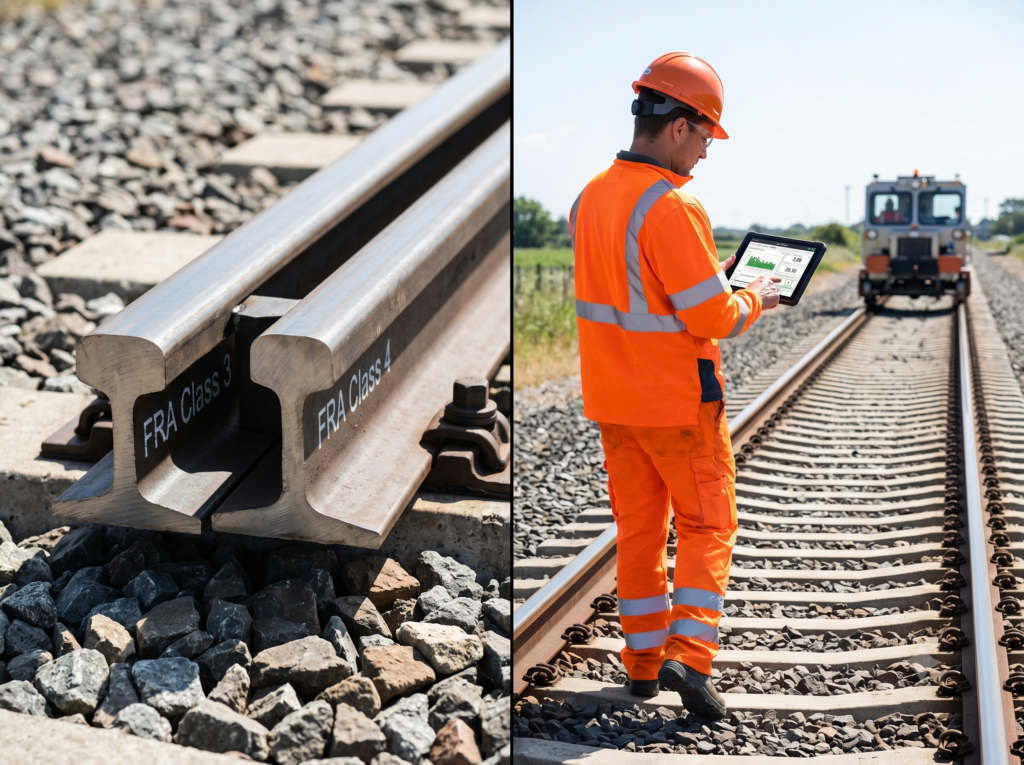
Track classifications form the backbone of every safe and efficient railway system operating across the United States. The Federal Railroad Administration (FRA) developed these track classifications to set clear speed limits, inspection standards, and safety requirements for every type of rail line in the country. Without a solid understanding of track classifications, rail operators, inspectors, and safety professionals cannot make informed decisions about how to maintain or upgrade their infrastructure.
The U.S. rail network stretches over 140,000 miles, and not every mile carries the same trains at the same speeds. Some lines support heavy freight moving at low speeds through industrial yards. Others carry passengers at 110 mph or more across major corridors. The FRA created a classification system: ranging from Class 1 through Class 9: to reflect these real differences in operational demand and safety requirements.
Our article walks through each of the nine track classifications, explaining what they mean, what speed limits they allow, and what inspection obligations they create for rail operators.
What Is the Classification of Rail?
Track classification refers to the category assigned to a section of railroad track based on its allowable operating speed and the safety standards it must meet. The FRA introduced this framework under the Federal Track Safety Standards, codified in 49 CFR Part 213.
These track classifications exist for one core reason: to match the physical condition and maintenance of a track to the speed and weight of the trains running over it. A track that carries light industrial traffic at 10 mph does not need the same geometry standards as one that carries Amtrak trains at 90 mph. The classification system draws those distinctions clearly.
There are nine track classifications under the FRA framework. Here is a quick overview:
- Class 1: Maximum 10 mph (freight) / 15 mph (passenger)
- Class 2: Maximum 25 mph (freight) / 30 mph (passenger)
- Class 3: Maximum 40 mph (freight) / 60 mph (passenger)
- Class 4: Maximum 60 mph (freight) / 80 mph (passenger)
- Class 5: Maximum 80 mph (freight) / 90 mph (passenger)
- Class 6: Maximum 110 mph (passenger only)
- Class 7: Maximum 125 mph (passenger only)
- Class 8: Maximum 160 mph (passenger only)
- Class 9: Maximum 200+ mph (emerging/experimental)
Each step up in track classifications brings tighter tolerances, more frequent inspections, and stricter geometry requirements. Now that the full range of track classifications is clear, how do the lower classes: the ones most common in everyday freight and regional rail: actually work in practice? The details reveal more than most people expect.
Classes 1 Through 4: The Foundation of Track Classifications
The first four track classifications cover the vast majority of active railroad lines in the United States. From slow industrial spurs to busy mainlines carrying freight at 60 mph, these classes define the everyday operational landscape of American rail.
Class 1 Track: The Starting Point
Class 1 represents the lowest tier among all track classifications. It allows freight trains to operate at a maximum of 10 mph and passenger trains at 15 mph. This class typically applies to industrial sidings, yard tracks, and branch lines that see minimal traffic.
At this level, inspection requirements are relatively straightforward. The FRA requires visual inspections, primarily on foot or by vehicle, to identify obvious defects in rail, ties, fasteners, and ballast. Rail operators must complete these inspections at regular intervals determined by traffic frequency.
Despite the low speed limits, Class 1 track classifications still carry real safety obligations. A derailment at 10 mph inside a chemical plant or a busy freight yard can cause serious damage and injury.
Class 2 Track: Light Rail Operations
Class 2 track classifications allow freight operations up to 25 mph and passenger operations up to 30 mph. These tracks often appear on short-line railroads, branch lines, and secondary freight routes.
The inspection standards at Class 2 build on those at Class 1, with greater attention to track geometry. Rail gage, surface alignment, and tie condition all receive closer scrutiny. Operators must address defects within defined timeframes or issue slow orders to reduce speeds further.
Class 3 Track: Regional and Freight Lines
Class 3 is one of the most common track classifications found across the national freight network. It permits freight speeds up to 40 mph and passenger speeds up to 60 mph.
At this level, the physical demands on the track increase significantly. Rail wear, ballast support, and joint conditions become more critical. Inspection frequency rises, and operators must maintain tighter tolerances on track geometry to stay compliant with FRA standards.
Class 4 Track: Main Line Standards
Class 4 represents a significant step up among track classifications. It allows freight trains to travel at up to 60 mph and passenger trains at up to 80 mph. Most major freight mainlines in the U.S. operate at Class 4 standards.
At this level, track geometry cars: specialized inspection vehicles equipped with measurement technology: become a common tool. These machines measure gage, surface, alignment, cross-level, and curvature continuously as they travel. The data they collect helps operators identify developing problems before they cause failures.
The jump from Class 3 to Class 4 is not just about speed. It represents a meaningful increase in inspection rigor and maintenance investment.
Classes 1 through 4 lay the groundwork, but what happens when operating speeds push beyond 80 mph? The answer starts with Class 5, and the rules change dramatically.
What Does Class 1 Rail Mean?
Class 1 rail refers to the lowest FRA track classification, designating track where maximum operating speeds do not exceed 10 mph for freight and 15 mph for passenger service. The term does not describe the quality of a railroad company: it specifically identifies the condition and standard of a physical track segment.
This distinction matters. A large, well-funded railroad company may operate some track segments under Class 1 track classifications within its yard system, even while maintaining Class 4 or Class 5 mainlines elsewhere.
In practical terms, Class 1 track tends to appear in locations such as:
- Industrial loading spurs inside manufacturing facilities
- Freight yard lead tracks with heavy switching activity
- Infrequently used branch lines awaiting upgrades
- Temporary track laid during construction or maintenance projects
The FRA also uses a separate definition for “Class I railroad”: referring to large railroad companies based on annual revenue thresholds. This is entirely separate from Class 1 track classifications. Mixing up these two uses of the term “Class 1” is a common source of confusion in industry discussions.
As rail safety expert and former FRA track inspector Don Itzkoff noted in an industry panel discussion, “The classification assigned to a track tells you everything about what that track demands from the operator. Low-class track still demands discipline. Slow does not mean safe by default.”
Classes 5 and 6: High-Speed Track Classifications and Their Demands
Class 5 Track
Class 5 track classifications permit freight operations up to 80 mph and passenger operations up to 90 mph. At these speeds, the margin for error in track geometry shrinks considerably.
Inspection requirements at Class 5 include mandatory use of geometry measurement technology. Track surface irregularities that would be acceptable at lower speeds can cause dangerous dynamic forces at 80 to 90 mph. Operators must monitor and correct these issues on a tighter schedule.
Rail condition also receives greater attention. Surface defects, internal cracks detected through ultrasonic testing, and rail head wear all carry lower tolerance thresholds at Class 5 compared to the classes below it.
Class 6 Track
Class 6 track classifications apply exclusively to passenger operations, permitting speeds up to 110 mph. No freight trains operate under Class 6 standards. At this level, the physical and procedural demands intensify sharply.
Geometry tolerances at Class 6 are strict. Cross-level variations, surface irregularities, and alignment deviations that might generate a warning at Class 5 become mandatory slow-order triggers at Class 6. Rail fastener condition, tie spacing, and ballast consolidation all require close monitoring.
The table below summarizes the six track classifications covered in Part 1:
| Class | Max Freight Speed | Max Passenger Speed | Key Inspection Focus |
| Class 1 | 10 mph | 15 mph | Visual inspection, basic defect detection |
| Class 2 | 25 mph | 30 mph | Gage, tie condition, fasteners |
| Class 3 | 40 mph | 60 mph | Geometry, rail wear, joint conditions |
| Class 4 | 60 mph | 80 mph | Geometry cars, surface alignment |
| Class 5 | 80 mph | 90 mph | Ultrasonic testing, tight geometry tolerances |
| Class 6 | N/A | 110 mph | Passenger-only; strict surface and alignment standards |
Classes 7 Through 9: Where Track Classifications Enter High-Speed Territory
Classes 7, 8, and 9 represent the upper end of the FRA’s classification framework. These track classifications apply almost entirely to passenger rail corridors, and they demand inspection standards and infrastructure investments that go far beyond anything required at the lower classes.
Class 7 Track: 125 mph Operations
Class 7 track classifications permit passenger train operations at speeds up to 125 mph. No standard freight operations run under Class 7 standards. At this speed, every component of the track structure: rail, fasteners, ties, ballast, and subgrade: must perform within extremely tight tolerances.
Continuous welded rail (CWR) is mandatory at Class 7. Jointed track introduces dynamic impacts at high speeds that make it structurally incompatible with 125 mph operations. Geometry tolerances for surface, alignment, gage, and cross-level are significantly stricter than those required at Class 6. Operators must run geometry measurement cars frequently and act on identified deviations quickly.
Class 8 Track: 160 mph Operations
Class 8 track classifications allow passenger operations up to 160 mph. Only a small number of corridors in the United States currently operate at or near this standard. Amtrak’s Acela service on the Northeast Corridor reaches Class 8 speeds on specific segments of that route.
At 160 mph, inspection technology must move beyond conventional geometry cars. Ground-penetrating radar, advanced ultrasonic rail testing systems, and high-speed video inspection platforms all become part of the standard inspection toolkit. The FRA requires more frequent measurement cycles, and defect response times are shorter than at any lower track classification.
Ballast condition, subgrade stability, and drainage all receive intensive monitoring at Class 8. A compromised subgrade that might generate a slow order at Class 4 becomes a line closure trigger at 160 mph.
Class 9 Track: The Emerging Frontier
Class 9 track classifications represent the experimental edge of the FRA framework, covering operations at speeds exceeding 200 mph. No U.S. rail corridor currently operates at full Class 9 standards in revenue service. However, this classification exists to provide a regulatory framework for future high-speed rail development, including projects currently in planning and early development stages across several states.
The inspection and infrastructure requirements for Class 9 track classifications extend well beyond current conventional rail technology. Dedicated right-of-way, advanced signaling systems, and continuous automated monitoring are among the baseline expectations for any line seeking to operate at this level.
Now that all nine track classifications are clearly defined, how do these standards actually translate into the inspection procedures that rail operators carry out on the ground every day? The answer lies in a structured, class-driven framework that shapes every decision inspectors make.
How Track Classifications Drive Real-World Inspection Requirements
The FRA does not simply assign a class number and leave operators to figure out the rest. Each of the nine track classifications carries specific, codified inspection obligations that operators must follow to remain compliant and keep their lines in service.
Inspection requirements scale directly with class level. The tools, frequency, and personnel qualifications all increase as the classification rises.
Here are the key inspection elements that FRA-qualified inspectors evaluate across all track classifications:
- Rail gage: the distance between the inside faces of the two rail heads, measured at specified intervals
- Surface and alignment: the vertical and horizontal smoothness of the track, measured continuously at higher classes
- Rail condition: visible surface defects, head wear, and internal defects detected through ultrasonic testing
- Tie condition: the structural integrity, spacing, and fastener engagement of every tie along the line
- Ballast quality: the depth, distribution, and drainage capacity of the stone supporting the track structure
- Joint condition: the gap, bolt tightness, and vertical alignment at bolted rail joints where they exist
At Class 1 and Class 2, qualified inspectors conduct these evaluations primarily through walking inspections or slow-speed vehicle inspections. The human eye and a few basic measurement tools handle the workload at these lower track classifications.
At Class 3 and Class 4, the inspection toolkit expands. Operators begin using geometry measurement vehicles and more systematic rail testing programs. Defect recording and trending become important tools for managing maintenance across longer distances.
At Class 5 and above, manual inspection alone cannot satisfy FRA requirements. High-speed geometry cars, ultrasonic rail flaw detection vehicles, and computerized data analysis systems become standard components of every compliant inspection program. These technologies allow operators to measure hundreds of miles of track quickly, capture precise geometry data, and flag developing problems before they reach the threshold that triggers a speed restriction or service disruption.
For a full breakdown of FRA inspection requirements by class, the FRA’s official track safety standards provide the authoritative reference at https://www.ecfr.gov/current/title-49/subtitle-B/chapter-II/part-213.
Knowing what inspectors look for is one thing: but what happens when a track segment fails to meet the standard required by its assigned classification? The consequences are more serious than most people outside the industry realize.
What Happens When Track Falls Below Its Classification?
When a track segment no longer meets the maintenance standards required by its current track classification, the FRA framework provides a clear set of consequences designed to protect public safety.
The first and most immediate response is a slow order. A slow order reduces the maximum allowable operating speed on the affected segment to a level consistent with the track’s actual condition. In practical terms, this means the line effectively drops to a lower track classification until the deficiency is corrected and the track is re-qualified.
If the defect is serious enough: a broken rail, severe geometry deviation, or compromised subgrade: the FRA has the authority to issue an emergency order requiring the complete suspension of operations on that segment until repairs are made.
The financial and operational consequences extend well beyond the repair costs themselves. According to FRA data, track-caused derailments consistently rank among the leading causes of train accidents in the United States, accounting for a significant share of the roughly $100 million in annual accident costs the agency tracks across the national network. Service disruptions on high-traffic corridors can cost operators millions of dollars per day in diverted freight, delayed passengers, and emergency maintenance expenditures.
Beyond direct costs, non-compliance with track classification standards exposes operators to FRA civil penalties. Individual violations can reach tens of thousands of dollars, and systemic non-compliance can trigger compliance agreements, increased federal oversight, and reputational damage that affects commercial relationships across the supply chain.
What Are Different Types of Railway Tracks?
Railway tracks fall into several distinct categories based on their function, location, and role within the broader rail network. Understanding these types helps clarify how track classifications apply across different operational contexts.
The main categories of railway track types include:
- Mainline track: the primary route carrying the highest traffic volumes and typically maintained to Class 3, 4, or higher track classifications
- Branch line track: secondary routes connecting smaller communities or industrial facilities to the mainline, often maintained to Class 2 or Class 3 standards
- Siding track: parallel tracks used for train meets, passing, and temporary storage, typically maintained to the same class as the mainline they serve
- Yard track: the network of tracks within a freight or passenger yard used for switching, classification, and staging, most commonly maintained to Class 1 or Class 2 track classifications
- Industrial spur track: short tracks leading directly into a customer facility, usually operating at Class 1 standards
Each of these track types carries its own operational demands, traffic patterns, and maintenance histories. Track classifications provide the common standard that applies across all of them, ensuring that regardless of where a track sits in the network, its maintenance and inspection obligations match the speeds and loads it actually carries.
Final Thoughts
The FRA’s nine track classifications provide the structural foundation for safe rail operations across the United States. From Class 1 industrial sidings where trains crawl at 10 mph to the emerging Class 9 corridors designed for 200 mph operations, each of these track classifications carries a specific set of speed limits, geometry tolerances, and inspection obligations that operators must meet without exception.
Track classifications shape how rail infrastructure gets built, maintained, inspected, and regulated at every level of the network. They determine which tools inspectors use, how often they use them, and what happens when the track no longer meets the standard its assigned class demands. For rail operators, safety professionals, and inspection organizations, understanding these track classifications is not background knowledge: it is the core of the job.
Key Takeaways
- The FRA defines nine track classifications, each carrying specific speed limits and inspection requirements that operators must follow
- Track classifications scale from Class 1 at 10 mph freight up to Class 9 at 200+ mph experimental operations
- Each step up in track classifications brings tighter geometry tolerances and stricter maintenance obligations for operators
- Inspection tools and frequency increase significantly with every step up in the track classification framework
- Class 1 and Class 2 track rely on visual walking inspections conducted by qualified FRA inspectors on foot
- Class 4 and above require geometry measurement cars that continuously record track condition data across long distances
- Class 5 and higher demand ultrasonic rail flaw detection and computerized data analysis as standard inspection practice
- A track that falls below its required classification triggers slow orders, service suspensions, or significant FRA civil penalties
- Different railway track types — mainline, branch line, siding, yard, and industrial spur — all operate under applicable track classifications
- Rail safety professionals who master the full classification framework build compliant, disciplined, and consistently safe rail operations
FAQs
What is 1st class and 2nd class?
In FRA track classifications, Class 1 allows freight trains up to 10 mph and Class 2 allows up to 25 mph. Both apply to low-traffic lines such as yard tracks and industrial sidings.
What is a class 3 railway?
A Class 3 railway is a track segment that permits freight operations up to 40 mph and passenger operations up to 60 mph. It commonly appears on regional freight networks and secondary rail corridors.
What is a class 7 train?
Class 7 refers to the track standard that supports passenger operations up to 125 mph. It requires continuous welded rail and strict geometry tolerances to safely handle high-speed service.
What are the 4 types of track?
The four main types are mainline track, branch line track, siding track, and yard track. Each type operates under track classifications that match its speed and traffic demands.
What are the 4 types of rail gauges?
The four types are standard gauge, broad gauge, narrow gauge, and dual gauge. Standard gauge is the most common across U.S. rail lines and applies across all FRA track classifications.
