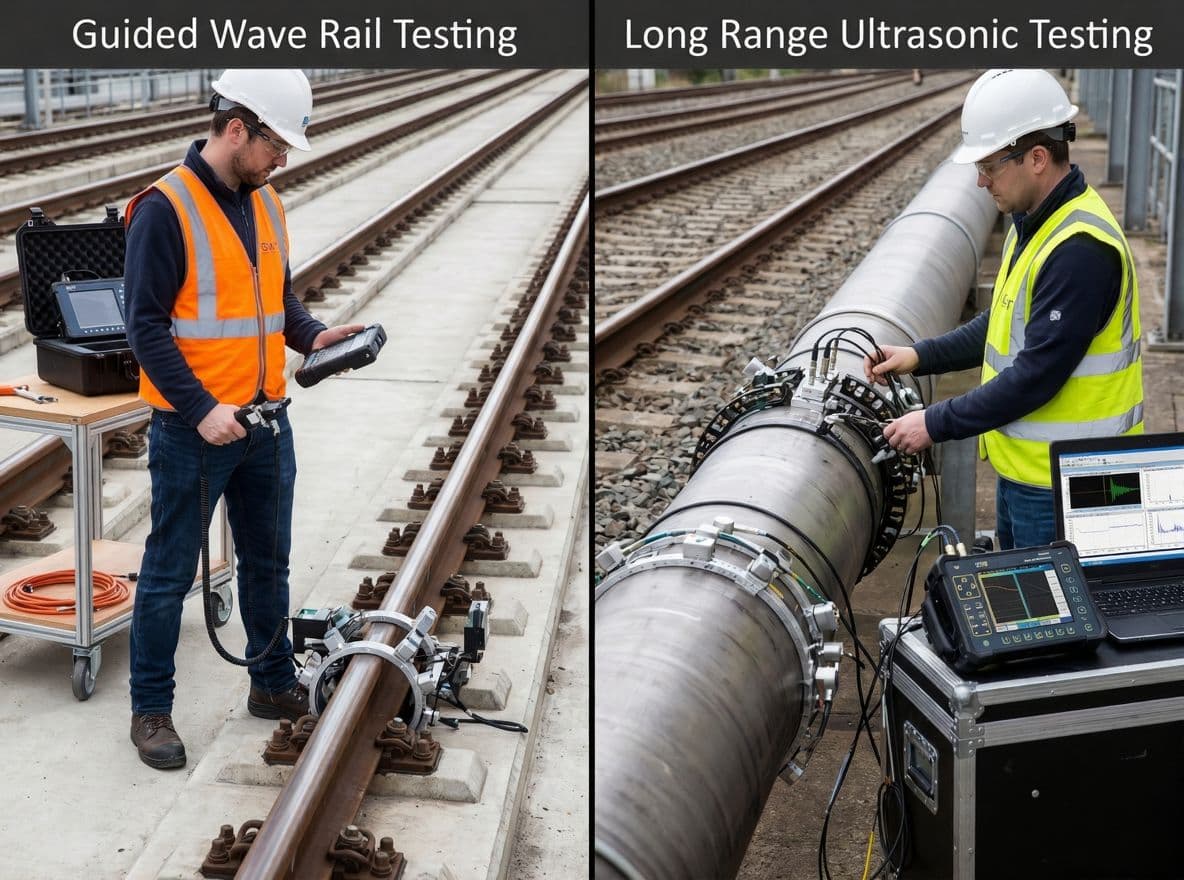
Guided Wave vs Long Range Ultrasonic Testing remains one of the most discussed comparisons in modern non-destructive testing. Guided Wave vs Long Range Ultrasonic Testing plays a critical role in evaluating rail infrastructure and pipelines without causing disruption. Guided Wave vs Long Range Ultrasonic Testing also helps industries detect hidden defects early, reducing the risk of catastrophic failures.
Rail networks and pipelines stretch across vast distances, often exposed to harsh environmental conditions. Inspecting these assets requires methods that deliver both speed and accuracy. Engineers must select techniques that minimize downtime while ensuring reliable defect detection.
What Is Guided Wave Ultrasonic Testing?
Guided wave ultrasonic testing uses low-frequency ultrasonic waves that travel along the length of a structure. These waves propagate through rails or pipelines and reflect when they encounter defects like corrosion, cracks, or wall thinning.
How Guided Wave Works in Rail Inspection
Guided wave systems send controlled ultrasonic signals along the rail track. These waves move through the material and interact with structural boundaries. When the waves encounter irregularities, they reflect back toward the transducer. Engineers analyze these reflections to identify potential flaws.
The method operates at lower frequencies compared to conventional ultrasonic testing. Lower frequencies allow waves to travel longer distances with minimal energy loss. This characteristic makes guided wave inspection ideal for screening long sections of rail from a single access point.
Key characteristics of guided wave testing include:
- Long-distance wave propagation across rails and pipelines
- Effective detection of corrosion and wall thickness changes
- Reduced need for continuous physical access along the structure
- Ability to screen large areas quickly before detailed inspection
Guided Wave vs Long Range Ultrasonic Testing often begins with understanding this propagation advantage. Guided wave methods prioritize coverage and efficiency, making them highly valuable for initial inspection stages.
In practical rail applications, guided wave testing allows inspectors to evaluate difficult-to-access sections. These include areas under crossings, embedded tracks, and insulated zones. This capability reduces the need for dismantling infrastructure, saving both time and cost.
What Are the Two Types of Ultrasonic Testing?
The two main types of ultrasonic testing are pulse-echo testing and through-transmission testing.
Pulse-echo testing sends ultrasonic waves into a material and measures reflections from internal discontinuities. Through-transmission testing uses two transducers placed on opposite sides of the material to measure signal transmission.
| Method | Working Principle | Common Use |
| Pulse-Echo | Detects reflected signals from defects | Crack detection, thickness measurement |
| Through-Transmission | Measures signal passing through material | Identifying voids and inclusions |
Pulse-echo testing remains the most widely used method in rail inspection. It allows defect detection and localization using a single probe. Through-transmission testing serves specialized applications where detecting internal voids is critical.
Guided Wave vs Long Range Ultrasonic Testing builds upon these foundational methods. Both techniques extend ultrasonic capabilities to cover larger areas efficiently. They adapt the principles of wave propagation to suit long-distance inspection needs.
Understanding these two types helps explain why advanced methods evolved. As infrastructure expanded, traditional techniques could not meet the demand for faster inspections. This gap led to the development of guided wave and long range ultrasonic testing systems.
Fact #1: Range of Coverage Differs Significantly
Guided wave testing offers exceptional range coverage from a single inspection point. The ultrasonic waves travel along the rail and can cover extended distances depending on material properties and conditions.
Long range ultrasonic testing also provides extended inspection coverage. It typically allows inspection up to 100 meters in each direction from the testing location. However, its effectiveness depends on signal clarity and environmental factors.
Traditional ultrasonic testing requires inspectors to scan each section individually. This process takes time and increases operational costs. Guided wave and long range ultrasonic methods reduce this burden by covering larger areas in fewer setups.
Guided Wave vs Long Range Ultrasonic Testing highlights how range influences inspection strategies. Guided wave testing serves as a powerful screening tool for large infrastructure networks. It helps identify areas that require further investigation.
In rail systems, this advantage becomes critical. Tracks often run through remote or inaccessible locations. Inspecting them using traditional methods would require extensive manual effort. Guided wave testing simplifies this process by enabling long-distance evaluation.
However, range alone does not determine effectiveness. Accuracy and setup also play a major role in inspection outcomes. So, how do these systems differ in their physical setup and equipment design? The next section reveals those differences.
Fact #2: The Transducer Setup Is Not the Same
Guided wave systems use ring-shaped or array transducers that surround the rail or pipe. These transducers generate ultrasonic waves that travel along the structure in multiple directions.
Long range ultrasonic testing uses collar-based systems. Technicians clamp these collars around the structure to transmit and receive ultrasonic signals.
Key differences in equipment setup include:
- Guided wave systems use full circumferential transducer arrays
- Long range UT relies on modular collar-based configurations
- Guided wave requires calibration for specific wave modes
- Long range UT focuses on directional signal transmission
Guided Wave vs Long Range Ultrasonic Testing also differs in setup complexity. Guided wave systems demand careful calibration to ensure consistent wave propagation. Improper setup can lead to inaccurate results.
Long range ultrasonic testing setups are relatively straightforward. However, they require precise alignment to maintain signal quality. Any misalignment can reduce inspection accuracy.
Equipment design directly impacts inspection efficiency. A well-configured system ensures reliable data collection and reduces the need for repeated inspections.
Setup differences also influence portability and ease of use. Guided wave systems may require more preparation time, while long range UT systems allow quicker deployment in certain environments.
Fact #3: Sensitivity to Different Defect Types
Guided wave testing excels at detecting widespread defects like corrosion and wall thinning. It identifies areas of concern across long distances but does not always provide precise measurements.
Long range ultrasonic testing offers higher sensitivity for localized defects. It allows inspectors to determine defect size, depth, and severity with greater accuracy.
Guided Wave vs Long Range Ultrasonic Testing demonstrates how sensitivity varies based on inspection objectives. Guided wave methods focus on identifying potential problem areas quickly. Long range UT focuses on detailed evaluation of those areas.
This complementary nature often leads to combined usage. Engineers first perform guided wave testing to screen large sections. They then apply long range or conventional UT to analyze specific defects in detail.
In rail applications, this approach improves maintenance planning. Early detection allows operators to address issues before they escalate. This reduces downtime and enhances safety.
Defect sensitivity also depends on material properties and environmental conditions. Certain defects may produce weak signals, making detection challenging. This raises an important question, how do these methods perform in complex environments? That answer unfolds in the next section.
Fact #4: Operating Environments and Constraints
Inspection environments play a critical role in determining method effectiveness. Factors such as temperature, coatings, and accessibility influence ultrasonic wave behavior.
Guided wave testing performs well in challenging environments. It can inspect insulated or buried structures without removing coatings. This capability makes it suitable for pipelines and underground rail systems.
Long range ultrasonic testing performs best in controlled conditions. External factors such as heavy coatings or uneven surfaces can affect signal quality.
When Coatings and Insulation Are a Problem
Environmental constraints include:
- Thick coatings that absorb or scatter ultrasonic waves
- High temperatures that impact transducer performance
- Limited access areas that restrict equipment placement
- Surface irregularities that distort wave propagation
Guided Wave vs Long Range Ultrasonic Testing highlights how adaptability differs between the two methods. Guided wave systems handle complex environments more effectively due to their wave propagation characteristics.
In rail infrastructure, environmental challenges are common. Tracks may run through tunnels, bridges, and coastal areas. Each environment presents unique inspection difficulties. Guided wave testing helps overcome these challenges by reducing the need for direct access.
However, environmental adaptability must be balanced with accuracy. While guided wave testing works in harsh conditions, it may not provide detailed defect characterization. This trade-off influences method selection in real-world scenarios.
Fact #5: Speed of Inspection
Guided wave testing offers significant advantages in inspection speed. A single setup can scan long sections of rail within minutes. This rapid screening capability makes it ideal for large-scale inspections.
Long range ultrasonic testing operates at a slower pace. It requires detailed signal analysis and careful interpretation. However, this slower process delivers more accurate defect characterization.
Industry data shows that guided wave inspections can reduce inspection time by up to 70 percent compared to traditional methods. This efficiency allows operators to inspect more assets within shorter timeframes.
Guided Wave vs Long Range Ultrasonic Testing emphasizes the balance between speed and precision. Faster inspections enable broader coverage, while slower methods provide deeper insights into defect conditions.
In large rail networks, speed becomes a critical factor. Delays in inspection can lead to operational disruptions and increased maintenance costs. Guided wave testing helps maintain inspection schedules without compromising safety.
At the same time, long range ultrasonic testing ensures that identified defects are analyzed thoroughly. This combination of speed and accuracy supports effective maintenance planning.
Inspection speed also impacts workforce requirements. Faster methods reduce labor hours, while detailed methods require skilled technicians for interpretation. This difference influences overall project efficiency and cost.
Ultimately, selecting the right method depends on inspection objectives. Engineers must consider whether speed or detail takes priority in a given scenario.
Fact #6: Cost Implications of Each Method
Cost plays a major role when selecting an inspection method. Guided wave testing often requires higher initial investment in equipment. However, it reduces labor costs due to faster inspections.
Long range ultrasonic testing involves moderate equipment costs but higher operational expenses. The need for skilled technicians and longer inspection times increases overall cost.
Key cost factors include:
- Equipment purchase and maintenance
- Labor requirements and technician expertise
- Inspection duration and downtime impact
- Accessibility and preparation costs
Guided Wave vs Long Range Ultrasonic Testing highlights how cost depends on project scale. Guided wave becomes more cost-effective for large assets due to reduced inspection time. Long range ultrasonic testing suits targeted inspections where precision matters more than speed.
In rail infrastructure, minimizing downtime is crucial. Faster inspections reduce service interruptions, which translates into cost savings. Guided wave testing supports this goal by covering large sections quickly.
However, cost alone does not determine suitability. Real-world applications often reveal which method performs better under specific conditions. But where do these methods truly excel in practice? That answer emerges in the next section.
Fact #7: Real-World Applications in Rail and Pipeline
Guided wave testing finds extensive use in rail tracks, underground pipelines, and subsea systems. Its ability to inspect long distances without direct access makes it highly versatile.
Long range ultrasonic testing is commonly used in above-ground pipelines, storage tanks, and industrial facilities. It provides detailed insights into defect conditions, making it suitable for critical components.
Applications in Rail Infrastructure Specifically
In rail systems, guided wave testing helps inspect:
- Continuous rail tracks over long distances
- Embedded rails in urban environments
- Hard-to-access sections such as tunnels and bridges
Long range ultrasonic testing supports rail inspections by providing precise defect characterization. It helps engineers determine the severity of flaws detected during initial screening.
Guided Wave vs Long Range Ultrasonic Testing demonstrates how these methods complement each other in real-world scenarios. Guided wave identifies potential problem areas, while long range UT confirms and evaluates them.
This combination enhances maintenance planning and ensures infrastructure safety. Rail operators rely on both methods to maintain operational efficiency and reduce unexpected failures.
What Is the Range of Long Range Ultrasonic Testing?
Long range ultrasonic testing typically covers up to 100 meters in each direction from the test point. This range depends on factors such as material condition, coating thickness, and environmental noise.
Signal attenuation plays a key role in determining effective range. As ultrasonic waves travel, they lose energy due to material absorption and external conditions. Inspectors must account for these factors when planning inspections.
Guided Wave vs Long Range Ultrasonic Testing shows how both methods extend inspection reach beyond traditional techniques. Long range UT provides a balance between coverage and detail, making it suitable for targeted inspections.
Understanding range limitations helps engineers choose the right method for each application. It ensures accurate results and prevents missed defects.
Fact #8: Regulatory Standards and Compliance
Inspection methods must comply with industry standards to ensure reliability and safety. Organizations such as ASTM, ISO, and EN define guidelines for ultrasonic testing practices.
Guided wave testing follows standards related to long-range inspection and wave propagation. Long range ultrasonic testing adheres to standards focusing on defect detection and measurement accuracy.
Standards That Matter for Rail Inspections
Key standards include:
- ASTM E2775 for guided wave testing practices
- ISO 18211 for ultrasonic testing of metallic materials
- EN standards for rail inspection and maintenance
- ASME guidelines for pipeline integrity assessment
Guided Wave vs Long Range Ultrasonic Testing highlights how compliance ensures consistent results. Following standards helps maintain inspection quality and supports regulatory approval.
In rail infrastructure, compliance is essential for safety certification. Authorities require regular inspections that meet established guidelines. This ensures that rail systems operate without risk to passengers and cargo.
Standards also influence equipment selection and inspection procedures. Engineers must choose methods that align with regulatory requirements.
But compliance alone does not answer the most important question. Which method should engineers ultimately choose for their specific needs? The final fact provides that answer.
Fact #9: Which Method Should Engineers Choose
No single method serves as a universal solution. Engineers must evaluate inspection goals, asset conditions, and operational constraints before making a decision.
Guided wave testing works best for large-scale screening. It provides rapid coverage and identifies potential defects across long distances.
Long range ultrasonic testing excels in detailed analysis. It allows precise measurement of defect size and severity.
| Criteria | Guided Wave Testing | Long Range Ultrasonic Testing |
| Range | Long-distance screening | Moderate extended range |
| Sensitivity | Detects general defects | Precise defect sizing |
| Speed | Fast inspection | Slower but detailed |
| Cost | Lower for large assets | Higher for detailed work |
| Environment | Handles harsh conditions | Works best in controlled settings |
| Defect Type | Corrosion, wall loss | Cracks, localized flaws |
Guided Wave vs Long Range Ultrasonic Testing shows that the best choice depends on the application. Many industries combine both methods to achieve optimal results.
Engineers often use guided wave testing as a first step. Once potential issues are identified, they apply long range or conventional ultrasonic testing for detailed evaluation. This layered approach ensures both efficiency and accuracy.
Final Thoughts
Guided Wave vs Long Range Ultrasonic Testing clearly demonstrates how inspection strategies must adapt to different operational needs. Both methods play a vital role in maintaining the safety and reliability of rail and pipeline infrastructure. Guided wave testing supports fast, large-scale screening, while long range ultrasonic testing delivers detailed and accurate defect analysis where precision matters most.
Guided Wave vs Long Range Ultrasonic Testing ultimately depends on inspection goals, environmental conditions, and the level of detail required. No single method provides a complete solution on its own. Instead, combining both techniques often produces the most effective results by balancing speed, coverage, and accuracy.
Understanding these nine key facts allows engineers to make informed decisions and design efficient inspection plans. With the right approach, industries can detect issues early, reduce downtime, and ensure long-term structural performance without unnecessary disruptions.
Key Takeaways
- Guided wave testing enables long-distance inspection from a single point, improving efficiency significantly.
- Long range ultrasonic testing provides precise defect sizing and depth measurement for accurate evaluation.
- Guided wave methods excel in rapid screening across large infrastructure sections with minimal setup.
- Long range ultrasonic testing works best when detailed analysis of specific defects is required.
- Environmental conditions such as coatings and temperature strongly influence ultrasonic testing performance outcomes.
- Guided wave testing reduces inspection time and minimizes operational downtime in large rail networks.
- Long range ultrasonic testing requires skilled technicians due to complex signal interpretation processes.
- Combining both testing methods ensures comprehensive inspection coverage and improved maintenance decision-making strategies.
- Equipment setup differences between methods directly impact inspection speed, accuracy, and overall project efficiency.
- Selecting the right inspection method depends on application needs, asset condition, and operational constraints.
FAQs
What is the range of ultrasonic testing?
The range of ultrasonic testing depends on the method used and material conditions. Traditional ultrasonic testing covers short distances, while long range ultrasonic testing can inspect up to 100 meters in each direction. Factors such as material thickness, coatings, and signal attenuation influence the effective range.
What is long range testing?
Long range testing refers to an ultrasonic inspection method that uses low-frequency waves to travel long distances along a structure. It allows inspectors to evaluate extended sections of pipelines or rails from a single test point. This method is commonly used for detecting corrosion and structural defects without requiring full access.
What is the principle of guided wave?
Guided wave testing works by sending ultrasonic waves that travel along the structure’s boundaries. These waves reflect back when they encounter defects such as cracks or corrosion. By analyzing the reflected signals, inspectors can identify the location and presence of flaws over long distances.
What is ultrasonic rail testing?
Ultrasonic rail testing is a non-destructive method used to inspect railway tracks for internal defects. It uses high-frequency sound waves to detect cracks, inclusions, and other structural issues. This technique helps prevent rail failures and ensures safe train operations.
Does temperature affect ultrasonic testing?
Yes, temperature affects ultrasonic testing by influencing wave speed and signal quality. High temperatures can reduce transducer performance and alter material properties. Inspectors must adjust calibration and testing parameters to maintain accuracy under varying temperature conditions.