Have you ever wondered how engineers detect flaws in hard-to-reach areas of pipelines or rails without causing damage? Guided Wave Ultrasonic Testing (GWUT) is a cutting-edge method that makes this possible.
This article will introduce you to the basics of GWUT, how it works, and its key applications in industries like rail flaw detection and pipeline inspection. By the end, you'll have a clear understanding of this powerful non-destructive testing (NDT) technique and its advantages over traditional methods.
What is Guided Wave Ultrasonic Testing?
Guided Wave Ultrasonic Testing (GWUT) is a non-destructive testing (NDT) method used to detect defects in materials, particularly in hard-to-reach areas like pipelines or rail tracks. Unlike traditional ultrasonic testing, which uses direct contact between a probe and the material's surface, GWUT employs guided waves that travel along the surface and within the material, allowing for the inspection of larger areas from a single testing point.- Basic Principle: GWUT sends ultrasonic waves along a material's surface, and the waves travel in the form of guided waves. These waves are influenced by the material’s properties and any defects within it, such as cracks or corrosion. The waves reflect back to the sensor, revealing information about the condition of the material.
- Key Benefits:
- Can cover large areas, reducing the need for multiple access points.
- Effective for both metallic and non-metallic materials.
- Offers faster results compared to traditional methods.
Comparison with Conventional Ultrasonic Testing
When compared to traditional ultrasonic testing methods, Guided Wave Ultrasonic Testing offers several significant advantages. Here’s how they differ:- Range: Traditional ultrasonic testing is generally limited to inspecting small areas or regions close to the test point. In contrast, GWUT can inspect larger sections of material, sometimes up to several hundred meters in length, making it ideal for pipelines and rail flaw detection.
- Access: Traditional methods require direct access to the material's surface. This often means cutting or removing insulation. With GWUT, only minimal access is needed, as the guided waves can travel along the material without direct contact.
- Sensitivity: While conventional ultrasonic testing can detect small, localized defects, it may struggle with larger or deeper issues, especially in thick materials. Guided Wave Ultrasonic Testing, however, excels at detecting these flaws at a distance, even in complex geometries.
How Does Guided Wave Ultrasonic Testing Work?
Guided Wave Ultrasonic Testing relies on specialized equipment to generate and receive ultrasonic waves. Here’s a closer look at the key components:- Transducers: These devices convert electrical signals into mechanical vibrations (ultrasonic waves) and vice versa. For GWUT, the transducers are typically placed on the surface of the material and generate waves that travel along the material.
- Waveguides: The material itself serves as the waveguide, allowing the ultrasonic waves to travel along its surface or within it. These waves are influenced by any defects present within the material.
- Control Unit: This is the central part of the system that sends signals to the transducer and processes the received echoes. It’s responsible for controlling the frequency, wave type, and timing of the ultrasonic waves.
- Data Acquisition System: This system collects and analyzes the reflected signals from the material, converting them into readable data that can be interpreted by the technician. The data helps determine the location and size of any defects.
Explanation of Wave Propagation and Defect Detection
In Guided Wave Ultrasonic Testing, the generated waves travel through the material, and their behavior changes when they encounter flaws or changes in material properties. Here's how it works:- Wave Propagation: Once the ultrasonic waves are generated, they move through the material in a particular pattern. These waves can be classified into two types: Lamb waves (in thin materials) and Rayleigh waves (in thicker materials). The waves propagate along the material’s surface or within it, depending on the mode of propagation chosen.
- Interaction with Defects: As the waves travel, they interact with any defects such as cracks, corrosion, or other irregularities in the material. When the waves hit a defect, part of the energy is reflected back towards the sensor.
- Detection: The reflected waves are then captured by the transducers. The time it takes for the waves to return and the changes in wave characteristics (amplitude, frequency, etc.) provide important information about the defect’s size, shape, and location.
Applications of Guided Wave Ultrasonic Testing
Guided Wave Ultrasonic Testing (GWUT) has found wide application across various industries due to its ability to detect flaws over large distances and in hard-to-reach locations. Let's take a closer look at some of its key uses.Use in Pipeline Inspection
One of the most significant applications of Guided Wave Ultrasonic Testing is in pipeline inspection, especially for industries like oil, gas, and water supply. Pipelines often span vast distances and can be difficult to inspect due to their location or the need for minimal disruption.- Long-distance inspection: GWUT can inspect pipes that are hundreds of meters long, making it a perfect fit for pipeline networks.
- Detection of corrosion and cracks: The waves travel along the pipe’s surface, detecting any corrosion, cracks, or other defects in the material, even if they’re located far from the sensor.
- Cost-effective and time-saving: Since it eliminates the need to remove insulation or expose the entire pipeline, GWUT reduces both labor and material costs, while also decreasing downtime.
Application in Rail Flaw Detection
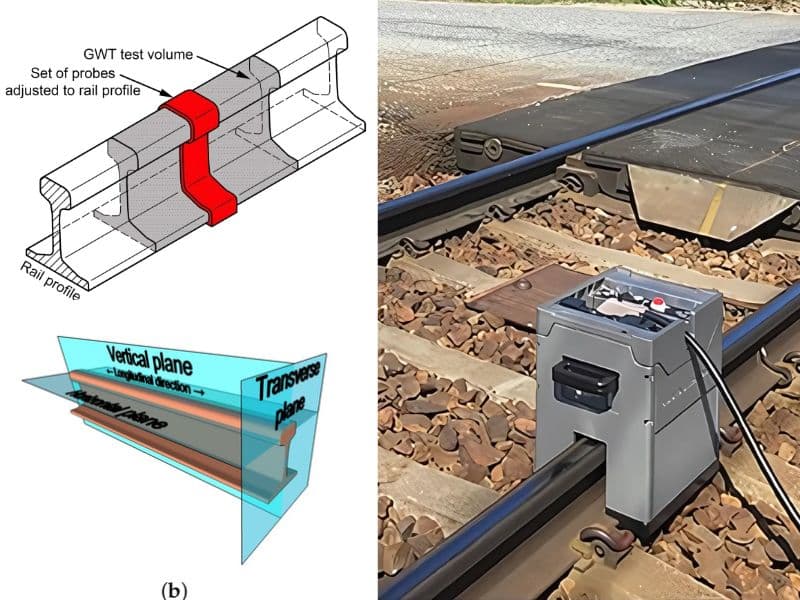
In the railway industry, safety is paramount. Small cracks or defects in rail tracks can lead to significant safety risks, and Guided Wave Ultrasonic Testing provides an effective solution for early detection.- Detecting internal and surface defects: GWUT can be used to inspect the rails for internal cracks, corrosion, and other structural issues that might be difficult to detect using traditional methods.
- Long-range inspection: With the ability to inspect long sections of rail from a single test point, it’s perfect for routine checks along extensive rail networks.
- Cost efficiency: By covering more area at once, GWUT saves time and resources, especially for rail operators who need to conduct frequent inspections.
Other Industrial Applications
Beyond pipelines and railways, GWUT is used in several other industries, including:- Aerospace: Inspecting large aircraft components for cracks or corrosion, which could be hidden in complex structures.
- Petrochemical: Inspecting storage tanks, reactors, and other large equipment for internal damage without requiring dismantling.
- Marine: Inspecting ship hulls and other submerged structures for fatigue cracks and other defects.
- Manufacturing: Ensuring the integrity of metal structures and machinery, detecting any weaknesses before they become a safety hazard.
Advantages of Guided Wave Ultrasonic Testing
Guided Wave Ultrasonic Testing offers a range of advantages that make it an essential tool in many industries. Below are the main reasons why it is favored over other inspection methods.Long-Range Inspection Capabilities
- Coverage of large areas: GWUT can inspect materials over distances of hundreds of meters, making it ideal for long pipelines, rail tracks, or large industrial equipment.
- Fewer test points needed: Instead of testing multiple spots, GWUT allows for a single point to cover a wide area, making inspections faster and more efficient.
Minimal Surface Preparation Required
- No need for surface removal: Unlike other ultrasonic methods, Guided Wave Ultrasonic Testing doesn’t require extensive surface cleaning, insulation removal, or coating stripping. This makes it more efficient and less disruptive.
- Reduced downtime: Because GWUT requires minimal preparation, industries can carry out inspections without causing significant delays or interruptions to operations.
Ability to Inspect Hard-to-Reach Areas
- Access to confined spaces: GWUT is particularly effective for areas that are hard to reach with traditional methods, such as pipes buried underground or rails beneath heavy machinery.
- Detects flaws in complex geometries: Whether it’s pipelines with tight bends or structures with intricate shapes, GWUT can detect flaws without needing to expose or alter the material.
Limitations of Guided Wave Ultrasonic Testing
While Guided Wave Ultrasonic Testing (GWUT) offers many advantages, it is not without its limitations. Understanding these challenges can help users make informed decisions about when to deploy this technology. Let’s take a closer look at the key limitations of GWUT.Challenges in Complex Geometries
One of the main limitations of Guided Wave Ultrasonic Testing lies in its performance when dealing with complex geometries or materials that do not have a uniform structure.- Effect of bends and curves: GWUT is highly effective for straight-line inspections, but when dealing with pipes or materials that have sharp bends, curves, or complex shapes, the guided waves may not propagate as efficiently. This can lead to difficulties in detecting defects or flaws in those areas.
- Solution: Some methods, like adjusting the angle of wave propagation, can mitigate these challenges, but they do not eliminate the issue entirely.
- Accuracy in non-linear shapes: Materials with irregular shapes, such as flanges or joint connections, can cause distortions in the wave, leading to reduced accuracy in flaw detection. This limitation means GWUT is best suited for inspecting straight sections rather than intricate designs.
Sensitivity to Certain Types of Defects
While Guided Wave Ultrasonic Testing excels at detecting certain types of flaws, it can struggle with others, particularly those that are very small or located in areas with low sensitivity.- Small, shallow defects: GWUT may have trouble detecting very small or shallow defects that do not interact strongly with the guided waves. For example, small surface cracks or minor corrosion might be missed if they do not create noticeable changes in wave characteristics.
- Solution: To address this, GWUT is often used in conjunction with other NDT methods, such as traditional ultrasonic testing or visual inspections, to ensure a comprehensive assessment of the material.
- Subsurface defects: While GWUT can be effective at detecting flaws near the surface, its sensitivity decreases as the defect’s depth increases. Deep internal flaws, such as those located in the core of a thick material, may be harder to detect with this method alone.
Conclusion
Guided Wave Ultrasonic Testing (GWUT) is a highly effective non-destructive testing method that offers significant benefits for industries like pipeline inspection, rail flaw detection, and beyond. Its long-range inspection capabilities, minimal surface preparation, and ability to inspect hard-to-reach areas make it an invaluable tool for ensuring safety and reliability. However, as with any technology, it does have its limitations, particularly when dealing with complex geometries and certain types of defects. By understanding both the strengths and limitations of GWUT, industries can make informed decisions about when and how to use this method. While it may not be the solution for every scenario, its efficiency, cost-effectiveness, and broad application range make it an essential part of modern inspection practices. As technology continues to evolve, Guided Wave Ultrasonic Testing will likely remain at the forefront of non-destructive testing, playing a key role in enhancing safety and performance across various sectors.Key Points
- Guided Wave Ultrasonic Testing (GWUT) is a non-destructive testing method used to detect flaws and defects in materials, particularly in large structures like pipelines and rail tracks.
- GWUT uses guided waves that travel along the surface of a material, allowing for the inspection of long distances from a single test point.
- Conventional ultrasonic testing involves sending sound waves directly into the material, but GWUT uses guided waves, offering a more efficient solution for large-scale inspections.
- Applications of GWUT include pipeline inspection, rail flaw detection, aerospace, marine, and petrochemical industries, making it a versatile tool for diverse sectors.
- In pipeline inspection, GWUT allows for long-distance coverage and can detect defects like corrosion or cracks without needing to remove insulation or expose the entire pipeline.
- Rail flaw detection benefits from GWUT's ability to detect internal and surface cracks in long rail sections, ensuring safety across extensive rail networks.
- Advantages of GWUT include its ability to cover long distances, require minimal surface preparation, and inspect hard-to-reach areas, reducing downtime and costs.
- GWUT is particularly effective for straight-line structures, but can face challenges when inspecting complex geometries or irregular shapes that interfere with wave propagation.
- Sensitivity to small or shallow defects can limit the effectiveness of GWUT, requiring the use of additional NDT methods for a comprehensive assessment.
- Limitations of GWUT include its reduced sensitivity to deep internal defects and challenges in areas with bends or curves, but combining it with other inspection methods can address these issues.