
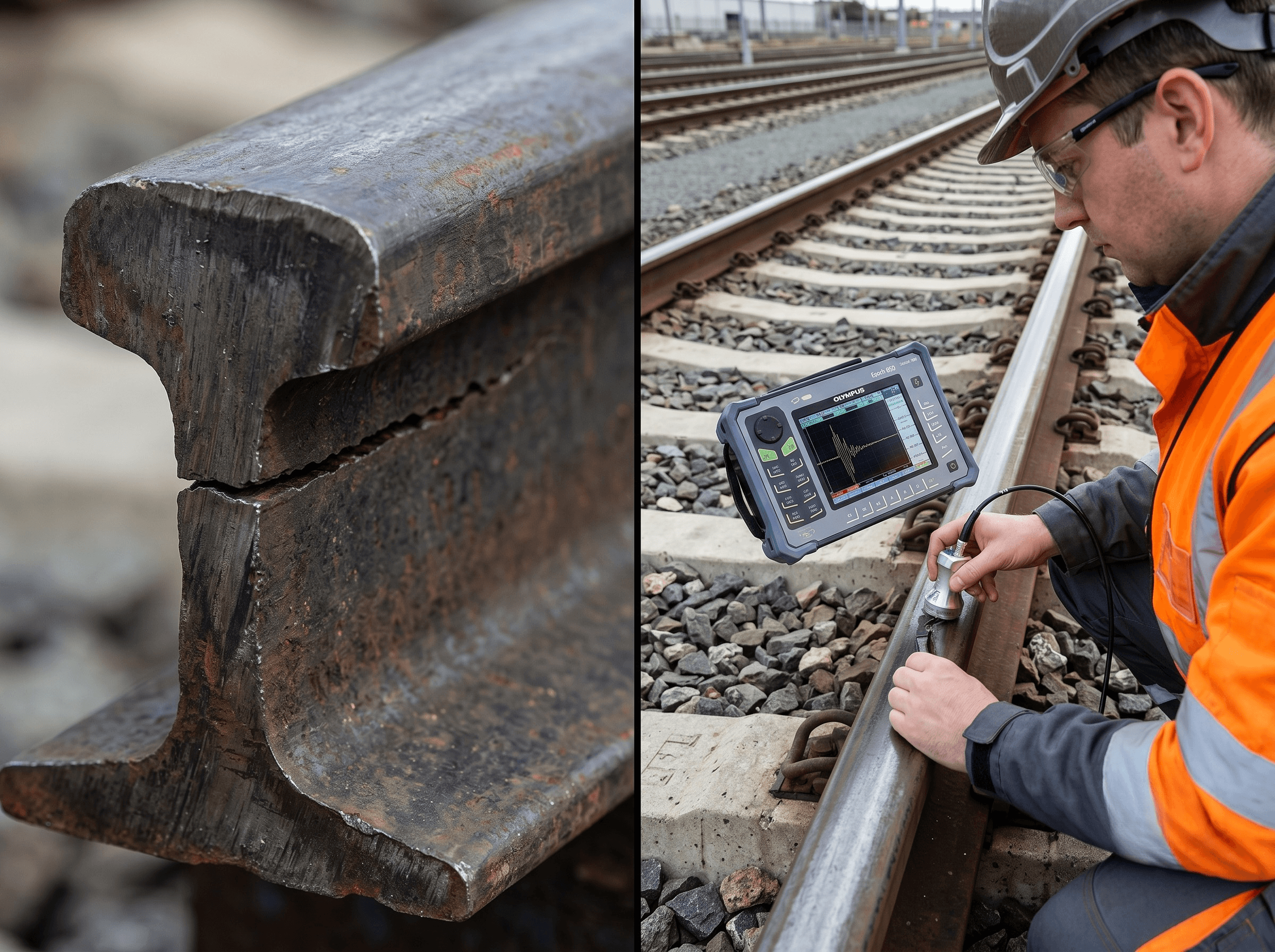
Rail safety depends on catching hidden problems before they become catastrophes. A horizontal split head rail represents one of the most dangerous defects that can develop in railway infrastructure. Understanding what a horizontal split head rail is and how to detect it saves lives and protects valuable infrastructure. The problem exists deep within the rail itself, making detection without proper technology nearly impossible. Transportation authorities worldwide rely on advanced testing methods to identify these defects before they cause derailments.
Understanding the Defect
What Exactly Is a Horizontal Split Head Rail?
A horizontal split head rail defect occurs when the head of the rail develops internal cracks running horizontally. The rail head bears the weight of every passing train, making it the most stressed component of the entire rail system. Over time, repeated stress creates internal fractures that split the steel along horizontal planes.
The defect typically initiates in the subsurface layers of the rail head. Unlike surface cracks that inspectors can spot visually, a horizontal split head rail remains hidden beneath the rail's outer layers. This hidden nature makes manual inspection completely ineffective at detecting these defects. The danger intensifies because the horizontal split head rail can grow undetected for months or even years.
The Origins of Horizontal Split Head Rail Problems
Several factors contribute to horizontal split head rail defect formation:
- Repetitive Stress Cycles - Heavy trains passing over the same rails create billions of stress cycles. The horizontal split head rail develops gradually through metal fatigue.
- Overloaded Train Cars - When cargo exceeds weight specifications, the additional pressure accelerates horizontal split head rail formation exponentially.
- Poor Track Geometry - Misaligned rails concentrate stress in specific areas, creating ideal conditions for a horizontal split head rail to begin.
- Environmental Degradation - Moisture and temperature fluctuations weaken the steel, making horizontal split head rail initiation more likely.
- Maintenance Lapses - Inadequate rail grinding and maintenance allow minor surface issues to develop into serious horizontal split head rail problems.
Environmental conditions accelerate the defect's growth significantly. Corrosion weakens the steel structure from within. Cold temperatures make steel more brittle, increasing horizontal split head rail propagation rates. The interaction of all these factors creates a perfect storm for hidden rail defects.
But understanding what a horizontal split head rail actually is only addresses half the equation. The real danger emerges when transportation authorities fail to detect these hidden defects, and the consequences of missing a horizontal split head rail extend far beyond railway operations. What happens when these critical defects go undetected?
Why Detection Matters
The Real Cost of Undetected Horizontal Split Head Rail Defects
Missing a horizontal split head rail defect can trigger catastrophic events. When a horizontal split head rail breaks completely, the rail fractures suddenly under train weight. The train wheels lose contact with the fractured rail, and a derailment becomes virtually inevitable.
Derailments involving passenger trains create life-threatening situations instantly. Trains carrying hazardous materials can cause environmental disasters when a horizontal split head rail failure occurs. The financial liability from a single major incident can bankrupt railway operators who failed to maintain proper inspection protocols for detecting horizontal split head rail defects.
Safety Risks Associated with Horizontal Split Head Rail
The consequences of undetected horizontal split head rail problems extend across multiple dimensions:
• Loss of Life - Passenger derailments from a horizontal split head rail defect often result in fatal injuries
• Environmental Contamination - Hazmat train failures stemming from horizontal split head rail defects pollute water supplies and soil
• Legal Liability - Railway operators face massive lawsuits when negligence allows a horizontal split head rail to remain undetected
• Infrastructure Damage - A single derailment from horizontal split head rail failure can destroy miles of track
• Economic Disruption - Service interruptions from horizontal split head rail emergencies cost millions in lost revenue
Economic and Operational Impact
The business case for detecting horizontal split head rail defects strongly favors proactive inspection. Emergency repairs following horizontal split head rail failure cost significantly more than preventive maintenance. Railway companies that detect horizontal split head rail defects early avoid catastrophic expenses entirely.
Preventive detection of horizontal split head rail problems maintains service continuity. Scheduled maintenance windows allow replacement of compromised rails before failures occur. This approach keeps trains running safely and reliably across entire networks.
The stakes surrounding undetected horizontal split head rail defects are undeniably high, making detection the absolute priority for any responsible transportation authority. So how exactly can railway inspectors reliably identify the presence of a horizontal split head rail defect before disaster strikes? The answer lies in revolutionary testing technology that can see what human eyes never could, and that technology is ultrasonic testing.
Ultrasonic Testing Technology
What Is Ultrasonic Testing and How Does It Work?
Ultrasonic testing represents a breakthrough in rail defect detection. This technology uses high-frequency sound waves to penetrate deep into the rail structure. The sound waves travel through the steel and bounce back when they encounter internal defects like a horizontal split head rail.
The equipment generates ultrasonic waves at frequencies between 50 kilohertz and several megahertz. These frequencies are far beyond human hearing range. A specialized probe called a transducer converts electrical pulses into mechanical vibrations that create the sound waves.
The transducer emits sound waves into the rail material. As the waves travel through the steel, they maintain their energy effectively. When the waves strike an internal boundary, such as the gap created by a horizontal split head rail crack, the waves reflect back toward the transducer.
The Fundamentals of Ultrasonic Testing Technology
The basic principle sounds simple but works with remarkable precision. Sound waves in steel move at a known speed, approximately 5,960 meters per second. By measuring the time delay between wave emission and return, operators calculate the exact distance to any defect. This distance calculation reveals whether a horizontal split head rail exists and determines its precise location.
Different probe angles help identify different defect types. A straight probe sends waves perpendicular to the surface, perfect for detecting horizontal defects like a horizontal split head rail. Angle probes send waves at different angles, helping identify other defect orientations.
The equipment displays signals on a screen showing wave reflections in real time. Large spikes indicate significant defects. A horizontal split head rail produces distinctive signal patterns that experienced technicians recognize immediately. The amplitude of the signal corresponds to defect severity.
How Ultrasonic Testing Identifies Horizontal Split Head Rail Defects Specifically
Detecting a horizontal split head rail requires understanding the ultrasonic signatures that this specific defect produces. The horizontal orientation of a horizontal split head rail defect creates predictable reflection patterns on the equipment screen. Technicians position the probe directly above the defect location for optimal detection sensitivity.
The probe must maintain firm contact with the rail surface. Technicians apply coupling fluid between the probe and rail to ensure acoustic coupling. Without proper contact, ultrasonic waves cannot penetrate effectively into the steel. This contact requirement makes surface preparation critical for identifying a horizontal split head rail.
As the probe moves along the rail, operators monitor the display continuously. When a horizontal split head rail defect approaches beneath the probe, the signal amplitude increases steadily. The peak signal occurs directly above the defect center. Operators immediately record the location and signal strength for a horizontal split head rail discovery.
What Are NDT Methods for Rail Defect Detection?
Railway networks employ multiple inspection methodologies to maintain safety standards. Understanding these different approaches clarifies why ultrasonic testing became the gold standard for detecting a horizontal split head rail.
Common NDT Techniques in Rail Inspection
• Eddy Current Testing - Creates electromagnetic fields to detect surface and near-surface defects, limited for deep horizontal split head rail detection
• Magnetic Particle Inspection - Uses magnetism to reveal surface cracks, ineffective for internal horizontal split head rail problems
• Radiography - Requires source material and creates radiation exposure concerns, impractical for field horizontal split head rail inspection
• Visual Inspection - Depends entirely on accessible surface flaws, completely misses hidden horizontal split head rail defects
• Ultrasonic Testing - Penetrates deep into steel to reveal internal horizontal split head rail defects with precision
Why Ultrasonic Testing Stands Out for Horizontal Split Head Rail Detection
Ultrasonic testing surpasses other methods specifically for detecting internal rail defects. The technology reliably identifies a horizontal split head rail regardless of surface condition. Rust, paint, or contamination do not interfere with ultrasonic signal penetration.
The method requires no hazardous materials or radiation exposure. Technicians can scan rails continuously at reasonable inspection speeds. A single technician with portable equipment can inspect hundreds of kilometers of track over multiple days. This practical efficiency makes widespread horizontal split head rail detection economically feasible for large railway networks.
The sensitivity of ultrasonic equipment exceeds other inspection methods dramatically. Modern instruments detect horizontal split head rail defects as small as a few millimeters. This early detection capability enables preventive rail replacement before failures occur. The cost savings from preventing even a single derailment justify the entire inspection program expense.
Equipment and Standards
Equipment and Standards for Detecting Horizontal Split Head Rail
Railway inspection programs operate under strict international standards. These standards ensure that every horizontal split head rail detection follows consistent protocols across different regions and operators. Organizations like the European Committee for Standardization (EN) and the American Society for Testing and Materials (ASTM) establish the requirements for detecting a horizontal split head rail.
Compliance with these standards protects railway safety and legal liability. Equipment manufacturers design ultrasonic instruments specifically to meet these demanding specifications. The same standards apply whether inspectors are scanning rails in Europe, North America, or Asia for horizontal split head rail defects.
Probe Types and Specifications
Different probes serve different detection purposes within a horizontal split head rail inspection program:
• Straight Probes (Normal Angle) - Send ultrasonic waves perpendicular to the rail surface, ideal for detecting horizontal split head rail defects
• 45-Degree Angle Probes - Direct waves at an angle to identify defects at different orientations alongside horizontal split head rail
• 60-Degree Angle Probes - Penetrate deeper into the rail structure for finding horizontal split head rail defects below the head surface
• Dual-Element Probes - Combine transmission and reception for superior sensitivity detecting horizontal split head rail
• Phased Array Probes - Use multiple elements simultaneously to create precise images of horizontal split head rail locations
The frequency selection for a horizontal split head rail inspection typically ranges from 2 to 5 megahertz. Higher frequencies provide better resolution but penetrate less deeply. Lower frequencies penetrate farther but sacrifice detail. Rail inspectors choose frequencies specifically optimized for detecting a horizontal split head rail at expected depths.
Transducer diameter affects the beam spread and detection sensitivity for horizontal split head rail. Smaller transducers create narrow beams for precise defect location. Larger transducers produce broader coverage but less precision for pinpointing a horizontal split head rail position.
Calibration and Standards for Horizontal Split Head Rail Testing
Accurate equipment calibration forms the foundation of reliable horizontal split head rail detection. Engineers must calibrate instruments against reference blocks before each inspection session. These reference blocks contain artificial defects of known sizes and depths.
The inspection procedure for detecting a horizontal split head rail requires calibration at multiple depths. Technicians verify equipment response at shallow depths, medium depths, and maximum inspection depths. This multi-level calibration ensures accurate measurement of horizontal split head rail positions throughout the rail structure.
International standards specify reference block materials and defect specifications. Standards dictate that a horizontal split head rail inspection system must detect artificial defects within specific size ranges. Regular calibration verification protects against equipment drift that could miss dangerous horizontal split head rail defects.
Practical Detection Process
Step-by-Step: How Inspectors Find Horizontal Split Head Rail Defects
The inspection process for detecting a horizontal split head rail follows a carefully choreographed sequence. Each step builds upon the previous one, creating a systematic approach to finding hidden rail defects. Success in discovering a horizontal split head rail depends on consistent execution of every procedure.
Pre-Inspection Preparation
Railway inspectors cannot begin scanning for a horizontal split head rail until surface preparation is complete:
- Clean the Rail Surface - Remove rust, scale, and debris that block ultrasonic signal transmission
- Inspect for Surface Cracks - Document any visible defects before ultrasonic horizontal split head rail scanning
- Check Rail Geometry - Verify straight sections for proper probe contact during horizontal split head rail inspection
- Set Up Equipment - Arrange all instruments, cables, and reference blocks for horizontal split head rail testing
- Verify Calibration - Confirm equipment calibration against standards before detecting horizontal split head rail
Surface cleaning proves critically important for horizontal split head rail detection. Thick rust deposits create air gaps between the probe and rail. These gaps prevent ultrasonic signals from penetrating the steel effectively. Inadequate surface preparation renders the entire horizontal split head rail inspection worthless.
The Inspection Process for Horizontal Split Head Rail
The actual scanning for a horizontal split head rail follows a methodical pattern. Technicians move the probe along the rail at a consistent speed. The probe must maintain firm contact with the rail throughout the horizontal split head rail inspection.
Operators monitor the display screen continuously while searching for a horizontal split head rail. The baseline signal from the rail's far surface appears as a reference signal. Any deflection from this baseline indicates an internal anomaly like a horizontal split head rail. Technicians immediately mark the location and record signal characteristics.
A horizontal split head rail produces distinctive signal patterns. The signal amplitude increases as the probe approaches the defect. Peak signal occurs directly above the horizontal split head rail location. The signal amplitude decreases beyond the defect, creating a characteristic profile that experienced technicians recognize instantly.
Interpreting Results from Horizontal Split Head Rail Scanning
Reading ultrasonic signals requires training and experience. Small signal reflections might represent metallurgical variations rather than a horizontal split head rail. Technicians must distinguish between different signal sources accurately.
The signal amplitude provides information about horizontal split head rail severity. Larger amplitude signals typically indicate larger or more reflective defects. However, experienced inspectors understand that signal amplitude depends on multiple factors beyond horizontal split head rail size.
The signal timing reveals the exact depth of a horizontal split head rail within the rail structure. Signals returning quickly indicate shallow defects. Delayed signals indicate defects deeper within the rail. This timing information determines whether a horizontal split head rail requires immediate removal or can remain in service temporarily.
Detecting Horizontal Split Head Rail in Practice
Successful horizontal split head rail detection programs operate across the world's major railway networks. These programs prevent derailments and save lives through systematic identification of dangerous defects. The implementation of technology for detecting a horizontal split head rail demonstrates how scientific advancement translates into practical safety improvements.
Railway System Case Studies
Major railway operators have implemented comprehensive programs for detecting a horizontal split head rail. European railways systematically inspect mainline tracks for horizontal split head rail using ultrasonic technology. These programs have reduced rail-caused derailments by up to 40 percent in some regions.
Asian railway networks expanded horizontal split head rail detection programs significantly over the past decade. High-speed rail operations cannot tolerate the risks posed by undetected horizontal split head rail. These critical routes receive the most intensive inspection schedules for detecting horizontal split head rail.
North American freight railways implemented horizontal split head rail detection on their heaviest-traffic corridors. The economic case proved compelling, preventing even one major derailment from a horizontal split head rail justifies years of routine inspection. These practical applications demonstrate that detecting a horizontal split head rail represents a sound investment.
USFD (Ultrasonic Flaw Detector) and Horizontal Split Head Rail
USFD technology evolved specifically for rail inspection applications. USFD commonly is used for detecting internal rail defects that visual inspection cannot reveal. The instrument provides portable, reliable detection of a horizontal split head rail anywhere along the track network.
USFD systems combine portability with sophisticated signal processing. Battery-powered units allow technicians to scan rails for hours without external power. Modern USFD instruments include digital displays and data logging capabilities that support comprehensive horizontal split head rail documentation.
The probe selection for USFD applications depends on specific inspection objectives. For detecting a horizontal split head rail, technicians typically use angle probes optimized for the expected defect depth. USFD equipment can identify a horizontal split head rail as small as a few millimeters, enabling early intervention before failures occur.
Future Technology
The Evolution of Horizontal Split Head Rail Detection Technology
Innovation continues to reshape how transportation authorities detect rail defects. Emerging technologies promise to enhance the detection and characterization of a horizontal split head rail. The future of railway safety depends on continued investment in improving how professionals find a horizontal split head rail.
Automated scanning systems are replacing manual inspections in some applications. Robotic vehicles carry ultrasonic equipment along the tracks, systematically scanning for a horizontal split head rail. These automated systems maintain consistent speed and probe contact, improving detection reliability compared to manual methods.
Artificial intelligence analysis of ultrasonic signals improves horizontal split head rail detection accuracy. Machine learning algorithms trained on thousands of defect examples can identify a horizontal split head rail more quickly than human operators. AI systems reduce operator fatigue and improve detection consistency across inspection programs.
Phased array technology represents the next evolution in horizontal split head rail detection methodology. These advanced systems create three-dimensional images of internal rail structure. A horizontal split head rail appears as a clear anomaly in these volumetric images, enabling precise defect characterization.
Final Thoughts
The complete picture of horizontal split head rail detection emerges from understanding both the fundamental principles and practical implementation details. A horizontal split head rail represents a serious safety threat that demands systematic detection efforts. Without proper procedures for identifying a horizontal split head rail, railway operators cannot ensure passenger and freight safety.
Ultrasonic testing technology provides the most effective method currently available for detecting a horizontal split head rail with precision and reliability. The investment required to implement comprehensive inspection programs for finding a horizontal split head rail pays for itself through prevented derailments and saved lives. Transportation authorities worldwide recognize that detecting a horizontal split head rail remains essential infrastructure maintenance.
The future of railway safety depends on continued commitment to advanced detection technologies and rigorous inspection protocols. As railway networks expand and trains increase in weight and speed, the importance of reliably detecting a horizontal split head rail only grows. Professional railway inspectors who master the procedures and equipment required for finding a horizontal split head rail perform critical work protecting entire communities.
Railway safety represents a collective responsibility shared by infrastructure operators, inspection professionals, equipment manufacturers, and regulatory agencies. Each party contributes to the effort of reliably detecting a horizontal split head rail before catastrophic failures occur. Through dedication to these principles and technologies, the railway industry continues advancing toward zero defect-related derailments, where every horizontal split head rail is identified and addressed before it threatens lives or property.
Key Takeaways
- Horizontal split head rail defects develop internally through repetitive stress and fatigue on railway infrastructure systems.
- Missing detection of a horizontal split head rail can result in catastrophic derailments and loss of life.
- Surface inspection methods cannot detect horizontal split head rail defects because they remain hidden beneath outer rail layers.
- Ultrasonic testing technology penetrates deep into steel structures to reliably identify horizontal split head rail defects early.
- Modern ultrasonic equipment can detect a horizontal split head rail as small as a few millimeters in size.
- Ultrasonic testing surpasses other NDT methods for horizontal split head rail detection due to superior sensitivity and accuracy.
- Strict international standards ensure every horizontal split head rail detection follows consistent protocols across all railway operations.
- Proper equipment calibration and surface preparation are absolutely critical for successful detection of horizontal split head rail defects.
- Real-world implementation of horizontal split head rail detection programs has reduced rail-caused derailments by up to forty percent.
- Emerging technologies like artificial intelligence and phased array systems promise enhanced detection of horizontal split head rail defects.
FAQs
How Does Ultrasonic Crack Detection Work?
Sound waves penetrate rail steel. When hitting internal cracks like horizontal split head rail, waves bounce back. Equipment measures timing to identify defect location, severity, and depth within steel structure.
What Is the Principle of Ultrasonic Detection?
Sound waves travel at known speeds through materials. When horizontal split head rail defects appear, waves bounce back. Timing measurements reveal exact defect location and depth within the steel rail.
Which NDT Method Is Best for Detecting Surface Cracks?
Visual inspection detects surface cracks effectively. However, ultrasonic testing surpasses visual methods for internal defects like horizontal split head rail. Ultrasonic detects hidden cracks that surface inspection methods completely miss.
What Are the Main Types of NDT Methods?
NDT methods include visual inspection, eddy current, magnetic particle inspection, and radiography. Ultrasonic testing is another key method. Ultrasonic excels detecting internal horizontal split head rail defects other methods miss.
How to Tell if an Ultrasonic Is Working?
Verify ultrasonic equipment using calibration reference blocks. Equipment must display clear signals and detect known defects. Finding horizontal split head rail defects requires ultrasonic equipment functioning at full operational capacity.