How Often Must Rail Be Tested is one of the most important questions in modern railway safety management. How Often Must Rail Be Tested directly affects track reliability, operational safety, and regulatory compliance across freight and passenger rail systems. How Often Must Rail Be Tested also determines whether rail operators can prevent costly derailments, service disruptions, and emergency repairs before they occur.
Rail networks carry millions of passengers and tons of freight every year. Even a small track defect can trigger catastrophic accidents if inspectors fail to identify the issue early. Because of these risks, the Federal Railroad Administration (FRA) enforces strict testing schedules for every rail operator in the United States.
The FRA does not apply a single testing interval to every railroad. Instead, inspection frequency depends on track class, traffic volume, train speed, and rail condition. Higher-speed rail corridors require more frequent testing because the consequences of undetected defects increase significantly at higher operating speeds.
Rail testing has evolved far beyond simple visual inspections. Modern railroads now combine manual inspections, automated geometry testing, ultrasonic flaw detection, and digital monitoring systems to remain compliant with FRA standards. Yet many operators still struggle to understand how these rules apply to their specific networks.
Understanding these requirements is essential for maintaining compliance and protecting long-term infrastructure performance.
What Is the FRA and Why Does Rail Testing Matter?
The Federal Railroad Administration operates under the U.S. Department of Transportation and oversees railroad safety throughout the country. The agency creates and enforces regulations covering track inspections, equipment maintenance, signaling systems, and operational safety.
Rail testing matters because track defects remain one of the leading causes of train derailments in North America. According to FRA safety reports, track-related defects contribute to hundreds of rail incidents each year. Cracked rails, alignment problems, and broken joints often develop gradually before becoming major safety hazards.
This is why How Often Must Rail Be Tested remains a critical regulatory concern. Frequent inspections help identify hidden defects before trains encounter dangerous track conditions. Early detection reduces repair costs and lowers the risk of service interruptions.
The FRA also holds operators legally responsible for maintaining safe infrastructure. Failure to comply with inspection schedules can result in civil penalties, operational restrictions, and emergency shutdown orders. In severe cases, railroads may face liability claims after accidents linked to poor maintenance practices.
Rail testing also protects public confidence in railway transportation. Passenger rail systems depend heavily on predictable safety standards. Freight companies rely on consistent infrastructure conditions to maintain delivery schedules and reduce cargo damage risks.
Beyond compliance, regular testing improves operational efficiency. Railroads can plan maintenance activities proactively instead of responding to unexpected failures. This approach minimizes downtime and supports long-term asset management strategies.
However, the frequency of these inspections depends heavily on one key factor: track classification. That distinction changes everything about FRA testing requirements.
How Often Must Rail Be Tested: Understanding FRA Track Classes
How Often Must Rail Be Tested depends primarily on FRA track classifications. The FRA divides railroad tracks into six main classes based on maximum operating speed and intended use. Each class carries its own inspection frequency requirements.
Higher track classes support faster trains and therefore require stricter monitoring standards. Lower classes operate at slower speeds and generally face reduced inspection frequency requirements.
The Six FRA Track Classes
The FRA uses track classes to establish safe operating conditions across different railway systems.
- Class 1
- Freight speed: up to 10 mph
- Passenger speed: up to 15 mph
- Commonly used in low-density industrial rail operations
- Class 2
- Freight speed: up to 25 mph
- Passenger speed: up to 30 mph
- Frequently used for branch lines and regional freight routes
- Class 3
- Freight speed: up to 40 mph
- Passenger speed: up to 60 mph
- Requires more frequent inspection activity
- Class 4
- Freight speed: up to 60 mph
- Passenger speed: up to 80 mph
- Common on busy freight corridors and commuter systems
- Class 5
- Freight speed: up to 80 mph
- Passenger speed: up to 90 mph
- High-priority inspection requirements apply
- Class 6
- Passenger speed exceeds 110 mph
- Used for high-speed passenger rail systems
- Requires advanced inspection technologies
How Often Must Rail Be Tested increases as operating speeds rise because faster trains place greater stress on rail infrastructure. Even small track deviations become dangerous under high-speed conditions.
Inspection Frequency by Track Class
The FRA establishes minimum inspection intervals for each track class.
| Track Class | Max Freight Speed | Max Passenger Speed | Minimum Inspection Frequency |
| Class 1 | 10 mph | 15 mph | Twice monthly |
| Class 2 | 25 mph | 30 mph | Twice monthly |
| Class 3 | 40 mph | 60 mph | Weekly |
| Class 4 | 60 mph | 80 mph | Weekly |
| Class 5 | 80 mph | 90 mph | Twice weekly |
| Class 6 | N/A | 110+ mph | Twice weekly or more |
These schedules represent minimum federal requirements. Many rail operators conduct inspections more frequently based on traffic density, weather conditions, or maintenance history.
Track curvature also influences testing needs. Curved sections experience greater lateral stress and often require closer monitoring. Heavy freight traffic can accelerate rail wear and increase the likelihood of internal defects.
Climate conditions create additional challenges. Extreme heat can trigger rail expansion and track buckling. Freezing temperatures may weaken joints and fastening systems. Coastal regions often deal with corrosion-related issues caused by moisture exposure.
Now that the frequency requirements by track class are clear, what specific methods do inspectors actually use to catch defects and which ones does the FRA mandate? The answer may be more complex than expected.
How Are Train Tracks Inspected?
Train tracks are inspected through a combination of visual inspections, automated testing systems, and advanced flaw detection technologies. The FRA requires railroads to use specific inspection methods depending on track class and operational conditions.
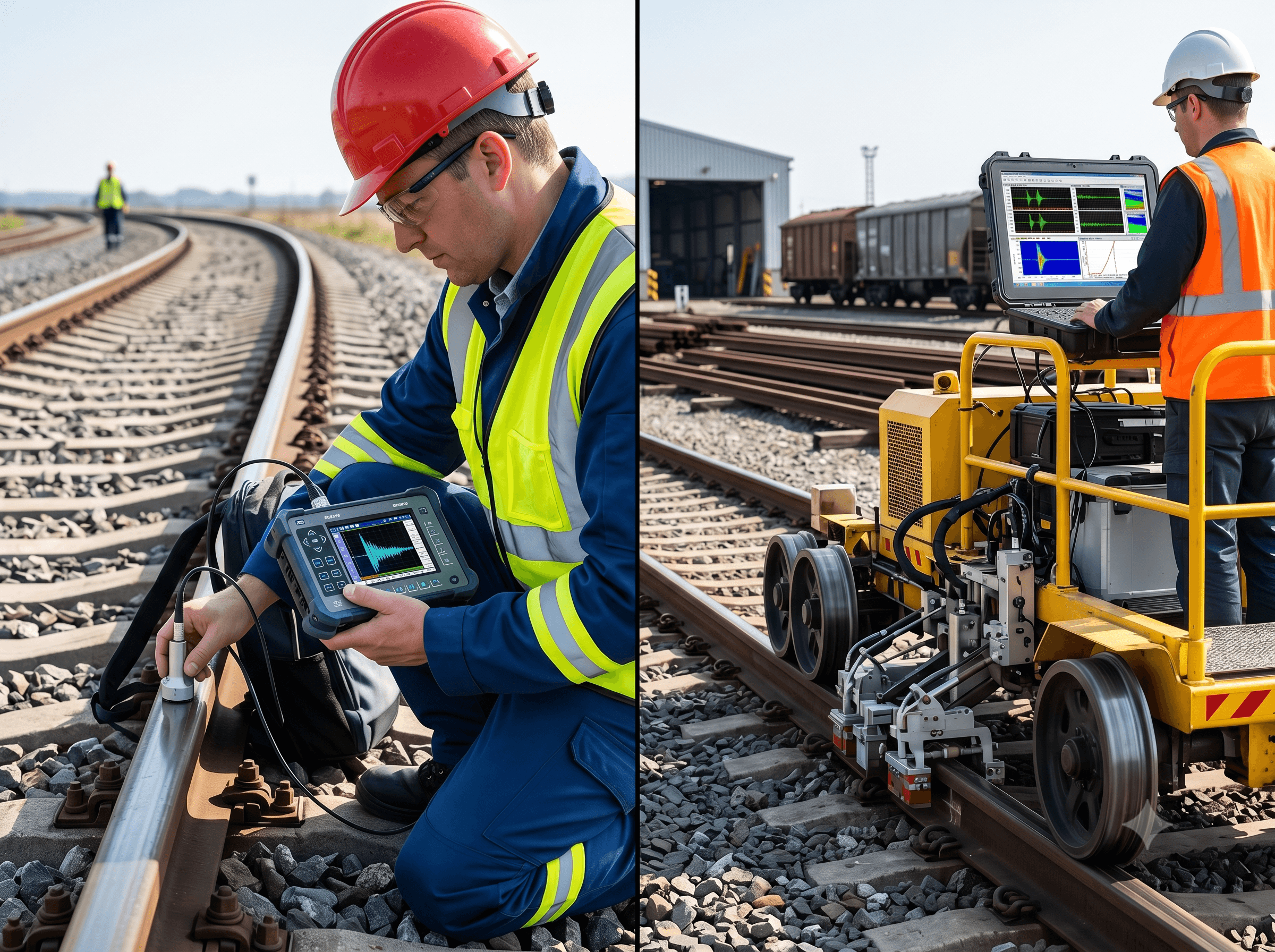
Visual inspections remain one of the most common methods. Inspectors often walk sections of track or use specialized vehicles to identify obvious defects. These inspections focus on track geometry, rail condition, fasteners, ballast stability, and drainage performance.
Automated track inspection vehicles have transformed modern rail testing. These systems collect detailed measurements while moving at operational speeds. Sensors identify alignment deviations, gauge irregularities, and surface defects more accurately than manual inspections alone.
Ultrasonic rail flaw detection plays a major role in identifying internal cracks. Unlike surface inspections, ultrasonic systems can detect hidden defects inside the rail before visible damage appears. Many Class 4, 5, and 6 tracks require regular ultrasonic testing because internal rail fractures can lead to severe derailments.
How Often Must Rail Be Tested also affects the frequency of ultrasonic inspections. High-speed corridors typically require more aggressive flaw detection schedules than lower-speed freight routes.
Inspectors usually search for several critical defect categories, including:
- Surface cracks and rail head defects
- Gauge widening or narrowing
- Misaligned track sections
- Damaged rail joints
- Loose or broken fasteners
- Ballast instability
- Drainage failures
- Vegetation interference near track structures
Digital reporting systems now help railroads document inspection results in real time. These platforms improve recordkeeping accuracy and allow maintenance teams to prioritize repairs faster.
Some railroads also deploy drones and artificial intelligence systems to monitor inaccessible track areas. These tools improve efficiency while reducing inspection risks for personnel working near active rail lines.
Despite these advancements, certain rail systems require even greater oversight due to their construction design. Continuous Welded Rail systems represent one of the most demanding examples.
FRA Regulations on Continuous Welded Rail (CWR) Testing
Continuous Welded Rail, commonly called CWR, uses long welded rail sections instead of shorter jointed rails. This design improves ride quality, reduces maintenance requirements, and supports higher train speeds.
However, CWR introduces unique safety challenges. Thermal expansion and contraction can create extreme internal stress during temperature fluctuations. If operators fail to manage these stresses correctly, the rail may buckle or fracture unexpectedly.
Because of these risks, the FRA requires railroads operating CWR systems to implement formal management plans. These plans must address inspection frequency, rail neutral temperature monitoring, maintenance procedures, and emergency response protocols.
How Often Must Rail Be Tested becomes especially important for CWR systems operating in regions with severe temperature swings. Heat-related track buckling incidents often occur during summer months when rail temperatures rise rapidly.
FRA regulations require railroads to document all CWR inspections carefully. Certified personnel must monitor rail conditions and verify that maintenance activities comply with federal standards. Railroads must also establish procedures for responding to suspected thermal defects immediately.
Many operators now combine geometry testing, ultrasonic inspection, and thermal monitoring technologies to improve CWR safety management. These systems help identify stress-related defects before they become operational hazards.
Advanced predictive maintenance software also supports modern CWR inspection programs. By analyzing temperature patterns and historical defect data, railroads can identify higher-risk segments more efficiently.
How Often Must a Locomotive in Use Be Inspected?
A locomotive in active service must undergo daily, periodic, and annual inspections under FRA regulations. These inspections ensure that locomotives operate safely and meet all federal performance standards before entering service.
Daily inspections focus on operational safety. Qualified personnel inspect brakes, safety appliances, lighting systems, wheels, and visible structural conditions before the locomotive begins operation. Any defect that compromises safety must be repaired immediately or documented according to FRA procedures.
The FRA also requires periodic inspections every 92 days. These inspections involve more detailed mechanical reviews and performance testing. Inspectors evaluate air brake systems, electrical components, suspension assemblies, fuel systems, and cab safety equipment.
Annual inspections provide the most comprehensive evaluation. Maintenance teams disassemble critical systems and conduct advanced testing procedures to identify hidden wear or long-term damage.
How Often Must Rail Be Tested often overlaps with locomotive inspection requirements because track conditions directly affect locomotive performance and safety. Poor track quality can accelerate wheel wear, suspension damage, and braking problems.
Key inspection areas usually include:
- Brake system performance
- Wheel and axle condition
- Coupler integrity
- Electrical systems
- Fuel and lubrication systems
- Cab safety equipment
- Structural frame condition
- Event recorder functionality
Rail operators must maintain detailed inspection records for every locomotive. FRA inspectors frequently review these records during compliance audits.
Modern locomotive fleets now use predictive maintenance systems to monitor component health continuously. Sensors track temperature changes, vibration levels, and pressure readings to identify potential failures early.
Still, locomotive inspections alone cannot guarantee safety. Rail testing schedules must also adapt to unusual operating conditions and emergency situations.
How Often Must Rail Be Tested: Special Cases and Exceptions
How Often Must Rail Be Tested changes significantly during unusual operating conditions. The FRA allows railroads to increase inspection frequency whenever environmental or operational risks rise beyond normal conditions.
Extreme weather events create some of the most serious inspection challenges. Flooding can weaken ballast foundations and wash away track support structures. High temperatures may trigger track buckling, especially on Continuous Welded Rail systems. Earthquakes and severe storms can also shift track alignment unexpectedly.
After these events, railroads often perform emergency inspections before reopening affected routes. Inspectors assess track geometry, rail stability, drainage systems, and bridge structures to confirm safe operating conditions.
Accidents and near-miss incidents may also trigger additional testing requirements. If inspectors identify repeated defects on a specific corridor, operators may need to increase inspection intervals until maintenance teams resolve the issue completely.
Traffic density plays another major role. High-volume freight corridors experience heavier stress cycles than lightly used branch lines. Passenger rail systems operating at higher speeds also require stricter monitoring schedules.
How Often Must Rail Be Tested may also vary when operators apply for FRA waivers. In limited situations, the FRA may approve alternative inspection programs if railroads demonstrate equal or greater safety performance through advanced technologies or enhanced monitoring systems.
However, waivers rarely reduce safety obligations entirely. Railroads must still prove that their alternative inspection strategies maintain acceptable risk levels.
Special cases often place enormous pressure on maintenance teams and compliance managers. A single delayed inspection can create significant legal and operational consequences.
Consequences of Non-Compliance with FRA Rail Testing Requirements
The FRA takes rail testing violations very seriously. Operators that fail to meet inspection schedules may face substantial financial penalties, operational restrictions, and legal exposure.
Civil penalties can reach thousands of dollars per violation depending on the severity of the issue. Repeated violations often trigger higher penalties and increased federal oversight. In serious cases, the FRA may issue emergency orders requiring immediate corrective action.
Non-compliance also increases derailment risks significantly. Delayed inspections allow hidden defects to worsen over time. A small crack can evolve into a catastrophic rail failure if inspectors fail to detect it early.
How Often Must Rail Be Tested becomes especially important after major accidents. Investigators frequently examine inspection records to determine whether operators followed required testing schedules before the incident occurred.
Operational disruptions represent another major consequence. Railroads may need to suspend service on affected corridors until inspectors complete emergency evaluations. These shutdowns create costly delays for freight operators and passenger services alike.
Insurance costs may also increase after repeated compliance violations. Railroads with poor safety records often face greater liability exposure and stricter regulatory monitoring.
Several high-profile derailments have demonstrated how missed inspections can escalate into national safety crises. In many cases, investigators discovered that operators overlooked warning signs or failed to complete required testing intervals.
Compliance therefore extends beyond simple regulatory paperwork. It directly affects public safety, operational continuity, and long-term infrastructure reliability.
Fortunately, modern inspection technologies now help railroads meet these requirements more efficiently than ever before.
The Role of Technology in Meeting FRA Testing Frequency Standards
Technology has transformed modern rail inspection programs. Advanced systems now help operators identify defects faster, improve inspection accuracy, and maintain compliance with demanding FRA schedules.
Automated Track Inspection Vehicles (ATIVs)
Automated Track Inspection Vehicles use high-speed sensors, lasers, cameras, and computer systems to inspect rail infrastructure continuously. These vehicles collect massive amounts of track data while traveling at operational speeds.
ATIVs measure:
- Track alignment
- Gauge variation
- Surface irregularities
- Rail profile wear
- Cross-level deviations
- Curvature conditions
These systems reduce human error and improve inspection consistency. Maintenance teams can analyze digital reports immediately and prioritize repairs based on defect severity.
How Often Must Rail Be Tested becomes easier to manage when operators use automated inspection systems regularly. High-speed corridors especially benefit from continuous monitoring technologies because manual inspections alone may not provide sufficient coverage.
Some railroads now integrate artificial intelligence into their inspection programs. AI systems analyze inspection data patterns and predict where future defects may develop.
Ground-Penetrating Radar and Ultrasonic Testing
Ground-Penetrating Radar helps inspectors evaluate subsurface conditions beneath the track structure. These systems detect moisture buildup, ballast deterioration, and void formation that may weaken track stability.
Ultrasonic testing remains one of the most effective tools for identifying internal rail flaws. Specialized equipment sends sound waves through the rail to detect hidden cracks before visible fractures appear.
The FRA strongly encourages advanced flaw detection programs for higher-class tracks and heavily used freight corridors. Many operators now conduct ultrasonic testing several times per year to maintain compliance and reduce derailment risks.
Some systems also combine thermal imaging with ultrasonic data to identify heat-related stress conditions more accurately.
Technology continues to improve inspection efficiency, but compliance still depends on strong operational procedures and disciplined maintenance planning.
Technology helps railroads stay ahead of compliance — but even the best tools are only as effective as the systems behind them. So what does a best-practice rail testing program actually look like in the real world?
Best Practices for Staying Compliant with FRA Rail Testing Schedules
Successful railroads combine technology, workforce training, and proactive maintenance planning to maintain compliance consistently. Strong inspection programs reduce safety risks while improving long-term operational efficiency.
The following best practices help operators maintain effective testing schedules:
- Maintain real-time digital inspection records
Digital systems improve documentation accuracy and simplify FRA audit preparation. Maintenance teams can access inspection histories instantly. - Train and certify inspection personnel regularly
Qualified inspectors remain essential despite advances in automation. Continuous education helps teams understand evolving FRA requirements. - Develop weather-based reinspection protocols
Extreme weather events require rapid response procedures. Railroads should establish clear reinspection triggers for flooding, excessive heat, and storm damage. - Use predictive maintenance analytics
Data analysis helps operators identify high-risk track segments before failures occur. Predictive systems reduce emergency repair costs. - Conduct internal compliance audits
Routine audits help railroads identify documentation gaps and procedural weaknesses before federal inspections occur. - Create clear defect escalation procedures
Maintenance teams should know exactly how to respond when inspectors identify serious defects or unsafe conditions.
How Often Must Rail Be Tested becomes easier to manage when operators follow structured compliance systems consistently. Preventive maintenance programs reduce uncertainty and improve inspection coordination across large rail networks.
Many leading railroads also integrate centralized monitoring platforms that combine inspection data, maintenance schedules, and operational reporting into a single system. These platforms improve communication between field inspectors and management teams.
Consistent planning remains one of the strongest defenses against compliance failures.
How Often Should You Inspect Equipment Used in Rail Testing?
Equipment used in rail testing should undergo visual inspections before each use and calibration checks according to manufacturer specifications and FRA standards. Proper equipment maintenance ensures inspection accuracy and reliable defect detection.
Testing instruments operate in demanding environments that expose them to vibration, moisture, dust, and temperature extremes. Even minor calibration problems can affect inspection reliability significantly.
Inspectors usually examine sensors, ultrasonic probes, cables, batteries, and data collection systems before beginning field operations. Calibration testing often occurs monthly, quarterly, or annually depending on equipment type and operational demands.
How Often Must Rail Be Tested also depends partly on the reliability of the testing equipment itself. Faulty inspection tools may fail to detect dangerous defects, creating serious safety risks.
Many railroads now maintain dedicated calibration laboratories to verify equipment accuracy regularly. These programs improve testing consistency and support long-term regulatory compliance.
Final Thoughts
Rail safety depends heavily on consistent inspection practices, accurate defect detection, and strict regulatory compliance. Throughout this article, the discussion explored how FRA regulations determine inspection schedules based on track class, operational conditions, and infrastructure design.
How Often Must Rail Be Tested ultimately depends on several critical factors, including train speed, traffic density, weather exposure, and track condition. However, FRA regulations establish the minimum inspection standards that every operator must follow.
The article also explained how locomotive inspections, automated testing technologies, ultrasonic flaw detection, and Continuous Welded Rail monitoring all contribute to safer rail operations. Advanced inspection systems continue to improve efficiency, but successful compliance still requires disciplined operational planning and trained personnel.
How Often Must Rail Be Tested will remain a central issue for rail operators as infrastructure demands continue growing across freight and passenger networks. Railroads that invest in proactive testing programs can reduce operational risks, improve long-term reliability, and strengthen regulatory compliance.
Key Takeaways
- FRA rail testing frequency depends heavily on track class, operating speed, and usage conditions.
- Higher-speed rail corridors require more frequent inspections to maintain safe operational performance standards.
- Ultrasonic rail testing helps inspectors detect internal cracks before visible surface damage appears.
- Continuous Welded Rail systems require additional monitoring because thermal stress can cause dangerous failures.
- Automated track inspection vehicles improve defect detection accuracy and support faster compliance reporting processes.
- Extreme weather conditions often require emergency rail inspections before operators can safely resume service.
- Locomotive inspections include daily, periodic, and annual evaluations to maintain FRA regulatory compliance standards.
- Predictive maintenance systems help railroads identify high-risk track segments before major failures occur.
- Failure to meet FRA inspection schedules can result in severe penalties and operational shutdowns.
- Strong rail inspection programs improve infrastructure reliability, reduce derailment risks, and support public safety.
FAQs
What is inspection in railway?
Railway inspection is the process of examining tracks, rail components, signaling systems, and supporting infrastructure to identify defects or safety risks. Rail operators use visual inspections, ultrasonic testing, and automated track inspection systems to maintain FRA compliance and improve operational safety.
What is inspection frequency?
Inspection frequency refers to how often inspections must occur within a specific time period. In railway operations, inspection frequency depends on factors such as track class, train speed, traffic density, and environmental conditions.
What is maintenance frequency?
Maintenance frequency describes how regularly maintenance activities should take place to keep equipment or infrastructure in safe working condition. Railroads often schedule preventive maintenance based on FRA standards, inspection findings, and historical wear patterns.
What monthly inspections are required by OSHA?
OSHA requires monthly inspections for certain workplace safety equipment, including fire extinguishers, lifting devices, and some fall protection systems. In rail maintenance environments, operators may also perform monthly inspections on tools, electrical systems, and safety equipment to support overall compliance programs.
What is the inspection frequency of lifting equipment?
The inspection frequency of lifting equipment depends on usage conditions, equipment type, and regulatory standards. Most lifting equipment requires daily visual checks, periodic documented inspections, and annual comprehensive examinations to ensure safe operation in rail maintenance and industrial environments.