

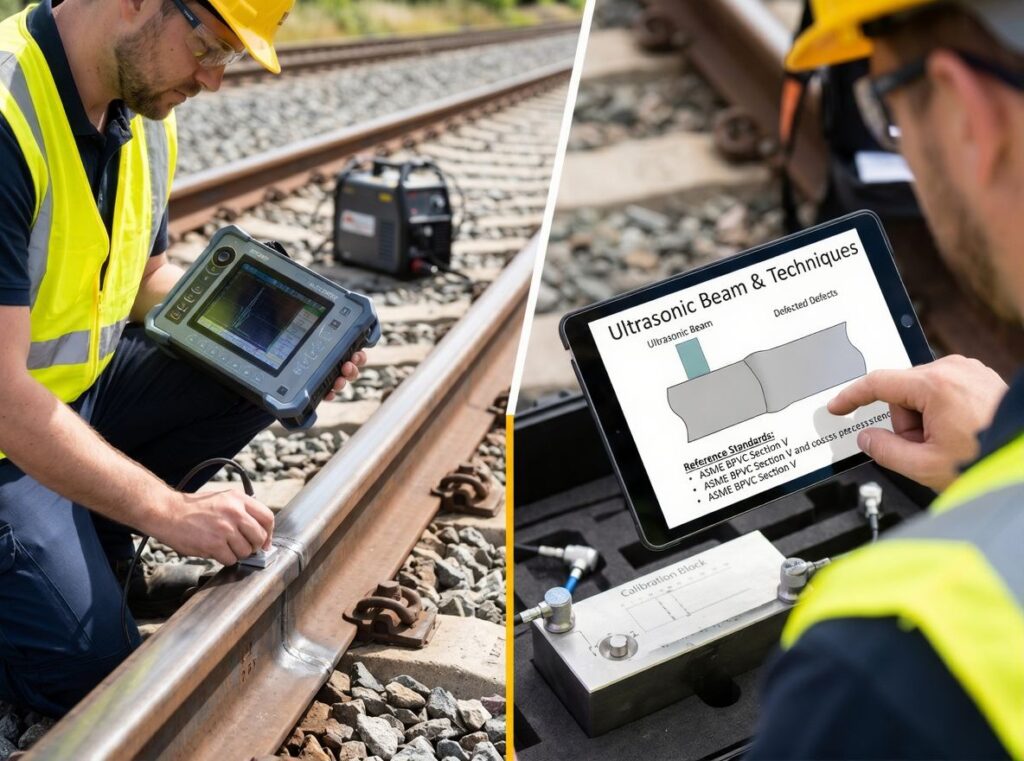
Flash butt weld inspection stands as a critical process in ensuring the strength and reliability of welded joints across demanding industries. Flash butt weld inspection allows engineers to detect internal defects that cannot be seen with the naked eye but may lead to serious failures. Flash butt weld inspection also plays a key role in maintaining safety, compliance, and long-term performance in infrastructure and manufacturing systems.
In today’s industrial landscape, welding quality directly affects operational success. Rail networks, pipelines, and automotive components rely heavily on flawless welds. Even a minor imperfection can cause structural weakness, leading to downtime or costly repairs. This growing demand for precision has pushed inspection technologies to evolve significantly.
Among all non-destructive testing methods, ultrasonic testing has gained widespread acceptance. It offers deep insight into weld integrity without damaging the material. This capability makes it an essential part of modern inspection strategies, especially in critical applications where failure is not an option.
What Is Flash Butt Welding and Why Does Inspection Matter?
Flash butt welding is a resistance welding process that joins two metal components by applying heat and pressure. The process generates heat through electrical resistance, causing the metal ends to melt and fuse under controlled force. This method creates strong, uniform joints widely used in rails, rods, and heavy-duty components.
Inspection becomes essential because the welding process, although efficient, can still produce defects. These defects may develop due to improper parameters, contamination, or uneven pressure during welding. Without proper evaluation, these flaws can remain hidden until they cause failure.
Industries depend on weld integrity to ensure safety and performance. Railway systems, for example, experience constant mechanical stress. A weak weld in a rail track can lead to derailments. Similarly, pipeline systems must maintain leak-proof joints to prevent environmental damage and financial losses.
Common Defects Found in Flash Butt Welds
- Cracks caused by thermal stress or rapid cooling
- Porosity formed due to trapped gases during welding
- Lack of fusion where metal surfaces do not bond properly
- Inclusions created by foreign materials inside the weld
- Misalignment due to improper positioning of components
These defects often remain invisible on the surface. Visual inspection alone cannot detect internal irregularities. This limitation highlights the need for advanced inspection techniques that can examine the internal structure of the weld.
Now that the risks associated with hidden defects are understood, the next question arises. How can industries inspect the inside of a solid weld without damaging it? The answer lies in a powerful technique that uses sound waves to reveal what cannot be seen.
What Is the Ultrasonic Inspection Method?
The ultrasonic inspection method uses high-frequency sound waves to detect internal flaws within a material. Inspectors introduce these waves into the weld, and the reflected signals provide information about any discontinuities.
This method operates on a simple principle. Sound waves travel through the material until they encounter a boundary, like a crack or void. When this happens, part of the wave reflects back to the receiver. The system then analyzes these reflections to determine the location and size of the defect.
Two primary types of waves are commonly used:
- Longitudinal waves that travel in the same direction as the wave propagation
- Shear waves that move at angles and allow inspection from multiple directions
Ultrasonic testing offers several advantages. It provides real-time results, detects both surface and internal defects, and does not expose operators to harmful radiation. Compared to radiographic testing, it is safer and more efficient for on-site inspections.
Another key benefit lies in its precision. Inspectors can accurately locate defects and measure their size. This information helps determine whether a weld meets safety standards or requires repair.
However, understanding the method alone does not explain its full potential. What specific techniques make ultrasonic testing so effective in flash butt weld inspection? The next section reveals these advanced approaches.
Ultrasonic Testing Techniques Used in Flash Butt Weld Inspection
Different ultrasonic techniques enhance inspection accuracy and reliability. Each method focuses on identifying specific types of defects and improving detection capability.
Pulse-Echo Technique
The pulse-echo technique sends a sound pulse into the weld and measures the time it takes for the echo to return. If a defect is present, the wave reflects back earlier than expected.
This method helps identify the depth and position of flaws. It remains one of the most widely used techniques due to its simplicity and effectiveness in routine inspections.
Time-of-Flight Diffraction (TOFD)
TOFD detects defects by analyzing the time difference between diffracted signals. It is highly effective in identifying planar defects like cracks.
This technique provides accurate sizing of flaws, which is essential for evaluating severity. It also reduces the risk of missing small defects that may grow over time.
Phased Array Ultrasonic Testing (PAUT)
PAUT uses multiple ultrasonic elements to send sound waves at different angles. This approach generates detailed images of the weld structure.
It allows inspectors to visualize defects clearly and inspect complex geometries with high precision. This capability makes it ideal for advanced inspection requirements.
Key advantages of PAUT include:
- High-resolution imaging of weld structures
- Faster inspection compared to conventional methods
- Ability to scan complex shapes effectively
- Improved accuracy in defect characterization
These advanced techniques make ultrasonic testing a powerful tool in flash butt weld inspection. They provide detailed insights that traditional methods cannot achieve.
But even the most advanced techniques require proper guidelines. Without standardized procedures, inspection results may vary and lead to inconsistent decisions. So, what ensures uniformity and reliability across inspections?
What Is the ASME Standard for Ultrasonic Testing?
The ASME standard for ultrasonic testing is defined in Section V, Article 4 of the ASME Boiler and Pressure Vessel Code. This standard outlines the procedures, calibration requirements, and acceptance criteria for ultrasonic inspections.
It ensures that inspections follow a consistent approach. Inspectors must calibrate equipment properly, use approved techniques, and evaluate results based on established criteria. This consistency is crucial for maintaining quality across different industries.
In flash butt weld inspection, ASME standards guide inspectors in assessing weld integrity. They define how defects should be detected, measured, and evaluated. This structured approach helps ensure that only safe and reliable welds are approved for use.
Other standards also support ultrasonic testing practices:
- ASTM E164 focuses on contact ultrasonic testing methods
- EN ISO 17640 defines testing procedures for fusion welds
- AWS D1.1 provides guidelines for structural steel weld inspection
Comparison of Key UT Standards for Weld Inspection
| Standard | Governing Body | Application Area | Key Requirement |
| ASME Section V | ASME | Pressure vessels, piping | Article 4 UT procedure |
| ASTM E164 | ASTM | Contact UT of welds | Calibration and scanning |
| EN ISO 17640 | ISO/CEN | Fusion welds | Acceptance levels A/B/C |
| AWS D1.1 | AWS | Structural steel welds | Flaw sizing criteria |
These standards create a unified framework for inspections. They ensure that results remain accurate, repeatable, and reliable regardless of location or application.
At this point, the importance of combining advanced techniques with strict standards becomes clear. Together, they form the backbone of effective inspection systems.
Ultrasonic Weld Inspection Procedure for Flash Butt Welds
The ultrasonic weld inspection procedure is a structured method used to detect and evaluate internal flaws using high-frequency sound waves. In flash butt weld inspection, this procedure ensures that welds meet strict safety and performance requirements before they are approved for service. It provides a reliable way to assess weld quality without damaging the material.
The process begins with surface preparation. Inspectors clean the weld area to remove dirt, rust, oil, or scale. A clean surface ensures proper transmission of ultrasonic waves. Even minor surface contamination can distort signals and lead to inaccurate results.
Next comes equipment calibration. Inspectors use standard reference blocks with known dimensions and artificial defects. These blocks help adjust the ultrasonic instrument for sensitivity and accuracy. Calibration ensures that the readings match real-world defect sizes and positions.
After calibration, inspectors select the appropriate probe and scanning pattern. Probe selection depends on weld thickness, geometry, and expected defect type. Angle beam probes are often used in flash butt weld inspection because they can detect flaws from different orientations.
The inspection then moves to scanning. Inspectors apply a couplant, like gel or oil, between the probe and the weld surface. This couplant eliminates air gaps and ensures efficient sound transmission. The probe moves systematically across the weld, sending and receiving signals.
During scanning, the equipment displays signals on a screen. Inspectors analyze these signals to identify any irregularities. They measure the amplitude, position, and shape of reflections to determine the size and nature of defects.
Finally, inspectors document the findings. They compare the results with acceptance criteria defined by standards like ASME or AWS. Based on this evaluation, they decide whether the weld passes or requires repair.
Now that the procedure is clear, another important question emerges. How do inspectors decide whether a detected flaw is acceptable or dangerous? That decision leads directly into acceptance criteria and fitness-for-service analysis.
Acceptance Criteria and Fitness-for-Service in Flash Butt Weld Inspection
Acceptance criteria define the limits within which a weld is considered safe. In flash butt weld inspection, these criteria depend on the type of defect, its size, and its location within the weld.
Inspectors evaluate flaws using different approaches. Amplitude-based methods compare signal strength to reference levels. Advanced methods like TOFD provide precise sizing of defects. These approaches help determine whether a flaw exceeds allowable limits.
Standards like ASME Section V and AWS D1.1 provide guidelines for acceptance. They specify maximum permissible defect sizes and conditions under which a weld must be rejected. These standards ensure consistency across inspections.
Fitness-for-service analysis goes beyond simple acceptance or rejection. It evaluates whether a weld can continue operating safely despite minor imperfections. This approach considers factors like load conditions, material properties, and environmental exposure.
For example, a small defect in a low-stress component may not pose a risk. However, the same defect in a high-pressure pipeline could lead to failure. This analysis helps industries make informed decisions about repair or replacement.
Experts in non-destructive testing often stress the importance of accurate flaw characterization. Reliable inspection results allow engineers to predict the remaining life of a component. This predictive capability reduces unexpected failures and improves maintenance planning.
Now that the decision-making process is understood, it becomes important to explore how ultrasonic testing compares with other inspection methods.
What Are the 5 Methods of NDT?
The five primary methods of non-destructive testing are visual testing, magnetic particle testing, liquid penetrant testing, radiographic testing, and ultrasonic testing. Each method serves a unique purpose in evaluating material integrity.
Visual testing is the simplest method. Inspectors examine the surface for visible defects like cracks or misalignment. While useful, it cannot detect internal flaws.
Magnetic particle testing is used for ferromagnetic materials. It reveals surface and near-surface defects by applying a magnetic field and observing particle patterns.
Liquid penetrant testing detects surface-breaking defects. Inspectors apply a dye to the surface, which penetrates cracks and becomes visible under inspection.
Radiographic testing uses X-rays or gamma rays to capture images of internal structures. It provides detailed results but involves radiation safety concerns and longer processing times.
Ultrasonic testing stands out among these methods. It detects internal defects with high accuracy and provides immediate results. It does not involve radiation and can be performed on-site.
In flash butt weld inspection, ultrasonic testing is often the preferred method. It offers a balance of speed, safety, and precision that other methods cannot match.
But how do these inspection methods translate into real-world applications? The answer lies in industries where weld integrity is critical.
Industry Applications of Flash Butt Weld Inspection
Flash butt weld inspection plays a crucial role in industries that depend on strong and reliable welded joints. Its application ensures safety, efficiency, and long-term performance.
Railway Industry
Railway systems rely on continuous welded rails for smooth and efficient operation. Flash butt welding joins rail sections into long tracks. Inspection ensures that these welds can withstand heavy loads and constant vibrations.
Regular ultrasonic inspection helps detect defects before they lead to failure. Studies in railway maintenance show that proper inspection reduces the risk of derailments significantly. This makes flash butt weld inspection an essential part of railway safety programs.
Oil & Gas Pipelines
Pipelines transport oil and gas over long distances under high pressure. Any weld failure can result in leaks, environmental damage, and financial loss. Flash butt weld inspection ensures that pipeline joints remain secure and reliable.
Regulatory authorities often require strict inspection protocols for pipelines. Ultrasonic testing helps meet these requirements by providing accurate and repeatable results. It also enables early detection of defects, allowing preventive maintenance.
Automotive and Manufacturing
In automotive and heavy manufacturing industries, flash butt welding is used to join components like axles and frames. Inspection ensures that these components meet performance standards and safety requirements.
Reliable welds improve product durability and reduce the risk of failure during operation. This directly impacts customer safety and brand reputation.
Now that the importance of applications is clear, another challenge arises. Even with advanced techniques, inspection is not always straightforward.
Challenges in Flash Butt Weld Inspection and How They Are Overcome
Flash butt weld inspection presents several challenges due to the nature of the welding process. One major challenge is the complex geometry of the weld zone. Irregular shapes can make it difficult for ultrasonic waves to travel uniformly.
Another challenge comes from the heat-affected zone. Changes in grain structure can create noise that interferes with signal interpretation. This noise can mask defects and reduce detection accuracy.
Inspectors also face difficulties in accessing certain weld areas. Limited access can restrict probe movement and reduce inspection coverage.
To overcome these challenges, industries use advanced techniques like phased array ultrasonic testing and TOFD. These methods provide better imaging and improved defect detection.
Modern equipment also includes advanced signal processing features. These features filter noise and enhance the clarity of signals. As a result, inspectors can identify defects more accurately.
Training and certification of inspectors also play a critical role. Skilled professionals can interpret complex signals and make accurate judgments. This human expertise complements technological advancements.
Now that the challenges and solutions are understood, the overall importance of inspection becomes even more evident.
Final Thoughts
Flash butt weld inspection remains a vital process in ensuring the safety and reliability of welded structures across industries. It helps identify hidden defects, evaluate weld quality, and prevent failures that could lead to serious consequences.
Ultrasonic testing has proven to be the most effective method for this purpose. It provides accurate, real-time results without damaging the material. By combining advanced techniques with established standards, industries can maintain consistent quality and performance.
Flash butt weld inspection not only ensures compliance with safety regulations but also supports long-term operational efficiency. Organizations like EMA Quality Industries continue to deliver reliable inspection solutions that meet global standards and industry demands.
Key Takeaways
- Flash butt weld inspection plays a crucial role in ensuring structural integrity across critical industrial applications.
- Ultrasonic testing enables accurate detection of internal weld defects without damaging the material structure.
- Advanced techniques like PAUT and TOFD significantly improve defect detection accuracy and inspection efficiency.
- Proper calibration and surface preparation are essential steps in achieving reliable ultrasonic inspection results.
- Standards like ASME and AWS ensure consistency and reliability in inspection procedures worldwide.
- Flash butt weld inspection helps industries prevent failures and reduce long-term maintenance costs effectively.
- Ultrasonic inspection provides real-time data, allowing faster decision-making during quality assurance processes.
- Different NDT methods exist, but ultrasonic testing remains the most effective for internal flaw detection.
- Industry applications like railways and pipelines depend heavily on accurate weld inspection practices.
- Continuous advancements in inspection technology help overcome challenges like noise and complex weld geometry.
FAQs
What are the ASME testing standards?
ASME testing standards refer to guidelines set by the American Society of Mechanical Engineers for inspecting and evaluating materials and welds. These standards, especially ASME Section V, define procedures for non-destructive testing methods like ultrasonic testing. They ensure consistency, accuracy, and safety in inspection processes across industries.
What are the two types of ultrasonic testing?
The two main types of ultrasonic testing are conventional ultrasonic testing and advanced ultrasonic testing. Conventional methods include pulse-echo techniques, while advanced methods include phased array ultrasonic testing (PAUT) and time-of-flight diffraction (TOFD). Both types play a key role in flash butt weld inspection by detecting internal defects effectively.
What are the 7 NDT methods?
The seven commonly recognized NDT methods include visual testing (VT), ultrasonic testing (UT), radiographic testing (RT), magnetic particle testing (MT), liquid penetrant testing (PT), eddy current testing (ET), and acoustic emission testing (AE). Each method serves a specific purpose, but ultrasonic testing is most widely used for internal weld evaluation.
What are the calibration methods for ultrasonic testing?
Calibration methods in ultrasonic testing involve using reference blocks with known dimensions and artificial defects. Inspectors adjust equipment sensitivity, range, and time base using these blocks. Proper calibration ensures accurate detection and sizing of defects during flash butt weld inspection.
What is the frequency of ultrasonic inspection?
The frequency of ultrasonic inspection depends on the application and industry requirements. Typically, ultrasonic probes operate between 1 MHz and 10 MHz. Lower frequencies penetrate deeper materials, while higher frequencies provide better resolution for detecting smaller defects.
