
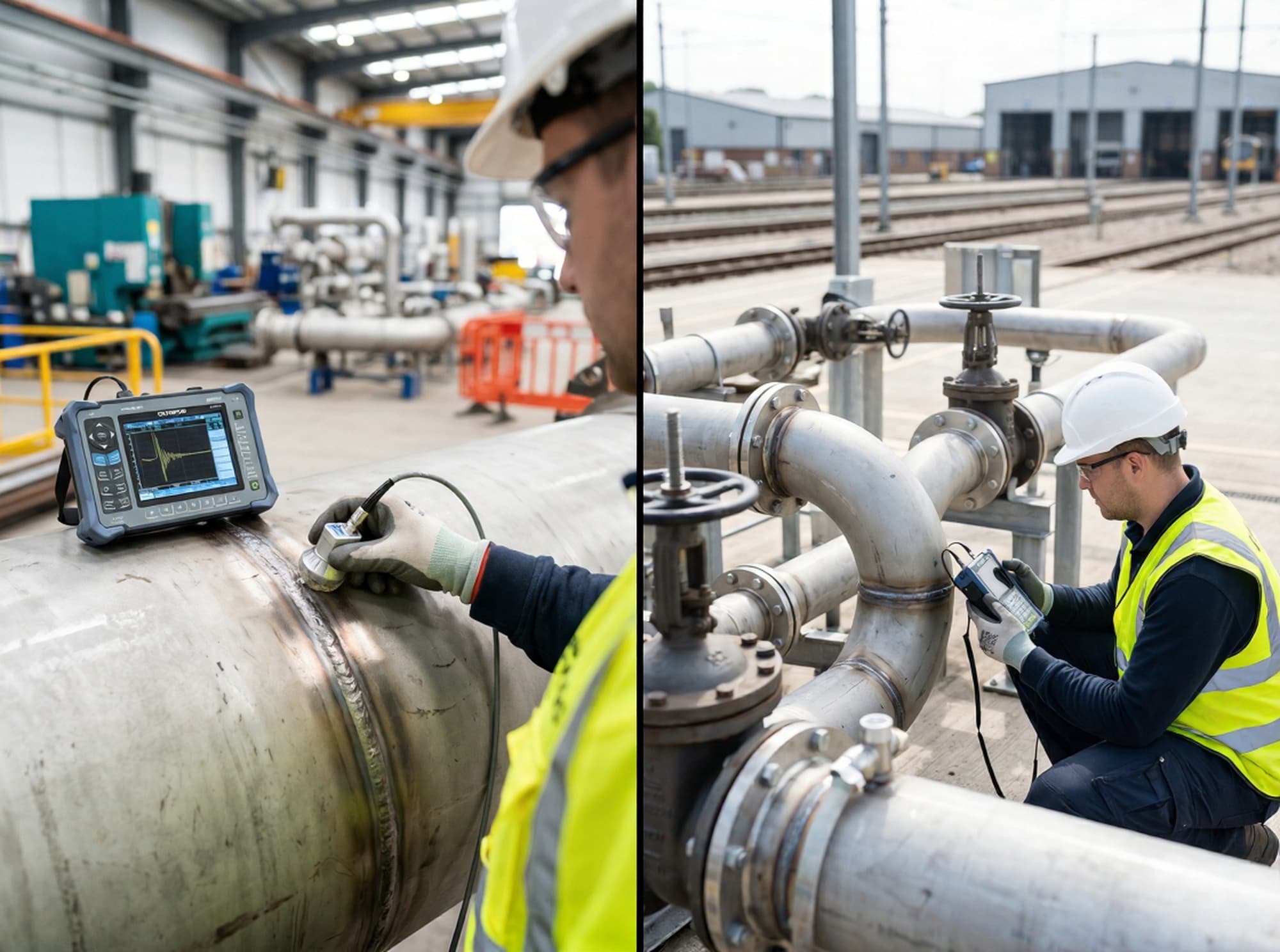
Pressure vessels and industrial piping systems operate under extreme conditions every day. ASME weld ultrasonic inspection plays a critical role in ensuring these systems remain safe, reliable, and compliant with industry codes. Through ASME weld ultrasonic inspection, inspectors can identify hidden weld discontinuities before they develop into costly failures. As industries continue to demand higher levels of safety and quality, ASME weld ultrasonic inspection remains one of the most trusted non-destructive testing methods available.
A single weld defect can trigger equipment shutdowns, environmental incidents, and expensive repairs. Industry reports estimate that weld-related failures contribute to billions of dollars in losses across manufacturing, energy, and processing sectors each year. Because pressure vessels and piping often contain hazardous materials under pressure, even minor defects can create serious consequences.
To prevent these risks, organizations rely on advanced inspection techniques that detect flaws before they become critical. Among these methods, ultrasonic testing stands out for its accuracy, depth of coverage, and ability to examine internal weld conditions without damaging the component.
What Is ASME Weld Ultrasonic Inspection?
ASME weld ultrasonic inspection is a non-destructive testing method that uses high-frequency sound waves to examine weld integrity in pressure vessels, piping systems, and structural components. The technique identifies internal flaws that may not be visible on the surface.
During ASME weld ultrasonic inspection, a transducer generates ultrasonic waves and directs them into the material. When these sound waves encounter discontinuities such as cracks, slag inclusions, or lack of fusion, part of the signal reflects back to the instrument. Inspectors analyze these reflections to determine the location and size of potential defects.
Unlike visual inspection, which only evaluates surface conditions, ASME weld ultrasonic inspection examines the entire weld volume. This capability makes it highly effective for detecting subsurface flaws that could compromise safety.
The process follows strict code requirements established by the American Society of Mechanical Engineers (ASME). These requirements ensure consistency, reliability, and compliance across industries that depend on pressure-retaining equipment.
What Is the ASME Standard for Ultrasonic Testing?
The primary ASME standard for ultrasonic testing is ASME Boiler and Pressure Vessel Code (BPVC) Section V, Article 4.
This section outlines the procedures, equipment requirements, calibration methods, examination techniques, and reporting standards for ultrasonic examinations. ASME weld ultrasonic inspection performed under these requirements provides a standardized approach for evaluating weld quality.
For pressure vessels, acceptance criteria are often defined under ASME Section VIII, while piping systems may follow additional code requirements depending on the application.
Key elements covered by the standard include:
- Scope of the standard – Defines where and how ultrasonic examinations apply.
- Calibration requirements – Establishes procedures for accurate equipment setup.
- Documentation and reporting – Ensures traceability and inspection consistency.
- Personnel qualification – Requires inspectors to meet recognized standards such as ASNT SNT-TC-1A.
By following these requirements, ASME weld ultrasonic inspection delivers dependable results that support safe operation and regulatory compliance.
Understanding the standard is one thing but how does this process actually unfold on a pressure vessel weld? The answer lies in the mechanics, and it's more precise than most people expect.
How Does Ultrasonic Weld Inspection Work?
Ultrasonic weld inspection works by transmitting high-frequency sound waves into a weld and analyzing the reflected signals to identify internal defects.
The process begins with careful preparation. Even the most advanced ASME weld ultrasonic inspection equipment depends on proper surface conditions and accurate calibration.
The inspection typically follows these steps:
- Surface preparation of the weld
Inspectors clean the weld area to remove scale, paint, grease, or debris that may interfere with sound transmission. - Coupling agent application
A coupling medium, such as gel or oil, creates effective contact between the transducer and the test surface. - Transducer placement and angle selection
The inspector selects an appropriate probe angle based on weld geometry and inspection requirements. - Sound beam transmission and reflection
Ultrasonic waves travel through the material and reflect from discontinuities or boundaries. - Signal interpretation and flaw sizing
Returned signals appear on the instrument display and allow inspectors to determine flaw location, orientation, and size.
Modern ASME weld ultrasonic inspection systems provide several display formats for analysis.
Common Ultrasonic Display Types
- A-scan – Displays signal amplitude versus time.
- B-scan – Provides a cross-sectional view of the inspected area.
- C-scan – Produces a plan-view image of the test region.
Traditional manual ultrasonic testing remains widely used because of its flexibility and cost-effectiveness. However, many facilities now adopt advanced methods such as Phased Array Ultrasonic Testing (PAUT) to improve coverage and accuracy.
The following comparison highlights the differences between common ultrasonic methods:
| Method | Coverage | Speed | Flaw Detail |
| Manual UT | Limited | Moderate | Basic |
| Phased Array UT | Wide | Fast | High |
| TOFD | Full volume | Fast | Very High |
Phased Array systems can electronically steer and focus sound beams, allowing inspectors to evaluate complex weld geometries more efficiently. As a result, ASME weld ultrasonic inspection has become more powerful and reliable than ever before.
In many applications, inspectors combine advanced imaging technologies with established code requirements to achieve comprehensive weld evaluations. This combination improves defect detection while reducing inspection time.
Now that the inspection process is clear, a critical question still remains — which types of pressure vessel and piping welds actually require this level of scrutiny? The answer may be broader than expected.
Applications in Pressure Vessels and Piping
Pressure vessels and piping systems often operate under high temperatures, elevated pressures, and corrosive environments. Under these conditions, weld quality becomes a critical factor in maintaining safe operation.
ASME weld ultrasonic inspection helps identify flaws before equipment enters service or during scheduled maintenance intervals. This proactive approach reduces the risk of leaks, ruptures, and unplanned shutdowns.
Industries that commonly rely on ASME weld ultrasonic inspection include:
- Oil and gas
- Petrochemical processing
- Power generation
- Pharmaceutical manufacturing
- Chemical production
- Refining operations
Several weld configurations routinely undergo inspection.
Common Weld Types Subject to Inspection
- Butt welds
- Nozzle welds
- Seam welds
- Repair welds
Pressure vessels constructed under ASME Section VIII frequently require ultrasonic examination for critical welds. Similarly, process piping systems governed by ASME B31.3 often use ASME weld ultrasonic inspection to verify weld integrity and code compliance.
Industry studies consistently show that weld-related defects remain among the leading causes of pressure equipment failures. Early identification through ultrasonic testing significantly reduces repair costs and helps avoid catastrophic incidents.
Because ultrasonic testing examines the weld volume rather than just the surface, it provides valuable information that other inspection methods may miss.
What Is the Minimum Thickness for Ultrasonic Weld Testing?
ASME Section V generally supports ultrasonic weld testing for materials with thicknesses of approximately 6 mm (¼ inch) or greater.
Material thickness directly affects how ultrasonic waves travel through the component. If the section becomes too thin, sound reflections may overlap and create interpretation challenges.
For this reason, ASME weld ultrasonic inspection works best within thickness ranges that allow clear signal separation and accurate flaw detection.
Several thickness-related considerations influence method selection:
- Thin sections – Radiographic testing often provides better evaluation results.
- Thick sections above 25 mm – Ultrasonic testing frequently offers advantages over radiography.
- Transition thickness ranges – Combined inspection approaches may improve reliability.
Advancements in phased array technology continue to expand the effectiveness of ASME weld ultrasonic inspection for thinner materials. Modern equipment provides improved focusing capabilities and enhanced imaging, allowing inspectors to evaluate applications that were previously difficult to examine.
Thickness is not the only factor affecting inspection quality. Material type, weld geometry, surface condition, and access restrictions also influence examination effectiveness.
For pressure vessels and piping systems, selecting the correct inspection technique requires careful consideration of all these variables. Engineers and inspectors must balance code requirements, material characteristics, and operational risks to determine the most suitable examination strategy.
As inspection technologies continue to evolve, industries gain access to more precise methods for assessing weld quality. Yet technology alone cannot guarantee reliable results. Equipment, procedures, and inspector expertise must work together to achieve accurate evaluations.
Ultrasonic Testing of Pressure Vessels: A Deeper Look
Ultrasonic testing of pressure vessels is a non-destructive examination method that evaluates welds and base materials for internal defects without causing damage to the vessel.
Pressure vessels present unique inspection challenges compared to standard welded structures. Their curved surfaces, varying wall thicknesses, and complex weld geometries require careful planning during ASME weld ultrasonic inspection. These factors influence sound beam behavior and affect how inspectors interpret signals.
Pressure vessel inspections occur during different stages of a component's lifecycle. Pre-service inspections verify fabrication quality before commissioning, while in-service inspections assess degradation that may develop during operation.
The effectiveness of ASME weld ultrasonic inspection becomes particularly important when vessels operate under high pressure, elevated temperatures, or corrosive conditions. In these environments, even small weld defects can grow into serious structural concerns.
Many industry experts emphasize that defect prevention costs significantly less than failure recovery. This principle drives the widespread adoption of ASME weld ultrasonic inspection across critical industries.
Common Challenges in Pressure Vessel Ultrasonic Testing
- Geometric complexity of vessel designs
- Material grain noise in certain alloys
- Limited access to inspection surfaces
- Surface condition and coating interference
Heat-affected zones around welds also require special attention. These regions often experience changes in material properties during welding, making ASME weld ultrasonic inspection essential for confirming weld quality and structural integrity.
The growing demand for safer operations continues to increase reliance on advanced ultrasonic technologies. However, overcoming inspection challenges requires more than traditional equipment alone.
The challenges are real but so are the solutions. Modern technology has transformed how inspectors overcome these obstacles. What tools are reshaping ASME weld ultrasonic inspection today?
Advanced Technologies Driving Modern ASME Weld Ultrasonic Inspection
Technology has significantly enhanced the accuracy, speed, and reliability of ASME weld ultrasonic inspection over the past two decades.
Traditional ultrasonic testing remains effective, but advanced techniques now provide greater coverage and more detailed imaging. These improvements allow inspectors to identify smaller flaws and evaluate complex weld geometries with greater confidence.
One of the most important developments is Phased Array Ultrasonic Testing (PAUT). This technology uses multiple ultrasonic elements that can electronically steer and focus sound beams. As a result, ASME weld ultrasonic inspection becomes more efficient and comprehensive.
Another major advancement is Time of Flight Diffraction (TOFD). This method accurately sizes flaws by measuring diffracted sound waves from defect tips. Many industries combine TOFD with ASME weld ultrasonic inspection programs to improve flaw characterization.
Automated Ultrasonic Testing (AUT) also plays a growing role in pipeline and large-diameter piping inspections. Automated systems reduce operator variability while increasing inspection speed.
Phased Array vs. Conventional UT — Key Differences
| Feature | Conventional UT | Phased Array UT |
| Beam steering | Fixed | Electronic |
| Scan coverage | Single angle | Multi-angle |
| Data imaging | A-scan only | Full sectorial scan |
| Operator dependency | High | Reduced |
| Code compliance | ASME V Art. 4 | ASME V Art. 4 + Code Cases |
Modern facilities increasingly adopt these technologies because they improve defect detection and reduce inspection time. Consequently, ASME weld ultrasonic inspection continues to evolve alongside industry safety expectations.
Advanced imaging capabilities also provide permanent digital records. These records support future assessments and improve long-term asset management strategies.
Technology alone does not guarantee a safe weld — the people behind the equipment matter just as much. So what qualifications must inspectors hold to carry out ASME weld ultrasonic inspection?
Inspector Qualifications and Certification Requirements
Qualified personnel form the foundation of every successful ASME weld ultrasonic inspection program.
Even the most advanced equipment cannot compensate for inadequate training or poor interpretation skills. Therefore, industry codes require inspectors to demonstrate competency through recognized qualification programs.
ASME Section V references personnel qualification requirements that ensure consistency and reliability during inspections. Most organizations follow ASNT SNT-TC-1A guidelines when establishing certification programs.
The certification structure generally includes three qualification levels:
- Level I – Performs testing under supervision.
- Level II – Conducts examinations and interprets results.
- Level III – Develops procedures and oversees inspection programs.
In addition to ASNT certifications, many professionals hold credentials from internationally recognized organizations such as:
- ASNT
- PCN
- CSWIP
These certifications demonstrate technical competence in ultrasonic testing and related non-destructive examination methods.
Because ASME weld ultrasonic inspection directly affects safety-critical equipment, organizations must ensure that inspectors possess the necessary training, experience, and practical knowledge.
Common Weld Defects Detected by ASME Weld Ultrasonic Inspection
One of the greatest strengths of ASME weld ultrasonic inspection is its ability to identify internal weld discontinuities before they become serious failures.
Different defect types produce unique sound reflections. Experienced inspectors analyze these signals to determine the nature and severity of the indication.
The most common defects detected through ASME weld ultrasonic inspection include:
- Lack of Fusion (LOF)
Occurs when weld metal fails to bond properly with the base material. - Lack of Penetration (LOP)
Results when the weld does not extend fully through the joint. - Porosity Clusters
Consist of trapped gas pockets within the weld metal. - Slag Inclusions
Occur when non-metallic materials remain trapped during welding. - Cracks
Include transverse and longitudinal cracking that may propagate during service. - Laminations
Exist within the parent material and can affect weld performance.
Each defect interacts differently with ultrasonic sound waves. Some create strong reflections, while others generate more subtle signal patterns. Skilled interpretation remains essential for accurate evaluation.
Early detection through ASME weld ultrasonic inspection offers significant financial and safety benefits. Corrective actions performed during fabrication typically cost far less than repairs required after equipment enters service.
In critical industries, preventing a single failure can save millions of dollars while protecting personnel, equipment, and the environment.
Final Thoughts
Throughout modern industry, ASME weld ultrasonic inspection provides a proven method for identifying hidden weld discontinuities before they become critical problems. By combining advanced technology, established code requirements, and qualified personnel, ASME weld ultrasonic inspection helps organizations maintain compliance while protecting valuable assets.
As inspection technologies continue to evolve, ASME weld ultrasonic inspection will remain a cornerstone of pressure equipment integrity management.
Whether evaluating new fabrication projects or conducting in-service assessments, organizations benefit from the precision and reliability that ASME weld ultrasonic inspection delivers.
Key Takeaways
- ASME weld ultrasonic inspection detects hidden internal weld defects before failures occur.
- ASME Section V Article 4 provides the primary framework for ultrasonic testing.
- Pressure vessels and piping systems require rigorous inspections to maintain operational safety.
- Ultrasonic testing evaluates the entire weld volume, not just surface conditions.
- Phased Array Ultrasonic Testing improves coverage, imaging quality, and defect characterization.
- Time of Flight Diffraction provides accurate flaw sizing for critical weld assessments.
- Qualified inspectors are essential for producing reliable and code-compliant inspection results.
- Early defect detection helps reduce repair costs and prevent unexpected equipment downtime.
- ASME weld ultrasonic inspection supports compliance with ASME Section VIII and B31.3.
FAQs
What are the two types of ultrasonic testing?
The two primary types of ultrasonic testing are conventional ultrasonic testing (UT) and Phased Array Ultrasonic Testing (PAUT). Conventional UT uses a single transducer to inspect materials, while PAUT uses multiple elements to produce detailed images and improve defect detection accuracy.
What is the basic principle of ultrasonic testing?
Ultrasonic testing works by transmitting high-frequency sound waves into a material and analyzing the reflected signals. When the sound waves encounter defects such as cracks, inclusions, or lack of fusion, they reflect back to the instrument, allowing inspectors to locate and evaluate the discontinuity.
What are the three methods of performing ultrasonic inspections?
The three commonly used ultrasonic inspection methods are pulse-echo testing, through-transmission testing, and Time of Flight Diffraction (TOFD). Each method serves different inspection objectives depending on the component geometry, material properties, and defect detection requirements.
How to check the welding thickness?
Inspectors can check welding thickness using ultrasonic thickness gauges or advanced ultrasonic testing equipment. These devices measure the time required for sound waves to travel through the material and return, allowing accurate thickness measurements without damaging the component.
What are the different types of ultrasonic testing?
Several ultrasonic testing techniques are used across industries, including conventional UT, Phased Array Ultrasonic Testing (PAUT), Time of Flight Diffraction (TOFD), Automated Ultrasonic Testing (AUT), and thickness measurement testing. The selection depends on the inspection scope, weld configuration, and applicable code requirements.