
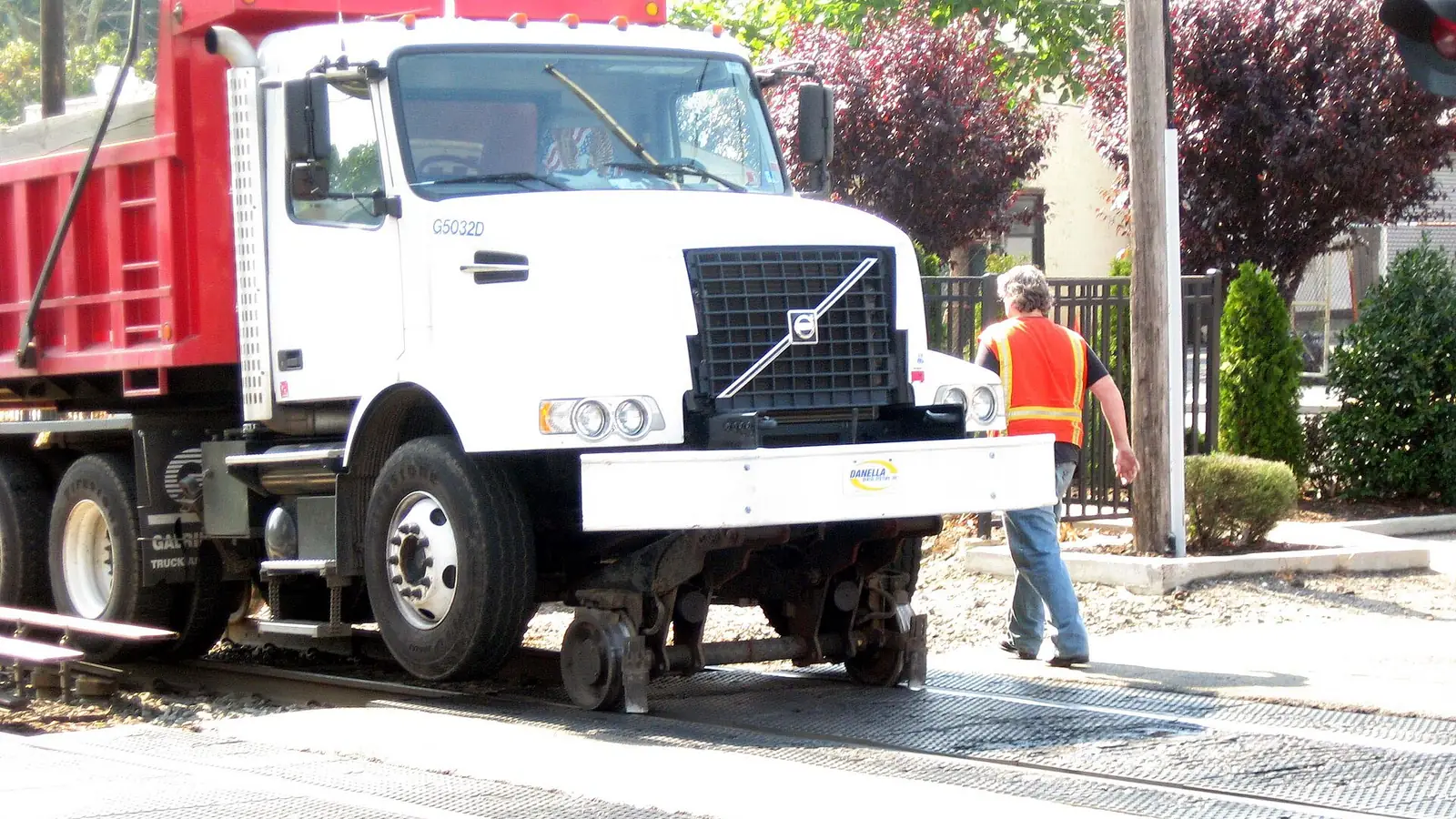
A hi-rail vehicle is a road vehicle, built to Federal Motor Vehicle Safety Standards, that carries retractable flanged steel wheels so it can drive on the highway or on railroad track. That is the definition in 49 CFR 214.7, and 49 CFR 214.523 requires its rail gear to be inspected at least annually, with no more than 14 months between inspections.
Whether it is called a hi-rail, hy-rail, high-rail or high railer, it is a platform, not an inspection method. A pickup with rail gear carries a track inspector; a chassis-cab truck can carry an ultrasonic rail flaw system; an excavator digs. This guide explains what the vehicle is, how the gear works, how it gets on and off the track, why it usually can't be seen by a track circuit, and which FRA rules follow it onto the rail.
It does not cover the inspector's job, the owner's checklist for hiring a hi-rail test, or the choice between a truck and a cart. Those have their own pages: hi-rail track inspector, hi-rail rail flaw testing for owners and hi-rail truck vs inspection cart.
Contents: Definition · Names · How the gear works · Vehicle types · Setting on and off · Track circuits · 214.523 · On-track safety · Speed · Worked example · UT units · Limits · FAQ
What is a hi-rail vehicle under 49 CFR 214.7?
Under FRA's roadway worker rules, a hi-rail vehicle is one kind of roadway maintenance machine: a highway-legal vehicle with retractable rail wheels. The definition in 49 CFR 214.7 reads:
"Hi-rail vehicle means a roadway maintenance machine that is manufactured to meet Federal Motor Vehicle Safety Standards and is equipped with retractable flanged wheels so that the vehicle may travel over the highway or on railroad tracks." — 49 CFR 214.7, read on Cornell LII, November 2026
Three parts of that sentence do work:
| Phrase | What it means in practice |
|---|---|
| "roadway maintenance machine" | A device "powered by any means of energy other than hand power" used on or near track for maintenance, repair, construction or inspection (214.7). A hand-pushed test cart is not one; a hi-rail truck is |
| "manufactured to meet Federal Motor Vehicle Safety Standards" | The base vehicle is a road vehicle certified to the standards in 49 CFR Part 571. That is what separates a hi-rail from an "on-track roadway maintenance machine", which 214.7 defines as "self-propelled, rail-mounted, non-highway", over 7,500 lb light weight and "whose purpose is not for the inspection of railroad track" |
| "retractable flanged wheels" | The rail gear lifts clear for the road and lowers onto the rail for track travel. A vehicle whose road wheels are swapped for rail wheels isn't retractable, and a rail-bound inspection car has no road capability at all |
The rule also defines a new hi-rail vehicle as one "ordered after December 26, 2003 or completed after September 27, 2004". That date decides whether the alarm and beacon requirements in 214.523(c) apply, covered below.
Part 214 reaches hi-rails only where it applies at all. Under 214.3 the part "applies to railroads that operate rolling equipment on track that is part of the general railroad system of transportation". Rapid transit that isn't connected to that system falls under FTA's 49 CFR Part 671 and the state safety oversight agency, so a hi-rail on an isolated light rail line works to the agency's program instead.
Key takeaway: a hi-rail vehicle is defined by what it is built on (a road vehicle) and what it carries (retractable flanged wheels), not by what it does on the track.
Where do the names hi-rail, hy-rail and high-rail come from?
They all describe the same thing: a highway vehicle that runs on rail. "Hi-rail" and "high-rail" are generic contractions of "highway-rail". "HY-RAIL" is a registered trademark: a 2004 operator's manual for a front guide wheel unit states that "HY-RAIL® is a registered trademark of Harsco Track Technologies, Harsco Corporation" (Harsco HR3000 Series C1 manual, Bulletin 1427, September 2004).
FRA uses "hi-rail vehicle" in Part 214, so that is the term for a specification or an RFP; "hy-rail" reads as a brand name and "high railer" is slang.
How does hi-rail gear work?
Rail gear is a pair of hydraulically raised and lowered guide wheel units, one at each end of the vehicle, that lift the road tires at one or both ends clear of the rail and keep the vehicle on gauge. The details vary by maker and by vehicle weight. One manufacturer's manual for a front guide wheel unit on cab-chassis trucks describes the arrangement plainly (Harsco Bulletin 1427, 2004; a vendor document):
- The front unit extends under the front suspension in the rail position and lifts the front of the vehicle, "raising the front tires above the rails" so they don't touch the rail "while the vehicle is propelling through crossings, switches, etc."
- "The guide wheel unit utilizes the vehicle's suspension to support the vehicle front load when on track."
- "A steering lock is used during on track operation" to hold the front tires straight.
- "The vehicle's rear inner dual wheels are used for propulsion on the track."
- On-track braking "is provided by the vehicle's rear brakes, the front guide wheel unit's brakes and the rear guide wheel unit's brakes, if so equipped."
- In the rail position the wheel arms sit "15° – 20° over center" against welded stop blocks, so a loss of hydraulic pressure can't fold the gear up under load.
That is the common light- and medium-truck pattern: the rail wheels guide, the tires drive and brake. Some heavier designs power the rail wheels themselves. A 2007 US patent for a "hydrostatic hi-rail system" describes lift assemblies with "hydraulic motors, couplers and fail-safe brakes" on the rail wheels, powered from the vehicle's hydraulic pump (US 7,201,106 B2, granted April 10, 2007, now expired).
The same manual gives numbers that explain why rail gear is matched to the vehicle:
| Item (one maker's front guide wheel unit, 2004 manual) | Value |
|---|---|
| Maximum load on the front guide wheel unit | 13,000 lb (5,896 kg), or 6,500 lb (2,948 kg) per guide wheel |
| Left-to-right balance of guide wheel load | Within ±100 lb (45 kg) |
| Minimum front tire clearance above the rail, on track | 1-1/2 in. (38 mm); if it can't be reached, "some of the load must be removed from the vehicle" |
| Rear wheel spacing | Larger-diameter wheels or spacers set the rear tires to track gauge, and the speedometer "must be re-calibrated" afterward |
Those are one product's limits, but every maker publishes weight limits for its gear, and a crane, a water tank for an ultrasonic system or a full crew cab changes the guide wheel load and the tire clearance.
Key takeaway: on most hi-rail trucks the rail wheels only steer; traction and braking come from the road tires, so wet rail, grease and leaves affect stopping distance.
Which vehicles are fitted with hi-rail gear?
Anything from a half-ton pickup to an excavator, as long as the base vehicle is a road vehicle and the gear is rated for its weight. Manufacturers' product literature, as reported in trade press (Progressive Railroading hi-rail equipment updates, March 2019 and December 2021), covers these classes:
| Vehicle class | Typical use on the railroad | Rail-gear note |
|---|---|---|
| Pickup or SUV (half-ton to one-ton) | Track inspection under 213.233, signal maintenance, supervision | Gear is offered for standard half-ton to one-ton pickups and full-size SUVs; one maker reports its SUV installation was tested to the FMVSS 126 stability control standard |
| Chassis-cab truck with body | Section truck with crane and tools; welding truck; rail flaw detection truck with a probe carriage, water tank and operator station | Heavier gear with higher guide wheel ratings; under-cab mounting on some medium-duty chassis |
| Material-handling truck | Moving rail, ties and OTM, often towing rail or tie carts | Carts have their own "insulated flanged guide wheels" and air brakes |
| Hi-rail excavator or backhoe | Ditching, tie work, undercutting, brush cutting | Hydraulically powered hi-rail function; some carry train air brake connections for moving cars |
| Specialist inspection truck | Vendor-operated geometry, joint bar and rail inspection trucks | The sensors are separate systems with their own calibration and rules |
The rail flaw detection truck is the class that matters for internal rail testing. The truck is a hi-rail vehicle under 214.7, and the ultrasonic system fitted to it is a separate piece of equipment with its own 213.238 qualified operator, its own calibration and its own 213.241 record. How that system searches the rail is covered in how ultrasonic testing for railways works.
A hand-pushed test cart is not in this table: it is hand-powered, so it isn't a roadway maintenance machine at all. See the ultrasonic rail detection cart page.
How does a hi-rail vehicle set on and off the track?
At a grade crossing or a hi-rail pad, under the railroad's operating rules, and only after the crew has track authority. Part 214 doesn't prescribe the set-on procedure. FRA said so in its 2016 safety advisory on maintenance machines at crossings: Part 214 Subpart C "does not mention, nor is it generally intended to address, movement of roadway maintenance machines in travel mode over highway-rail grade crossings under the authority of a train dispatcher" (FRA Safety Advisory 2016-01, 81 FR 14516, March 17, 2016). The railroad's rules and the gear maker's instructions fill the gap.
The 2004 Harsco manual gives the maker's version of the move for a truck with a front unit:
- "Ensure that highway vehicles are not approaching the grade crossing while placing the vehicle on track. Flag the crossing per railroad rules and regulations."
- Drive about 25 ft past the track, then back onto the rails so the rear wheels (the inner duals on a dual-wheel truck) are centered on the rails; "it may be necessary to move the vehicle back and forth several times."
- Park, apply the parking brake, engage the hydraulic power source, and lower and lock the guide wheel unit.
Setting off reverses the sequence at the next usable crossing. Three points follow from that procedure:
- The crossing is a road hazard while the truck is on it. FRA's review for the 2016 advisory found 187 accidents between maintenance-of-way equipment and motor vehicles at crossings from January 2010 to November 2015, with 2 motorist deaths, 62 motor vehicle occupants injured and 6 railroad employees injured. Most happened while equipment was travelling over a crossing, not while a gang was working at one.
- Flagging equipment may be required on board. Under 214.521, a hi-rail vehicle carries a flagging kit that complies with the railroad's rules when it runs where those rules require flagging and it isn't inside a work group, or it leads or trails one.
The advisory also states the right-of-way rule most railroads apply: "roadway maintenance machines do not have the right-of-way over vehicular traffic", and the practice is to "approach every highway-rail grade crossing prepared to stop and not proceed until it is seen that the grade crossing is clear."
Key takeaway: a hi-rail sets on where the geometry allows and the railroad's rules permit, never on the strength of the gear alone.
Why don't most hi-rail vehicles shunt track circuits?
Because a light vehicle with insulated or lightly loaded rail wheels doesn't reliably close the circuit between the two rails, and in most cases it isn't designed to. A train shunts a track circuit through its axles, which drops the track relay and sets signals to stop and crossing gates down. FRA's 2016 advisory describes the problem for maintenance machines in general:
"Unlike trains, roadway maintenance machines do not always shunt or maintain shunt in track circuits to trigger activation of grade crossing warning device systems and, in most cases, roadway maintenance machines are not designed or built to shunt the track circuit." — FRA Safety Advisory 2016-01, 81 FR 14516
The advisory came out of a January 9, 2015 collision at Gilroy, California, where a spiker in a 62-machine rail gang reached a crossing after the gates had already lifted behind the machine ahead of it, and a motorist was killed.
Why the design is this way:
- Rail gear is usually insulated on purpose. Guide wheels and carts are sold with "insulated flanged guide wheels" (trade press, 2019 and 2021). An uninsulated truck would show up as a train in signalled territory, dropping signals and starting crossing gates on every move. A general reference on road-rail vehicles makes the same point: they "are generally designed to be insulated and so do not activate railway signalling circuits" (Wikipedia, road–rail vehicle).
- Light wheel loads shunt poorly. Under 49 CFR 236.56, a track circuit must respond to a 0.06 ohm shunt across the rails, but rust, contamination and a few thousand pounds of wheel load are a different thing from a loaded freight car. Even trains lose shunt on rusty rail.
- Switchable shunts are not fail-safe. FRA notes that some railroads fit hi-rails with shunting devices "that can be switched on or off to activate grade crossing warning devices", and "strongly recommends" that operators be told "such shunts are not fail-safe and may lose shunt without warning." Such a device is "only a supplement" to the railroad's crossing rules.
For a test crew the consequences are practical. Crossing gates may not come down for the truck, so someone protects the road, and signals don't protect the truck, so the move depends on the working limits described next.
Key takeaway: treat every hi-rail as invisible to the signal system unless the railroad's rules say otherwise for that vehicle.
What does 49 CFR 214.523 require of a hi-rail vehicle?
An annual rail-gear inspection no more than 14 months apart, a record of it, a start-of-shift operator check, and on newer vehicles a backup alarm and a 360-degree beacon. 49 CFR 214.523 is the one section of Part 214 Subpart D written for hi-rail vehicles alone:
| 214.523 paragraph | Requirement |
|---|---|
| (a) | Hi-rail gear "inspected for safety at least annually and with no more than 14 months between inspections. Tram, wheel wear, and gage shall be measured and, if necessary, adjusted" |
| (b) | The employer keeps the inspection record (paper or electronic) "until the next required inspection is performed", on the vehicle or at a designated location, available to FRA and participating states |
| (c) | A new hi-rail vehicle (ordered after December 26, 2003 or completed after September 27, 2004) has an automatic change-of-direction or backup alarm "at least three seconds long and distinguishable from the surrounding noise", and "an operable 360-degree intermittent warning light or beacon mounted on the outside of the vehicle" |
| (d)(1) | The operator checks the vehicle for compliance with Subpart D "prior to using the vehicle at the start of the operator's work shift" |
| (d)(2) | A non-complying condition that can't be fixed at once is tagged, dated and reported to the employer's designated official |
| (d)(3) | Non-complying alarms, backup alarms and beacons are "repaired or replaced as soon as practicable within seven calendar days" |
Five other Subpart D sections name hi-rail vehicles alongside on-track machines:
| Section | What it adds for a hi-rail vehicle |
|---|---|
| 214.501 | Subpart D sets "minimum safety standards for on-track roadway maintenance machines and hi-rail vehicles"; the employer may set stricter ones; conditions it doesn't cover, such as noise, fall to OSHA |
| 214.503 | The operator may refuse to run a vehicle he or she believes in good faith doesn't comply or is unsafe, and the employer needs written procedures to resolve the challenge, naming its designated official's title and location |
| 214.521 | The flagging kit rule described above |
| 214.525 | Towing pushcars or other equipment needs "a towing bar or other coupling device", and the tow must stay within the vehicle's braking capability, considering grade |
| 214.531 and 214.533 | A non-complying vehicle is brought into compliance "as soon as practicable within seven calendar days" or placed out of on-track service. If a part is needed, it is ordered by the end of the next business day, the repair is made within seven days of receiving it, and the vehicle comes out of on-track service if it isn't repaired within 30 days of the report. Repair records are kept at least one year (214.533(d), as amended August 31, 2026) |
Most of the rest of Subpart D does not reach a hi-rail truck. Sections 214.505 to 214.519 and 214.527 to 214.529 name only "on-track roadway maintenance machines", which 214.7 defines as non-highway machines. So the cab, lighting, horn and brake rules written for tampers and regulators don't apply to it, and its start-of-shift check is 214.523(d), not 214.527.
Key takeaway: the hi-rail gear record is a dated one-line document that either exists or doesn't; ask for it before mobilization.
What on-track safety rules apply to a hi-rail move?
Once the gear is down, the truck is on-track equipment and everyone in it is a roadway worker fouling the track, so Part 214 Subpart C applies in full. 214.7 defines a roadway worker as any employee of a railroad "or of a contractor to a railroad" whose duties include inspection or maintenance of track "on or near track or with the potential of fouling a track", and fouling as being close enough to be struck "or in any case is within four feet of the field side of the near running rail".
The rules that shape a hi-rail move:
| Rule | Effect on a hi-rail crew |
|---|---|
| 214.321 exclusive track occupancy | The dispatcher or control operator withholds train authority on a defined segment; oral authority is written and repeated; limits are set by a flagman, a Stop signal, a station, a milepost sign or another identifiable point. Inside the limits, trains and machines move only as the roadway worker in charge directs, at restricted speed unless authorized otherwise (214.321(d)) |
| 214.323(d) foul time | The roadway worker in charge "shall not permit the movement of trains or other on-track equipment into or within working limits protected by foul time". A moving hi-rail test therefore normally runs under exclusive track occupancy, not foul time |
| 214.7 restricted speed | "A speed that will permit a train or other equipment to stop within one-half the range of vision", "but not exceeding 20 miles per hour", unless the railroad's rules restrict it further |
| 214.341 and 214.355 | No roadway worker operates a roadway maintenance machine without training under 214.355 and knowledge of that machine's safety instructions; the employer's on-track safety program sets "maximum working and travel speeds for machines dependent upon weather, visibility, and stopping capabilities"; qualification is "evidenced by demonstrated proficiency" |
| 214.336(e)(3)(i) | The adjacent-controlled-track procedures of 214.336(a) to (c) don't apply to a group working with "a hi-rail vehicle or other rail-bound vehicle … being used for inspection or minor correction purposes, provided that such vehicle is not coupled to one or more railroad cars". The job briefing decides when groups mix |
| 214.337(g) | Individual train detection, the lone-worker method, can't be used with "a roadway maintenance machine, equipment, or material that cannot be readily removed by hand". A hi-rail crew is never a lone worker with that method |
The operator's training requirement is easy to miss. A driver's licence covers the road only; the person at the wheel on the rail needs 214.355 training from the employer, knowledge of the gear's safety instructions and the host railroad's on-track safety qualification. A contractor's operator also falls under the employer's training program required by 49 CFR Part 243.
Key takeaway: the gear gets the truck onto the rail; the authority keeps it alive there. Never confuse the two.
How fast can a hi-rail vehicle travel on track?
Part 214 sets no hi-rail travel speed of its own; the limits come from restricted speed inside working limits, from the employer's program and from the railroad's rules, and the gear maker's rating is a ceiling, not a target. Three different numbers get mixed up:
| Number | What it actually is | Source |
|---|---|---|
| 20 mph | The ceiling on restricted speed, which applies to moves inside working limits unless the roadway worker in charge authorizes more | 214.7, 214.321(d) |
| 5 mph | The maximum for a vehicle used for visual track inspection "when traversing track crossings and turnouts"; elsewhere the inspection speed is "at the sole discretion of the inspector" | 213.233(b) |
| 30 to 45 mph | Manufacturers' ratings for rail travel with particular gear or drive systems (one friction-drive option for a medium-duty truck is rated to 45 mph on rail, trade press 2021) | Vendor literature |
None of these is the working speed of a hi-rail ultrasonic test. Test vehicles are "capable of speeds up to 30 mph in a non-stop testing mode. However, in practice the vehicle stops frequently to hand verify indications", and so "typically average 6 to 8 mph" (Jeffrey and Peterson, MPC 99-106, 1999). The day's average is set by how many suspects need verifying, as the continuous vs stop-and-verify comparison explains.
Two physical limits sit under any rating. Braking on most trucks comes through the tires on the railhead, so stopping distance grows on wet or greasy rail, and guide wheels on a narrow tread take switch points, frogs and crossing surfaces slowly whatever the rating says.
Worked example: is this truck ready for a five-day job?
A track owner has a hi-rail rail flaw test booked for Monday, November 16 to Friday, November 20, 2026. Three contractor trucks are offered. Each is a "new" hi-rail vehicle under 214.7 (all ordered after 2003), so 214.523(c) applies.
| Truck | Last 214.523(a) gear inspection | 14-month limit (last inspection plus 14 months) | Status for the job |
|---|---|---|---|
| A | December 10, 2025 | February 10, 2027 | Inside the limit for all five days. Ready, subject to the daily 214.523(d)(1) check |
| B | September 3, 2025 | November 3, 2026 | The limit passed 13 days before the job starts. The gear must be inspected, with tram, wheel wear and gage measured, before the truck sets on |
| C | January 15, 2026 | March 15, 2027 | Inside the limit, but see the beacon problem below |
Truck C's 360-degree beacon failed on Monday, November 9, 2026. The operator tagged and dated it and reported it to the designated official that day, as 214.523(d)(2) requires. The clocks that start from that report:
| Rule | Deadline from November 9, 2026 | What happens |
|---|---|---|
| 214.523(d)(3): alarms and beacons "repaired or replaced as soon as practicable within seven calendar days" | November 16, 2026 | Repaired by the first day of the job: the truck is compliant on day one |
| 214.533(a): if a part is needed, order it "by the end of the next business day" | Tuesday, November 10, 2026 | A missed order date puts the truck out of on-track service under 214.533(c) |
| 214.533(b): repair within seven days of receiving the part; the vehicle may keep working meanwhile, subject to the operator's 214.503 right to refuse it | Seven days after the part arrives | If the part arrives Friday, November 13, the beacon is due by November 20 |
| 214.533(b) hard stop: not repaired within 30 days of the report | December 9, 2026 | Out of on-track service until repaired |
So Truck A is the clean choice, Truck B needs a gear inspection first, and Truck C can work the week only if the beacon is fixed by November 16 or a part is on order with the paperwork to show it. Two documents settle all of it: the dated gear inspection record (214.523(b)) and the repair record (214.533(d)), both of which may be kept on the vehicle.
Where does a hi-rail ultrasonic test unit fit?
A hi-rail ultrasonic test unit is a chassis-cab hi-rail vehicle carrying a probe carriage, a water or couplant supply, a flaw detector and an operator's station. The vehicle is the 214.7 hi-rail; the search is the system's. The probe carriage, usually wheel or sled probes at 0°, around 37 to 45° and 70°, rides the railhead behind or under the truck, and the operator watches the channel display from the cab. When a suspect shows, the truck stops and sets back, and a technician verifies the location by hand with a portable instrument. The rail UT process guide covers the probe set, coverage and what makes a search valid under 213.237.
Because the truck sets on and off at crossings, hi-rail testing suits segments with road access at useful intervals; yards, short possessions and special trackwork go to a cart or hand testing, as hi-rail truck vs inspection cart explains.
An owner hiring a hi-rail test is really checking three things with three sets of rules: the vehicle (214.523), the crew's protection (214.319 to 214.323) and the test itself (213.237, 213.238 and 213.241). The checklist for all three is in hi-rail rail flaw testing: what a track owner must arrange.
What a hi-rail vehicle is not
A hi-rail vehicle solves access. It doesn't solve anything else, and several things are routinely expected of it that it can't deliver.
- It isn't an inspection method. A hi-rail with nobody qualified in it inspects nothing. Visual inspection is a 213.7 designated person working to 213.233; internal rail testing is a 213.238 operator working to 213.237; geometry is a system working to 213.333 or the owner's program. The truck carries them.
- It isn't seen by the signal system. Crossing gates and signals can't be relied on to respond to it, as the FRA advisory above makes clear.
- It measures unloaded track. A truck weighing a few tons doesn't load the track the way a 286,000 lb car does, so gage readings from it are light-vehicle readings; loaded gage is a separate measurement under 213.110.
- Its gear has a weight budget. A body, crane, tank or crew that pushes the axle weight past the gear's rating is a safety problem, not a paperwork one.
- Part 214 doesn't follow it everywhere. On rapid transit not connected to the general system, the FTA and state oversight rules apply instead, and the agency's own program sets the on-track safety method.
How EMA Industries applies this
EMA Industries lists hyrail ultrasonic rail flaw detection, manual rail scanning and weld examination among its capabilities, with a technical program supported by an ASNT NDT Level III. For a hi-rail ultrasonic rail test, ask for the three sets of documents this article separates: the vehicle's 214.523 gear inspection and repair records, the crew's on-track safety qualifications for your railroad, and the 213.238 operator qualifications and 213.241 report format for the test itself. EMA Industries supports work in Southern California and mobilizes for projects throughout the United States; contact us with the segment, its track class and the usable crossings, and the plan starts from there.
Frequently asked questions
Is a hi-rail vehicle the same as a track inspection vehicle?
A track inspection vehicle can be a hi-rail, a rail-bound geometry car or a hand-pushed cart, so the phrase describes a use, not a type. A hi-rail vehicle is a specific thing under 49 CFR 214.7: a road vehicle built to Federal Motor Vehicle Safety Standards with retractable flanged wheels.
What qualification does a hi-rail operator need?
On an FRA railroad the operator needs training under 214.355 and knowledge of the vehicle's safety instructions before operating it on track (214.341(b)), plus the railroad's own on-track safety qualification. A driver's licence covers the highway part only, and there is no FRA "hi-rail licence".
How often must hi-rail gear be inspected?
At least annually, with no more than 14 months between inspections, under 214.523(a). Tram, wheel wear and gage are measured and adjusted, and the record is kept until the next inspection. On top of that, the operator checks the vehicle for compliance at the start of every shift (214.523(d)(1)).
Why don't the crossing gates come down for a hi-rail truck?
Because most hi-rails are insulated or too light to shunt the track circuit reliably, and FRA's 2016 advisory says that "in most cases, roadway maintenance machines are not designed or built to shunt the track circuit". Some railroads fit switchable shunting devices, but FRA warns they "are not fail-safe and may lose shunt without warning". The crew protects the crossing under the railroad's rules.
Can a hi-rail truck be driven on any railroad track?
Only with the track owner's permission and, on an FRA railroad, under on-track safety established through Part 214 working limits. The railroad's rules decide where it sets on and off and how fast it moves. On an isolated transit system, the agency's safety program applies instead of Part 214.
Sources
- 49 CFR 214.3, 214.7 (definitions: hi-rail vehicle, roadway maintenance machine, on-track roadway maintenance machine, roadway worker, fouling a track, restricted speed): eCFR Part 214 Subpart A; text read on Cornell LII 214.7, November 2026
- 49 CFR 214.321, 214.323, 214.336, 214.337, 214.341, 214.355 (Subpart C): eCFR Part 214 Subpart C; text read on Cornell LII 214.341 and 214.336
- 49 CFR 214.501, 214.503, 214.521, 214.523, 214.525, 214.527, 214.531, 214.533 (Subpart D): eCFR Part 214 Subpart D; text read on Cornell LII 214.523 and 214.533 (as amended at 91 FR 55752, August 31, 2026)
- 49 CFR 213.233(b) vehicle inspection speed, 213.110 gage restraint: eCFR Part 213; text read on Cornell LII 213.233
- 49 CFR 236.56 shunting sensitivity: eCFR 236.56
- 49 CFR Part 571, Federal Motor Vehicle Safety Standards: eCFR Part 571
- 49 CFR Part 671, FTA rail transit roadway worker protection: eCFR Part 671
- FRA Safety Advisory 2016-01, Movement of Roadway Maintenance Machines Over Highway-Rail Grade Crossings, 81 FR 14516, March 17, 2016: govinfo
- Harsco Track Technologies, HR3000 Series C1 Front Universal HY-RAIL Guide Wheel Unit, Operator's Service and Parts Manual, Bulletin 1427, September 2004 (vendor document): harscorail.com
- US Patent 7,201,106 B2, Hydrostatic hi-rail system, granted April 10, 2007: Google Patents
- Progressive Railroading, Hi-rail equipment update 2019 (March 2019) and Technology update: Hi-rail equipment (December 2021), trade press summaries of manufacturers' literature: 2019, 2021
- Jeffrey and Peterson, Assessment of Rail Flaw Inspection Data, Mountain-Plains Consortium MPC 99-106, August 1999: ugpti.org
- Wikipedia, Road–rail vehicle (general reference on insulation and propulsion): en.wikipedia.org