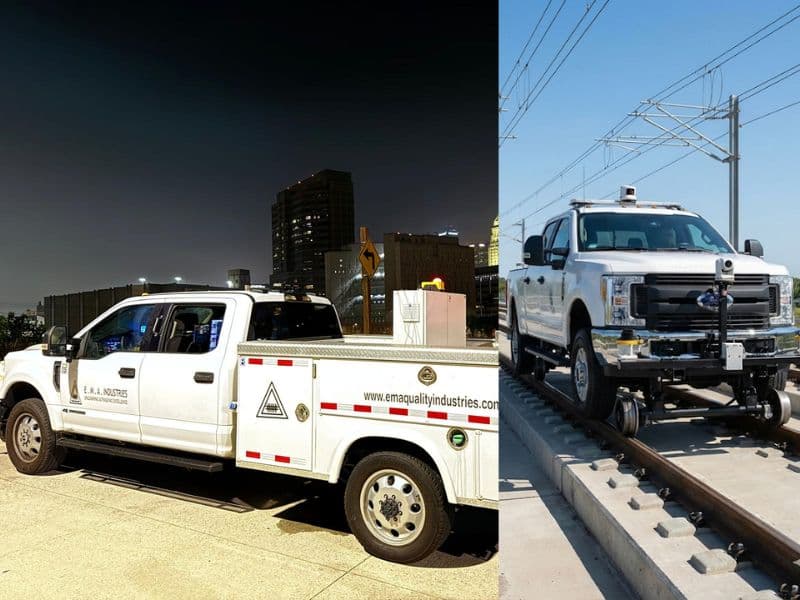
A hi-rail track inspector is a track inspector who inspects track from a highway-rail truck instead of on foot. Under 49 CFR 213.233(b), a vehicle inspection may run no faster than 5 mph over track crossings and turnouts. Ultrasonic rail flaw, geometry and imaging systems are separate equipment that some hi-rail trucks carry.
That distinction is the point of this article. A hi-rail truck is a platform. What it finds depends on who is in it and what is fitted to it: a qualified visual inspector working to 213.233, an ultrasonic rail flaw system working to 49 CFR 213.237 (see EMA's 213.237 rail flaw testing guide), a geometry system, or some combination. Each has its own rule, its own speed and its own blind spots.
This guide covers what the visual rule allows, how hi-rail ultrasonic testing differs from a dedicated test car and a push cart, the Part 214 on-track safety rules that apply to every hi-rail move, why hi-rails may not shunt track circuits, and a worked test-day plan for a short line.
What does a hi-rail track inspector do under 49 CFR 213.233?
A hi-rail track inspector performs the visual track inspection that Part 213 requires, from a vehicle instead of on foot. Section 213.233(b) allows either method and sets the conditions for the vehicle:
"Each inspection shall be made on foot or by traversing the track in a vehicle at a speed that allows the person making the inspection to visually inspect the track structure for compliance with this part. … If a vehicle is used for visual inspection, the speed of the vehicle may not be more than 5 m.p.h. when traversing track crossings and turnouts; otherwise, the inspection vehicle speed shall be at the sole discretion of the inspector, based on track conditions and inspection requirements." — 49 CFR 213.233(b), as amended at 85 FR 63389 (Oct. 7, 2020)
Note the wording: the 5 mph limit applies to track crossings and turnouts. Part 213 doesn't define "track crossing", but in context it reads as rail-to-rail crossings (diamonds), not highway grade crossings. Outside those locations the speed is the inspector's call, and the test is whether the inspector can actually see the track structure at that speed.
The same paragraph limits how much track one vehicle can cover:
| 213.233(b) condition | Requirement |
|---|---|
| One inspector in a vehicle | Up to 2 tracks at once, visibility unobstructed, second track centered no more than 30 ft away |
| Two inspectors in a vehicle | Up to 4 tracks at once, each centered within 39 ft of the track traversed |
| Main track | Traversed by the vehicle or inspected on foot at least once every 2 weeks |
| Sidings | Traversed by the vehicle or inspected on foot at least monthly |
| Records | Must show which tracks were traversed and which were inspected on foot |
The frequency comes from 213.233(c): weekly on excepted and Class 1–3 main track and sidings (twice weekly if passenger trains run or the track carried more than 10 MGT the previous year), and twice weekly on Class 4–5 track. Switches, turnouts and track crossings also need a monthly inspection on foot under 213.235, so a hi-rail can't cover them alone.
Section 213.233(b) also says "mechanical, electrical, and other track inspection devices may be used to supplement visual inspection." Supplement is the word that matters. A camera or sensor on the truck does not replace the inspector's visual inspection.
Key takeaway: the visual inspection is done by a qualified person, not by the truck, and it finds surface conditions only.
What is a hi-rail vehicle under FRA rules?
FRA defines a hi-rail vehicle as a roadway maintenance machine built to highway vehicle standards with retractable flanged wheels. The 49 CFR 214.7 definition reads: a roadway maintenance machine "that is manufactured to meet Federal Motor Vehicle Safety Standards and is equipped with retractable flanged wheels so that the vehicle may travel over the highway or on railroad tracks."
Part 214 sets equipment rules for the hi-rail itself in 214.523:
| 214.523 requirement | Detail |
|---|---|
| Hi-rail gear inspection | At least annually, no more than 14 months apart; tram, wheel wear and gage measured and adjusted |
| Records | Kept until the next required inspection, on the vehicle or at a designated location |
| New hi-rail vehicles | Automatic change-of-direction or backup alarm (at least 3 seconds, distinguishable from surrounding noise) and an operable 360° intermittent warning light or beacon |
| Daily check | The operator checks the vehicle before use at the start of each shift; defects that can't be fixed are tagged and reported |
| Repair window | Non-complying alarms and beacons repaired or replaced as soon as practicable within 7 calendar days |
"New" means ordered after December 26, 2003 or completed after September 27, 2004 (214.7). The original version of this article said hi-rail safety inspections are "often required annually (or per regulatory interval)". The actual rule is the annual, 14-month-maximum gear inspection plus a daily operator check.
How does hi-rail ultrasonic rail testing work?
Hi-rail ultrasonic testing mounts rolling search units under a hi-rail truck and sends angled and straight sound beams into each rail as the truck moves. It is an internal rail inspection under 213.237, carried out by an operator qualified under 213.238. It is a different job from the visual inspection in 213.233, even when both are done from the same type of truck.
What probe set does a hi-rail UT system use?
The probe set is similar to any rail test vehicle. Typical channels are:
| Beam | What it is aimed at |
|---|---|
| 70° shear, forward and backward | Transverse defects in the head: transverse fissures and detail fractures |
| 0° straight beam | Horizontal split heads, compound fissures, and loss of back-wall signal |
| About 37–45° | Web and bolt-hole cracks |
| Side-looking or gage-corner probes | Vertical split heads and gage-corner defects |
Most systems couple through fluid-filled wheels or sleds with a water or glycol spray. One patent describes wheel-probe transducers "typically centered at 2.25 Mhz" (US 5,777,891). Exact angles, frequencies and channel counts vary by system, so treat this table as typical practice, not a specification. The physics is covered in more depth in how ultrasonic rail flaw detection works.
How fast does hi-rail UT test?
Rated maximum speeds and real average speeds are very different numbers. Equipment makers rate some current hi-rail systems at up to 45 mph under good rail conditions (Plasser American, vendor figure). A 2025 conference paper describes hi-rail rolling search units running "at speeds up to ~30 mph" (Hosseinzadeh et al., SHM 2025).
The average achieved in practice is much lower when the test stops to verify. A 1999 Mountain-Plains Consortium report said test cars were "capable of speeds up to 30 mph in a non-stop testing mode" but, with stopping and hand verification, "typically average 6 to 8 mph in practice" (MPC 99-106). That figure is old and refers to test cars generally, but the principle hasn't changed: every suspect means a stop, a back-up and a hand probe.
On short lines and industrial track with many joints, welds, crossings and turnouts, plan on an average speed well below the rated speed. The worked example below uses 4 mph as a planning assumption.
Stop-and-verify or continuous testing?
Stop-and-verify testing confirms each indication on the spot; continuous testing runs without stopping and verifies suspects later. The difference is regulatory, not just operational:
| Stop-and-verify | Continuous testing (213.240) | |
|---|---|---|
| When indications are checked | At the time of the test, with a hand probe | Afterwards, by field verification |
| Verification deadline | Under 213.113(b), within 4 hours, or immediately for defects needing remedial action A, A2 or B | Within 84 hours, or 36 hours for suspected A, A2 or B defects |
| Unverified suspects | Not applicable | Get the most restrictive remedial action until verified |
| Paperwork | Normal 213.241 records | Test type designated and recorded before testing, plus the 213.240(g) annual report |
| Best fit | Short lines, transit, industrial track, lower mileage | High-mileage networks with data review staff |
Under 213.240(c), "the track owner must designate and record the type of rail test (continuous or stop-and-verify) to be conducted prior to commencing the test over a track segment." Continuous testing is an option the owner elects; the default is stop-and-verify.
Key takeaway: for most short lines, hi-rail UT means stop-and-verify, and the honest planning number is the average speed, not the rated one.
Hi-rail UT vs a test car vs a push cart: which fits the job?
The right platform depends on mileage, track access and how much special trackwork the territory has. All four methods below are common, and many programs use two of them together.
| Method | Rule it serves | What it finds | Speed (hedged) | Access needed | Best fit | Main limits |
|---|---|---|---|---|---|---|
| Visual hi-rail inspection | 213.233 | Surface conditions: gage, fastenings, ties, drainage, visible rail damage | ≤5 mph over track crossings and turnouts; otherwise inspector's discretion | Track authority for the move | Routine 213.233 inspections over longer territory | Finds nothing inside the rail; switches still need a monthly foot inspection (213.235) |
| Hi-rail UT | 213.237 internal testing | Internal head and web defects | Rated up to ~30–45 mph (vendor); average far lower with stop-and-verify | Exclusive track occupancy for the test window; road access to set on | Short lines, transit and secondary lines of tens of miles | Base coverage, special trackwork, worn or shelled rail |
| Dedicated rail-bound test car | 213.237, sometimes 213.240 continuous | Same UT physics; often more channels | Rated up to ~30 mph non-stop (MPC 99-106, 1999); stop-and-verify averages lower | Track time on the main line; no set-on point needed | Long, high-tonnage territory | Mobilization, scheduling and cost for small owners |
| Walking stick or push cart | 213.237 on short track; verification | Internal defects with full operator control of the probe | Walking pace | Working limits or other on-track safety for the crew on foot | Turnouts, crossings, yards, industrial spurs, bridges, verification | Low daily mileage |
A push cart is also the usual way to cover what a moving vehicle misses: frogs, switch points, welds that need a base scan, and short track that isn't worth a vehicle set-on. EMA's ultrasonic rail detection cart article covers that method, and hi-rail truck vs inspection cart compares the two in more detail.
What on-track safety rules apply to a hi-rail?
Every hi-rail crew is made up of roadway workers under 49 CFR Part 214, and no one may foul a track without on-track safety. Part 214 applies to railroads that operate on the general railroad system (214.3). Rail transit not connected to that system falls under FTA's 49 CFR Part 671 and the state safety oversight agency instead.
The original version of this article said hi-rail access reduces "the need for track closures". It doesn't remove the need for track authority. A hi-rail on the rail is on-track equipment, and the crew are fouling the track the moment they set on.
The core rules:
| Part 214 rule | What it means for a hi-rail crew |
|---|---|
| 214.7 "fouling a track" | Within 4 ft of the field side of the near running rail, or close enough to be struck. Setting on and off fouls the track |
| 214.319 working limits | Only one qualified roadway worker in charge (RWIC) controls the working limits on a segment |
| 214.321 exclusive track occupancy | The dispatcher or control operator issues authority to the RWIC; oral authority is written down and repeated back; limits are defined by a flagman, a Stop signal, a named station, a milepost sign or another identifiable location |
| 214.321(d) | Movements of trains and roadway maintenance machines inside the limits are made only under the RWIC's direction, at restricted speed unless the RWIC authorizes more |
| 214.323 foul time | The RWIC "shall not permit the movement of trains or other on-track equipment into or within working limits protected by foul time" |
| 214.315 job briefing | Before fouling: the on-track safety method, limits and duties, acknowledged by each worker |
Because of 214.323(d), a moving test is normally run under exclusive track occupancy (a track warrant, track bulletin or similar authority under the railroad's operating rules), not foul time. Confirm the form of authority with the host railroad, since operating rules differ.
Setting on and off at grade crossings
Hi-rails usually set on and off at highway-rail grade crossings, because that is where road meets rail at the same level. Part 214 doesn't set a specific procedure for this. FRA has said that Part 214 Subpart C "does not mention, nor is it generally intended to address, movement of roadway maintenance machines in travel mode over highway-rail grade crossings" (FRA Safety Advisory 2016-01, 81 FR 14516). The railroad's operating rules govern it.
In practice that means:
- the authority is in effect before the truck fouls the track, and the truck sets off before the authority is released
- the truck doesn't block road traffic longer than needed, and someone watches traffic while the gear goes down
- on-track equipment approaches every crossing "prepared to stop" and yields to road vehicles, as the Union Pacific rule quoted in the advisory requires
FRA's review in that advisory found 187 accidents between maintenance-of-way equipment and motor vehicles at grade crossings from January 2010 to November 2015, with 2 motorist fatalities.
Do hi-rail vehicles shunt track circuits?
Not reliably, and in most cases they aren't designed to. FRA Safety Advisory 2016-01 states it directly:
"Unlike trains, roadway maintenance machines do not always shunt or maintain shunt in track circuits to trigger activation of grade crossing warning device systems and, in most cases, roadway maintenance machines are not designed or built to shunt the track circuit." — FRA Safety Advisory 2016-01, 81 FR 14516 (Mar. 17, 2016)
Two consequences follow for a hi-rail test:
- Crossing warnings may not activate, or may recover early. The crew can't count on gates and lights. FRA notes that some railroads fit switchable shunting devices to hi-rails, and "strongly recommends" that operators be told "such shunts are not fail-safe and may lose shunt without warning."
- Signal systems may not see the truck. A track circuit that doesn't detect the hi-rail can't protect it. That is one reason hi-rail moves rely on authority and working limits rather than on signal indications. How each railroad handles this is set in its own rules; ask the host railroad.
Shunting also depends on rail condition. An FRA safety bulletin on loss of shunt (Safety Bulletin 2025-05, December 2025, seen in summary only) lists low axle counts, contaminants such as leaves, and rail condition including rust among the causes, for trains as well as machines.
What about geometry, imaging and GPS systems?
Geometry, camera and laser systems are optional fitted equipment, and their accuracy is whatever that specific system is rated and calibrated to. The original article said hi-rail vehicles map rail profiles "with millimetre accuracy" and log "the exact position of each reading" by GPS. Neither holds as a general statement:
- Accuracy is system-specific. A laser profile or camera system's resolution is a vendor specification for that product, checked by its own calibration. A truck without one doesn't have the capability at all.
- Light vehicles measure unloaded geometry. Gage measured under a light truck can read tighter than gage under a loaded freight car. FRA treats loaded gage as a separate measurement under 213.110 (gage restraint measurement systems).
- GPS position depends on the receiver and correction service, and degrades in cuts, under structures and in tunnels. The location reference that counts for compliance is the milepost or other reference the owner records. For continuous testing, 213.240(f) requires suspect locations to be recorded "with repeatable accuracy" so a crew can find them again.
- Imaging supplements, it doesn't replace. Under 213.233(b), devices "supplement visual inspection".
If an RFP asks for geometry or imaging, ask for the specific system, its rated resolution, its calibration method and a sample report, not a general claim.
Worked example: a short-line hi-rail test day
Here is how one test day on a short line can be planned around a fixed track window. The figures are planning assumptions for illustration, not measured EMA performance.
The line: a 20.0-mile short line, MP 0.0 to MP 20.0, Class 2, jointed and welded rail, 8 public grade crossings and 6 turnouts. Class 1–2 track has no 213.237 interval, so the owner is testing to its own program or contract requirements. If part of the line were Class 3 with passenger trains or hazmat traffic, the 370-day / 30 MGT rule would apply (how often must rail be tested).
The window: exclusive track occupancy from 07:00 to 15:00, 8.0 hours (480 minutes), set on at the MP 0.0 grade crossing.
| Time block | Activity | Minutes |
|---|---|---|
| 07:00–07:30 | Job briefing, authority received, written and repeated back; set on at the grade crossing | 30 |
| 07:30–07:50 | Start-of-shift calibration on the reference rail | 20 |
| 07:50–14:20 | Testing: moving test plus hand testing at turnouts | 390 |
| 14:20–14:40 | End-of-shift calibration check | 20 |
| 14:40–15:00 | Set off, clear the track, release the authority | 20 |
| Total | 480 |
The testing block (390 minutes):
- Hand testing at turnouts (frogs and switch points aren't well covered by rolling search units): 6 turnouts × 15 minutes = 90 minutes
- Moving test time left: 390 − 90 = 300 minutes = 5.0 hours
- Planned average speed, including stop-and-verify stops and slowing at the 8 crossings: 4 mph
- Miles covered: 5.0 h × 4 mph = 20.0 miles
So the plan covers the whole line in one window, with no slack. If verification stops run long and the average falls to 3 mph, the same 5.0 hours covers only 15.0 miles, leaving MP 15.0 to MP 20.0 for a second window. Any rail not validly tested is recorded as untested under 213.241(c)(6) rather than counted.
Two lessons come out of the arithmetic. First, overhead (briefing, set-on, calibration, set-off) took 90 of 480 minutes, nearly 19% of the window. Second, the turnouts took as much time as 6 miles of moving test at 4 mph. Asking for a longer window, or splitting turnouts out to a separate push-cart crew, can matter more than the vehicle's rated speed.
What can't hi-rail inspection find?
A visual hi-rail inspection can't see inside the rail, and hi-rail UT has the same blind spots as any rolling-search-unit system.
- Internal defects, visually. A transverse fissure growing inside the head is invisible from the cab. That is what 213.237 testing is for.
- Defects under shelling and head checks. Surface damage blocks the beam, and it mainly masks detail fractures, which start there. In a 1998 benchmark of six hi-rail UT systems, the detection rate for transverse defects under shells was about 62% against 77% for those not under shells (TTCI TD-99-006, dated data).
- The rail base. Rolling search units cover the head and web well and most of the base poorly, which matters at thermite welds.
- Special trackwork. Cast manganese frogs are coarse-grained and attenuate ultrasound heavily; FRA research reports that in-service examination of these components is visual only (FRA RR 22-25). See railroad switch and crossing inspection.
- Rail hidden at crossings. In TSB report R19M0018, rail web corrosion under a crossing surface "had not been identified by the visual or ultrasonic track inspections". See grade crossing rail inspection.
- Worn rail. Fixed-angle probes on a worn head can inspect "the wrong volume of material" (TTCI TD-16-030).
- Every indication. Not every echo is a defect, and lost coupling is untested rail, not a clean result. See false calls in rail UT.
- Tunnels. GPS, lighting and clearances all get harder underground; tunnel rail inspection covers the extra on-track safety steps.
The same 1998 benchmark found 72% of 49 planted flaws overall. Systems have improved since, but no rule requires 100% detection, and no system achieves it.
How EMA Industries applies this
EMA Industries performs ultrasonic rail flaw testing for transit agencies, short lines and industrial track owners, working from Southern California and mobilizing nationwide. EMA plans the deployment method around the access the owner can provide, such as push-cart and hand-probe testing, turnout and weld coverage, and work inside the owner's RWP windows, rather than around a single vehicle type. For the scope and the rules behind it, see ultrasonic rail testing services and EMA's overview of the FRA track safety standards, or contact EMA Industries with your track miles, turnout count and available windows.
Frequently asked questions
Is a hi-rail track inspector the same as a rail flaw detector operator?
No. A hi-rail track inspector does the visual inspection required by 213.233 and is designated by the owner under 213.7. A rail flaw detector operator runs internal testing under 213.237 and must be qualified under 213.238, with at least 160 hours of supervised experience. One person can hold both roles, but they are separate qualifications for separate inspections.
How fast can a hi-rail inspect track?
For visual inspection, no faster than 5 mph over track crossings and turnouts, and otherwise at a speed that lets the inspector actually see the track (213.233(b)). For ultrasonic testing, vendors rate hi-rail systems at up to about 30–45 mph, but stop-and-verify testing averages much less; a 1999 report put test-car averages at 6 to 8 mph.
How often must the hi-rail vehicle itself be inspected?
The hi-rail gear must be inspected at least annually, with no more than 14 months between inspections, including tram, wheel wear and gage (214.523(a)). The operator also checks the vehicle at the start of each shift, and non-complying alarms or beacons on new hi-rails must be fixed within 7 calendar days.
Why does a hi-rail need track authority if it can get off the track quickly?
Because Part 214 protects people fouling the track, and setting on or riding the rail is fouling. A train may not be able to stop short of a truck on the rail, and a hi-rail may not show on track circuits. The crew needs working limits, normally exclusive track occupancy, from the dispatcher or control operator before the truck goes on the rail.
Can hi-rail UT replace a dedicated rail test car?
On short lines, transit and secondary track, often yes, because the physics and the 213.237 requirement are the same. On long, high-tonnage territory a rail-bound test car's daily mileage usually makes more sense. Either way, turnouts, frogs and weld bases usually need hand or cart testing as well.
Sources
- 49 CFR 213.233 Track inspections: eCFR; text read on Cornell LII, Oct 2026
- 49 CFR 213.235, 213.237, 213.238, 213.240, 213.241: eCFR Part 213 Subpart F; Cornell LII 213.240
- 49 CFR 213.113(b) and 213.110: eCFR Part 213
- 49 CFR 214.7, 214.319, 214.321, 214.323, 214.523: eCFR Part 214; text read on Cornell LII 214.523 and 214.7
- FRA Safety Advisory 2016-01, Movement of Roadway Maintenance Machines Over Highway-Rail Grade Crossings, 81 FR 14516, Mar. 17, 2016: govinfo
- Jeffrey and Peterson, Assessment of Rail Flaw Inspection Data, Mountain-Plains Consortium MPC 99-106, Aug. 1999: ugpti.org
- Garcia and Reiff, TTCI Technology Digest TD-99-006, Feb. 1999 (six hi-rail UT systems benchmarked): mxvrail.com
- TTCI Technology Digest TD-16-030 (worn rail and false indications): mxvrail.com
- Hosseinzadeh et al., Improving the Capabilities of Ultrasonic Inspection of Railroad Rails in High-Speed and Walking-Speed Testing, Structural Health Monitoring 2025 (DEStech): dpi-proceedings.com
- US Patent 5,777,891 (rail wheel probe): Google Patents
- Plasser American ultrasonic testing services (vendor speed rating): plasseramerican.com
- FRA RR 22-25 (special trackwork UT feasibility) and TSB R19M0018: see the linked EMA switch and grade crossing articles for full citations