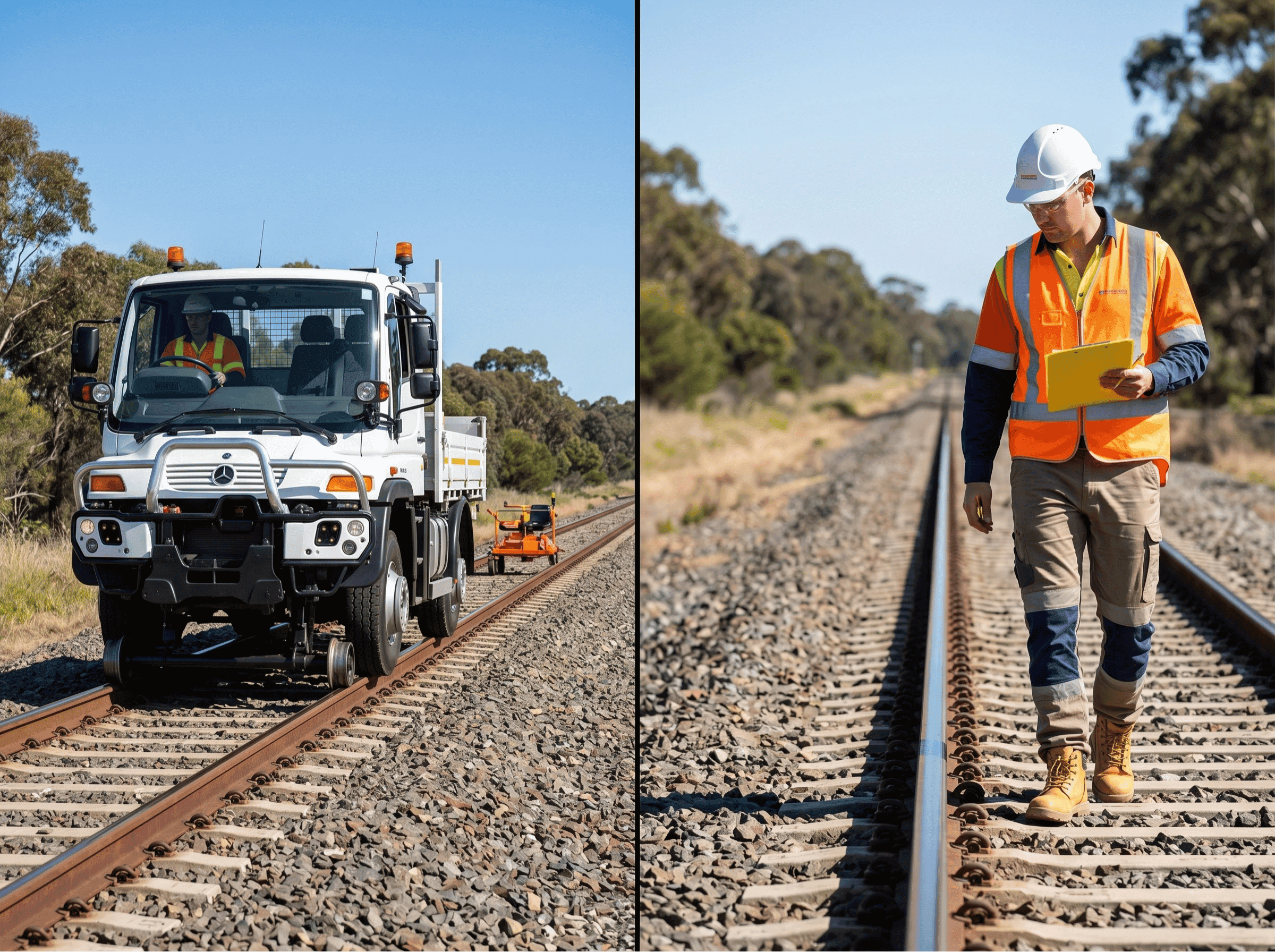
Hi-rail truck vs inspection cart is a choice about how to deliver the internal rail testing that 49 CFR 213.237 requires, not which rule applies. A hi-rail UT truck averages single-digit mph once stop-and-verify is counted (6 to 8 mph for test cars in a 1999 study), while a push cart moves at walking pace but reaches turnouts and yards.
This page compares four ways of deploying rail flaw testing: a hi-rail ultrasonic truck, a push cart or walking stick, hand testing with a single probe, and a dedicated rail-bound test car. It covers how fast each one really tests, how much verification work it creates, how it handles turnouts and special trackwork, what track access and Part 214 protection it needs, and what drives its cost. A decision matrix and a worked example for a 60-mile network with 40 turnouts show how the methods combine.
It deliberately doesn't repeat the deep dives. EMA's hi-rail track inspector article covers hi-rail vehicles, 213.233 visual inspection and a hi-rail test day; the ultrasonic rail detection cart article covers carts, qualification and a cart test day; and continuous vs stop-and-verify rail testing covers the 213.240 verification regime.
What are the four ways to deploy rail flaw testing?
Rail flaw testing in North America is ultrasonic pulse-echo testing from the rail head, and the four methods differ in what carries the probes, not in the physics. In its 2014 Improving Rail Integrity final rule, FRA described four test processes. The portable process is "pushing a test device over the rail at a walking pace"; the start/stop process "tests at a slow speed (normally not exceeding 20 mph)"; the chase-car process puts a verification car behind a lead test vehicle; and the continuous process runs non-stop and verifies suspects later.
"The main technologies utilized for non-destructive testing on U.S. railroads are the ultrasonic and induction methods. Ultrasonic technology is the primary technology used, and induction technology is currently used as a complementary system." — FRA, Track Safety Standards; Improving Rail Integrity, 79 FR 4234 (Jan. 24, 2014), p. 4237
The four deployment methods map onto those processes like this:
| Method | What carries the probes | FRA process it usually runs | Typical role |
|---|---|---|---|
| Hi-rail UT truck | A highway truck with retractable flanged wheels and rolling search units | Start/stop (stop-and-verify); some systems also continuous | Main and branch lines of tens of miles, transit, short lines |
| Push cart or walking stick | A hand-pushed frame (one or two rails) or a light single-rail stick | Portable | Turnouts, yards, short track, tunnels, verification |
| Hand testing | A single contact probe on a flaw detector, moved by hand | Portable (spot coverage only) | Verifying indications, weld base scans, rail ends, frog and switch areas |
| Dedicated test car | A rail-bound vehicle built for testing, often with more channels | Start/stop, chase car or continuous (213.240) | Long, high-tonnage territory |
The probe set is broadly the same on all four: typically a 0° straight beam for horizontal defects and loss of back-wall echo, 70° beams for transverse defects in the head, and roughly 37–45° or side-looking beams for the web and gage corner. Exact angles and channel counts vary by system, so treat that as typical practice rather than a specification.
All four methods also share one requirement. Under 213.238, the person operating the equipment must be a qualified operator for that type of equipment, and it is that operator who decides whether a valid search was made. A hand probe in an unqualified pair of hands is no more compliant than an unqualified crew in a test car.
Key takeaway: the methods trade speed against reach and control; none of them changes what the rule requires.
Is walking track inspection the same as rail flaw testing?
No. "Walking" covers two different jobs, and only one of them is rail flaw testing. Walking visual track inspection is done under 49 CFR 213.233, which allows inspection "on foot or by traversing the track in a vehicle" by a person designated under 213.7. It looks for surface conditions: gage, fastenings, crossties, drainage and visible rail damage. It can't see a transverse defect growing inside the head.
Walking rail flaw testing is a person pushing an ultrasonic cart or walking stick along the rail, which is an internal rail inspection under 213.237. The walk is the same, but the rule, the qualification, the equipment and the record are all different.
| Walking visual inspection | Walking rail flaw testing (cart or stick) | |
|---|---|---|
| Rule | 213.233 (track), 213.235 (switches and turnouts) | 213.237 (internal rail inspection) |
| Person | Inspector designated under 213.7 | Qualified operator under 213.238 |
| What it finds | Surface and track-structure conditions | Internal head and web defects |
| Turnouts | 213.235 requires each switch, turnout and track crossing to be inspected on foot at least monthly | No turnout-specific rule; coverage is the owner's and tester's plan |
| Records | 213.233 / 213.235 inspection records | 213.241 internal rail inspection records |
The original version of this page treated walking inspection as a third rail testing method that "human inspectors" use to notice "unusual smells" or vibration. That describes neither job. A visual inspection on foot is an essential, separate duty, and a hi-rail truck doing visual inspection is still a person inspecting at a speed that lets them see, limited to 5 mph over track crossings and turnouts by 213.233(b). Neither substitutes for internal testing, and internal testing doesn't satisfy 213.233 or 213.235.
Key takeaway: compare walking carts with hi-rails for rail flaw testing; compare walking with hi-rail visual inspection only under 213.233.
Does track class decide which test method you use?
No. Track class, tonnage and passenger service set how often rail must be tested under 213.237(c); they don't set the equipment. The rule's interval text reads:
"Internal rail inspections on Class 4 and 5 track, or Class 3 track with regularly-scheduled passenger trains or that is a hazardous materials route, shall not exceed a time interval of 370 days between inspections or a tonnage interval of 30 million gross tons (mgt) between inspections, whichever is shorter." — 49 CFR 213.237(c), read on Cornell LII, Oct. 2026
Other Class 3 track must be tested at least once each calendar year (no more than 18 months apart) or every 30 MGT, whichever is longer, and never more than 5 years apart. There is no 213.237 interval for Class 1 or 2 track, so testing there is set by the owner's program, a transit agency standard or a contract. For the full interval logic, see how often must rail be tested and EMA's 213.237 rail flaw testing guide.
The original article said hi-rail vehicles serve "high-speed Class 4 to Class 6" track and carts serve "Class 1 to Class 3". That mapping has no basis in the rule. Section 213.237 names no method; it requires equipment "capable of detecting defects between joint bars, in the area enclosed by joint bars" (213.237(f)) and a valid search interpreted by a qualified operator. A cart can test Class 5 track, and a hi-rail can test Class 1 track. What decides the method is mileage, access, special trackwork and verification workload, which the rest of this page works through.
Class does matter indirectly. Higher tonnage shortens the interval, which means more tests a year and makes production speed worth more. Passenger service brings tighter track windows. Neither turns into an equipment rule.
Hi-rail truck vs inspection cart: how fast does each method test?
The honest comparison is average production including stops, and the public figures for it are thin and dated. Rated speeds describe what the equipment can do on clean rail without stopping; they aren't test speeds. The best published average is from a 1999 university assessment of test-car data:
"[I]n practice the vehicle stops frequently to hand verify indications"; test cars "typically average 6 to 8 mph." — Jeffrey and Peterson, Assessment of Rail Flaw Inspection Data, MPC 99-106, Aug. 1999
The same report said test cars were "capable of speeds up to 30 mph in a non-stop testing mode". Here is what the sources support for each method:
| Method | Stated or rated speed | Average production the sources support | Source and confidence |
|---|---|---|---|
| Hi-rail UT truck | Vendors rate current systems about 30–45 mph | No current public average; stop-and-verify is "normally not exceeding 20 mph" while moving, and averages fall to single digits with stops | FRA 2014 and 2020 rules (high); vendor pages (vendor claims); MPC 99-106 (dated) |
| Dedicated test car | Up to 30 mph non-stop (1999) | 6 to 8 mph average with stop-and-verify (1999); continuous testing avoids most stops | MPC 99-106 (dated, test cars generally) |
| Push cart or walking stick | "Walking pace" (FRA); one vendor rates a single-rail cart at up to 5 km/h (about 3.1 mph) | No public production rate; stops to verify bring the average below walking speed | FRA 2014 (high); vendor sheet (vendor claim) |
| Hand testing | Not a production method | Spot coverage only, measured in locations, not miles | Practice |
Two more figures help bracket the vehicle number. FRA's 2014 small-entity cost estimate assumed an average Class III railroad's roughly 70 miles of Class 3–5 track takes 3 days with a rented detector car, which implies about 23 miles a day. That is a regulatory planning estimate, not a measured rate. EMA's own sibling articles use planning assumptions of about 4 mph average for a hi-rail on a short line and 2.0 mph for a cart on plain yard track. Those are illustrations, not measured EMA performance.
What sets the average is the same for every method: suspects to verify, joints and welds, special trackwork, crossings, rail surface condition and how often the crew has to clear for trains. A contractor quoting miles per shift should say which of those it assumed. Ask for planned miles per window on track like yours, not top speed. The hi-rail track inspector article explains why a vendor rating isn't a working speed.
Key takeaway: a vehicle tests several times faster than a cart on plain track, but the gap shrinks wherever verification and turnouts dominate.
How much verification work does each method create?
Every suspect indication on a stop-and-verify test means a stop, a back-up and a hand-probe check, so verification time scales with the number of suspects, not the miles. Under 213.113(b), once the owner learns of an indication it must be verified within 4 hours, or immediately where the suspected defect would call for remedial action A, A2 or B. On a stop-and-verify test, the crew normally verifies on the spot.
The methods spread verification work differently:
| Method | Who verifies, and when | Where the workload falls |
|---|---|---|
| Hi-rail UT (stop-and-verify) | The vehicle crew, at the time of the test, with a hand probe | Inside the track window; each stop cuts miles tested |
| Dedicated test car (stop-and-verify) | The car crew, on the spot | Same as hi-rail, on larger territory |
| Test car (continuous, 213.240) | Separate field crews later: within 84 hours, or 36 hours for suspected A, A2 or B defects | Off the test vehicle, onto verification crews and their own track time |
| Push cart or walking stick | The operator, immediately, standing over the rail | Small per suspect, but walking pace means fewer miles per window |
| Hand testing | Is itself the verification method | It is the tool the other methods call on |
The suspect rate depends on the rail. Worn, shelled or heavily lubricated rail throws up far more indications, and many are not defects. Lost coupling on dirty or dry rail is not a clean result: under 213.237(g), if the qualified operator decides a valid search couldn't be made, "that particular length of track may not be considered as internally inspected". That rail goes on the record as untested under 213.241(c)(6), and the owner must retest it, hold trains to 25 mph, or replace it before the deadline (213.237(h)). See false calls in rail UT for why not every echo is a defect.
Continuous testing, the alternative that moves verification off the vehicle, has its own rules, windows and reporting. It is covered in continuous vs stop-and-verify rail testing, and it suits high-mileage owners with data review staff more than short lines or industrial track.
Key takeaway: double the suspect rate and a vehicle's production can fall by a third or more, as the worked example below shows; a cart's barely changes.
How do turnouts and special trackwork change the choice?
Turnouts are where vehicles lose their speed advantage, because rolling search units lose coupling and coverage through switch points, frogs and guard rails. Section 213.237 itself never mentions frogs or switch points, so there is no rule-defined turnout coverage. Coverage is a matter of the test plan: what the vehicle covers as it rolls through, and what the crew then covers by cart or hand.
The parts of a turnout behave differently:
| Turnout part | What a moving vehicle does | What a cart or hand probe adds |
|---|---|---|
| Stock rails and closure rails | Usually tested as plain rail, with gaps at joints and heel blocks | Slow, controlled scanning and hand checks where the wheel loses contact |
| Switch points | Changing head shape and planing reduce reliable coupling | Hand-probe checks on the point and the stock rail beside it |
| Cast manganese frogs | Coarse-grained cast austenitic manganese steel attenuates ultrasound heavily | Little: FRA research reports in-service examination of these castings is visual only |
| Rail-bound frogs and welds at the heel | Partial coverage | Hand scans of welds, including the base |
| Guard rails and their bolts | Not reliably covered | Hand testing of the running rail behind them where accessible |
On cast frogs, FRA's own research is blunt: "Revenue service examinations of these special trackwork components currently use only visual inspections" (FRA RR 22-25). The reason is the grain structure of the casting, not just its shape. So an honest test plan for a frog says "visual" and doesn't promise ultrasonic coverage it can't deliver.
In practice, turnouts push the method mix in one direction. A territory with few turnouts per mile suits a vehicle running through and a short hand-test stop at each one. A yard or terminal with a turnout every few hundred feet suits a cart crew, because the vehicle spends most of its time stopping anyway. Separately, 213.235 still requires each switch, turnout and track crossing to be inspected on foot at least monthly; that visual duty stands whatever the UT method. For defect types and remedial rules at switches, see railroad switch and crossing inspection.
What track access and Part 214 protection does each method need?
Every method puts people on or near the track, so every method needs on-track safety under 49 CFR Part 214; what differs is the form of protection. Part 214 applies on the general railroad system. Rail transit not connected to it falls under FTA's 49 CFR Part 671 and the state safety oversight agency, whose rules differ in detail.
The equipment type matters because of how Part 214 defines it. Under 214.7, a hi-rail vehicle is a roadway maintenance machine with retractable flanged wheels, and a roadway maintenance machine is "a device powered by any means of energy other than hand power". A hand-pushed cart is therefore not a roadway maintenance machine; its crew are roadway workers on foot.
| Method | Form of protection usually needed | Access points |
|---|---|---|
| Hi-rail UT truck | Working limits, normally exclusive track occupancy: 214.323(d) bars moving "trains or other on-track equipment" within foul-time limits | A set-on point, usually a grade crossing; road access to the territory |
| Dedicated test car | Track time and authority as a train or on-track equipment, set by the railroad's operating rules | No set-on point, but it must reach the territory by rail |
| Push cart or walking stick | Working limits or train approach warning by watchman/lookout, depending on the railroad's on-track safety program | Walking access anywhere; carts can be lifted off at any point |
| Hand testing | As for carts; a lone worker may use individual train detection only within strict limits | Anywhere a person can reach the rail |
Individual train detection is narrow. Under 214.337, it is available only to a trained and designated lone worker doing routine inspection or minor correction, outside interlockings and controlled points, with sight of a train at maximum authorized speed at least 15 seconds away, and not with equipment "that cannot be readily removed by hand". Whether a particular railroad allows it for a single hand-test location is that railroad's program decision. A two-person cart crew isn't a lone worker and needs another form of protection.
Access often decides the method before speed does. A hi-rail needs a set-on point near the territory and a window long enough to justify the briefing, set-on and calibration overhead, which the hi-rail track inspector worked example puts at about 90 minutes of an 8-hour window. A cart can work short night windows between trains, inside tunnels and on embedded street track where a truck can't set on. Hi-rails also don't reliably shunt track circuits, which is another reason their moves rely on authority rather than signals. For underground work, see tunnel rail inspection.
What drives the cost of each method?
For an owner hiring a contractor, cost is driven by crew-days and track windows, not by the price of the equipment. The original version of this page gave equipment prices of $5,000 to $50,000 for carts and $150,000 to $500,000 for hi-rail trucks. No public source for those figures was found, so they have been removed. Public contract documents do show what owners actually pay and how it is structured.
| Cost driver | How it varies by method |
|---|---|
| Crew-days or windows | The biggest item. Carts need more windows per mile; vehicles need fewer but longer ones |
| Mobilization and travel | Higher for a hi-rail or test car brought in from far away; a cart crew travels light |
| Track protection | Usually provided by the owner (flaggers, RWIC, authority); more windows means more protection cost for the owner |
| Verification | Inside the window for stop-and-verify; separate crews for continuous testing |
| Turnouts and special trackwork | Fixed time per turnout, whatever the method |
| Standby and weather | Lost windows are often billed at a test-day rate |
| Reporting | Records under 213.241 and the owner's format; continuous testing adds data review |
Three dated public data points show the scale. In a 2019–2021 transit contract, San Diego MTS priced ultrasonic rail testing at $212.43 to $221.02 per track mile for about 192 track miles a year, with a 2019 test day at $3,100.73 for 8 hours, mobilization at $2,847.08 per travel day and standby billed at the test-day rate (MTS board materials, Dec. 13, 2018). FRA's 2014 rule analysis assumed $2,000 a day to rent a rail flaw detector car. And in 2025 the three proposals for a five-year BART rail testing contract ranged from about $1.2 million to $2.6 million, the low price helped partly by a local firm saving travel and lodging costs.
None of those prices transfers directly to another owner. They bundle different scopes, rail conditions and windows. The method lesson is that a per-mile price hides the window count, and the window count follows from the method mix. For more on estimating and reducing cost, see ultrasonic rail testing cost and how to reduce it.
Which method fits which track? A decision matrix
Match the method to the track segment, not to the whole network. Most owners end up with two methods: a vehicle for the plain line and a cart or hand crew for turnouts, yards and verification.
| Factor | Hi-rail UT truck | Push cart or walking stick | Hand testing | Dedicated test car |
|---|---|---|---|---|
| Plain main or branch line, tens of miles | Good fit | Slow; many windows | No | Good fit; mobilization may not pay |
| Hundreds of miles, high tonnage | Possible, many days | No | No | Best fit; continuous testing possible |
| Turnouts, yards, terminals | Slow; partial coverage | Best fit | For points, welds and rail ends | Slow; partial coverage |
| Cast manganese frogs | Visual only in service | Visual only in service | Visual only in service | Visual only in service |
| Short or night windows | Overhead eats the window | Good fit | Good fit | Needs a long window |
| No road access or set-on point | Not possible | Good fit | Good fit | Only if reachable by rail |
| Tunnels and embedded street track | Depends on clearance and set-on | Good fit | Good fit | Depends on the system |
| Verification of indications | Uses hand probe | Built in | Best fit | Uses hand probe or chase crew |
| Thermite weld base | Not covered | Hand scan needed | Best fit | Not covered |
| Worn or shelled rail, high suspect rate | Production falls sharply | Production falls less | For confirming | Production falls; continuous shifts load to field crews |
Read the matrix with the rule in mind. Every column can produce a valid search under 213.237 where the equipment performs as intended and a qualified operator interprets it, and none can where coupling is lost or the rail is masked. The choice is about getting a valid search over all the rail within the interval at the lowest total window count, not about which method is "compliant".
Worked example: choosing the method mix for a 60-mile network
This example compares three method mixes for one annual test of a 60-track-mile network with 40 turnouts. All inputs are planning assumptions for illustration, not measured EMA rates. Replace them with the contractor's records for similar track.
The network:
| Segment | Track miles | Class and traffic | Turnouts | Interval |
|---|---|---|---|---|
| Main line | 42.0 | Class 3, regularly scheduled passenger trains, 8 MGT a year | 12 | 370 days or 30 MGT, whichever is shorter: at 8 MGT, the 370 days controls |
| Branch and industrial lead | 10.0 | Class 2 freight | 6 | No 213.237 interval; the owner tests annually with the main line |
| Yard | 8.0 | Class 1 | 22 | Owner's program |
| Total | 60.0 | 40 |
Assumptions:
- Work window: 8 hours (480 minutes)
- Vehicle overhead (briefing, set-on, calibration, end check, set-off): 90 minutes, leaving 390 minutes of testing per window
- Cart overhead (briefing, calibration, end check): 60 minutes, leaving 420 minutes per window
- Moving speed: hi-rail 8 mph; test car 15 mph (both below FRA's "normally not exceeding 20 mph" for stop-and-verify); cart 2.0 mph
- Suspects: 1.0 per track mile, each needing 6 minutes to stop and hand-verify
- Turnouts: 15 minutes each by cart and hand probe
Mix A: cart crews for everything
- Plain track: 60.0 mi ÷ 2.0 mph = 30.0 h = 1,800 minutes
- Verification: 60 suspects × 6 min = 360 minutes
- Turnouts: 40 × 15 min = 600 minutes
- Total: 1,800 + 360 + 600 = 2,760 minutes ÷ 420 = 6.57, so 7 cart windows
Mix B: hi-rail for main and branch, cart for yard and all turnouts
- Hi-rail moving: 52.0 mi ÷ 8 mph = 6.5 h = 390 minutes
- Hi-rail verification: 52 suspects × 6 min = 312 minutes
- Hi-rail total: 702 minutes ÷ 390 = 1.8, so 2 hi-rail windows (average 52.0 ÷ 11.7 h = 4.4 mph)
- Cart, yard plain track: 8.0 mi ÷ 2.0 mph = 240 minutes, plus 8 × 6 = 48 minutes
- Cart, turnouts: 40 × 15 = 600 minutes
- Cart total: 240 + 48 + 600 = 888 minutes ÷ 420 = 2.11, so 3 cart windows
Mix C: dedicated test car for main and branch, cart for yard and all turnouts
- Car moving: 52.0 mi ÷ 15 mph = 3.47 h = 208 minutes
- Car verification: 312 minutes
- Car total: 520 minutes ÷ 390 = 1.33, so 2 car windows (average 52.0 ÷ 8.67 h = 6.0 mph), plus mobilization
- Cart: the same 888 minutes, 3 cart windows
The results side by side:
| Mix A: all cart | Mix B: hi-rail + cart | Mix C: test car + cart | |
|---|---|---|---|
| Vehicle windows | 0 | 2 | 2 (+ mobilization) |
| Cart windows | 7 | 3 | 3 |
| Total windows | 7 | 5 | 5 |
| Main and branch track time (minutes) | 2,142 | 702 + 270 = 972 | 520 + 270 = 790 |
| Vehicle windows at 2.0 suspects per mile | n/a | 1,014 ÷ 390 = 2.6, so 3 | 832 ÷ 390 = 2.13, so 3 |
The main and branch track time for Mix A is the cart's 52 miles (1,560 minutes moving plus 312 verifying) plus the 18 main and branch turnouts (270 minutes): 1,560 + 312 + 270 = 2,142 minutes. In Mixes B and C, the 270 minutes are the cart crew's turnout time on those tracks.
What the arithmetic shows:
- The vehicle mix saves windows, not just hours. Mix B needs 5 windows against 7, and it cuts main-line and branch occupancy from 2,142 to 972 minutes. On a passenger main line, where windows are scarce, that second number usually matters more.
- A faster car doesn't save a window here. At 15 mph the test car's 520 minutes still need 2 windows at 390 minutes each, the same as the hi-rail. Verification (312 minutes) is larger than the car's moving time (208 minutes), so speed stops paying. Its 6.0 mph average sits inside MPC 99-106's 6 to 8 mph range, which suggests the inputs are realistic. A test car starts to pay on hundreds of miles, or with continuous testing.
- Verification decides the vehicle count. If worn rail doubles the suspect rate to 2.0 per mile, the hi-rail's total rises from 702 to 1,014 minutes, its average falls from 4.4 to 3.1 mph, and it needs 3 windows. The cart's yard work rises by only 48 minutes.
- Turnouts are a fixed cost. The 40 turnouts take 600 minutes whichever mix is chosen, more than the hi-rail's whole moving time. Splitting them out to a cart crew, which can work while the hi-rail tests elsewhere, is what keeps the vehicle windows at 2.
The frogs in this network are assumed to be cast manganese, so the 15 minutes per turnout covers the points, closure rails and heel welds by UT and the frog visually. Any rail that couldn't be validly searched is recorded as untested under 213.241(c)(6) and goes on a retest list before the 370-day deadline.
What can't any of these methods do?
No deployment method removes the physical limits of in-track rail UT, and no rule requires 100% detection.
- The rail base. Sound from the head reaches the base directly beneath the web, not the flange tips. TTCI put it plainly: "the ultrasonic rail flaw detection process only scans the head and web of the rail, and not the majority of the base" (TD-00-013, 2000). Thermite weld bases need hand scans whatever the main method.
- Rail under shells and head checks. Surface damage blocks the beam. In a 1998 benchmark of six hi-rail systems, transverse defects under shells were found about 62% of the time (7 defects) against 77% with no surface anomaly (33 defects) (TTCI TD-99-006, dated data). A cart doesn't fix masking; grinding or replacement does.
- Cast manganese frogs. Visual only in service, as above.
- Rail hidden under crossings and in embedded track. Web and base corrosion under a crossing surface can escape both visual and ultrasonic inspection.
- Every flaw. The same 1998 benchmark found 72% of 49 known flaws overall across the six systems. Equipment has improved since, but that benchmark is a reminder that a clean report means no reportable indications were found, not that the rail is defect-free.
- Daily mileage on foot. A cart can't test a long main line within a sensible number of windows.
- Visual inspection. No UT method satisfies 213.233 or 213.235.
How EMA Industries applies this
EMA Industries performs ultrasonic rail flaw testing for transit agencies, short lines and industrial track owners, working from Southern California and mobilizing nationwide. EMA plans the deployment method around the access the owner can provide, such as push-cart and hand-probe testing, turnout and weld coverage, and work inside the owner's RWP windows, rather than around a single vehicle type. For scope and the rules behind it, see EMA's ultrasonic rail testing services, or contact EMA Industries with your track miles, turnout count and available windows.
Frequently asked questions
Is a push cart test a valid search under 213.237?
It can be. Section 213.237 names no method; it requires a continuous inspection where the equipment performs as intended, responses are interpreted by an operator qualified under 213.238, and the equipment can detect defects between joint bars. A cart that meets those conditions gives a valid search over the rail it covers. Rail where coupling was lost counts as untested.
How many miles a day can a hi-rail UT truck test?
There's no standard figure. Vendors rate current systems at about 30–45 mph, but stop-and-verify testing normally moves at no more than 20 mph and averages far less with stops; a 1999 study put test-car averages at 6 to 8 mph. In the worked example above, a hi-rail averages 4.4 mph and tests 52 miles in 2 windows. Ask for planned miles per window on similar track.
Do turnouts need separate testing?
Usually, yes in practice. Rolling search units lose coverage at switch points, frogs and guard rails, so turnouts typically get a cart or hand-probe pass, and cast manganese frogs are examined visually in service. Separately, 213.235 requires a monthly visual inspection of each switch and turnout on foot, which no UT method replaces.
Who provides track protection for a rail flaw test?
The track owner normally provides the authority and protection: working limits, flaggers or a roadway worker in charge under its Part 214 program (or Part 671 and SSOA rules for isolated transit). A hi-rail moving within limits normally needs exclusive track occupancy, because 214.323(d) bars on-track equipment moves under foul time. The contract should say who supplies protection and for how many windows.
When does a dedicated test car make more sense than a hi-rail?
When the territory runs to hundreds of miles of high-tonnage track and long windows are available, or when the owner wants continuous testing under 213.240 with separate verification crews. On a network of tens of miles, as in the worked example, verification time rather than vehicle speed decides the window count, and a test car's mobilization may not pay.
Sources
- 49 CFR 213.237 Inspection of rail: eCFR; text read on Cornell LII, Oct. 2026
- 49 CFR 213.233, 213.235, 213.238, 213.240, 213.241: eCFR Part 213 Subpart F; 213.235 read on Cornell LII
- 49 CFR 213.113(b): eCFR
- 49 CFR 214.7, 214.323, 214.337: eCFR Part 214; 214.337 read on Cornell LII
- FRA, Track Safety Standards; Improving Rail Integrity, 79 FR 4234, Jan. 24, 2014 (test processes, p. 4237; small-entity cost estimate): govinfo
- FRA, Track Safety Standards; Continuous Rail Testing, 85 FR 63362, Oct. 7, 2020: govinfo
- Jeffrey and Peterson, Assessment of Rail Flaw Inspection Data, Mountain-Plains Consortium MPC 99-106, Aug. 1999: ugpti.org
- Garcia and Reiff, Benchmarking Results of North American Rail-Flaw Detection Technologies, TTCI TD-99-006, Feb. 1999: mxvrail.com
- Kristan, Thermite Weld Failure Survey, TTCI TD-00-013, July 2000: mxvrail.com
- FRA RR 22-25 (ultrasonic examination of special trackwork castings): ROSA P
- San Diego MTS board agenda and materials, Dec. 13, 2018 (ultrasonic rail testing contract pricing): sdmts.com
- BART RFP 6M3750 board item, June 26, 2025: bart.legistar.com