
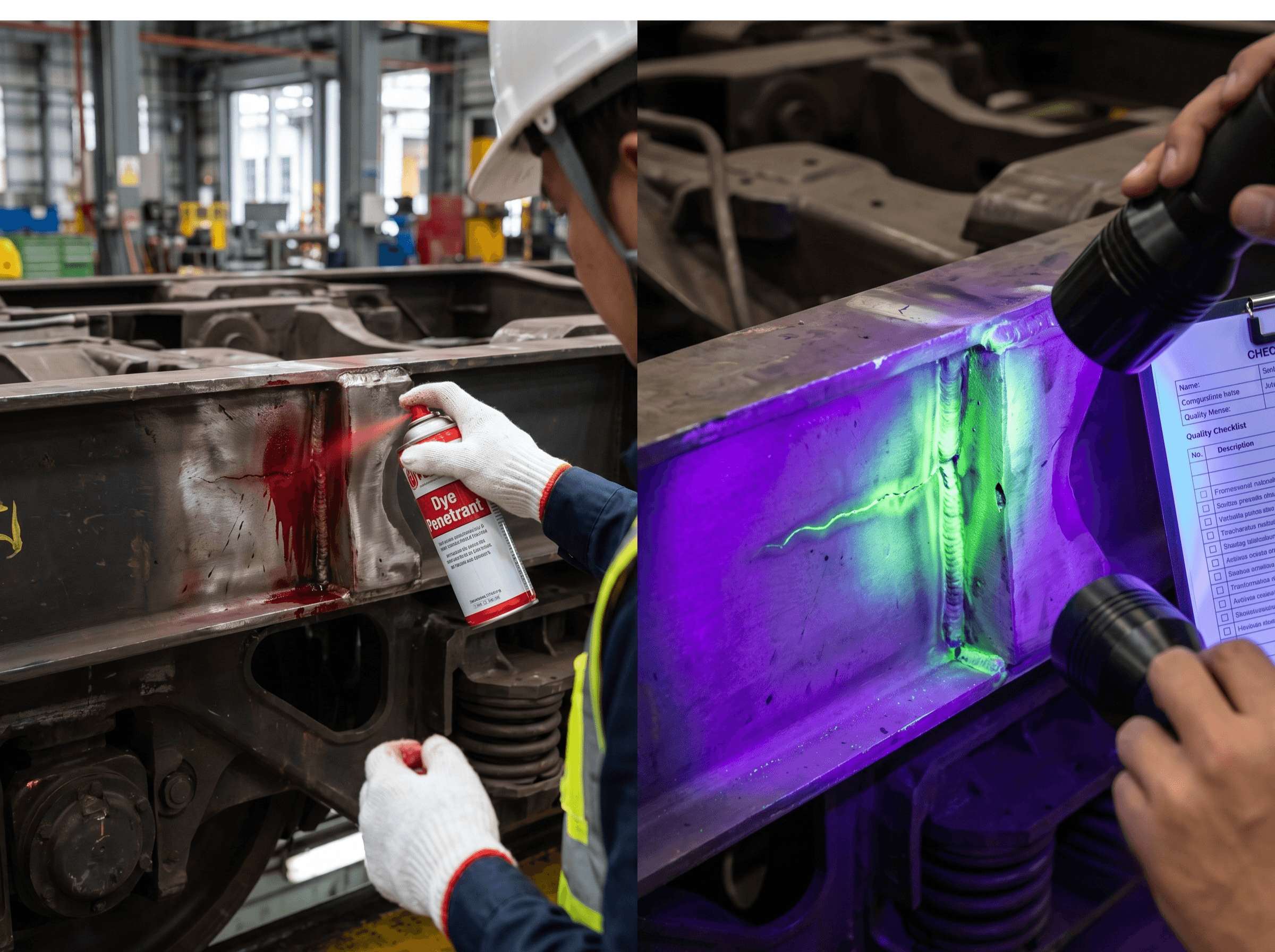
Liquid penetrant testing plays a vital role in maintaining railway safety and operational reliability. Liquid penetrant testing helps inspectors identify surface defects before they develop into serious failures. Across modern railway networks, liquid penetrant testing remains one of the most trusted non-destructive testing methods for detecting cracks, seams, and discontinuities.
Railway systems operate under demanding conditions every day. Heavy loads, continuous vibration, environmental exposure, and repeated stress place immense pressure on critical components. Even a small crack can grow over time and compromise the integrity of a rail asset.
For this reason, railway operators invest heavily in non-destructive testing (NDT) programs. These inspections help maintenance teams detect defects early without damaging valuable components. Early detection reduces downtime, lowers maintenance costs, and improves passenger and freight safety.
Regulatory compliance also drives inspection activities. Railway authorities across the world require strict quality control measures to ensure infrastructure and rolling stock remain safe throughout their service life. Liquid penetrant testing supports these requirements by offering a practical method for finding surface-breaking defects.
Maintenance engineers often combine liquid penetrant testing with other NDT techniques to create comprehensive inspection programs. This approach helps rail operators maintain reliability while extending the lifespan of expensive assets.
A tiny surface crack may appear harmless at first glance. However, what happens when that crack expands under thousands of load cycles? The answer begins with understanding how liquid penetrant testing actually works.
What Is Liquid Penetrant Testing?
Liquid penetrant testing is a non-destructive testing method that reveals surface-breaking defects by using a specially formulated liquid penetrant and a developer.
The process relies on a simple scientific principle known as capillary action. When inspectors apply penetrant to a clean surface, the liquid flows into tiny openings such as cracks, laps, seams, and porosity. After excess penetrant is removed, a developer draws the trapped penetrant back to the surface, making defects visible.
Liquid penetrant testing works on a wide range of non-porous materials. These materials include steel, stainless steel, aluminum, nickel alloys, and many engineered components commonly found in railway systems.
The technique has existed in some form for more than a century. Early inspection methods used oil and chalk to reveal cracks in metal components. As industrial standards evolved, manufacturers developed more sophisticated penetrants and developers, improving sensitivity and reliability.
Today, liquid penetrant testing supports industries such as aerospace, power generation, manufacturing, automotive engineering, and railway transportation. Its ability to detect extremely fine surface flaws makes it particularly valuable in safety-critical environments.
The Science Behind Liquid Penetrant Testing
The effectiveness of liquid penetrant testing depends on three key elements:
- A clean inspection surface
- A penetrant with strong capillary properties
- A developer that highlights indications
When these elements work together, inspectors can identify defects that remain invisible to the naked eye.
Why Surface Defect Detection Matters
Many failures begin at the surface of a component. Repeated loading creates small fatigue cracks that gradually grow larger. If maintenance teams miss these early warning signs, significant structural damage may occur later.
Railway components often experience millions of stress cycles during their service life. Detecting defects during their earliest stages helps prevent unexpected failures and costly repairs.
The theory sounds straightforward enough. Yet the real effectiveness of liquid penetrant testing comes from a carefully controlled inspection process. Understanding those steps reveals why this method remains trusted throughout the railway industry.
How Liquid Penetrant Testing Works in the Railway Context
Railway maintenance teams follow a structured process to ensure consistent and reliable inspection results. Each stage contributes to the accuracy of liquid penetrant testing and helps inspectors identify critical defects.
The Step-by-Step Process
1. Surface Preparation
Inspectors first clean the component thoroughly. Dirt, rust, grease, paint, and contaminants can block defects and prevent penetrant from entering surface openings.
Proper cleaning remains one of the most important stages of liquid penetrant testing because inspection accuracy depends on surface condition.
2. Penetrant Application
Technicians apply the penetrant evenly across the inspection area. The liquid spreads across the surface and begins entering any cracks or discontinuities that are open to the surface.
The penetrant must cover the entire inspection area to ensure complete defect detection.
3. Dwell Time
The penetrant remains on the surface for a specified period. During this dwell time, capillary action draws the liquid deeper into any surface-breaking defects.
Different materials and defect types may require different dwell times.
4. Excess Penetrant Removal
Inspectors carefully remove excess penetrant from the surface. The goal is to clean the surface without removing penetrant trapped inside defects.
This stage requires attention and experience because excessive cleaning may affect inspection results.
5. Developer Application and Inspection
The developer creates a contrasting background and pulls trapped penetrant from defects. As indications appear, inspectors examine the component under suitable lighting conditions.
Visible indications help technicians evaluate the size, location, and characteristics of potential defects.
Inspection Example in Railway Maintenance
Consider a railway axle undergoing scheduled maintenance. Engineers suspect fatigue damage due to prolonged service. After completing the inspection process, liquid penetrant testing reveals several small surface cracks near a stress concentration area.
Because inspectors identified these defects early, maintenance teams can replace or repair the component before failure occurs. This preventive approach improves safety while reducing operational disruption.
Factors That Affect Inspection Accuracy
Several factors influence inspection quality:
- Surface cleanliness
- Penetrant sensitivity
- Dwell time
- Developer quality
- Lighting conditions
- Inspector competency
Railway organizations establish strict procedures to control these variables and maintain consistent inspection standards.
While the process remains largely the same, not all penetrants work identically. Some inspections require exceptional sensitivity, while others prioritize speed and convenience. The next section explores the two main penetrant categories used throughout railway maintenance operations.
What Are the Two Types of Liquid Penetrant?
The two primary types of liquid penetrant are fluorescent penetrants and visible color contrast penetrants.
Both types follow the same inspection principle. However, they differ in how inspectors view and interpret defect indications.
Fluorescent Penetrants
Fluorescent penetrants contain special dyes that glow under ultraviolet (UV) light. These systems offer extremely high sensitivity and can reveal very fine surface defects.
Many railway operators use fluorescent liquid penetrant testing when inspecting safety-critical components. Axles, wheelsets, bogies, and highly stressed structural parts often require this higher level of sensitivity.
The bright fluorescent indications make small defects easier to identify, especially in controlled inspection environments.
Visible Color Contrast Penetrants
Visible penetrants use colored dyes, usually red, that contrast against a white developer background. Inspectors can perform examinations under normal white light without specialized UV equipment.
Visible liquid penetrant testing provides a practical solution for field inspections and routine maintenance activities. Maintenance teams frequently use it for weld inspections, brake components, and general structural assessments.
Its simplicity and portability make it popular across railway workshops and maintenance depots.
Comparison of Penetrant Types
| Type | Medium | Best For | Common Railway Use |
| Fluorescent | UV Light | High-sensitivity crack detection | Axles, wheelsets, bogies |
| Visible (Color Contrast) | White Light | Routine field inspections | Welds, brake components |
Choosing the Right Method
Inspection requirements determine the most suitable penetrant type. Components with high safety implications often require fluorescent systems. Routine inspections may benefit from visible systems because they simplify field operations.
Regardless of the chosen method, liquid penetrant testing provides a reliable way to identify surface-breaking defects before they evolve into larger problems.
The inspection methods are clear, but another important question remains. Why does the railway industry continue to depend so heavily on liquid penetrant testing when several other NDT methods are available?
Why the Railway Industry Relies on Liquid Penetrant Testing
Railway organizations maintain a zero-tolerance approach toward critical defects. Passenger safety, freight protection, and infrastructure reliability depend on early defect detection.
Liquid penetrant testing supports these goals by providing a practical, efficient, and cost-effective inspection method. The technique helps maintenance teams identify cracks before they threaten operational safety.
Supporting Railway Safety Culture
Every railway component experiences continuous mechanical stress. Wheels rotate over long distances, axles support heavy loads, and welded structures absorb constant vibration.
These conditions can create fatigue cracks over time. Liquid penetrant testing helps inspectors identify these flaws before they reach critical dimensions.
As a result, maintenance teams can make informed repair or replacement decisions.
Regulatory Compliance Requirements
Many railway authorities require formal NDT inspections during manufacturing, maintenance, and overhaul activities.
Examples include:
- Research Designs and Standards Organisation (RDSO) requirements
- European railway standards
- Association of American Railroads (AAR) inspection practices
- International quality management frameworks
Liquid penetrant testing frequently appears within these inspection programs because it provides dependable surface defect detection.
Operational Benefits
Railway organizations continue using liquid penetrant testing because it offers several practical advantages:
- Lower cost than destructive testing methods
- Fast inspection turnaround
- Portable equipment for field use
- Minimal disruption to operations
- No need to destroy components
- Effective detection of fine surface cracks
These benefits make the method suitable for routine maintenance and large-scale inspection programs.
Evidence of Preventive Maintenance Success
Industry studies consistently show that preventive maintenance reduces equipment failures and operational interruptions. Early defect detection remains one of the most effective strategies for improving railway safety performance.
Non-destructive testing methods, including liquid penetrant testing, help maintenance teams identify defects before they become costly failures. This proactive approach contributes to improved asset reliability and longer service life.
However, inspection effectiveness depends heavily on where the testing occurs. Certain railway components face much greater stress than others and therefore require closer attention. The next section examines the critical railway parts that commonly undergo liquid penetrant testing and explains why these inspections matter so much.
Key Railway Components Tested Using Liquid Penetrant Testing
Railway systems contain numerous components that experience repeated loading and environmental stress. Maintenance teams use liquid penetrant testing to identify surface defects before they compromise safety or performance.
The ability of liquid penetrant testing to reveal small cracks makes it particularly valuable for components subjected to fatigue, vibration, and impact forces.
Wheelsets and Axles
Wheelsets and axles operate under constant mechanical stress. Every journey introduces thousands of load cycles that gradually weaken metal surfaces.
Fatigue cracks often begin in high-stress areas. These cracks may remain invisible during routine visual inspections but can grow rapidly if left undetected.
Liquid penetrant testing helps maintenance engineers identify surface-opening fatigue cracks at an early stage. Early detection allows repairs or replacements before a defect becomes a serious safety concern.
Railway operators frequently include liquid penetrant testing within scheduled axle inspection programs because these components directly affect train stability and passenger safety.
Bogies and Frames
Bogies support the weight of railway vehicles while absorbing forces generated during movement. These structures contain numerous welded joints and fabricated sections.
Repeated stress can create small cracks near welds and connection points. Over time, these defects may expand and weaken structural integrity.
Liquid penetrant testing plays an important role in weld inspection activities. The method highlights surface-breaking defects that may otherwise escape detection.
Many maintenance facilities perform liquid penetrant testing during major overhauls to ensure bogies and frames remain fit for service.
Brake Components and Couplers
Brake systems and couplers perform safety-critical functions throughout railway operations. Failures within these systems can result in significant operational and safety risks.
Brake brackets, coupler housings, and connecting mechanisms often experience high impact loads. These conditions increase the possibility of fatigue-related damage.
Liquid penetrant testing helps inspectors identify cracks before component performance deteriorates. As a result, maintenance teams can address defects proactively rather than reactively.
Other Railway Components Commonly Inspected
Many additional railway components benefit from liquid penetrant testing, including:
- Rails and fishplates
- Engine casings
- Suspension components
- Welded assemblies
- Bearing housings
- Structural brackets
- Maintenance equipment components
Because different railway assets require different inspection approaches, engineers often combine multiple NDT methods. This raises an important question: where does liquid penetrant testing fit among the broader family of non-destructive testing techniques?
What Are the 4 Types of NDT?
The four commonly used non-destructive testing methods are Liquid Penetrant Testing, Magnetic Particle Testing, Ultrasonic Testing, and Radiographic Testing.
Each technique serves a specific purpose and offers unique advantages depending on the material and defect type.
Common NDT Methods Used in Railways
Liquid Penetrant Testing
Liquid penetrant testing detects surface-breaking defects on non-porous materials. It remains one of the most effective methods for identifying fine cracks and discontinuities.
Magnetic Particle Testing
Magnetic Particle Testing identifies surface and near-surface defects in ferromagnetic materials. It works well for steel components commonly found in railway applications.
Ultrasonic Testing
Ultrasonic Testing uses high-frequency sound waves to locate internal defects. It helps inspectors evaluate material thickness and internal integrity.
Radiographic Testing
Radiographic Testing uses X-rays or gamma rays to reveal internal discontinuities. It provides a permanent inspection record but generally requires more equipment and safety controls.
Why Liquid Penetrant Testing Stands Out
Although each method offers valuable capabilities, liquid penetrant testing remains particularly effective for detecting surface defects quickly and economically.
Unlike some other techniques, liquid penetrant testing works on both ferrous and non-ferrous materials. This versatility makes it highly attractive for railway maintenance programs involving diverse component types.
Furthermore, liquid penetrant testing requires relatively simple equipment and can be performed efficiently in workshop environments.
Advantages and Limitations of Liquid Penetrant Testing in Railways
Every inspection method has strengths and limitations. Understanding both helps railway operators select the most appropriate testing approach.
Advantages
Liquid penetrant testing provides several important benefits:
- Simple inspection procedure
- Cost-effective implementation
- Suitable for non-magnetic materials
- Detects very fine surface cracks
- Fast inspection turnaround
- Portable equipment options
- Minimal component damage
- Effective for complex geometries
These advantages explain why liquid penetrant testing remains widely used across railway manufacturing and maintenance facilities.
Limitations
Despite its benefits, liquid penetrant testing also has limitations:
- Detects only surface-breaking defects
- Requires clean inspection surfaces
- Less effective on porous materials
- Requires proper chemical handling
- Surface coatings must often be removed
- Inspection quality depends on technician skill
Railway organizations typically address these limitations by combining liquid penetrant testing with complementary NDT methods when necessary.
Balancing Performance and Practicality
No single inspection technique can detect every type of defect. However, liquid penetrant testing delivers an excellent balance of sensitivity, simplicity, and affordability.
For many railway applications, this balance makes it the preferred choice for routine surface crack detection.
Standards and Certifications Governing Liquid Penetrant Testing in Railways
Inspection consistency depends on established standards and qualified personnel. Railway operators rely on recognized procedures to ensure reliable inspection results.
Several international standards guide liquid penetrant testing activities across the railway sector.
Major Standards Used in Railway Inspection
ASTM E165
ASTM E165 provides general requirements for conducting liquid penetrant testing. Many organizations use this standard as a foundation for inspection procedures.
EN ISO 3452
EN ISO 3452 outlines penetrant testing requirements commonly used throughout Europe. Railway manufacturers frequently reference this standard during production and maintenance activities.
RDSO Guidelines
In India, railway inspections often follow guidance issued by the Research Designs and Standards Organisation (RDSO). These requirements support quality assurance across railway infrastructure and rolling stock.
Technician Certification Requirements
Effective liquid penetrant testing depends on trained personnel. Most organizations require technicians to obtain formal certification before performing inspections independently.
Common certification levels include:
- Level I – Performs inspections under supervision
- Level II – Conducts inspections and interprets results
- Level III – Develops procedures and supervises programs
Certification programs commonly follow ASNT or ISO 9712 frameworks.
Standards Overview
| Standard | Region | Scope |
| ASTM E165 | USA | General LPT procedure |
| EN ISO 3452 | Europe | Railway NDT compliance |
| RDSO Guidelines | India | Indian Railways NDT framework |
Importance of Standardization
Standardized procedures help ensure consistency across inspection programs. They also improve reliability, traceability, and regulatory compliance.
As railway systems continue evolving, standards help maintain confidence in liquid penetrant testing results and support safer transportation networks worldwide.
Final Thoughts
Railway safety depends on proactive maintenance and reliable inspection practices. Among the available non-destructive testing methods, liquid penetrant testing continues to play a critical role in identifying surface defects before they become major failures.
From wheelsets and axles to bogies, brake components, and structural welds, liquid penetrant testing helps maintenance teams detect cracks that could otherwise compromise operational safety. The method combines simplicity, affordability, and effectiveness, making it an essential part of modern railway inspection programs.
International standards, certified technicians, and well-established procedures further strengthen the reliability of liquid penetrant testing across the railway industry. As rail networks expand and equipment becomes more advanced, the importance of liquid penetrant testing will continue to grow.
For railway authorities, manufacturers, and maintenance engineers, liquid penetrant testing remains one of the most practical tools for protecting assets, supporting compliance, and enhancing passenger safety.
Key Takeaways
- Liquid penetrant testing helps identify surface-breaking defects before they become serious railway safety risks.
- Railway operators use liquid penetrant testing to improve reliability and reduce unexpected equipment failures.
- The method provides a non-destructive way to inspect components without causing any damage.
- Fluorescent penetrants offer higher sensitivity for detecting extremely small cracks in critical components.
- Visible color contrast penetrants support efficient field inspections under normal lighting conditions.
- Wheelsets, axles, bogies, and brake components commonly undergo regular liquid penetrant testing inspections.
- Liquid penetrant testing delivers cost-effective defect detection compared with many alternative inspection methods.
- International standards help ensure consistent inspection procedures and reliable defect evaluation practices.
- Certified technicians play a crucial role in maintaining inspection accuracy and regulatory compliance.
- Early defect detection through liquid penetrant testing supports safer railway operations and longer asset life.
FAQs
What is the LPT process?
The LPT process involves five main steps: surface preparation, penetrant application, dwell time, excess penetrant removal, and developer application. This process allows inspectors to identify surface-breaking defects such as cracks, seams, and porosity without damaging the component being tested.
What is a Type 1 and Type 2 penetrant?
Type 1 penetrants are fluorescent penetrants that require ultraviolet (UV) light for inspection and offer high sensitivity. Type 2 penetrants are visible color contrast penetrants that can be inspected under normal white light, making them suitable for routine field inspections and maintenance activities.
What are the 5 most common testing methods in NDT?
The five most common non-destructive testing methods are Liquid Penetrant Testing (LPT), Ultrasonic Testing (UT), Magnetic Particle Testing (MT), Radiographic Testing (RT), and Visual Testing (VT). Railway maintenance programs often use a combination of these methods to ensure comprehensive defect detection.
What industries use liquid penetrant testing?
Liquid penetrant testing is widely used in the railway, aerospace, automotive, manufacturing, power generation, oil and gas, and construction industries. Any industry that relies on metal components and requires surface defect detection can benefit from this inspection method.