Rail testing frequency requirements play a central role in keeping railroad infrastructure safe, reliable, and fit for continued service. Requirements of rail testing frequency helps track owners determine when internal rail inspections must take place and when a more frequent testing program may be appropriate. Because rail testing frequency requirements depend on factors like track class, traffic, tonnage, service type, inspection history, and rail condition, there is no single schedule that applies to every section of railroad track.
What Determines Rail Testing Frequency?
The first important distinction is between routine track inspection and internal rail flaw testing. These activities support the same safety objective, but they do not examine the rail in exactly the same way.
Routine inspections can identify visible conditions like damaged components, alignment problems, excessive wear, surface deterioration, and other track conditions. Internal rail testing goes further by using specialized detection equipment to search for defects within the rail itself.
That difference matters when interpreting rail testing frequency requirements. A track can receive regular visual inspections while still requiring a separate internal examination using ultrasonic or another approved rail flaw detection method.
Traffic and Accumulated Tonnage
Time is only one part of the equation. Every train places loads on the rail, and cumulative traffic can influence the development of fatigue-related defects.
Gross tonnage provides a practical way to measure that accumulated loading. A heavily used freight route can reach a tonnage threshold much sooner than a lightly used line, even when both tracks share the same calendar date for their previous inspection.
For that reason, rail testing frequency requirements use accumulated gross tonnage as an important scheduling factor for applicable track. A railroad that relies only on calendar reminders could overlook the significance of rapidly accumulating traffic.
Other conditions matter as well. FRA guidance identifies factors including temperature differences, curvature, residual stresses, rail sections, cumulative tonnage, and previous rail test results as considerations when determining an appropriate testing schedule.
Why “Once a Year” Is Not Always the Complete Answer
Annual testing sounds straightforward, but it can create an incomplete picture of how rail inspection actually works.
Consider a high-volume freight route that reaches 30 million gross tons several months before the anniversary of its previous internal inspection. Under the applicable rule, the tonnage threshold can become the controlling interval. The next inspection cannot simply be postponed until the calendar anniversary.
Conversely, a lower-volume Class 3 route without regularly scheduled passenger trains and outside the hazardous-material-route category follows a different provision. The rule allows the longer of the applicable annual/18-month framework or the 30-million-gross-ton interval, while still imposing the five-year maximum.
This is why rail testing frequency requirements need to be evaluated against actual operating conditions.
The same principle applies when a railroad has an unusual history of defects. A regulatory maximum represents a boundary, not a guarantee that waiting until the final permissible day is the best maintenance decision.
FRA's compliance guidance notes that some railroads conduct internal rail inspections more frequently than the minimum regulatory requirements. The guidance describes factors like track characteristics, maintenance, traffic, weather, accumulated tonnage, and past testing results as relevant to scheduling.
In practical terms, a responsible inspection program asks two separate questions: What does the regulation require, and what does the condition of the railroad demand?
How Ultrasonic Testing Fits Into Rail Inspection
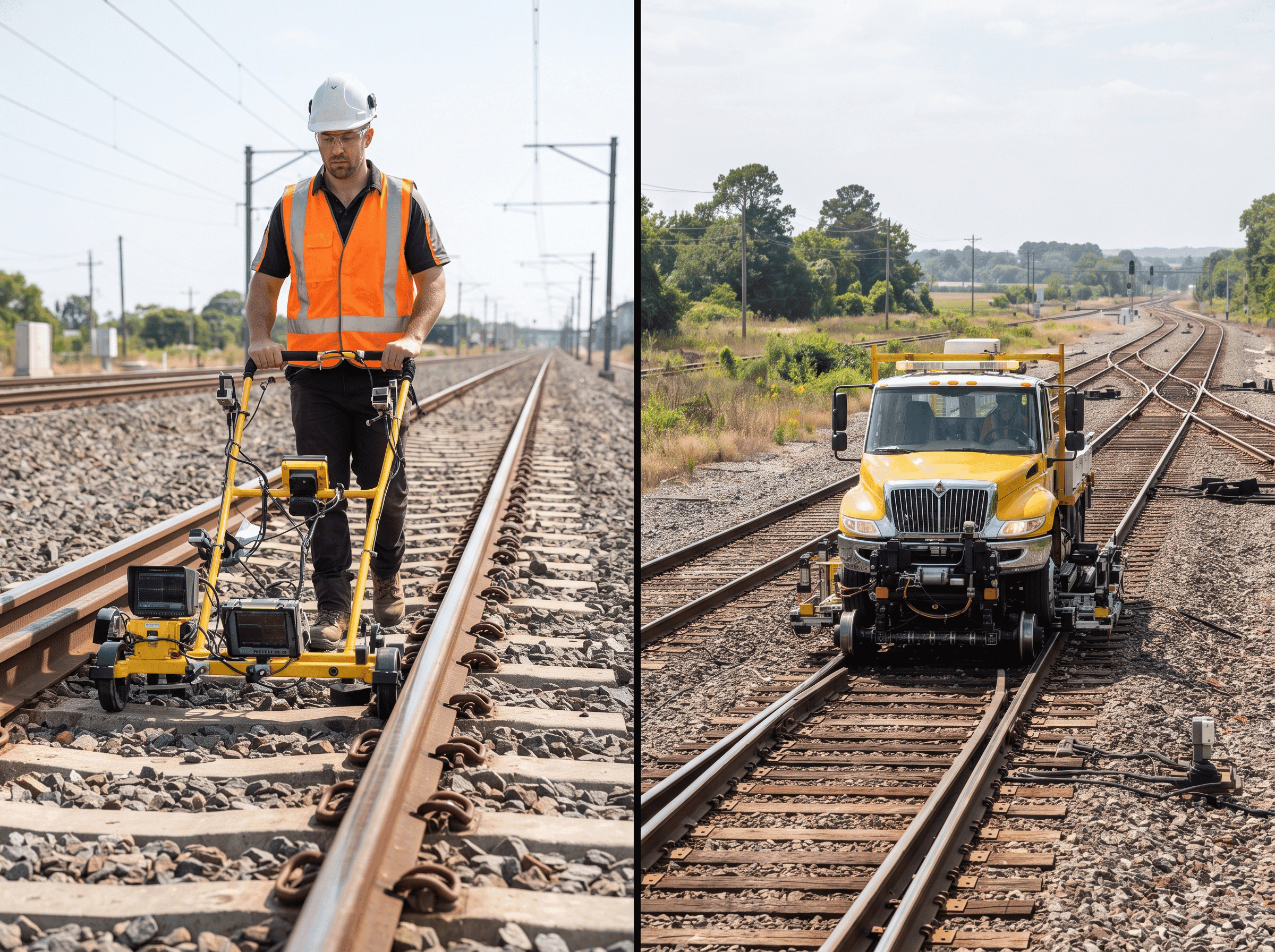
Internal rail testing depends on technology capable of examining areas that ordinary visual inspections cannot adequately evaluate. Ultrasonic testing is one of the most important nondestructive examination techniques used for this purpose.
Ultrasonic testing sends high-frequency sound energy into the material and analyzes returning signals to identify changes associated with internal discontinuities. In railroad applications, the technique can help identify hidden flaws in rail without cutting or otherwise damaging the rail.
The value of ultrasonic examination becomes clearer when considering the nature of rail defects. A flaw can develop inside the rail head, web, or other areas without creating a large visible indication on the surface. A specialized inspection system can provide information that visual inspection alone cannot.
That is one reason rail testing frequency requirements are closely connected with the availability and effective use of specialized rail flaw detection equipment.
What Happens When a Test Finds a Rail Defect?
Finding a potential defect is only the beginning of the response process.
When a rail-testing system identifies a suspected indication, the railroad may need to verify the indication and determine what action the applicable rules require. The appropriate response depends on the type, location, severity, and circumstances surrounding the defect.
A simplified process can look like this:
- Detect the indication
Specialized equipment identifies a response that may represent an internal rail flaw. - Evaluate or verify the indication
Qualified personnel assess the finding using the applicable inspection procedure. - Determine the required response
The railroad evaluates whether the condition requires repair, replacement, speed restriction, removal from service, or another prescribed action. - Document the result
Inspection information and corrective action become part of the railroad's maintenance and safety records. - Use the result in future scheduling
Defect patterns and service-failure information can influence future inspection planning.
This final step is particularly important. An inspection program should learn from its own results rather than treating every test as an isolated event.
The FRA's continuous rail-testing framework illustrates how quickly a suspected defect may require attention. Under the applicable continuous-testing provisions, railroads can collect location-specific data while moving along the track, followed by analysis and field response when indications require verification.
A valid inspection also depends on proper equipment performance and qualified operators. Section 213.237 requires the person operating rail defect detection equipment to be qualified under §213.238 and proficient in the rail flaw detection process for the equipment being used.
The point is simple: an inspection interval has little value if the inspection itself cannot produce a dependable search.
That leads to the practical question facing every track owner: how can a testing program satisfy the rules while also responding to the actual behavior of the rail?
Why More Frequent Testing Can Make Sense
Meeting the minimum standard does not always mean that a railroad has chosen the most protective testing interval.
High-tonnage routes, heavily curved track, passenger operations, hazardous-material routes, areas with recurring defects, and sections exposed to demanding environmental conditions may justify more frequent testing.
The FRA's current compliance guidance specifically describes inspection frequency as something influenced by detected defect rates, service-failure rates, and accumulated tonnage. It also explains that the self-adaptive scheduling approach can require increased testing frequency when performance indicates a need for it.
This is where rail testing frequency requirements become more than a compliance checklist. The regulatory framework establishes minimum boundaries, while a railroad's inspection history can help determine whether those boundaries provide an appropriate safety margin.
For example, two similar track segments may have identical track classifications but very different inspection histories. One may consistently produce few indications, while the other may show recurring defects in the same general area. Treating both segments identically would ignore useful information.
Weather and rail temperature can also matter. Thermal conditions affect rail behavior, while curvature and residual stresses can contribute to different loading conditions. FRA guidance has specifically identified these types of variables as factors that may be considered when selecting an inspection frequency.
More frequent testing can also provide more data. Repeated inspection results can help identify trends, recurring locations, and changes in defect behavior over time.
FRA has noted that modern continuous rail-testing technology can make more frequent testing easier and can generate larger quantities of inspection data for understanding how defects develop.
In that sense, increased testing is not simply about adding more inspection dates. It can create a better picture of rail condition.
How Often Should Railroad Tracks Be Inspected?
This question needs a careful answer because “track inspection” can refer to several different activities.
Routine visual track inspections are governed by requirements that differ from those covering internal rail flaw inspections. Section 213.233 addresses visual track inspections, while §213.237 addresses internal rail inspections. FRA's track-safety program treats both as important parts of railroad safety.
Therefore, rail testing frequency requirements should not be used as a substitute for the separate inspection requirements that apply to the overall track structure.
A railroad can conduct routine inspections for visible track conditions while separately conducting internal rail flaw testing with specialized equipment. The schedules can differ because the inspections serve different purposes.
The distinction also explains why an answer like “once a year” may be misleading when someone asks how often railroad tracks should be inspected. The correct interval depends on the type of inspection, track class, applicable federal requirements, traffic, and other operating factors.
Building a Practical Rail Testing Schedule
A strong testing program begins with the regulatory requirements and then adds information about actual track performance.
A practical scheduling process can follow five basic steps:
- Identify the track classification and operating profile.
Determine the track class and establish whether regularly scheduled passenger trains or hazardous-material operations affect the applicable requirements. - Track accumulated gross tonnage.
Maintain accurate tonnage information from the previous internal inspection so that the applicable threshold does not arrive unexpectedly. - Review previous inspection results.
Compare defect indications, service failures, recurring locations, and other inspection findings. - Consider track-specific risk factors.
Account for curvature, rail section, temperature conditions, residual stress, traffic patterns, maintenance history, and other relevant variables. - Set and document the inspection interval.
Establish a schedule that satisfies the federal framework and reflects the actual risk and performance of the track.
This approach turns rail testing frequency requirements into an active rail-integrity management process.
Documentation is especially important. Accurate records allow track owners to determine when the previous inspection occurred, how much tonnage accumulated afterward, what defects were detected, and whether the chosen interval produced satisfactory results.
The data also supports future decisions. If a particular segment repeatedly generates indications, the historical record can provide evidence for increasing inspection frequency or taking other maintenance action.
What Railroads Should Consider Beyond the Minimum Requirement
A testing program also has to work in the real world.
Inspection vehicles and qualified personnel may have limited availability. Maintenance windows can change because of train schedules, weather, construction, emergency work, or other operational demands. A sound program therefore requires planning rather than relying on a last-minute response.
Modern inspection technology can help. FRA's continuous rail-testing rule was designed to allow qualifying ultrasonic and GPS-based technology to examine rail while the test vehicle continues moving, reducing some of the operational limitations associated with repeated stopping and verification.
The result can be a more flexible inspection operation without abandoning the underlying safety objective.
At the same time, railroads should avoid assuming that automated technology eliminates the need for trained personnel. Inspection data must be interpreted correctly, suspected indications must receive appropriate attention, and required remedial actions must be completed.
FRA's inspection guidance emphasizes the importance of valid searches and qualified operators. When equipment does not perform as intended or a valid search cannot be completed, the affected rail cannot simply be treated as successfully inspected.
This is another reason rail testing frequency requirements should be considered together with inspection quality. A frequent but unreliable test does not provide the same value as a properly executed examination.
Final Thoughts
Railroads cannot follow one testing schedule and expect it to fit every mile of track. Rail testing frequency requirements vary because rail conditions, traffic, track class, accumulated tonnage, and the type of service can all change from one location to another.
For Class 4 and Class 5 track, along with qualifying Class 3 track, federal rules generally require internal rail inspections within 370 days or 30 million gross tons, whichever comes first. Some other Class 3 track follows a different schedule, including annual and 18-month provisions, a 30-million-gross-ton provision, and a five-year limit.
Ultrasonic testing is particularly valuable because some rail defects develop beneath the surface and remain difficult to spot during an ordinary visual inspection. Modern rail-testing systems can also examine substantial lengths of track efficiently, giving railroad teams more information when deciding where additional attention may be needed.
In the end, rail testing frequency requirements provide the regulatory starting point, not the entire rail-safety strategy. The strongest programs combine those requirements with reliable inspection data, experienced personnel, suitable testing equipment, and sound maintenance decisions.
Key Takeaways
- Rail testing frequency requirements change according to track class, traffic patterns, tonnage, and operating conditions.
- Internal rail testing looks for hidden flaws that routine visual inspections may miss.
- Federal regulations use both elapsed time and accumulated gross tonnage when establishing certain inspection intervals.
- Heavily trafficked routes can reach their applicable tonnage threshold much sooner than quieter routes.
- Passenger operations and hazardous-material routes can bring additional considerations into the rail inspection schedule.
- A history of recurring defects may signal that testing should happen more frequently.
- Ultrasonic inspection helps identify internal discontinuities without requiring the rail to be removed.
- Rail testing frequency requirements become more useful when inspection findings are reviewed alongside maintenance and traffic records.
- Experienced personnel are needed to operate detection equipment and properly assess questionable inspection indications.
- A practical testing program applies rail testing frequency requirements while also responding to the actual condition of the track.
Frequently Asked Questions
How often should inspections be conducted?
Yes. Railroad inspections need to follow the requirements that apply to the particular track and inspection method. Internal rail testing may be governed by both time and accumulated gross tonnage, while routine track inspections have their own schedules. Rail testing frequency requirements therefore do not mean that every railroad track must undergo the same type of inspection at the same interval.
What is inspection in railway?
Yes. Railway inspection is the process of checking rails, track components, and related infrastructure for conditions that could affect safe train operations. The work can include visual examinations, measurements, track geometry testing, and nondestructive examination. Rail testing frequency requirements specifically help determine how often certain internal rail inspections must be performed under applicable federal rules.
What is the inspection checklist?
Yes. A railroad inspection checklist can include rail condition, gauge, alignment, joints, fasteners, ties, ballast, drainage, crossings, and visible signs of damage or deterioration. An internal rail-testing record can also include the test date, accumulated tonnage, areas examined, indications found, verification results, and corrective measures. The exact checklist varies according to the inspection being performed and the railroad’s procedures.
How often are rail tracks replaced?
No. Rail does not have a fixed replacement age that applies across every railroad. Heavy traffic, accumulated tonnage, wear, rail type, environmental exposure, maintenance practices, defects, and operating conditions can all affect service life. Rather than replacing rail simply because it has reached a certain age, railroads generally use inspection findings and maintenance records to decide when replacement is warranted.