

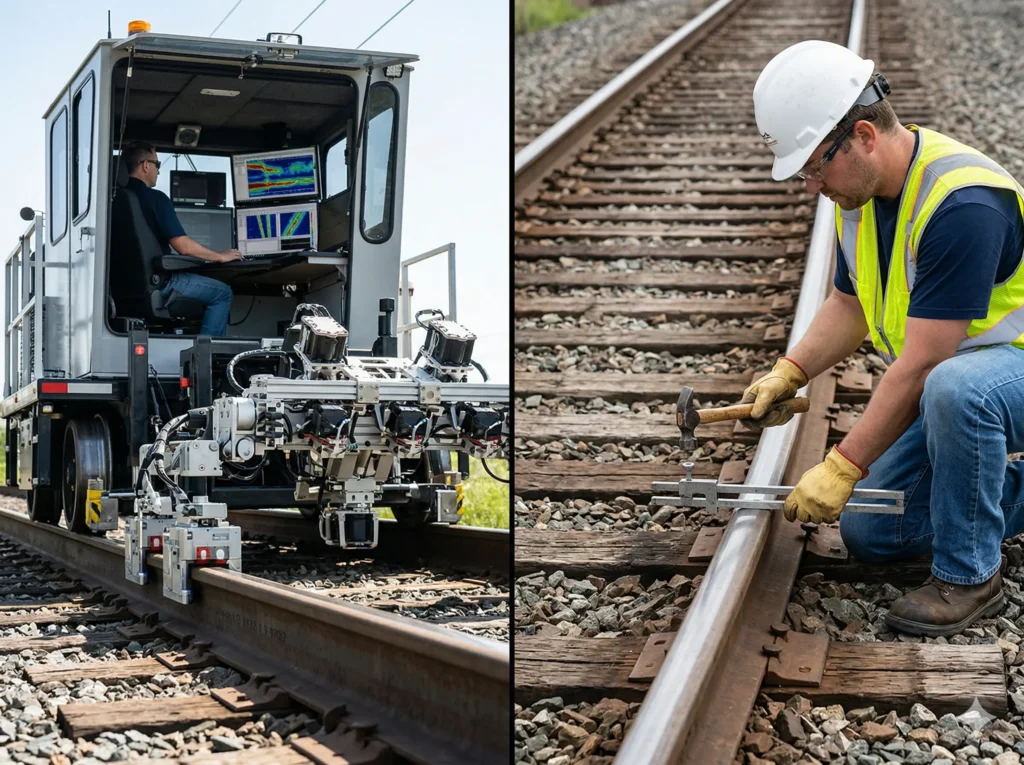
Railway safety has always depended on consistent and accurate inspection systems, and today the conversation around URFS vs Traditional Railway Inspection Methods is more relevant than ever. As rail networks expand and operational speeds increase, the comparison of URFS vs Traditional Railway Inspection Methods continues to shape how infrastructure is monitored and maintained. In fact, understanding URFS vs Traditional Railway Inspection Methods has become essential for railway operators aiming to balance safety, efficiency, and technological advancement.
Railway inspection refers to the systematic evaluation of tracks, components, and infrastructure to ensure safe train operations. For decades, this process relied heavily on manual labor and human expertise. Inspectors walked miles of track, visually scanning for defects, while specialized vehicles provided limited data insights.
However, the modern railway ecosystem demands more. High-speed trains, dense traffic, and aging infrastructure create a complex environment where traditional inspection struggles to keep up. Subtle defects can escalate quickly, and delays in detection can lead to costly or even dangerous outcomes.
The industry now stands at a turning point, where technology is no longer optional but necessary. While traditional inspection laid the foundation for railway safety, newer systems promise speed, accuracy, and real-time intelligence.
But what exactly defines these traditional methods, and why are they beginning to fall short in today’s fast-evolving railway landscape? The answer unfolds in the next section.
What Is Traditional Railway Inspection?
Traditional railway inspection is the process of manually examining railway tracks and infrastructure using visual checks, mechanical tools, and specialized inspection vehicles. This method has served as the backbone of railway safety for decades, relying primarily on trained personnel and periodic assessments.
Inspectors play a central role in this approach. They physically traverse railway lines, looking for visible defects such as cracks, misalignments, or wear. In addition to manual observation, railways deploy equipment like track geometry cars and handheld ultrasonic devices to detect internal flaws.
Despite its long-standing reliability, this method depends heavily on human judgment and scheduled inspections rather than continuous monitoring.
Key Characteristics of Traditional Railway Inspection
Traditional inspection methods exhibit several defining traits that have shaped railway maintenance practices over time.
Manual visual checks form the foundation of this approach. Inspectors rely on their experience to identify irregularities, often working in challenging environments and varying weather conditions.
Track geometry cars provide a more structured analysis. These vehicles measure alignment, gauge, and elevation, offering valuable but periodic data snapshots rather than continuous monitoring.
Ultrasonic testing, often conducted manually, helps detect internal rail flaws. While effective, it requires skilled operators and can be time-consuming.
Ground Penetrating Radar is also used in certain cases to assess subsurface conditions. However, its deployment typically involves manual setup and limited coverage.
For decades, these methods have defined railway inspection standards across the globe. They have ensured safety and reliability, but their limitations are becoming increasingly evident as railway systems evolve.
What Are the 4 Types of Railway Inspections?
The four main types of railway inspections are visual inspection, geometric inspection, ultrasonic or non-destructive testing (NDT), and structural or civil inspection. Each type focuses on a specific aspect of railway infrastructure, collectively ensuring operational safety.
The Four Main Types
Visual inspection involves direct observation of tracks, fasteners, and surrounding components. Inspectors look for obvious defects such as cracks, corrosion, or misalignment. This method remains the most basic and widely used form of inspection.
Geometric inspection evaluates the physical alignment and dimensions of the track. Specialized vehicles measure parameters like gauge, curvature, and track elevation. These measurements help identify deviations that could affect train stability.
Ultrasonic or non-destructive testing focuses on detecting internal flaws within the rail. Using sound waves, inspectors can identify cracks or defects that are not visible externally. This method plays a critical role in preventing rail failures.
Structural or civil inspection examines bridges, tunnels, and supporting infrastructure. Engineers assess structural integrity, ensuring that all components can withstand operational loads and environmental conditions.
Each inspection type contributes to overall railway safety, yet they all share a common limitation: they often operate in isolation and lack real-time integration.
If these methods have worked for decades, what exactly is causing the growing concern around their effectiveness today? The next section reveals the hidden challenges.
Limitations of Traditional Inspection Methods in Railway
Despite their historical importance, traditional railway inspection methods face several critical challenges in modern railway systems. These limitations directly impact efficiency, safety, and scalability.
Human error remains one of the most significant concerns. Since inspections rely heavily on manual observation, results can vary depending on the inspector’s experience, fatigue, and environmental conditions. Even a small oversight can lead to major consequences.
Operational disruptions also pose a major issue. Many traditional inspections require track closures or reduced train speeds, which can disrupt schedules and reduce network efficiency. In high-traffic rail systems, such interruptions are increasingly difficult to manage.
Speed is another limitation. Inspecting large railway networks manually takes time, making it difficult to maintain frequent inspection cycles. As networks grow, this challenge becomes even more pronounced.
Data gaps further complicate the process. Traditional methods often produce fragmented or delayed data, making it difficult to achieve real-time insights. Without continuous monitoring, railway operators may miss early warning signs of potential failures.
These limitations highlight a growing mismatch between traditional inspection capabilities and modern railway demands.
As railway systems push for greater efficiency and safety, a new approach begins to take center stage, one that promises automation, precision, and real-time intelligence. But what exactly is this system, and how does it work? The answer lies ahead.
What Is URFS and How Does It Work in Railway Inspection?
URFS, commonly referred to as an Ultrasonic Rail Flaw Scanner or Under-Rail Flaw System, is an advanced inspection technology designed to detect rail defects using automated, high-speed ultrasonic scanning. This system represents a significant evolution in railway inspection practices.
Unlike traditional methods, URFS operates with minimal human intervention. It uses sensors and automated systems to continuously scan railway tracks, identifying both surface and internal defects with high precision.
The growing adoption of URFS vs Traditional Railway Inspection Methods reflects the industry’s shift toward smarter and more efficient inspection solutions. By enabling faster and more accurate data collection, URFS addresses many of the challenges associated with manual inspection.
Core Technology Behind URFS
URFS relies on several advanced technologies that set it apart from traditional inspection systems.
Automated ultrasonic sensors form the core of the system. These sensors emit sound waves into the rail and analyze the returned signals to detect internal flaws. This process allows for highly accurate defect identification without manual intervention.
Real-time data capture ensures that inspection results are immediately available. Unlike traditional methods, which may involve delays in data processing, URFS provides instant insights that enable quicker decision-making.
Integration with digital reporting systems further enhances its effectiveness. Data collected by URFS can be stored, analyzed, and shared across platforms, creating a comprehensive and centralized inspection record.
Railway operators increasingly recognize the advantages of URFS vs Traditional Railway Inspection Methods, particularly in terms of efficiency, accuracy, and scalability.
As technology continues to reshape the railway industry, URFS stands out as a transformative solution. But how does it truly compare to traditional methods when evaluated side by side? That comparison reveals insights that may redefine railway inspection standards altogether.
URFS vs Traditional Railway Inspection Methods: A Head-to-Head Comparison
The debate around URFS vs Traditional Railway Inspection Methods becomes clearer when both approaches are evaluated side by side. While traditional inspection has long served the industry, URFS introduces capabilities that align more closely with modern railway demands.
Speed stands out as one of the most noticeable differences. Traditional inspections often require slow-moving vehicles or manual track walking, which limits coverage per day. In contrast, URFS systems can scan tracks at higher speeds without compromising accuracy, allowing larger sections of railway to be inspected in significantly less time. This efficiency directly supports expanding rail networks.
Accuracy also plays a critical role. Traditional inspection depends on human observation and periodic testing, which can lead to inconsistencies. URFS, however, uses automated ultrasonic sensors that deliver precise and repeatable results. This consistency reduces the chances of missed defects and improves overall reliability.
Cost presents a more nuanced comparison. Traditional methods may appear less expensive initially, as they rely on existing workforce and tools. However, over time, the need for repeated inspections, labor costs, and potential disruptions can increase operational expenses. URFS systems, while requiring upfront investment, often result in long-term savings due to reduced downtime and improved efficiency.
Operational disruption further differentiates these approaches. Traditional inspections frequently require track closures or restricted train movement. URFS minimizes such disruptions by performing inspections at operational speeds, ensuring that railway services continue with minimal interruption.
Data output marks another significant advantage. Traditional methods often generate fragmented or delayed reports, making it difficult to maintain a complete picture of track conditions. URFS provides real-time, integrated data that supports predictive maintenance and faster decision-making.
The comparison of URFS vs Traditional Railway Inspection Methods clearly highlights a shift toward automation and data-driven processes. Yet, beyond these technical differences lies a deeper impact on safety and reliability.
So, how does this technological advancement translate into real-world accuracy and trust in railway operations? The next section explores this critical aspect.
Accuracy and Reliability: Where URFS Pulls Ahead
Accuracy forms the backbone of railway safety, and this is where URFS demonstrates a clear advantage. By leveraging automated ultrasonic technology, URFS significantly improves defect detection rates compared to traditional inspection methods.
Traditional inspection methods often depend on periodic assessments, which means defects can develop between inspection cycles. This gap increases the risk of undetected flaws. In contrast, URFS enables more frequent and consistent inspections, reducing the likelihood of defects going unnoticed.
Another key factor is the reduction of false negatives. Traditional methods may miss subtle internal flaws due to human limitations or environmental conditions. URFS systems, with their advanced sensors, can detect even minor irregularities within the rail structure. This level of precision enhances confidence in inspection results.
Reliability also improves through data consistency. Since URFS operates with automated systems, it eliminates variability caused by human factors such as fatigue or subjective judgment. The result is a standardized inspection process that delivers dependable outcomes across different conditions.
Industry observations indicate that adopting URFS vs Traditional Railway Inspection Methods leads to a measurable improvement in safety metrics. Railway operators benefit from earlier detection of issues, allowing proactive maintenance rather than reactive repairs.
Cost and Operational Efficiency
Cost considerations often drive decision-making in railway operations, and the comparison of URFS vs Traditional Railway Inspection Methods offers valuable insights into both short-term and long-term financial implications.
Traditional inspection methods typically involve ongoing labor costs, repeated inspections, and operational disruptions. While the initial investment may seem lower, these recurring expenses can accumulate over time. Additionally, delays caused by track closures can impact revenue and service reliability.
URFS, on the other hand, introduces a different cost structure. Although it requires a higher upfront investment in technology, it significantly reduces long-term operational costs. Automated inspections minimize the need for extensive manual labor, while faster inspection speeds reduce downtime.
Efficiency gains extend beyond cost savings. URFS enables continuous monitoring and real-time reporting, allowing railway operators to identify and address issues before they escalate. This proactive approach reduces the likelihood of major repairs and service interruptions.
Another critical factor is track availability. Traditional methods often require scheduled closures, which can disrupt operations. URFS systems operate with minimal interference, ensuring that rail networks remain functional during inspections.
The growing adoption of URFS vs Traditional Railway Inspection Methods reflects the industry’s recognition of these efficiency benefits. As railway systems aim to optimize performance and reduce costs, URFS emerges as a practical and forward-looking solution.
But beyond cost and efficiency, how does URFS perform in real-world railway environments? The next section uncovers how global networks are already putting this technology into action.
Real-World Applications of URFS in Railway Networks
Across the globe, railway operators are increasingly integrating URFS into their inspection strategies. This shift highlights the practical value of URFS vs Traditional Railway Inspection Methods in real-world scenarios.
In high-speed rail networks, where precision and reliability are critical, URFS plays a vital role in maintaining track integrity. Its ability to detect defects at high speeds ensures that inspections keep pace with operational demands.
Freight rail systems also benefit from URFS adoption. Heavy loads and continuous usage place significant stress on tracks, making frequent and accurate inspections essential. URFS provides the necessary monitoring capabilities to support these demanding conditions.
Urban transit networks, including metro systems, use URFS to maintain safety while minimizing service disruptions. Since these systems operate on tight schedules, the ability to conduct inspections without halting operations becomes a major advantage.
The adoption of URFS vs Traditional Railway Inspection Methods continues to expand as railway authorities recognize its impact on safety, efficiency, and reliability. Real-world implementations demonstrate that URFS is not just a theoretical improvement but a proven solution.
Final Thoughts
The comparison of URFS vs Traditional Railway Inspection Methods reveals a clear evolution in how railway infrastructure is monitored and maintained. While traditional methods have played a crucial role in ensuring safety over the years, their limitations are becoming increasingly evident in modern railway systems.
URFS introduces a new standard by combining automation, accuracy, and real-time data capabilities. It addresses the challenges of human error, operational disruption, and delayed reporting, offering a more efficient and reliable approach to inspection.
As railway networks continue to grow and evolve, the importance of adopting advanced technologies becomes undeniable. The shift toward URFS vs Traditional Railway Inspection Methods reflects a broader transformation within the industry—one that prioritizes safety, efficiency, and innovation.
EMA Quality Industries remains at the forefront of this transformation, delivering cutting-edge inspection solutions that meet the demands of modern railway systems. By embracing advanced technologies like URFS, railway operators can ensure safer and more efficient operations for the future.
Key Takeaways
- URFS enables faster inspection speeds while maintaining high accuracy across large railway networks
- Traditional inspection methods rely heavily on manual processes, increasing the chances of human error
- URFS systems provide real-time data, allowing quicker decision-making and proactive maintenance planning
- Railway operators benefit from reduced track downtime when using URFS instead of traditional inspection methods
- Traditional inspection often produces fragmented data, limiting the ability to detect issues early
- URFS improves defect detection rates by identifying both surface and internal rail flaws efficiently
- Long-term operational costs are reduced with URFS despite the higher initial investment required
- Traditional inspection struggles to keep up with expanding and high-speed railway infrastructure demands
- URFS supports digital integration, enabling centralized reporting and advanced data analysis capabilities
- The growing adoption of URFS vs Traditional Railway Inspection Methods reflects a shift toward smarter railway systems
FAQs
What is inspection and its types?
Inspection is the process of examining railway tracks and infrastructure to ensure safety and performance.It includes visual, geometric, ultrasonic, and structural inspections. Each type focuses on identifying specific defects or risks within the railway system.
Which is the most basic and common inspection method?
Visual inspection is the most basic and widely used method in railway systems. Inspectors manually examine tracks for visible defects such as cracks or misalignment. It remains essential but has limitations in detecting internal flaws.
What is a traditional method example?
A common traditional method example is manual track walking inspection. Inspectors physically walk along the tracks to identify visible defects and irregularities. This method relies heavily on human observation and experience.
What are the 4 types of quality inspection?
The four types include visual inspection, dimensional inspection, functional testing, and non-destructive testing. In railways, these align closely with track condition monitoring and defect detection methods. Each type ensures that infrastructure meets required safety and performance standards.
What are the three different types of inspection methods?
Three key inspection methods are visual inspection, ultrasonic testing, and geometric measurement. These methods work together to assess both surface-level and internal track conditions. They form the foundation of traditional railway inspection practices.
