
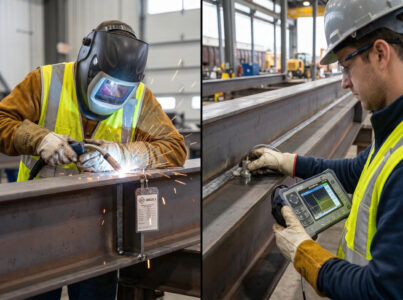
AWS D1.1 Weld Inspection stands as one of the most critical processes in structural steel construction today. Engineers, fabricators, and inspectors rely on AWS D1.1 Weld Inspection to ensure that every weld meets the strict safety and quality standards required for structural integrity. Without a thorough AWS D1.1 Weld Inspection process in place, even a single compromised weld joint can put an entire structure and the people within it, at serious risk.
The American Welding Society developed the D1.1 Structural Welding Code to create a unified framework for welding steel structures. This code defines everything from welder qualifications and welding procedures to detailed inspection protocols and acceptance criteria. Whether the project involves bridges, buildings, or industrial infrastructure, the standard serves as the authoritative reference for quality assurance in structural steel welding.
This article breaks down the core elements of AWS D1.1 Weld Inspection, covering what inspectors look for, the methods they use, and the criteria that determine whether a weld passes or fails.
What Is AWS D1.1 and Why Does It Matter?
The AWS D1.1 Structural Welding Code: Steel is the most widely referenced welding standard in the United States. The American Welding Society first published it in 1972, and it has undergone multiple revisions since then to reflect advances in materials, technology, and engineering practice.
The code applies to a broad range of stakeholders:
- Structural fabricators producing steel components for construction
- Certified Welding Inspectors (CWIs) responsible for quality verification
- Engineers and project owners who specify welding requirements
- Contractors performing field welding on structural assemblies
According to the American Welding Society, there are currently over 90,000 active Certified Welding Inspectors in the United States alone, a figure that reflects just how central inspection is to the welding industry.
The standard covers three major areas: welding procedure qualifications, welder performance qualifications, and inspection requirements. Each area connects directly to the others. A welder must follow a qualified procedure, and an inspector must verify that the result meets the code’s acceptance criteria.
The reach of this code extends across industries. From highway overpasses to high-rise steel frames, AWS D1.1 Weld Inspection governs the quality of welds that millions of people depend on every day. Understanding the standard is not optional for anyone working in structural steel, it is a professional necessity.
What Are the Inspection Requirements in AWS D1.1?
AWS D1.1 requires inspection to occur at every stage of the welding process, not just at the end. The standard divides inspection responsibilities between the contractor and the engineer of record, each carrying distinct duties that together form a complete quality management system.
The code recognizes two primary inspection roles:
Contractor Inspection: The contractor’s own quality control team performs this inspection. They verify that welding procedures, materials, equipment, and welder qualifications all comply with the approved documents before and during welding.
Verification Inspection: An independent inspector, typically hired by the owner or engineer, confirms that the contractor’s work meets the requirements of AWS D1.1. This layer of oversight adds accountability to the process.
A Certified Welding Inspector (CWI), credentialed by the American Welding Society, typically carries out both roles across different projects. The CWI must have documented knowledge of welding processes, metallurgy, and inspection techniques.
Before, During, and After Welding Inspection
AWS D1.1 structures inspection into three distinct phases:
- Pre-weld Inspection: Verify base metal identification, joint fit-up, preheat temperature, cleanliness of the weld area, and that the correct welding procedure specification (WPS) is in use.
- In-Process Inspection: Monitor interpass temperature, travel speed, electrode classification, heat input, and bead placement throughout the welding operation.
- Post-weld Inspection: Examine completed welds for surface discontinuities visually, and conduct non-destructive testing (NDT) as specified by the contract documents or the code itself.
Each phase catches a different category of defects. Pre-weld checks prevent setup errors. In-process monitoring catches technique problems as they happen. Post-weld inspection confirms the final result meets the code’s acceptance criteria.
Now that the inspection framework is clear: what exactly does the code say a weld must look like to pass? The acceptance criteria go deeper than most people expect, and the details matter enormously.
What Are the Acceptance Criteria for AWS D1.1?
The acceptance criteria in AWS D1.1 define the boundary between a weld that is fit for service and one that must be repaired or removed. The standard sets these criteria separately for visual inspection and for each non-destructive testing method used.
It is important to understand that not all discontinuities mean rejection. A discontinuity is any interruption in the typical structure of a weld. A defect, however, is a discontinuity that exceeds the acceptance criteria of the code. AWS D1.1 Weld Inspection distinguishes between the two precisely because weld discontinuities within allowable limits do not compromise structural performance.
Visual Inspection Acceptance Criteria
Visual Testing (VT) is always the first step in any AWS D1.1 Weld Inspection. The inspector examines the completed weld surface with the naked eye, aided by adequate lighting and sometimes a magnifying lens. The code specifies the following visual acceptance criteria for statically loaded structures:
- Cracks: No cracks of any size or orientation are permitted in the weld or base metal heat-affected zone
- Porosity: Pipe porosity greater than 3/32 inch in diameter is not acceptable; frequency limits also apply
- Undercut: Undercut adjacent to the weld toe must not exceed 1/32 inch for primary members
- Overlap: No overlap (cold lap) is permitted; the weld metal must fuse smoothly with the base material
- Crater filling: All craters must be filled to the full cross-section of the weld before the arc is extinguished
- Weld size: The weld must meet the minimum size specified on the drawing; undersized welds are rejectable
The table below summarizes the key visual discontinuity limits under AWS D1.1 for statically loaded structures:
| Discontinuity Type | Acceptance Limit (Statically Loaded) |
| Cracks | None permitted |
| Porosity (pipe) | Max 3/32 inch diameter |
| Undercut depth | Max 1/32 inch for primary members |
| Overlap | None permitted |
| Incomplete fusion | None permitted |
| Weld profile | Must meet drawing dimensions |
These limits represent the minimum standard. Some project specifications impose stricter criteria, particularly in seismic applications or cyclically loaded structures where fatigue performance is critical. In those cases, the project-specific requirements govern over the base code limits.
Visual inspection alone, however, cannot detect subsurface flaws, discontinuities hidden below the weld surface that may be just as dangerous as surface defects. That is where non-destructive testing methods become essential, and the range of methods available under AWS D1.1 Weld Inspection is broader than many assume.
Non-Destructive Testing Methods Used in AWS D1.1 Weld Inspection
AWS D1.1 Weld Inspection recognizes several non-destructive testing methods, each suited to detecting different types and locations of discontinuities. The standard does not require all methods on every project, the engineer of record, contract documents, or specific code provisions determine which methods apply.
The recognized NDT methods include:
- Visual Testing (VT): The baseline inspection method; required on all welds before any other NDT is performed
- Ultrasonic Testing (UT): The preferred method for detecting internal discontinuities in groove welds; particularly effective on thicker material sections
- Radiographic Testing (RT): Uses X-ray or gamma-ray imaging to reveal internal flaws; provides a permanent film record of the weld
- Magnetic Particle Testing (MT): Detects surface and near-surface discontinuities in ferromagnetic materials using magnetic fields and iron particles
- Penetrant Testing (PT): Reveals surface-breaking discontinuities using a liquid dye that seeps into open flaws and is then made visible under UV or white light
Each method has strengths and limitations. RT produces excellent documentation but involves radiation safety protocols and access requirements. MT works rapidly on surface defects but cannot penetrate deep into the weld. UT offers the most versatile detection capability for internal flaws and works efficiently on thick structural sections.
AWS D1.1 Weld Inspection specifies that UT is required for complete joint penetration (CJP) groove welds in tension that are subject to primary stress, one of the most critical weld categories in structural steel design. The specific UT acceptance criteria, equipment calibration procedures, and flaw classification methods deserve a detailed look of their own.
Ultrasonic Testing Requirements Under AWS D1.1 Weld Inspection
Ultrasonic Testing stands as the most widely used subsurface inspection method in AWS D1.1 Weld Inspection. It works by sending high-frequency sound waves into the weld metal and measuring how those waves reflect back. When a sound wave encounters a discontinuity: a crack, lack of fusion, or inclusion, it reflects differently than it would through sound, homogeneous metal. The inspector reads those reflections on a display screen and interprets them against the code’s acceptance criteria.
AWS D1.1 Weld Inspection requires UT on complete joint penetration groove welds in tension that carry primary stress. The standard mandates UT for base metal thicknesses of 5/16 inch and greater in these weld categories. For thinner material, other methods such as RT may apply depending on contract requirements.
The code sets specific equipment and calibration requirements that every UT inspector must follow before beginning an examination:
- The search unit (transducer) must produce a sound beam at the required angle: typically 45°, 60°, or 70° for shear wave inspection of groove welds
- Calibration must be performed using an IIW (International Institute of Welding) block or an approved alternative reference block
- The instrument must be calibrated at the start of each inspection and rechecked at least every two hours during continuous operation
- All calibration records must be documented and retained as part of the inspection record
Acceptance and Rejection Criteria for UT
AWS D1.1 Weld Inspection classifies ultrasonic indications into categories based on their severity. The standard uses a decibel-based rating system. Inspectors compare the amplitude of a reflected signal from a discontinuity against a reference level established during calibration.
The table below outlines the discontinuity classifications used in AWS D1.1 UT inspection:
| Classification | Description | Acceptance Status |
| Class A | Large discontinuity: always rejectable regardless of length | Reject |
| Class B | Medium discontinuity: rejectable if it exceeds length limits | Conditional |
| Class C | Small discontinuity: acceptable within defined frequency limits | Accept with limits |
| Class D | Minor discontinuity: always acceptable | Accept |
The rating level of an indication depends on the decibel difference between the indication amplitude and the reference level. Class A indications exceed the reference level by 10 dB or more and are always rejected. Class D indications fall 6 dB or more below the reference level and always pass. Classes B and C fall between those extremes, and their acceptance depends on the indication length relative to the weld thickness.
AWS D1.1 Weld Inspection also requires that UT inspectors hold a minimum qualification of AWS CAWI (Associate Welding Inspector) for basic UT support work, while Level II UT technicians certified per SNT-TC-1A or ASNT CP-189 perform and interpret the actual examination. This dual-qualification requirement ensures that both the welding knowledge and the NDT technical knowledge are present during every UT inspection.
Now that the UT requirements are fully laid out: how does the welding procedure itself factor into whether a weld ever reaches the inspection stage in good condition? That connection between procedure and outcome is where many compliance failures actually begin.
What Is the AWS D1.1 Welding Procedure?
The AWS D1.1 welding procedure defines the specific conditions under which a weld must be made to meet the requirements of the code. A welding procedure specification, commonly called a WPS, is the written document that records these conditions. Every production weld made under AWS D1.1 Weld Inspection must follow a qualified WPS.
The WPS tells the welder exactly how to perform the weld, what base metal to use, what filler metal to select, what preheat temperature to maintain, and what welding parameters to follow. It removes guesswork from the welding operation and creates a repeatable, documented process.
AWS D1.1 provides two pathways for establishing a qualified procedure:
Prequalified Procedures: The code allows certain combinations of base metals, filler metals, joint designs, and welding processes to be used without testing, provided they meet all the prequalification requirements listed in the standard. This pathway saves significant time and cost.
Qualified by Test: When a procedure falls outside the prequalified requirements, the contractor must weld test plates or pipe sections using the proposed procedure and submit them for mechanical testing. The test results are recorded in a Procedure Qualification Record (PQR), which supports the WPS.
Key Elements of a Compliant WPS
A complete WPS under AWS D1.1 Weld Inspection must document the following essential variables:
- Base metal type and thickness range: The specific steel specification and the range of thicknesses the procedure covers
- Filler metal classification: The AWS filler metal classification, trade name, and diameter
- Welding process: SMAW, GMAW, FCAW, SAW, or GTAW as applicable
- Joint design: Groove angle, root opening, root face dimensions, and backing type
- Welding position: Flat, horizontal, vertical, or overhead as qualified
- Preheat and interpass temperature: Minimum preheat and maximum interpass temperature limits
- Post-weld heat treatment (PWHT: Required when specified by the engineer for thick sections or certain steel grades
A WPS that omits or incorrectly states any of these essential variables is non-compliant. During AWS D1.1 Weld Inspection, the CWI verifies that the welder is actually following the WPS in effect, not a previous version, not a procedure from another project, and not a verbal instruction from a supervisor.
Common Defects Found During AWS D1.1 Weld Inspection
Even with qualified procedures and trained welders, defects occur. AWS D1.1 Weld Inspection exists precisely to catch these defects before the structure enters service. Understanding the most common defect types helps both inspectors and welders identify where process improvements are needed.
The most frequently encountered weld defects during AWS D1.1 Weld Inspection include:
- Porosity: Gas pockets trapped in the solidifying weld metal, caused by contamination, moisture, or improper shielding gas coverage
- Undercut: A groove melted into the base metal along the weld toe that reduces the effective cross-sectional area of the member
- Incomplete fusion: Weld metal that fails to fuse fully with the base metal or with adjacent weld passes, creating a planar discontinuity
- Cracks: The most serious weld defect category; hot cracks form during solidification, while cold cracks develop after cooling due to hydrogen embrittlement or residual stress
- Overlap (cold lap): Weld metal that rolls over the base metal surface without fusing to it, creating a notch-like condition
- Inadequate joint penetration: Incomplete penetration of the weld metal through the joint root on complete joint penetration welds
According to industry data published by the American Welding Society, incomplete fusion and porosity together account for a significant majority of weld rejections in structural steel fabrication. Both defects often trace back to procedural non-compliance: incorrect travel speed, improper heat input, or contaminated base metal surfaces.
As welding engineer and author Duane Miller noted in AWS technical publications, “The most effective way to prevent weld defects is to control the variables before the arc is struck, not to rely on inspection to find problems after the fact.” This perspective reinforces why AWS D1.1 Weld Inspection treats pre-weld verification as equally important as post-weld examination.
Knowing what defects look like is valuable, but knowing how to prevent them from appearing in the first place is what separates a competent welding operation from one that constantly battles rework and rejection.
Best Practices for Passing AWS D1.1 Weld Inspection
Consistently passing AWS D1.1 Weld Inspection requires more than skilled welders. It demands a structured quality management approach that begins long before the first arc is struck and continues through final documentation.
The following best practices give fabricators and contractors the strongest foundation for compliance:
- Qualify welders before production begins: Every welder must hold a current performance qualification for the process, position, and base metal thickness they will weld in production. Expired or inapplicable qualifications are a direct cause of inspection failure.
- Follow the approved WPS at all times: The WPS is not a suggestion. Inspectors check actual welding parameters against the WPS during in-process inspection. Deviations — even minor ones — can trigger rejection of the affected welds.
- Document every inspection stage: Maintain written records of pre-weld checks, in-process measurements, and post-weld examination results. AWS D1.1 Weld Inspection generates a paper trail that protects the contractor, the inspector, and the project owner.
- Calibrate NDT equipment before every inspection session: UT instruments drift over time and with temperature changes. Calibrating at the start of each session and rechecking every two hours ensures that indication readings remain accurate and defensible.
- Address non-conformances immediately: When a defect is found, the contractor must repair or remove the affected weld before proceeding with additional work in the same area. Continuing to weld over or around a known defect violates the code and compounds the problem.
Applying these practices consistently turns AWS D1.1 Weld Inspection from a stressful endpoint into a confirmation of work already done correctly.
Final Thoughts
AWS D1.1 Weld Inspection is far more than a final quality check: it is a complete system that governs how structural steel welds are planned, executed, and verified from start to finish. The standard’s acceptance criteria draw a clear line between welds that are safe for service and those that require correction. Its inspection requirements assign responsibility at every stage of the welding process, ensuring that no critical step goes unverified.
AWS D1.1 Weld Inspection covers visual examination, multiple non-destructive testing methods, ultrasonic testing protocols, and the procedure documentation that underpins every compliant weld. Together, these elements create a framework that structural projects across the United States and beyond depend on for public safety.
For fabricators, contractors, and project owners, investing in rigorous AWS D1.1 Weld Inspection is not a cost: it is a protection. Catching a defective weld during inspection costs a fraction of what a structural failure costs in repairs, liability, or human harm.
EMA Quality Industries brings deep expertise in AWS D1.1 Weld Inspection and structural welding compliance to every project it supports. Working with experienced inspectors who understand both the letter and the intent of the code is the most reliable path to structural welds that perform as designed: today and for decades to come.
Key Takeaways
- AWS D1.1 Weld Inspection governs the quality of all structural steel welds on construction projects.
- The standard applies to fabricators, contractors, engineers, and Certified Welding Inspectors on every project.
- Inspection must occur in three phases, pre-weld, in-process, and post-weld without exception.
- Visual Testing is always the first required step before any other NDT method is applied.
- Cracks, incomplete fusion, and overlap are never acceptable under any AWS D1.1 Weld Inspection criteria.
- Ultrasonic Testing is the primary method for detecting subsurface flaws in complete joint penetration groove welds.
- Every production weld must follow a qualified Welding Procedure Specification supported by proper documentation records.
- UT indications are classified from Class A to Class D, determining acceptance or rejection of each flaw.
- Common defects like porosity and incomplete fusion are largely preventable through strict welding procedure compliance.
- Early defect detection through thorough AWS D1.1 Weld Inspection eliminates costly rework and protects long-term structural safety.
FAQs
What are the acceptance criteria for UT?
AWS D1.1 classifies UT indications from Class A to Class D using a decibel-based rating system. Class A indications are always rejected, while Class D indications are always accepted. Classes B and C depend on indication length relative to weld thickness.
What is AWS D1.1 welder qualification?
It is the process where a welder proves the ability to produce code-compliant welds under specific conditions. The welder performs test welds that undergo visual and NDT examination. A valid qualification must match the actual production welding conditions.
How long is a D1.1 welder qualification test good for?
A D1.1 welder qualification stays valid as long as the welder uses the qualified process within every six-month period. If six months pass without using that process, the qualification expires and retesting is required.
What are the 5 defects of welding?
The five most common weld defects found during AWS D1.1 Weld Inspection are porosity, undercut, incomplete fusion, cracks, and overlap. Cracks are the most serious and are never acceptable under the code.
What is the difference between AWS D1.1 and ASME IX?
AWS D1.1 covers structural steel welding for buildings and bridges, while ASME Section IX applies to pressure vessels and piping. The two codes have different qualification requirements and acceptance criteria. A qualification under one does not satisfy the other.