

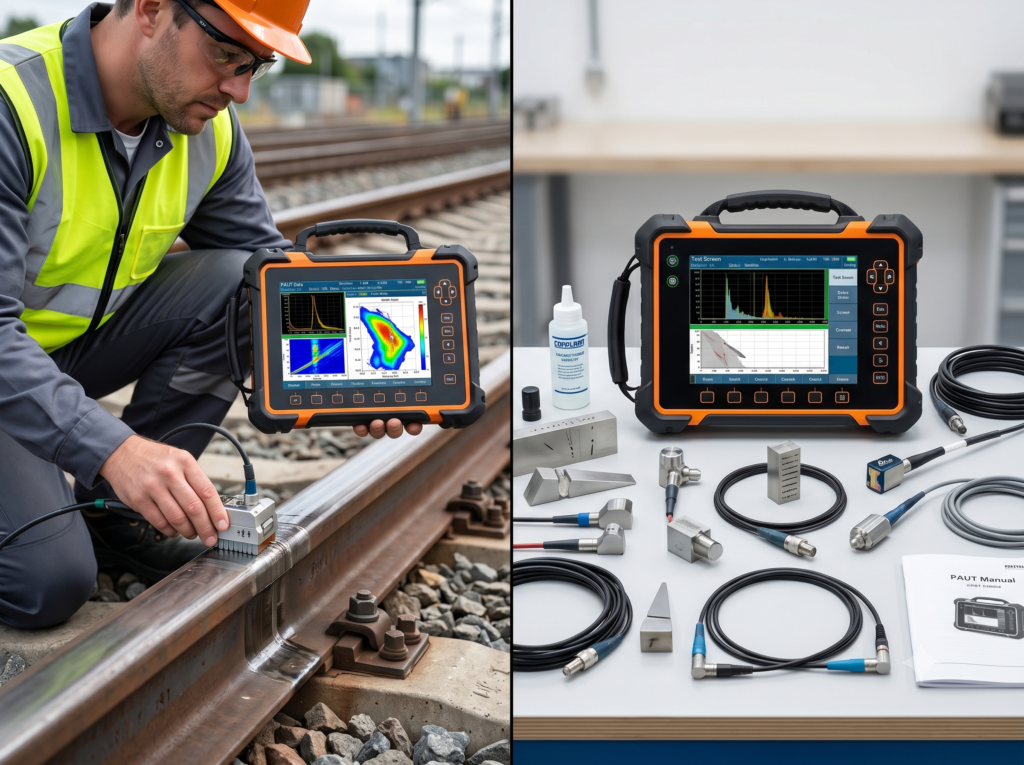
Phased Array Ultrasonic Testing Equipment has transformed the way industries perform non-destructive testing. Phased Array Ultrasonic Testing Equipment provides advanced imaging capabilities that help inspectors detect flaws with exceptional accuracy. Phased Array Ultrasonic Testing Equipment continues to gain popularity because industries demand safer, faster, and more reliable inspection methods.
Across sectors such as oil and gas, aerospace, power generation, and manufacturing, inspection quality directly affects safety and operational performance. Even a small defect can lead to equipment failure, costly downtime, or serious safety risks. As a result, companies increasingly rely on advanced testing technologies that deliver precise results without damaging the inspected component.
Among modern non-destructive testing methods, phased array technology stands out because it combines speed, flexibility, and detailed imaging. This guide explores the fundamentals of phased array systems, explains how they operate, examines their key components, and reviews the different types of equipment available today.
What Is Phased Array Ultrasonic Testing Equipment?
Phased Array Ultrasonic Testing Equipment refers to advanced ultrasonic inspection systems that use multiple ultrasonic elements within a single probe. Unlike conventional ultrasonic testing, which uses a single transducer element, phased array systems electronically control multiple elements to direct and focus sound beams.
Traditional ultrasonic testing often requires mechanical probe movement to inspect different angles. In contrast, Phased Array Ultrasonic Testing Equipment can steer ultrasonic beams electronically without moving the probe. This capability improves inspection speed while producing highly detailed images of internal structures.
The development of phased array technology began in the medical imaging industry. Engineers later adapted the technology for industrial inspections, where accurate flaw detection became increasingly important. Today, Phased Array Ultrasonic Testing Equipment serves as a critical tool for inspecting welds, pipelines, pressure vessels, structural components, and aerospace parts.
Several factors explain its growing adoption:
- Improved flaw detection capabilities
- Faster inspection procedures
- Enhanced imaging quality
- Better data recording and analysis
- Reduced inspection costs over time
As industries continue to demand greater reliability, the capabilities of phased array systems become even more valuable. However, understanding their effectiveness requires a closer look at the underlying inspection process.
How Does Phased Array Ultrasonic Testing Work?
Phased array ultrasonic testing works by electronically controlling multiple ultrasonic elements to generate, steer, and focus sound waves inside a test material.
Unlike conventional systems that emit a single ultrasonic beam, Phased Array Ultrasonic Testing Equipment uses an array of small transducer elements. Each element can transmit pulses at precisely controlled intervals. By adjusting these timing delays, the system changes the direction and focus of the ultrasonic beam.
When sound waves encounter a discontinuity such as a crack, void, or inclusion, part of the energy reflects back to the probe. The system captures these reflected signals and converts them into visual images that inspectors can analyze.
This process allows inspectors to examine a larger volume of material from a single probe position. As a result, inspections become faster and more comprehensive.
Beam Steering and Beam Focusing
Beam steering allows the ultrasonic beam to travel at different angles without physically moving the probe. This feature helps inspectors evaluate complex geometries and hard-to-reach areas.
Beam focusing concentrates ultrasonic energy at specific depths. Focused beams improve sensitivity and increase the probability of detecting small defects.
Modern Phased Array Ultrasonic Testing Equipment combines both capabilities to deliver highly detailed inspection results.
Electronic Sweeping
Electronic sweeping enables the beam to scan across a wide area rapidly. Instead of manually repositioning equipment, inspectors can generate multiple inspection angles electronically.
This capability significantly reduces inspection time while improving coverage.
The Role of the Focal Law
Focal laws determine how individual probe elements fire during an inspection. These mathematical instructions control beam direction, focus, and scanning patterns.
Different focal laws support different inspection objectives.
- Linear Scan – Moves the beam across the test area without changing the angle.
- Sectorial Scan (S-Scan) – Sweeps the beam through multiple angles from a single location.
- Dynamic Depth Focusing – Maintains optimal focus at varying depths during inspection.
The effectiveness of Phased Array Ultrasonic Testing Equipment depends heavily on properly configured focal laws. Correct settings help inspectors detect flaws accurately while minimizing false indications.
Many inspection professionals consider focal law optimization one of the most important aspects of successful quality control phased array inspections.
Now that the operating principles are clear, another important question emerges. What hardware makes these sophisticated inspections possible? The answer lies in the essential components found inside every phased array system.
Key Components of Phased Array Ultrasonic Testing Equipment
Every phased array inspection system contains several interconnected components that work together to generate, receive, process, and display ultrasonic data.
The performance of Phased Array Ultrasonic Testing Equipment depends on the quality and integration of these components.
Phased Array Probe (Transducer)
The probe serves as the heart of the system. It contains multiple ultrasonic elements arranged in a specific pattern.
These elements transmit and receive ultrasonic signals. Depending on the application, probes may contain dozens or even hundreds of individual elements.
Pulser/Receiver Unit
The pulser generates electrical signals that activate the probe elements.
The receiver captures returning ultrasonic echoes and converts them into electrical signals for further processing.
High-quality pulser/receiver units improve signal clarity and inspection accuracy.
Data Acquisition System
The data acquisition system collects information from the receiver and organizes it for analysis.
Modern systems process large amounts of inspection data in real time. This capability allows inspectors to evaluate conditions immediately during testing.
Display and Imaging Software
Advanced software transforms raw ultrasonic signals into visual representations.
Common display formats include:
- A-Scan
- B-Scan
- C-Scan
- S-Scan
These visual displays help inspectors identify defect size, location, and orientation.
Modern Phased Array Ultrasonic Testing Equipment often includes sophisticated software tools that support data archiving, reporting, and advanced analysis.
Wedge and Scanner Assembly
The wedge directs ultrasonic waves into the material at the desired angle.
Scanner assemblies help maintain consistent probe positioning during inspections. Automated scanners further improve inspection repeatability and efficiency.
When combined, these components create a powerful inspection platform capable of delivering highly accurate results.
The hardware provides the foundation, but another factor greatly influences performance. The materials used within probes and inspected components play a significant role in inspection quality.
What Materials Are Used in Phased Array?
Phased array systems primarily use piezoelectric materials to generate and receive ultrasonic waves.
The effectiveness of Phased Array Ultrasonic Testing Equipment depends on these specialized materials because they convert electrical energy into mechanical vibrations and vice versa.
Piezoelectric Materials
The most common piezoelectric material used in phased array probes is PZT (Lead Zirconate Titanate).
PZT offers several advantages:
- High sensitivity
- Strong signal generation
- Excellent durability
- Reliable performance
Another commonly used material is PVDF (Polyvinylidene Fluoride). Although less sensitive than PZT, PVDF provides greater flexibility for specialized applications.
Composite Materials in Modern Probes
Many advanced probes incorporate composite piezoelectric materials.
Composite designs improve acoustic performance while reducing unwanted signal noise. These materials help modern Phased Array Ultrasonic Testing Equipment achieve superior image quality and defect resolution.
Common Materials Tested Using PAUT
Phased array inspections support a wide range of industrial materials.
Common examples include:
- Carbon steel
- Stainless steel
- Aluminum alloys
- Composite materials (CFRP)
- Welded structures
- Pressure vessels
Because different materials possess unique acoustic properties, inspectors often adjust inspection parameters to achieve optimal results.
For example, aerospace composite structures require different settings than thick-wall steel pressure vessels. The flexibility of phased array technology makes these adjustments possible.
Material compatibility remains one of the reasons why phased array systems continue expanding into new industries and applications.
Types of Phased Array Ultrasonic Testing Equipment
Different inspection environments require different equipment configurations. Manufacturers therefore offer multiple types of Phased Array Ultrasonic Testing Equipment to meet specific operational requirements.
The two primary categories are portable systems and fixed automated systems.
Portable PAUT Systems
Portable systems provide mobility and flexibility for field inspections.
Technicians frequently use these units for:
- Pipeline inspections
- Offshore structures
- Storage tanks
- Power plant equipment
- Construction projects
Portable Phased Array Ultrasonic Testing Equipment typically features rugged designs, battery operation, and compact dimensions.
These systems allow inspectors to conduct advanced testing in challenging environments without sacrificing performance.
Fixed and Automated PAUT Systems
Fixed systems operate in manufacturing facilities and production environments.
These installations often integrate directly into automated inspection processes.
Common applications include:
- Manufacturing quality control
- Automated weld inspection
- Aerospace component production
- High-volume production lines
Automated systems deliver consistent results while supporting high inspection speeds.
Portable vs. Fixed Systems Comparison
| Feature | Portable Systems | Fixed/Automated Systems |
| Mobility | High | Low |
| Scan Speed | Moderate | High |
| Cost | Lower | Higher |
| Best For | Field Use | Production Lines |
| Setup Time | Short | Longer |
| Automation Level | Limited | Extensive |
Selecting the right system depends on inspection objectives, budget requirements, and operational conditions.
Many organizations begin with portable solutions before investing in automated inspection platforms as inspection demands grow.
What Are the Advantages of PAUT Over RT?
Phased Array Ultrasonic Testing offers several advantages over radiographic testing (RT), including improved safety, faster inspections, and real-time imaging capabilities.
For decades, radiographic testing remained a widely accepted inspection method. However, modern industries increasingly prefer Phased Array Ultrasonic Testing Equipment because it delivers detailed inspection data without exposing personnel to radiation hazards.
Key Advantages of PAUT Compared to RT
- No radiation exposure risks
- Real-time inspection results
- Faster inspection cycles
- Improved defect sizing accuracy
- Digital data storage and reporting
- Reduced operational downtime
One of the most significant benefits involves workplace safety. Radiographic testing requires strict radiation controls, restricted work zones, and additional safety procedures. In contrast, Phased Array Ultrasonic Testing Equipment allows inspections to occur without disrupting nearby operations.
Another major advantage is imaging capability. Inspectors can view defects immediately during the examination process. This real-time feedback helps technicians make quicker decisions and reduce delays.
Improved Defect Characterization
Radiographic testing often produces two-dimensional images. While useful, these images may not always reveal defect depth accurately.
Phased Array Ultrasonic Testing Equipment generates detailed cross-sectional views that help inspectors determine:
- Defect depth
- Defect orientation
- Defect length
- Defect severity
This information supports better maintenance planning and repair decisions.
Reduced Downtime and Faster Results
Industrial facilities continuously seek ways to minimize downtime. Every hour of shutdown can result in significant production losses.
Because phased array inspections occur rapidly and provide instant results, facilities can return equipment to service sooner. This efficiency makes PAUT particularly attractive for critical infrastructure inspections.
The advantages explain why industries increasingly adopt phased array technology. However, understanding where these systems create the greatest impact requires examining the industries that depend on them every day.
Industries That Rely on Phased Array Ultrasonic Testing Equipment
Many industries depend on Phased Array Ultrasonic Testing Equipment to maintain safety, quality, and regulatory compliance.
As infrastructure ages and quality requirements become stricter, organizations increasingly use phased array technology to detect defects before failures occur.
Oil and Gas Industry
Pipeline weld inspections represent one of the most common applications.
Phased array systems help operators detect corrosion, cracking, and weld defects while reducing shutdown requirements.
Aerospace Industry
Aircraft manufacturers require extremely high inspection standards.
Phased Array Ultrasonic Testing Equipment helps inspect composite structures, turbine components, and critical airframe parts.
Power Generation
Power plants rely on phased array inspections to evaluate boilers, pressure vessels, piping systems, and turbine components.
Regular inspections help prevent unexpected failures and costly outages.
Manufacturing Industry
Manufacturers use phased array systems to ensure product quality during production.
Automated inspection systems support continuous monitoring while maintaining production efficiency.
Construction and Infrastructure
Bridges, structural steel components, and large welded structures require periodic inspection.
Phased array technology helps engineers identify defects before they become serious structural concerns.
Common Industry Applications
- Pipeline weld inspection
- Pressure vessel evaluation
- Aerospace component testing
- Structural weld examination
- Composite material inspection
- Corrosion monitoring
Each industry applies the technology differently. Yet one question remains important for decision-makers planning future inspections. How can organizations select the right equipment from the many options available today?
How to Choose the Right Phased Array Ultrasonic Testing Equipment
Selecting the right Phased Array Ultrasonic Testing Equipment requires careful evaluation of inspection requirements, operating conditions, and long-term business goals.
A system that performs well in a laboratory may not be suitable for offshore inspections. Likewise, a field inspection unit may lack the automation capabilities required for production environments.
Frequency Range and Probe Selection
Frequency directly affects inspection performance.
Higher frequencies provide better resolution but lower penetration depth. Lower frequencies penetrate deeper materials but may reduce image clarity.
When selecting Phased Array Ultrasonic Testing Equipment, inspectors must balance penetration requirements with defect detection sensitivity.
Probe selection also plays a critical role. Different applications require different probe designs, element counts, and frequencies.
Software and Imaging Capabilities
Software functionality significantly influences inspection efficiency.
Advanced systems often support:
- A-Scan displays
- B-Scan displays
- C-Scan imaging
- S-Scan imaging
- Data recording and reporting
High-quality imaging software helps inspectors interpret results quickly and accurately.
Organizations investing in Phased Array Ultrasonic Testing Equipment should evaluate software capabilities carefully because imaging quality often determines inspection effectiveness.
Portability and Environmental Conditions
Inspection environments vary considerably.
Some applications occur inside manufacturing facilities. Others take place offshore, underground, or in extreme weather conditions.
Key considerations include:
- Battery life
- Environmental protection ratings
- Equipment durability
- Weight and portability
- Ease of operation
A system designed for harsh environments can significantly improve long-term reliability.
Training and Support
Equipment performance depends not only on technology but also on operator expertise.
Organizations should consider:
- Training availability
- Technical support
- Software updates
- Service agreements
Reliable support often contributes to successful long-term implementation.
Selecting suitable equipment involves many factors. Yet the science behind phased array technology ultimately determines its effectiveness. Understanding that science reveals why these systems outperform conventional ultrasonic methods.
What Is the Basic Theory of Phased Array Testing?
The basic theory of phased array testing relies on wave interference and controlled timing delays that steer and focus ultrasonic beams.
Phased Array Ultrasonic Testing Equipment uses multiple transducer elements that operate together. By adjusting firing times, the system creates constructive and destructive interference patterns.
These patterns control beam direction and focus.
Huygens’ Principle
Huygens’ Principle states that every point on a wavefront acts as a source of secondary wavelets.
When multiple ultrasonic elements generate waves simultaneously, those waves interact with one another.
Engineers use this principle to control beam behavior electronically.
Constructive and Destructive Interference
Constructive interference occurs when waves combine and strengthen one another.
Destructive interference occurs when waves cancel each other.
Phased Array Ultrasonic Testing Equipment strategically uses both effects to direct ultrasonic energy precisely where inspectors need it.
Why the Theory Matters
This capability provides several benefits:
- Electronic beam steering
- Dynamic focusing
- Improved defect detection
- Greater inspection coverage
- Enhanced imaging quality
These advantages explain why phased array systems frequently outperform conventional single-element ultrasonic testing methods.
The scientific principles are impressive, but technology alone does not guarantee reliable inspections. Industry standards and certification requirements ensure that phased array inspections consistently meet quality expectations worldwide.
Standards and Certifications for Phased Array Ultrasonic Testing Equipment
Standards help ensure consistency, reliability, and regulatory compliance when using Phased Array Ultrasonic Testing Equipment.
Many industries require inspections to comply with recognized international standards.
Why Compliance Matters
Compliance provides confidence that inspections follow established procedures.
Organizations benefit from:
- Improved inspection quality
- Consistent reporting
- Enhanced safety
- Regulatory acceptance
- Greater customer confidence
Important Industry Standards
- ASME Section V – Non-destructive examination requirements for pressure equipment.
- AWS D1.1 – Structural welding code requirements.
- ISO 13588 – Guidelines for phased array weld inspections.
- EN 16018 – European requirements for phased array examinations.
Many equipment manufacturers design Phased Array Ultrasonic Testing Equipment specifically to support these standards.
Personnel Certification
Equipment quality alone cannot guarantee successful inspections.
Technicians often obtain certifications through recognized programs such as:
- ASNT
- PCN
- ISO-based certification schemes
Proper training ensures accurate equipment setup, calibration, and data interpretation.
Standards establish the framework for reliable inspections. The next step involves understanding which manufacturers dominate the market and what buyers should evaluate before making a purchase.
Leading Brands and What to Look for When Buying
Several manufacturers have earned strong reputations within the non-destructive testing industry.
Popular brands include:
- Olympus
- Zetec
- Baker Hughes (formerly GE Inspection Technologies)
- Sonatest
- Eddyfi Technologies
Each manufacturer offers different capabilities, software features, and support services.
Buying Checklist
When evaluating Phased Array Ultrasonic Testing Equipment, organizations should consider:
- Probe frequency options
- Number of active channels
- Imaging software quality
- Ease of calibration
- Data storage capacity
- Reporting capabilities
- Compliance certifications
- Technical support availability
- Training resources
- Future upgrade options
Long-Term Value Considerations
Initial purchase cost should not be the only factor.
Buyers should evaluate:
- Maintenance requirements
- Software licensing costs
- Training expenses
- Upgrade potential
- Equipment lifespan
Investing in high-quality Phased Array Ultrasonic Testing Equipment often produces lower operating costs over the equipment’s lifecycle.
Final Thoughts
Phased Array Ultrasonic Testing Equipment has become one of the most advanced inspection technologies available in modern non-destructive testing. Through electronic beam steering, dynamic focusing, and high-resolution imaging, Phased Array Ultrasonic Testing Equipment enables industries to identify defects with remarkable accuracy.
From oil and gas pipelines to aerospace components and manufacturing facilities, Phased Array Ultrasonic Testing Equipment helps organizations improve safety, reduce downtime, and maintain quality standards. Its ability to deliver real-time results while eliminating radiation hazards has accelerated adoption across numerous sectors.
As inspection requirements continue evolving, Phased Array Ultrasonic Testing Equipment will remain a critical tool for ensuring asset integrity and operational reliability. Organizations seeking dependable inspection solutions can benefit from working with experienced providers such as EMA Quality Industries to identify systems that align with specific operational requirements and industry standards.
Key Takeaways
- Phased array technology uses multiple ultrasonic elements to improve inspection accuracy significantly.
- Phased Array Ultrasonic Testing Equipment provides detailed imaging for detecting internal defects.
- Electronic beam steering enables comprehensive inspections without constant probe repositioning requirements.
- Real-time imaging helps inspectors identify flaws and make decisions faster.
- Portable phased array systems offer flexibility for field inspections and maintenance.
- Automated systems support high-speed inspections in manufacturing and production environments.
- Common inspection targets include welds, pipelines, pressure vessels, and aerospace components.
- Advanced software enhances data analysis, reporting capabilities, and inspection efficiency.
- Industry standards ensure phased array inspections remain consistent, reliable, and compliant.
- Choosing suitable equipment requires evaluating frequency, software, portability, and support.
FAQs
What is the principle of phased array?
The phased array principle uses multiple ultrasonic elements that fire at different times. These controlled delays steer and focus the sound beam electronically. This allows accurate inspections from multiple angles.
What is PAUT used for?
PAUT is used to detect and evaluate internal flaws in materials. It is commonly used for weld inspections, pipelines, and pressure vessels. Many industries rely on it for quality and safety assurance.
What is phasing in PAUT?
Phasing refers to the timing delays applied to individual probe elements. These delays control the beam’s direction and focus. This feature enables advanced scanning and imaging capabilities.
What is the difference between UT and PAUT?
UT uses a single transducer element, while PAUT uses multiple elements. PAUT can electronically steer and focus the ultrasonic beam. This provides better coverage and more detailed inspection results.
What is the basic principle of UT?
UT works by sending high-frequency sound waves into a material. Reflected waves return when they encounter flaws or boundaries. Inspectors analyze these signals to identify internal defects.
