
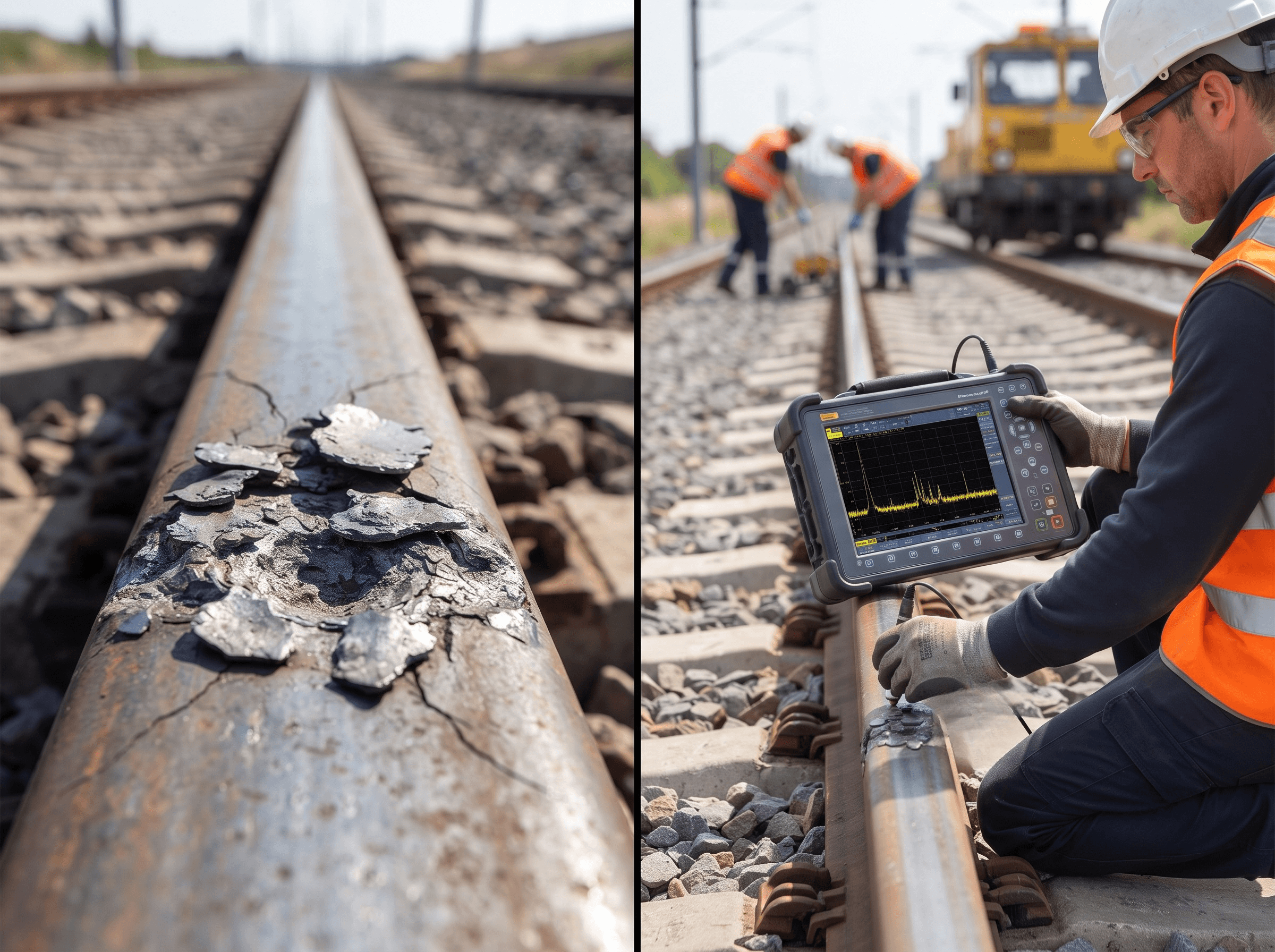
Rail shelling spalling starts small. A tiny flake lifts off the rail surface, barely visible, and most people walking the tracks would never notice it. Rail shelling spalling rarely stays small, though. Left alone, it burrows deeper into the rail head and turns into something far more dangerous than a cosmetic flaw.
This defect sits at an odd intersection. It looks like surface damage. It behaves like a structural threat, and that gap between appearance and reality is exactly why rail shelling spalling catches so many maintenance teams off guard.
In this article, we will cover what rail shelling spalling actually is, how it forms, and what warning signs to look for. It also covers why catching rail shelling spalling early matters more than most maintenance teams realize. And there's a twist in how these defects hide. One that trips up even experienced inspectors.
What Is Rail Shelling Spalling?
Shelling and spalling are two closely related defects, though they aren't identical twins. Shelling refers to small pieces of metal breaking away from the rail surface, usually near the gauge corner where wheel contact is heaviest. Spalling is a bit broader, it describes any flaking or chipping of the rail surface, often triggered by the same fatigue mechanisms.
Put them together, and rail shelling spalling becomes a catch-all term for surface degradation caused by repeated rolling contact between wheel and rail. It's not rust. It's not a manufacturing flaw, usually. It's fatigue, plain and simple, building up invisibly until it isn't invisible anymore.
One rail maintenance engineer put it bluntly in an industry forum post: rail shelling spalling is "the rail's way of telling you it's tired before it tells you it's broken." That's a fair way to think about it. The rail is still functional. It still carries trains. But it's sending signals.
What Are the Types of Defects in Rails?
Rails typically develop the following defect types over their service life:
- Fatigue cracks, caused by repeated stress cycles, often starting at existing flaws
- Wear, gradual loss of material from friction between wheel and rail
- Corrugation, a wavy pattern on the rail surface caused by vibration
- Shelling and spalling, surface flaking that can progress into deeper fatigue damage
- Squats, small depressions with cracking, common on high-speed lines
- Head checks, fine cracks clustered on the rail head, often precursors to more serious failure
Some of these overlap. A rail with corrugation is more prone to shelling, for instance, because the uneven surface increases localized stress. Rail shelling spalling doesn't develop in isolation. It's usually part of a broader pattern of wear that's been building for a while.
So the types are clear enough on paper. But knowing the categories doesn't explain why rail shelling spalling specifically tends to sneak past routine checks. That part takes a bit more digging.
How Rail Shelling Spalling Develops
The mechanics behind rail shelling spalling come down to repeated stress at the wheel-rail contact patch.
Common Contributing Factors
Several conditions speed up this process:
- Heavy axle loads, especially on freight lines
- Tight curves, where lateral forces increase stress on the rail head
- Poor lubrication, which increases friction at the wheel-rail interface
- Rail hardness mismatched to traffic type
- Infrequent grinding schedules, allowing surface irregularities to persist
Manufacturers walk a tightrope here, and rail shelling spalling often shows up where that balance tips slightly the wrong way for a given traffic load.
But here's the part that catches maintenance crews off guard: the surface can look almost fine right up until it doesn't. A rail segment might pass a casual visual check on Monday and show a fist-sized shell defect by Friday. What's actually happening underneath during that gap? That's where the next section comes in.
Warning Signs and Early Symptoms
Catching rail shelling spalling early depends on knowing what to look for, and knowing that the visible signs are often smaller than the underlying damage.
Visual Warning Signs
Inspectors trained to spot early-stage rail shelling spalling typically look for:
- Small dark patches or discoloration near the gauge corner
- Fine surface cracking, sometimes described as a "crocodile skin" pattern
- Slight flaking or chipping at the rail head
- Rough patches that catch a fingernail or inspection tool
These signs are subtle. A rail inspector moving quickly along a long stretch of track can miss them, especially in low light or during a routine walk-through rather than a detailed inspection.
Structural Warning Signs
Beyond the visual cues, rail shelling spalling often produces changes that show up through sound and feel rather than sight:
- A change in the rhythmic noise trains make passing over the affected section
- Increased vibration reported by train crews or track-side sensors
- Slight deformation of the rail head profile, detectable with gauge tools
- Localized softening or unevenness under load
What Are the Different Types of Rail Failure?
Rail failure doesn't always look the same. Some failures happen fast, a sudden fracture under a passing train. Others build for years before anything visible occurs. Rail shelling spalling belongs to the slow-burn category, but it's worth seeing how it stacks up against other failure types.
Here's a rough comparison of how these failures typically develop:
| Failure Type | Typical Cause | Detection Method | Risk Level |
| Shelling/Spalling | Rolling contact fatigue | Visual + ultrasonic | Moderate to high if untreated |
| Transverse fissure | Internal material flaw | Ultrasonic testing | High |
| Rail head wear | Long-term friction | Gauge measurement | Low to moderate |
| Bolt hole cracking | Stress concentration at joints | Visual + magnetic particle | Moderate |
| Corrugation | Vibration-induced wear | Visual + rail profile scan | Low |
Rail shelling spalling sits in an uncomfortable middle spot on this list. It's not the most catastrophic failure mode. But it's sneaky enough, and common enough, that ignoring it tends to push it toward the higher end of that risk range.
Some failures give almost no warning. A transverse fissure, for instance, can grow inside the rail with zero surface indication until the rail simply breaks. Rail shelling spalling isn't like that. It gives warning. The question is whether anyone's watching closely enough to catch it before it stops being a surface problem and becomes something a rail crew has to shut a line down for.
That distinction, visible warning versus silent failure, is exactly why detection methods matter so much. And not all detection tools work equally well for every failure type.
Detection and Testing Methods
Finding rail shelling spalling before it turns serious means combining a few different inspection techniques. No single method catches everything on its own.
Non-Destructive Testing (NDT) Techniques
The rail industry relies on several NDT approaches:
- Ultrasonic testing, sends sound waves through the rail to detect internal cracks invisible from outside
- Eddy current inspection, measures electromagnetic response to find surface and near-surface flaws, particularly useful for early-stage rail shelling spalling
- Magnetic particle inspection, highlights surface cracks using magnetic fields and fine iron particles
- Visual and manual inspection, still the frontline defense, despite being the least high-tech option
Ultrasonic testing gets a lot of attention because it can see beneath the surface. But it's not perfect for catching rail shelling spalling in its earliest stages, since the defect often starts so close to the surface that ultrasonic waves can miss the signal amid surface noise. Eddy current testing fills that gap fairly well.
A defect found during rail testing often shows up first through combined ultrasonic and visual data rather than either method alone. Inspectors cross-reference readings. A slight ultrasonic anomaly paired with a visible surface flake is a much stronger signal than either clue by itself.
Prevention and Maintenance Strategies
Track maintenance teams typically lean on a handful of core strategies:
- Rail grinding, removes the top layer of surface metal, taking early-stage fatigue cracks with it before they grow
- Lubrication management, reduces friction at the wheel-rail interface, slowing the fatigue process
- Load monitoring, tracks axle weights and traffic patterns to flag high-risk segments
- Timely rail replacement, swaps out sections showing advanced shelling before they progress to full failure
- Curve maintenance, pays special attention to tight curves, where lateral stress accelerates rail shelling spalling
Rail grinding deserves a bit more attention here, because it's genuinely one of the more effective tools against this specific defect. Done on a regular schedule, grinding shaves off the fatigued surface layer before cracks have a chance to grow deep. Skip a few grinding cycles, though, and rail shelling spalling can outpace what a routine grind can fix.
One regional freight operator documented a maintenance program shift a few years back, moving from reactive grinding to a scheduled quarterly cycle. The result, according to their internal reporting, was a meaningful drop in shelling-related rail replacements over the following two years. That's not a universal number. But it lines up with what the broader industry has found: consistent grinding beats reactive repair almost every time.
Prevention works. But it only works if someone's paying attention to the early warning signs discussed earlier. And when prevention fails, the consequences aren't just theoretical.
Final Thoughts
Rail shelling spalling starts small, almost invisible, and that's exactly why it gets overlooked. A flake lifts off the surface. Nobody panics. But underneath, fatigue has already been building for months, sometimes longer. What looks cosmetic today can turn structural tomorrow, and that shift happens faster than most maintenance schedules account for.
The good news is that rail shelling spalling isn't unpredictable. It follows patterns. Heavy axle loads, tight curves, poor lubrication, infrequent grinding, these conditions show up again and again across failure reports. Spot them early, and the fix is usually straightforward: grind the surface, adjust lubrication, keep testing on schedule.
Ignore them, and the story changes. A minor surface defect becomes an emergency replacement. A quiet maintenance budget turns into an unplanned expense. Rail networks that treat rail shelling spalling as background noise eventually pay for that choice, one way or another. Networks that stay alert to it rarely do. That difference alone makes early attention worth the effort.
Key Takeaways
- Rail shelling spalling looks harmless at first. It's not. That small flake is fatigue talking.
- This defect falls under rolling contact fatigue, and that family of problems doesn't stay quiet for long.
- Watch for discoloration and flaking early on, those visual clues usually show up before anything structural does.
- But don't ignore the sounds and vibrations either. Rails "talk" before they fail, if crews are listening.
- Ultrasonic testing has a blind spot here. It often misses rail shelling spalling when the defect sits too close to the surface.
- Pairing ultrasonic with eddy current testing works better. Together, they catch what either method alone tends to miss.
- Grinding still wins as the most reliable fix. Regular grinding removes fatigue damage before it has a chance to spread.
- Lubrication matters more than people assume. Less friction at the wheel-rail contact means slower fatigue buildup over time.
- Heavy loads and tight curves speed everything up. Rail shelling spalling develops faster wherever these two factors overlap.
FAQs
What are the three main types of rail surface defects?
Rail surface defects generally fall into three groups: fatigue-related flaws like rail shelling spalling, wear-based defects from friction, and geometric defects such as corrugation. Each develops differently. Fatigue defects build from repeated stress cycles. Wear happens gradually, almost silently, over years of traffic. Corrugation shows up as a wavy pattern and tends to worsen with vibration.
What defects commonly show up on railway tracks?
Railway tracks develop a mix of issues over time, rail shelling spalling, head checks, bolt hole cracking, and joint misalignment among them. Heavy traffic accelerates most of these. So does inconsistent maintenance. Some defects stay minor for years. Others, left unchecked, turn into safety risks fairly quickly.
What actually counts as a rail failure?
A rail failure happens when a rail can no longer safely carry the loads passing over it. Sometimes it's a sudden fracture. Sometimes it's slower, a structural breakdown building for months. Not every defect ends in failure. But rail shelling spalling, left untreated, often tips things that way. The line between "damaged" and "failed" usually comes down to how far the cracking has spread beneath the surface.