

Railway tracks are the backbone of safe and reliable train travel, but many people don’t realize how critical regular inspections are to keeping them in top condition. From preventing derailments and protecting passengers to reducing costly repairs and ensuring trains run on time, track inspections play a vital role in every aspect of rail operations.
In this guide for 2026, we’ll walk you through why inspections matter, the most common defects to watch for, the latest technologies being used, and how proper maintenance keeps railways safe and efficient. Whether you’re a railway professional, a passenger, or simply curious about rail safety, this article will give you a clear understanding of why regular track inspections are more important than ever.
What is Railway Track Inspections?
Railway track inspection is the process of checking railway tracks and related components to make sure they are safe for train operations. These inspections help identify damage, wear, or structural problems before they become dangerous.
We all know that railway tracks are constantly exposed to heavy loads, vibration, weather conditions, and daily train traffic. Over time, rails, fasteners, sleepers, ballast, and track alignment can deteriorate. Regular inspections allow maintenance teams to monitor track condition, detect defects early, and take corrective action before safety is affected.
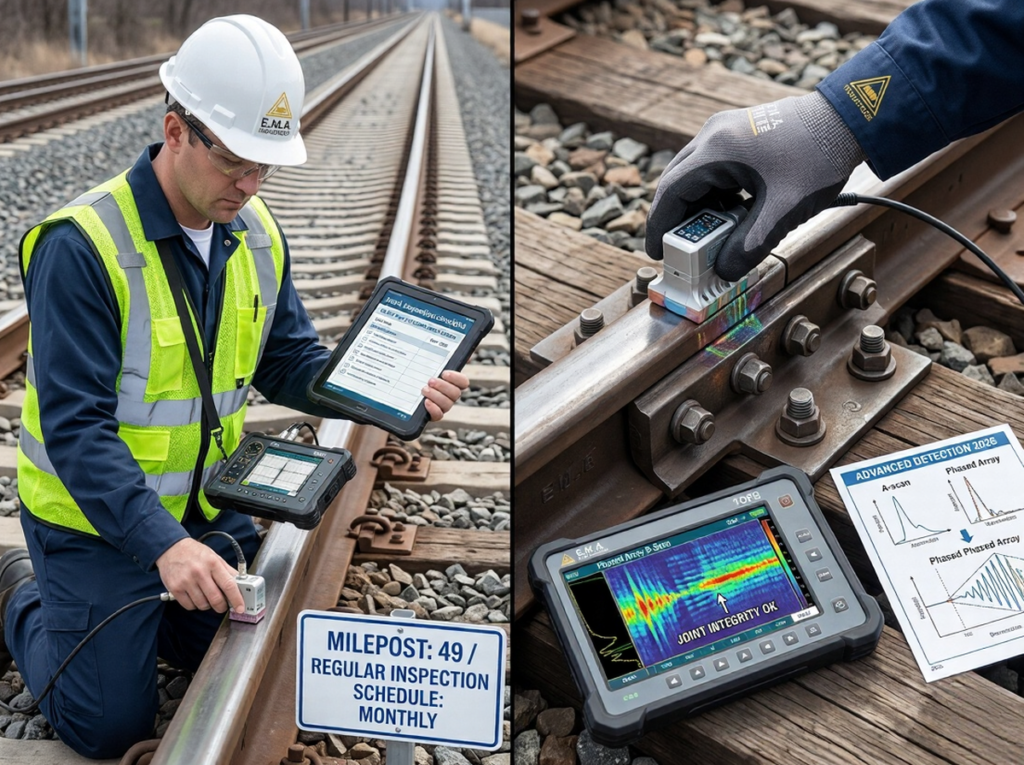
Here, inspections can be carried out manually by trained inspectors walking or driving along the track, or through advanced technologies such as ultrasonic testing systems, track geometry cars, and automated monitoring equipment.
The main goal is simple: keep trains running safely, smoothly, and without interruption.
Common Railway Track Defects
Railway tracks experience continuous stress from train weight, speed, temperature changes, and environmental exposure. Even small defects can grow quickly if they are not detected early.
Below are some of the most common railway track defects inspectors look for.
- Transverse Fissures: Transverse fissures are internal cracks that develop inside the rail head due to repeated stress and metal fatigue. These defects are difficult to see from the outside and are a major cause of rail failures if not detected through testing methods like ultrasonic inspection.
- Corrosion: Corrosion occurs when moisture, chemicals, or environmental conditions cause metal deterioration. Rust weakens the rail structure and reduces its ability to handle heavy loads, increasing the risk of fractures.
- Cracks: Cracks can form on the rail surface or within the metal itself. They often start small but grow larger under constant train pressure. Surface cracks may be visible during visual inspections, while internal cracks require specialized detection equipment.
- Shelling: Shelling refers to the breaking away of small pieces of metal from the rail surface due to rolling contact fatigue. This creates rough running surfaces and can eventually lead to deeper structural damage.
- Wheel Burns: Wheel burns are caused by slipping or locked train wheels that generate excessive heat. The heat alters the rail metal structure, creating weak spots that may later crack or fracture.
- Loose Fasteners: Fasteners hold rails firmly to sleepers. When they loosen due to vibration or wear, the track can shift or lose alignment, creating unsafe operating conditions.
How Defects Develop Over Time
Most railway track failures do not happen suddenly. They usually begin as minor surface imperfections caused by normal wear, temperature expansion, or repeated train loads. Over time, these small issues grow into internal damage within the rail structure.
For example, a tiny surface crack may expand with every passing train, allowing moisture to enter and accelerate metal fatigue. Loose fasteners can slowly change track alignment, increasing stress on certain rail sections. Without regular inspections, these small problems can develop into rail breaks, derailments, or major service disruptions.
Regular railway track inspections play a critical role in detecting defects at an early stage, allowing maintenance teams to repair issues long before they become serious safety risks.
Why are Inspections Important?
Railway track inspections are critical because they ensure the safety, reliability, and efficiency of train operations. Neglecting regular inspections can lead to accidents, costly repairs, and service disruptions.
Here are the key reasons why inspections are essential:
1. Prevent Derailments and Accidents
One of the main reasons railway track inspections are essential is to prevent derailments and serious accidents. Railways operate under extreme mechanical stress every day. Heavy trains, high speeds, changing temperatures, and continuous vibration gradually weaken track components. Without regular inspections, hidden problems can quickly turn into dangerous failures.
In fact, track and infrastructure failures are the second leading cause of train derailments in the United States, according to railway safety data. Issues such as broken rails, track misalignment, damaged fasteners, or weakened foundations can cause trains to leave the track unexpectedly. Many of these failures begin as small defects that are difficult to notice without proper inspection procedures.
Small undetected defects often grow over time. A minor crack in the rail may expand due to repeated train loads. Loose fasteners can slowly allow the track gauge to widen. Corrosion may weaken metal strength until the rail can no longer support passing trains. When these problems remain unnoticed, they can eventually lead to sudden rail breaks or loss of track stability, both of which are major causes of derailments.
The real cost of a derailment goes far beyond damaged equipment. Accidents can result in injuries or loss of life, environmental damage, destroyed cargo, and major disruption to rail networks. Railway companies may also face costly emergency repairs, legal claims, service shutdowns, and long-term reputational damage.
Regular railway track inspections help prevent these situations by identifying risks early. Detecting and repairing defects before failure occurs is one of the most effective ways to keep rail operations safe and reliable.
2. Keep Passengers and Workers Safe
Railway safety depends heavily on the condition of the track. When tracks are poorly maintained, the risk extends far beyond trains themselves. Passengers, railway workers, maintenance crews, and even people living or traveling near railway crossings can be placed in danger.
Passengers are at risk when track defects cause sudden braking, rough rides, or derailments. Freight train crews and locomotive operators also face serious hazards if a rail breaks or track alignment fails at high speed. Maintenance workers working along active rail corridors rely on stable and predictable track conditions to perform their duties safely.
In addition, communities located near rail lines can be affected if accidents lead to cargo spills, fires, or blocked crossings.
Regular railway track inspections directly protect lives by identifying unsafe conditions before trains operate over them. Inspectors check rail strength, alignment, fasteners, and track stability to ensure that trains can pass safely. When defects are found early, maintenance teams can repair or replace damaged components before they create dangerous situations.
There is a clear connection between track condition and accident rates. Rail networks that maintain consistent inspection schedules typically experience fewer derailments and safety incidents. Well-maintained tracks provide smoother train movement, better braking performance, and reduced mechanical stress on rolling stock.
By keeping tracks in safe condition, inspections play a vital role in protecting everyone who depends on the railway system every day.
3. Saves Money in the Long Run
Regular railway track inspections are not only a safety measure but also a smart financial strategy. Detecting problems early allows railway operators to fix minor defects before they develop into costly failures.
The cost difference between repairing a small defect and responding to a major accident is significant. A minor crack, loose fastener, or early-stage corrosion can often be repaired quickly during scheduled maintenance.
However, if that same issue goes unnoticed and leads to a derailment, the expenses can multiply rapidly. Post-accident repairs may involve replacing large sections of track, repairing damaged trains, restoring signaling systems, and rebuilding surrounding infrastructure.
Planned maintenance is far cheaper than emergency response. Scheduled inspections allow railways to organize maintenance work efficiently, minimize service interruptions, and use resources effectively. Emergency repairs, on the other hand, often require immediate shutdowns, overtime labor, specialized equipment, and urgent logistics, all of which increase operational costs.
Neglected tracks can also lead to rising insurance premiums, legal claims, and liability expenses. Accidents caused by poor maintenance may result in compensation payments, regulatory fines, environmental cleanup costs, and lawsuits. These financial risks can far exceed the cost of routine inspection programs.
By investing in regular railway track inspections, operators reduce unexpected expenses, protect assets, and maintain long-term financial stability while keeping the rail network safe and reliable.
4. Keep Train Services Running on Time
Reliable railway service depends on track conditions. Even small track defects can disrupt operations and cause delays across an entire rail network. Regular inspections help prevent unexpected problems that interfere with daily train schedules.
Track defects such as misalignment, damaged rails, loose fasteners, or unstable ballast often require trains to slow down or stop completely until repairs are completed. Speed restrictions are commonly introduced when inspectors detect unsafe sections of track. While these measures improve safety, they also lead to service delays and reduced network efficiency.
Service disruptions affect both freight and passenger operations. Freight trains depend on precise delivery schedules to support supply chains, manufacturing, and port operations. Delays can interrupt cargo movement, increase transportation costs, and create scheduling conflicts across multiple rail routes. Passenger services are equally affected, as delays reduce reliability, inconvenience travelers, and weaken public confidence in rail transport.
Downtime is expensive for railway operators. Every hour of service interruption can result in lost revenue, increased labor costs, equipment idle time, and operational rescheduling. Emergency repairs often require closing sections of track, rerouting trains, or canceling services altogether.
Regular railway track inspections reduce these risks by identifying potential problems before they cause disruptions. By maintaining stable track conditions, rail operators can keep trains running safely, efficiently, and on schedule.
5. Meet Legal and Regulatory Requirements
Railway operators are legally required to maintain safe track conditions through regular inspections. Government regulators establish strict safety rules to reduce accidents and protect passengers, workers, and surrounding communities. Compliance with these rules is a critical part of railway operations.
In the United States, railway track inspections are governed by the Federal Railroad Administration (FRA) Track Safety Standards under 49 CFR Part 213. These regulations define how often tracks must be inspected, acceptable track conditions, speed limits based on track class, and the qualifications required for track inspectors. Rail operators must follow these standards to legally operate trains.
Failure to comply with inspection requirements can lead to serious penalties. Regulatory agencies may issue fines, enforce speed restrictions, require immediate repairs, or suspend operations on unsafe track sections. Repeated violations can result in stronger enforcement actions, including legal proceedings and increased regulatory oversight.
Regular railway track inspections help operators stay compliant with safety laws. Documented inspections provide proof that the railway is actively monitoring track conditions and addressing risks. By following inspection schedules and maintaining accurate records, railway companies remain on the right side of the law while ensuring safe and reliable operations.
6. Extends the Life of Track Infrastructure
Railway tracks are major long-term investments, and regular inspections play an important role in protecting that investment. Continuous train movement places heavy stress on rails, sleepers, fasteners, and ballast. Without proper monitoring, normal wear can quickly turn into structural damage that shortens the lifespan of the entire track system.
Routine inspections help slow down wear and tear by identifying early signs of deterioration. Inspectors can detect uneven rail wear, ballast movement, drainage problems, or loose components before they place excessive stress on surrounding infrastructure. Timely maintenance actions such as tightening fasteners, grinding rails, or correcting alignment prevent damage from spreading to other parts of the track.
Regular checks also protect the long-term value of railway assets. Well-maintained infrastructure performs more efficiently, supports higher operating speeds, and reduces strain on trains and signaling systems. Keeping tracks in good condition helps railway operators maximize the return on their infrastructure investment over many years.
Most importantly, inspections reduce the need for full track replacements. Replacing entire rail sections or rebuilding track foundations is extremely expensive and disruptive to operations. Preventive maintenance based on inspection findings allows railways to extend infrastructure life, avoid premature replacement projects, and maintain reliable service with lower long-term costs.
7. Maintaining Public Trust
Public confidence is essential for any railway system. Passengers, freight customers, and communities expect rail operators to provide safe and reliable transportation. When safety incidents occur due to poor track maintenance, trust can be damaged quickly and may take years to rebuild.
Railway accidents and derailments often receive widespread media attention. Even a single incident can raise concerns about safety standards, operational practices, and overall reliability. Customers may hesitate to use rail services, freight clients may shift to alternative transport methods, and public confidence in the railway operator can decline.
Regular railway track inspections help maintain public trust by demonstrating a strong commitment to safety. Consistent inspections show that operators are actively monitoring infrastructure, preventing risks, and prioritizing the well-being of passengers and workers.
A strong safety record builds credibility with regulators, investors, and the general public. By preventing incidents before they happen, railway companies protect not only lives and assets but also their reputation and long-term business stability.
How Often Should Railway Tracks Be Inspected?
Railway track inspection frequency is not the same for every rail line. The inspection schedule depends on several factors, including track class, train speed, traffic volume, and overall operating conditions. Tracks that carry faster or more frequent train movements require more frequent inspections to maintain safety.
Frequency Based on Track Class, Traffic Volume, and Speed
Railway tracks are classified according to the maximum speed allowed for trains. Higher-class tracks that support high-speed passenger or heavy freight operations must be inspected more often because they experience greater mechanical stress.
Tracks with high traffic volume also require closer monitoring. Repeated train loads accelerate wear on rails, fasteners, and track foundations. Busy mainline routes may be inspected multiple times each week, while lightly used branch lines may follow longer inspection intervals. The goal is to match inspection frequency with the level of operational risk.
FRA Requirements for Tracks Used at Least Once a Week
Under Federal Railroad Administration (FRA) Track Safety Standards (49 CFR Part 213), tracks that are used at least once per week must undergo regular inspections by a qualified track inspector. The FRA sets minimum inspection frequencies based on track classification and usage to ensure safe operation.
If a track does not meet inspection requirements, rail operators may be required to reduce train speeds or suspend service until an inspection is completed and safety conditions are confirmed.
Special Inspections After Unusual Events
In addition to scheduled inspections, railways must conduct special inspections whenever conditions may have affected track safety.
These inspections are commonly required after:
- Floods or heavy rainfall that may weaken track foundations
- Severe storms, extreme heat, or freezing conditions
- Earth movement or washouts
- Reports of rough riding conditions from train crews
- Accidents or unusual track vibrations
These extra inspections help identify hidden damage that may not be visible during routine checks. By combining scheduled inspections with condition-based inspections, railway operators ensure that tracks remain safe under changing environmental and operational conditions.
Methods Used in Railway Track Inspections
Railway track inspections use a combination of traditional techniques and advanced technologies to ensure track safety. Different methods are applied depending on the type of defect, track location, and inspection goals.
Some of them are as follows:
- Visual Inspections: Visual inspections are the most basic and widely used method. Inspectors walk along the track or travel in specially equipped vehicles to look for obvious defects such as broken rails, loose fasteners, misaligned tracks, and surface cracks. Visual inspections are effective for spotting early signs of damage and monitoring general track conditions.
- Ultrasonic Testing: Ultrasonic testing uses high-frequency sound waves to detect internal defects in the rail that are invisible to the naked eye. This method can identify cracks, fissures, and other structural weaknesses deep inside the rail, helping prevent catastrophic failures before they occur.
- Eddy Current Testing: Eddy current testing is used to detect near-surface cracks or flaws in the rail. This non-destructive method sends electromagnetic currents through the rail, which react to irregularities, allowing inspectors to locate hidden surface damage.
- Track Geometry Cars: Track geometry cars are specialized vehicles that measure the physical alignment of the tracks over long distances. They collect data on rail gauge, elevation, alignment, and curvature, often covering hundreds of thousands of miles. These measurements help identify areas where track movement or deformation could lead to unsafe conditions.
- Ground-Penetrating Radar: Ground-penetrating radar (GPR) is used to assess the condition of ballast and the track foundation. GPR can detect water accumulation, ballast degradation, and subgrade instability, issues that may not be visible from the surface but can compromise track stability over time.
- Drone Inspections: Drones are increasingly used after severe weather events or in hard-to-reach areas. Equipped with cameras and sensors, drones can quickly scan tracks for washouts, debris, misalignment, or other damage, allowing maintenance teams to respond promptly.
By combining these methods, railway operators can detect defects both on the surface and below, ensuring comprehensive track safety and reducing the risk of accidents or service disruptions.
Who is Qualified to Inspect Railway Tracks?
Not just anyone can inspect railway tracks. Track inspections require specialized knowledge, training, and certification to ensure safety standards are met and inspections are accurate. Improperly conducted inspections can overlook critical defects, putting trains, passengers, and workers at serious risk.
FRA Qualification Requirements
In the United States, the Federal Railroad Administration (FRA) 49 CFR Part 213 sets strict qualification standards for track inspectors. Inspectors must meet minimum training requirements, pass exams, and demonstrate competency in identifying defects and evaluating track conditions.
Experience and Training Standards
Qualified inspectors typically have several years of hands-on experience in track maintenance or engineering. They must understand track geometry, rail metallurgy, ballast behavior, and common defect types. Inspectors also receive training on inspection tools and methods, including visual inspection techniques, ultrasonic testing, eddy current testing, and the use of track geometry cars.
Why Certification Matters
Rail track inspection certification ensures that only trained professionals can sign off on federally approved inspections. This prevents mistakes that could lead to derailments or regulatory penalties. Certified inspectors also maintain detailed records of their findings, which are required for compliance with FRA regulations and for maintaining public trust.
In short, qualified track inspectors are essential for reliable railway operations, ensuring that tracks are safe, defects are identified early, and repairs are properly documented.
Technological Advancements in Rail Track Inspections For 2026
Technology is transforming railway track inspections, making the process faster, safer, and far more precise than traditional manual checks.
Today, automated Track Inspection (ATI) systems now use lasers, cameras, and sensors mounted on locomotives or specialized rail cars to scan every foot of track as trains move across the network. The data collected is sent to central maintenance hubs, allowing teams to schedule repairs efficiently and address potential issues before they become critical.
Additionally, artificial intelligence (AI) and machine learning are increasingly being used to analyze inspection data. These systems can detect surface irregularities such as fractures, corrugations, corrosion, and alignment issues with far greater accuracy than human inspectors.
AI-powered solutions, like TrackEi, can identify broken rails and track misalignments even at speeds exceeding 60 miles per hour, something that would be impossible to spot visually.
Furthermore, drones are also playing a growing role in track inspections. Equipped with high-resolution cameras and sensors, they can monitor entire rail corridors quickly, identify maintenance needs, and detect safety hazards without interrupting train services.
By combining automated systems, AI analytics, and drone technology, railway operators in 2026 can maintain safer, more reliable tracks while reducing costs and minimizing service disruptions.
Conclusion
Regular railway track inspections are essential for ensuring safe, efficient, and reliable train operations.
By identifying defects early, whether they are surface cracks, internal fissures, corrosion, or loose fasteners, inspections prevent derailments, protect passengers and workers, and reduce costly repairs. Consistent monitoring also keeps trains running on schedule, extends the lifespan of track infrastructure, and ensures compliance with legal and regulatory standards.
Advancements in technology, such as automated inspection systems, AI analysis, and drone monitoring, are making inspections faster, more accurate, and less disruptive than ever before. These tools, combined with qualified inspectors, allow railway operators to detect and address problems before they become serious threats.
In 2026 and beyond, the importance of regular railway track inspections cannot be overstated. They safeguard lives, protect assets, maintain public trust, and keep the rail network operating smoothly. Investing in thorough and frequent inspections is not just a regulatory requirement. It is a critical part of building a safe and reliable railway system for everyone.
Key Takeaways
- Regular railway track inspections are essential for preventing derailments and serious accidents.
- Track defects often start as minor issues but can develop into dangerous problems if not detected early.
- Inspections directly protect passengers, workers, and nearby communities from safety risks.
- Identifying and repairing defects early saves railway operators significant costs compared to post-accident repairs.
- Well-maintained tracks help keep train services running on time, improving reliability for both freight and passenger operations.
- Compliance with FRA Track Safety Standards and other regulations is ensured through consistent inspections.
- Routine inspections extend the life of track infrastructure, reducing the need for costly full track replacements.
- Maintaining a strong safety record through inspections helps preserve public trust and the railway’s reputation.
- Qualified inspectors with proper training and certification are crucial for accurate and effective track evaluations.
- Technological advancements, including AI, automated inspection systems, and drones, enhance inspection speed, accuracy, and efficiency.
FAQs
Who performs railway track inspections in the USA?
Qualified inspectors certified by the Federal Railroad Administration (FRA) carry out track inspections. They must meet specific training and experience requirements to identify defects and recommend the right course of action.
Can automated systems replace manual track inspections?
Not entirely. While automated tools like ultrasonic testing and track geometry cars are widely used, the FRA still requires regular visual inspections. Both approaches work together, automation covers large distances quickly, while human inspectors verify and assess findings on the ground.
What happens if a defect is found during an inspection?
Depending on how serious the defect is, the track may face speed restrictions, scheduled repairs, or be taken out of service completely until it is fixed, all based on FRA defect thresholds.
What are the consequences for railway companies that fail to comply with inspection regulations?
Non-compliant companies face heavy civil penalties from the FRA, forced service shutdowns, and increased liability in the event of an accident. Repeated violations can also lead to federal enforcement actions.
What are the environmental impacts of neglecting rail track inspections?
Derailments caused by poor track conditions can lead to fuel spills, chemical leaks, and damage to surrounding ecosystems. Regular inspections reduce this risk and help protect both communities and the environment near railway corridors.
