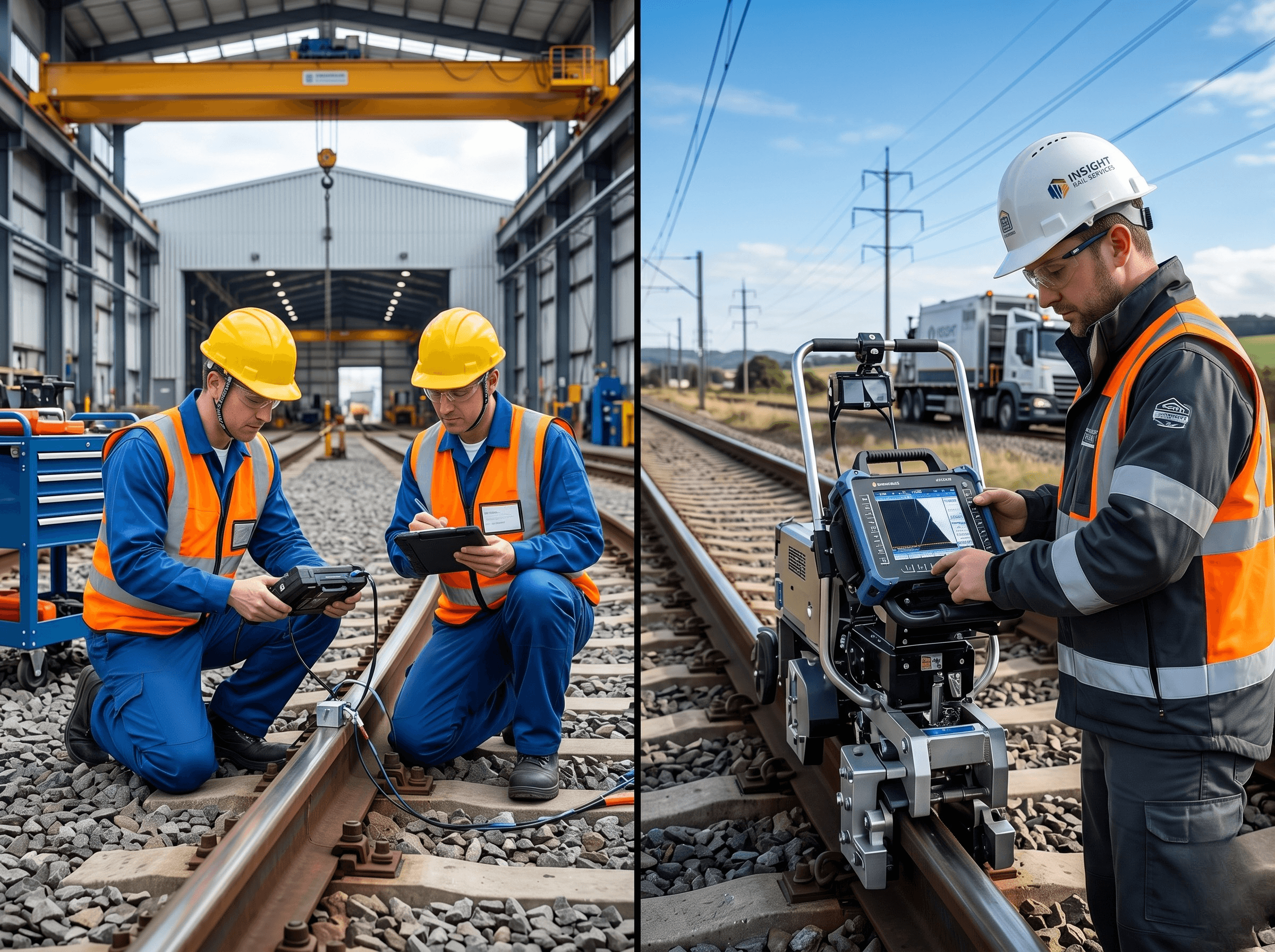
In-house vs outsourced rail inspection, for internal rail flaw testing, turns on one question: will you run a program that meets 49 CFR 213.238? That means a documented training program, at least 160 hours of supervised experience per operator, equipment-specific qualification, reevaluation and records. Contracting moves that work to a provider, but 213.5 keeps compliance with the track owner.
This guide is about the internal rail inspections that 49 CFR 213.237 requires, usually done by ultrasonic testing. It is written for the short-line track supervisor, industrial track owner or transit engineer deciding whether to buy equipment and qualify staff, hire a testing contractor, or split the work. It doesn't cover visual track inspection, switch inspection or geometry. Which Part 213 inspections an owner can contract out is covered in our guide to track inspection services. How to choose and check a contractor is in our buyer's guide to professional rail inspection services.
Contents: what each option means · whether the rules apply to your track · the 213.238 commitment · Part 243 · equipment, calibration and data · cost categories · break-even worked example · hybrid programs · what stays with the owner · a decision checklist · limits · FAQ
What does in-house vs outsourced rail inspection mean for rail flaw testing?
In-house means the track owner is the "provider of rail flaw detection" under 213.238(a). Outsourced means a contractor is. The rule names the provider, not the railroad, as the party that must have a training program, and it says the provider may be the track owner. It also puts a duty on the owner when someone else does the work:
"A track owner shall not utilize a provider of rail flaw detection that fails to comply with the requirements of this paragraph." — 49 CFR 213.238(a)
So the choice is not between doing the job yourself and handing it off completely. It is a choice about who carries the provider duties: the training program, the operator qualifications, the equipment and the test data. Some duties stay with the owner whichever way you go, and they are covered in their own section below.
| Duty | In-house program | Outsourced program |
|---|---|---|
| Documented 213.238 training program | Owner writes and keeps it | Contractor keeps it; owner checks it exists |
| Operator qualification, 160 supervised hours, reevaluation | Owner | Contractor |
| Part 243 training program for the operators | Owner's program covers them | Contractor's program; contractor gives the railroad a 243.101(e) document |
| Test equipment, spares and calibration | Owner buys, maintains and checks | Contractor |
| Valid-search judgment and the list of untested stretches | Owner's operator | Contractor's operator |
| Interval tracking, 213.113 decisions, remedial action, records retention | Owner | Owner |
Key takeaway: outsourcing moves the provider duties in 213.238, not the owner's duties in 213.5, 213.7, 213.113 and 213.241.
Do the rail flaw testing rules apply to your track?
They apply to standard-gage track in the general railroad system, and the 213.237 testing duty covers Class 3, 4 and 5 track. Class 6 and higher track has its own rule in 213.339. Before weighing in-house against outsourced, confirm which rules bind you, because the answer changes the cost of an in-house program.
- Plant railroads. Track inside an installation that isn't part of the general system is outside Part 213 (213.3) and outside Part 243 (243.3(a)(1)). An industrial owner in that position tests by choice, so it can set its own qualification rules, though following 213.238 is still a sound benchmark.
- Isolated rapid transit. Track used only for urban rapid transit that isn't connected to the general system is excluded from Part 213 (213.3(b)(3)) and from Part 243 (243.3(a)(3)). Those agencies answer to FTA's Part 674 state safety oversight program; in California that's the CPUC. See our guide to rail inspection services for government and transit authorities.
- Class 1 and 2 track. 213.237 doesn't require internal testing on it. An owner may still test.
- Shared-use and commuter track. FRA rules apply, so the full 213.238 and Part 243 commitment applies to in-house staff.
How often each class must be tested is set out in how often rail must be tested and in our 49 CFR 213.237 guide.
Key takeaway: if your track is in the general system and Class 3 or above, an in-house program carries the full federal training load described next.
What does an in-house program commit you to under 213.238?
An owner that tests its own rail becomes a provider of rail flaw detection and takes on every 213.238 duty. Those duties don't shrink because the program is small. A one-cart, one-operator program needs the same documents as a large one.
A documented training program
Section 213.238(a) requires a documented training program, and the provider must "identify the types of rail flaw detection equipment for which each equipment operator it employs has received training and is qualified." Part 213 doesn't define "type of equipment", so the owner's program has to decide what counts as a new type: a different cart, a hand-held flaw detector, a new probe configuration. Write that rule down, because it decides when an operator needs new proficiency checks.
160 hours of supervised experience
Under 213.238(c), each operator needs training under the documented program and "a minimum of 160 hours of rail flaw detection experience under direct supervision of a qualified operator or rail flaw detection equipment manufacturer's representative, or some combination of both." An owner starting from nothing has no qualified operator of its own, so the supervision has to be bought in from a manufacturer's representative or from a qualified operator employed elsewhere.
That is the first cost an in-house program can't avoid. It also creates a staffing risk: if your only qualified operator leaves, the next one needs another 160 supervised hours before testing alone. Many owners plan for two qualified operators so that one absence doesn't stop a test that the 370-day or 30 MGT limit has already scheduled.
Equipment-specific qualification and written authorization
The operator must "demonstrate proficiency in the rail defect detection process, including the equipment to be utilized, prior to initial qualification and authorization by the employer for each type of equipment" (213.238(c)). Section 213.238(b) then requires written authorization from the employer to do four things:
- conduct a valid search with the equipment the operator is qualified on
- determine that the equipment is performing as intended
- interpret equipment responses and act under the employer's procedures and instructions
- determine that each search was continuous and not compromised by contamination, rail conditions or equipment malfunction
The fourth duty matters most for in-house owners. Under 213.237(g), a stretch where the operator decides a valid search could not be made doesn't count as inspected. An in-house operator under schedule pressure from the same owner has to be willing to call a stretch untested, because 213.237(h) then forces a retest, a 25 mph limit or rail replacement before the deadline.
Reevaluation and records
Section 213.238(d) requires reevaluation and any recurrent training "as determined by and in accordance with the employer's documented program". The rule sets no interval. Reevaluation needs a recorded examination and demonstrated proficiency on each equipment type, and "Proficiency may be determined by a periodic review of test data submitted by the operator." Section 213.238(e) requires a record of each qualification in effect, and 213.238(g) requires training materials, recorded exams, proficiency and authorization records to be kept where FRA can inspect and copy them. Operators who were proficient before January 24, 2014 are deemed qualified under 213.238(f), but they are still subject to reevaluation.
| 213.238 paragraph | What the in-house owner must produce |
|---|---|
| (a) | A written training program, and a list of the equipment types each operator is qualified on |
| (b) | A written authorization for each operator covering the four duties |
| (c) | Training records, a log of at least 160 supervised hours, and a proficiency demonstration for each equipment type |
| (d) | A reevaluation schedule set by the program, recorded exams and proficiency checks |
| (e) | A record of each qualification in effect: name, equipment, qualification date, latest reevaluation |
| (g) | All of the above kept at a designated location, open to FRA during business hours |
Key takeaway: the 160 hours, the per-equipment proficiency and the written program are fixed costs that a small in-house program pays in full.
What does Part 243 add for in-house rail flaw testing staff?
A second training program. Part 243 covers every "safety-related railroad employee", and 243.5 includes anyone who, "in the application of parts 213 and 214", inspects track. A rail flaw test operator fits that definition whether the owner or a contractor employs them. Section 243.1(d) says Part 243 "augments" other training rules, so it sits on top of 213.238 rather than replacing it.
For an in-house program, Part 243 means:
- A training program submitted to FRA, adopted and followed (243.101(a)), with staff classified by occupational category or by reference to the CFR parts they apply (243.101(c)). Where tasks need hands-on learning, the program needs an on-the-job training component (243.101(d)).
- Qualification before duty. Only trained and qualified employees may perform safety-related service (243.201(a)). An employee who hasn't performed the duty or received training in the previous 180 days must be tested before returning to it (243.201(d)(2)).
- Refresher training at an interval not exceeding three calendar years (243.201(e)). For an inspector of track, the refresher must address identifying defective conditions and initiating immediate remedial action (243.201(e)(4)). For smaller employers whose last training event came before FRA approved their program, the first refresher is due by December 31, 2026 if they were operating as of May 1, 2023 (243.201(e)(2)).
- Records. Qualification records for each employee, kept accessible at system headquarters, and for 6 years after a former employee leaves (243.203(a), (b)).
- Periodic oversight tests or inspections, with a record of the date, time, place and result of each one (243.205(a), (i)).
FRA amended Part 243 in a final rule published May 15, 2026 and effective July 14, 2026 (FR Doc. 2026-09790, 91 FR 27849). FRA describes it as codifying agency guidance and clarifying existing requirements. Among other changes, it eliminates certain submissions such as similar training programs or plans, revises the refresher requirements, and lets each railroad and contractor decide which of them conducts periodic oversight.
When you contract the work, the contractor carries its own Part 243 program, but you still have paperwork. Section 243.1(b) says "Contractors shall coordinate with railroads and comply with the contents of this part, including those aspects of training that are specific to the contracting railroad's rules and procedures." A contractor that trains its own staff must give each railroad a document stating that its program was approved by FRA, or that it keeps a similar program under another rule (243.101(e)). The railroad must keep that document (243.101(f)). A contractor with more than 15 safety-related employees that trains its own staff and has supervisors capable of oversight conducts its own periodic oversight (243.205(g)), and the two parties may divide oversight in writing (243.205(h)).
| Part 243 item | In-house program | Outsourced program |
|---|---|---|
| Training program covering test operators | Owner's program | Contractor's program |
| 243.101(e) program document | Not needed | Contractor supplies it; owner keeps it (243.101(f)) |
| Railroad-specific rules and procedures training | Owner trains | Owner supplies its rules; contractor trains to them (243.1(b)) |
| 180-day retest and 3-year refresher | Owner tracks | Contractor tracks |
| Periodic oversight records | Owner | Contractor if 243.205(g) applies, or as agreed in writing |
Whether an owner's 213.238 program by itself counts as the "similar training program or plan" that 243.103(b) excuses from submission is not settled by the text alone. Confirm it with FRA or counsel before relying on it.
Key takeaway: in-house testing staff need both a 213.238 qualification and Part 243 coverage; a contractor carries both for its own operators.
What equipment, calibration and data duties come with an in-house program?
Part 213 sets two equipment duties and no calibration method, so the owner's own procedure has to fill the gap. The equipment must be "capable of detecting defects between joint bars, in the area enclosed by joint bars" (213.237(f)). The operator must determine that it "is performing as intended" (213.238(b)(2)). Part 213 names no test method; "ultrasonic" appears nowhere in it, and ultrasonic testing is the industry practice that meets the rule.
That leaves the in-house owner to write the calibration and functional-check procedure. FRA's 2026 study of handheld rail UT, Application of MAPOD to Handheld Ultrasonic Rail Flaw Inspection (DOT/FRA/ORD-26/07), reported that North American railroads have no standardized calibration procedure for handheld units, and that with a small exception no two operators in its trials produced statistically similar calibration results. It warns that "calibration errors can cause excessive false positives and false negatives". AREMA's Manual for Railway Engineering Chapter 4 includes a section titled Recommended Calibration Rails for Rail Flaw Detection System (2025 Chapter 4 contents). It is a recommended practice, not a federal rule, and its text is paywalled.
A workable in-house equipment program usually covers:
| Item | Why it matters | Rule link |
|---|---|---|
| Reference rail with known reflectors, matched to your rail sections | Sets and checks sensitivity for each probe channel | 213.238(b)(2) "performing as intended" |
| Written calibration and functional-check procedure, with check intervals | Part 213 sets none; the owner's procedure is what an FRA inspector reads | 213.238(a) documented program |
| Spare probes, wheels or sleds, couplant and a backup unit or a standby contract | A broken unit doesn't stop the 370-day or 30 MGT clock | 213.237(c), (h) |
| Test data and an untested-stretch log | Each record lists track not validly tested | 213.241(c)(6) |
| Records kept at least 2 years after the inspection and 1 year after initial remedial action | Retention runs from the later event | 213.241(d) |
| Electronic records controls: unique author, no change to completed records, amendments stored separately | Required if records are electronic | 213.241(j) |
Calibration and record practice is covered in more depth in our guide to UT calibration for rail inspection RFPs.
Key takeaway: with an in-house program, the owner writes the calibration procedure and keeps the test data, and both are what an FRA inspector will ask to see.
What are the cost categories in each option?
In-house costs are mostly fixed and arrive whether you test 20 miles or 200. Contract costs are mostly variable and scale with track miles and visits. That difference drives the break-even model in the next section.
| Cost category | In-house | Outsourced |
|---|---|---|
| Equipment purchase or lease | Capital cost, spread over its service life | In the contractor's price |
| Spares, repairs, calibration standards, consumables | Annual owner cost | In the contractor's price |
| Initial qualification (training plus 160 supervised hours per operator) | Owner pays trainee time and the supervisor | In the contractor's price |
| Reevaluation, Part 243 refresher, 180-day retests, oversight | Owner staff time | In the contractor's price |
| Program writing and records (213.238, Part 243, 213.241) | Owner admin time | Owner keeps 213.241 records and the 243.101(e) document |
| Test-day labor | Owner crew time per day | Per-mile, per-day or lump-sum price |
| Mobilization and travel | Low if local | Charged per visit in many contracts |
| On-track protection under Part 214 | Owner | Usually owner, under the railroad's on-track safety program; set it in the contract |
| Downtime and retest risk | Owner absorbs it, or buys a standby contract | Contract terms decide it |
| Owner oversight of the result | Same in both | Same in both |
No published purchase price for a hi-rail ultrasonic truck or a push-cart rail flaw detector was found; vendors quote on request. Public contract awards are the best dated reference for contract prices. One transit award in 2019 priced testing at $212.43 per track mile, and our ultrasonic rail testing cost guide sets out that and other public awards with their scope and dates. Use your own quotes in the model below.
Key takeaway: compare an in-house program's fixed annual cost with a contractor's variable cost per test-mile; that ratio, not the price of the cart alone, decides the answer.
Worked example: where does in-house rail flaw testing break even?
With the assumed inputs below, an in-house cart program breaks even at about 745 track miles tested once a year, or about 346 track miles tested twice a year. Every input is an assumption chosen to show the method. None is a market price or a quote. Replace each one with your own figures.
The model
- In-house annual cost = F + v × M × n
- Contract annual cost = n × (r × M + m)
- Break-even track miles: M* = (F − n × m) ÷ (n × (r − v))
Here F is the in-house fixed cost per year, v the in-house variable cost per test-mile, M the track miles, n the tests per year, r the contract price per test-mile and m the contract mobilization per visit. If r is less than or equal to v, in-house testing never breaks even, whatever the mileage.
Assumed inputs (illustrative, not prices)
| Input | Assumed value | Annual effect |
|---|---|---|
| Equipment (cart system, reference rail), 8-year life | $100,000 | $12,500 |
| Spares, repairs, calibration checks, consumables | $8,000 a year | $8,000 |
| Initial qualification: 2 operators × 160 h × ($60 trainee + $150 supervisor) | $67,200, spread over 4 years of expected tenure | $16,800 |
| Reevaluation, Part 243 refresher and oversight: 2 operators × 24 h × $60 | $2,880 a year | $2,880 |
| Program upkeep and records: 80 h × $75 | $6,000 a year | $6,000 |
| Fixed cost F | $46,180 | |
| Test-day labor: 2 people × 8 h × $60 | $960 a day | |
| Assumed productivity | 5 track miles a day | |
| Variable cost v | $960 ÷ 5 | $192 per test-mile |
| Contract price r | $250 per test-mile | |
| Contract mobilization m | $3,000 per visit |
On-track protection is left out of both sides on the assumption that the owner provides it either way.
Result for an 80-mile owner tested once a year
- In-house: $46,180 + $192 × 80 = $61,540 a year, and 80 ÷ 5 = 16 test days.
- Contract: $250 × 80 + $3,000 = $23,000 a year.
- Break-even at n = 1: ($46,180 − $3,000) ÷ ($250 − $192) = $43,180 ÷ $58 = about 745 track miles.
- Break-even at n = 2: ($46,180 − $6,000) ÷ (2 × $58) = $40,180 ÷ $116 = about 346 track miles.
How sensitive is the answer?
| In-house productivity | Contract price per test-mile | v per test-mile | Break-even, 1 test a year | Break-even, 2 tests a year |
|---|---|---|---|---|
| 5 miles a day | $250 | $192 | about 745 miles | about 346 miles |
| 8 miles a day | $250 | $120 | about 332 miles | about 155 miles |
| 5 miles a day | $350 | $192 | about 273 miles | about 127 miles |
| 8 miles a day | $350 | $120 | about 188 miles | about 87 miles |
The margin between the contract rate and your own variable cost per mile drives the result far more than the equipment price does. Test frequency matters next, which is why owners with Class 4 and 5 track carrying heavy tonnage, where 30 MGT arrives well before 370 days, are the ones most likely to find in-house testing pays. Two costs the model leaves out push the break-even higher: a standby contract or backup unit for when the in-house unit fails, and the risk of losing a qualified operator and paying for another 160 supervised hours.
Key takeaway: with these assumptions an in-house cart program pays only at hundreds of test-miles a year; recompute with your own quotes before deciding.
What does a hybrid rail testing program look like?
A common hybrid has the contractor run the scheduled 213.237 tests while the owner keeps one or two qualified operators with hand-test equipment for the work that can't wait for a contractor visit. That work includes:
- Plug rail. Rail used as a replacement plug rail in track that must be tested "must have been tested for internal rail flaws", and if non-compliant plug rail is in use, trains over it must not exceed Class 2 speeds until it is tested (213.237(c)). An owner with its own qualified operator can test a plug before or after it goes in without waiting for a call-out.
- Verifying indications. Under 213.113(b) the owner must verify an indication within four hours, or immediately for a defect needing remedial action A, A2 or B. If the contractor runs a continuous test under 213.240, each suspect must be field-verified by a person qualified under 213.238 within 84 hours, or 36 hours for suspected A, A2 and B defects. An in-house hand-test operator lets the owner meet those windows with its own staff. See continuous vs stop-and-verify rail testing.
- Spot checks between scheduled runs at turnouts, welds after repair, or a stretch the contractor's report listed as not validly tested.
The owner's hand-test staff are still rail flaw detection operators, so the owner becomes a provider under 213.238(a) for that equipment type and needs the training program, 160 supervised hours, authorization and records for each person. Their Part 243 coverage comes from the owner's program. The scheduled-test equipment, its calibration and its operators stay with the contractor.
The original version of this article gave a contractor running "quarterly advanced track geometry analysis" as its hybrid example. Geometry measurement falls under 213.333 and is a different service from rail flaw testing, so it isn't a hybrid of the decision covered here.
Worked example: is an in-house hand-test capability worth it?
Using the same assumed rates as above, one qualified operator with a hand-test kit costs:
| Item | Assumed value | Annual effect |
|---|---|---|
| Hand-test kit, 8-year life | $30,000 | $3,750 |
| Spares, calibration checks, consumables | $2,500 a year | $2,500 |
| Initial qualification: 1 × 160 h × $210, over 4 years | $33,600 | $8,400 |
| Reevaluation, refresher, oversight: 24 h × $60 | $1,440 a year | $1,440 |
| Program upkeep and records: 40 h × $75 | $3,000 a year | $3,000 |
| Annual cost of the capability | $19,090 |
If an unscheduled contractor call-out for a plug rail test or a verification is assumed to cost $4,000 all-in, the capability pays for itself at $19,090 ÷ $4,000 = about 4.8, so 5 call-outs a year. Below that, buying call-outs is cheaper, unless the time saved matters more than the money: a plug rail held to Class 2 speed or a four-hour verification window can be worth more than the arithmetic shows.
| Hybrid pattern | Owner does | Contractor does | Fits when |
|---|---|---|---|
| Scheduled test contracted, hand testing in-house | Plug rail tests, verifications, spot checks | All 213.237 interval tests | Frequent plug rail use, remote territory, long call-out times |
| Contractor for main track, owner for yards and sidings | Optional testing of low-class track | 213.237 testing of Class 3–5 track | Owner wants extra testing beyond the rule |
| Contractor tests, owner reviews data | Data review and 213.113 decisions by the owner's 213.7 people | Testing, valid-search calls, defect reports | Owner wants closer control without owning test equipment |
Key takeaway: the most common hybrid keeps scheduled testing with a contractor and puts a small, fully qualified hand-test capability with the owner.
What stays with the owner either way?
Responsibility for compliance, the 213.7 designations and the decision on every defect stay with the track owner. Contracting rail flaw testing moves the work, not these duties.
- 213.5 responsibility. An owner who knows or has notice of noncompliance must bring the track into compliance, halt operations, or operate under a person designated under 213.7(a) (213.5(a)). Responsibility moves only by an assignment notified to FRA's Track and Structures Division at least 30 days in advance (213.5(c)), and even then FRA may hold the owner, the assignee or both responsible (213.5(d)). A testing contract is not an assignment. Section 213.5(f) adds that a contractor performing a Part 213 function must perform it "in accordance with this part", so the contractor is accountable too, alongside the owner.
- 213.7 designation. The owner designates the qualified persons who inspect track and supervise restorations, and keeps a record of each designation, its date and its basis (213.7(e)). A 213.238 rail flaw operator is not a 213.7 person unless the owner also designates them.
- 213.113 remedial action. When the owner learns that a rail contains a listed defect, "a person designated under § 213.7 shall determine whether the track may continue in use" (213.113(a)). The owner verifies indications within the 213.113(b) window and initiates the remedial action in the 213.113(c) table. The defect types and actions are in our guide to FRA defect codes.
- 213.237 intervals and outcomes. The owner tracks days and tonnage, chooses among the 213.237(h) options when a search was invalid, and computes the service failure rate.
- 213.241 records. The owner keeps the internal rail inspection record. Its "initial remedial action taken and the date thereof" item can only come from the owner.
| Duty | Section | In-house | Outsourced |
|---|---|---|---|
| Compliance with Part 213 | 213.5(a), (d) | Owner | Owner, with the contractor accountable under 213.5(f) |
| Designation of track inspectors and supervisors | 213.7 | Owner | Owner |
| Whether track stays in use over a defect | 213.113(a) | Owner's 213.7 person | Owner's 213.7 person |
| Verification within 4 hours (immediately for A, A2, B) | 213.113(b) | Owner | Owner, using the contractor's notice |
| Choosing retest, 25 mph or replacement for untested rail | 213.237(h) | Owner | Owner |
| Keeping inspection records | 213.241 | Owner | Owner, from the contractor's report |
Key takeaway: whichever option you choose, your 213.7 people must be reachable during every test shift, because the defect decision is theirs.
How should a track owner decide? A checklist
Score your situation against these questions; the more "yes" answers in the left column, the stronger the case for in-house testing. The checklist reflects common practice and the costs above, not a Part 213 rule.
| Question | Points toward in-house | Points toward outsourced |
|---|---|---|
| How many test-miles a year (track miles × tests)? | Hundreds or more, by your own break-even | Below your break-even |
| Can you keep at least two qualified operators through turnover? | Yes, with a supervisor or manufacturer support for the 160 hours | No; one departure would stop testing |
| Will you write and maintain a 213.238 program and a Part 243 program? | Yes, with staff time assigned | No staff time for program upkeep |
| Can you cover a broken unit before the 370-day or 30 MGT limit? | Backup unit or standby contract in place | No backup |
| Do you need same-day verification or plug rail tests often? | Yes, consider at least a hybrid | Rarely |
| Do you have the track time and protection crews for 16 or more test days a year? | Yes | Track time is the constraint |
| Can an in-house operator call a stretch untested without schedule pressure? | Yes, with written authority | Independence is a concern |
If the answers split, test the hybrid first: it is the option with the smallest fixed cost that still gives the owner its own qualified operator.
What this decision framework can't tell you
The break-even model compares cost, not detection quality, and every number in it is an assumption. Keep these limits in mind before you use it to make a decision:
- Detection performance differs by operator and setup. FRA's ORD-26/07 study found wide variation in handheld calibration between operators. A lower cost per mile means nothing if the program misses defects, so judge in-house and contract options on qualification records and test data as well as price.
- No market prices are used. The equipment, labor and contract figures are placeholders. Public awards exist for some transit contracts, but no short-line or industrial bid prices for rail flaw testing were found.
- Labor agreements, insurance and indemnity terms can move costs in either direction and aren't modeled.
- Transit agencies outside FRA jurisdiction follow their state safety oversight program, which may set its own qualification and interval rules.
- Regulatory interpretation. Whether a 213.238 program alone satisfies Part 243's "similar program" provision, and how FRA treats a contractor's employee designated under 213.7, aren't settled by the rule text. Ask FRA or counsel.
- Nothing here replaces the rules. Read 213.237, 213.238 and Part 243 on eCFR before writing your program.
How EMA Industries applies this
EMA Industries performs ultrasonic rail flaw testing for transit agencies, short lines and industrial track owners, along with rail weld inspection and NDT Level III services. We're based in Southern California and mobilize nationwide. If you are weighing an in-house program against contracted testing, or planning a hybrid, ask any contractor you consider for its 213.238 qualification records for the equipment it will use and its 243.101(e) program document. To discuss a testing scope, see our ultrasonic rail testing services or contact us.
Related reading: Professional rail inspection services: a buyer's guide · Track inspection services: what Part 213 lets an owner contract out · Rail inspection services for government and transit authorities · Hi-rail truck vs inspection cart vs walking tests · Ultrasonic rail testing cost
Frequently asked questions
Can a railroad do its own rail flaw testing?
It can. Section 213.238(a) says "A provider of rail flaw detection may be the track owner." The owner then needs a documented training program, operators with at least 160 hours of supervised experience and proficiency on each equipment type, written authorization, reevaluation and records, plus Part 243 coverage for those operators.
Who is responsible for compliance if rail flaw testing is contracted out?
The track owner stays responsible under 49 CFR 213.5. The contractor must also perform the work in accordance with Part 213 (213.5(f)), but only a formal assignment notified to FRA at least 30 days ahead moves the owner's responsibility, and FRA may still hold both parties.
How many hours of training does a rail flaw test operator need?
At least 160 hours of rail flaw detection experience under the direct supervision of a qualified operator or a manufacturer's representative, after training under the provider's documented program (213.238(c)). The operator must also show proficiency on each type of equipment before the employer authorizes them to use it.
Does Part 243 apply to rail flaw testing contractors?
Yes, when they work on general-system track. Part 243 applies to contractors of railroads, and a person who inspects track in the application of Part 213 is a safety-related railroad employee. A contractor that trains its own staff gives each railroad a document confirming its program status (243.101(e)), and the railroad keeps it.
When does in-house rail flaw testing make financial sense?
When the fixed annual cost of equipment, qualification and program upkeep, spread over your test-miles, falls below a contractor's price per mile. With the illustrative inputs in this article, that took about 745 track miles tested once a year. Recompute with your own quotes, and include a backup plan for equipment failure.
Sources
- 49 CFR 213.238, Qualified operator, eCFR; text read on Cornell LII, October 2026
- 49 CFR 213.237, Inspection of rail, eCFR
- 49 CFR 213.241, Inspection records, eCFR
- 49 CFR 213.240, Continuous rail testing, eCFR
- 49 CFR 213.113, Defective rails, eCFR
- 49 CFR 213.5, Responsibility for compliance, eCFR
- 49 CFR 213.7, Designation of qualified persons, eCFR
- 49 CFR 213.3, Application, eCFR
- 49 CFR 243.1, 243.3, 243.5, 243.101, 243.201, 243.203 and 243.205, eCFR (text as amended May 15, 2026, read on Cornell LII)
- Training, Qualification, and Oversight for Safety-Related Railroad Employees, final rule, FR Doc. 2026-09790, Federal Register, May 15, 2026 (effective July 14, 2026)
- DOT/FRA/ORD-26/07, Application of MAPOD to Handheld Ultrasonic Rail Flaw Inspection, FRA, July 2026
- AREMA Manual for Railway Engineering, Chapter 4 table of contents (2025), section titles only