
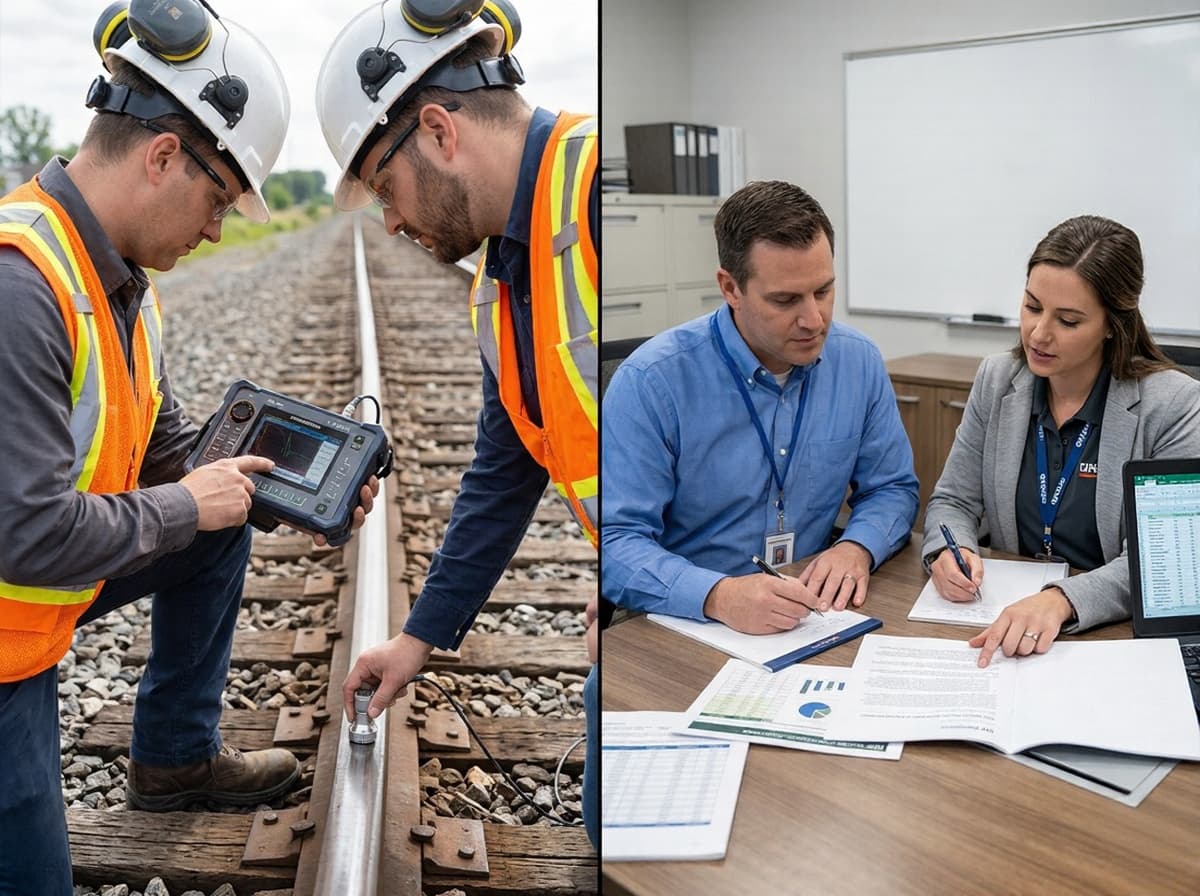
Rail inspection RFP evaluation is the step where a track owner tests each ultrasonic testing proposal against the rules the contract will enforce. On FRA track, 49 CFR 213.238(a) says an owner "shall not utilize" a flaw detection provider without a documented training program, so qualification evidence is checked before price is opened.
This page covers the evaluation half of the job: the questions to ask bidders, the evidence to demand, the red flags, a scoring method and the handoff after award. It is one of three EMA Industries pages on buying rail flaw testing:
- Writing the specification: the copyable clauses and the scope-of-work template are in our rail inspection RFP manual for ultrasonic testing.
- Jurisdiction and public procurement: who regulates your track (FRA, FTA or the state safety oversight agency) and how public agencies run the solicitation are in our guide to rail inspection services for government and transit authorities.
Read those first if you haven't issued the RFP yet. This page assumes the solicitation is out and the proposals are on the table.
Contents: What evaluation must prove · Rules to test against · Questions to ask · Evidence to request · Red flags · Scoring method · Worked example · Award handoff · Limits · FAQ
What does rail inspection RFP evaluation have to prove?
Rail inspection RFP evaluation has to prove three things before price matters: that the bidder can deliver a valid search with qualified operators, that it can hand over records the owner can keep under 49 CFR 213.241, and that its crews can work safely on the owner's track in the access windows the owner can actually give.
Internal rail flaw testing exists to find the defects that break rails. In FRA's train accident data, track causes were the largest cause group for main-track derailments: 1,145 of 3,051 main-track derailments in 2016–2025 (about 38%) had a track cause, and 384 of those were coded as broken rails or welds (FRA Form 54 data, dataset byy5-w977 on data.transportation.gov, queried October 24, 2026, data through July 31, 2026). Detail fractures (T207) were the single largest broken-rail code, at 110. Those counts cover railroads that report to FRA; isolated rail transit reports elsewhere. Our article on what causes a train to derail breaks the cause groups down further.
The figures matter for evaluation because a weak contractor doesn't usually fail by missing every defect. It fails quietly: rail that was never coupled counted as tested, a suspect left unverified overnight, a report that can't show which rail was searched. Those failures are visible in a proposal if the evaluators know what evidence to ask for.
Key takeaway: score each proposal on whether it can produce the records and the protection the contract requires, then compare price among the bidders that can.
Which rules should evaluators test each rail UT proposal against?
Evaluators should test each rail UT proposal against the federal sections the contract will cite, because each section creates a duty the bidder must show it can meet. On the general railroad system that means five Part 213 sections and Part 214; on isolated transit it means the agency's own standard and 49 CFR Part 671.
The most important sentence for evaluators is the first paragraph of the qualified-operator rule. It puts a duty on the track owner, not only on the contractor:
"Each provider of rail flaw detection shall have a documented training program in place and shall identify the types of rail flaw detection equipment for which each equipment operator it employs has received training and is qualified. A provider of rail flaw detection may be the track owner. A track owner shall not utilize a provider of rail flaw detection that fails to comply with the requirements of this paragraph." — 49 CFR 213.238(a)
That makes 213.238 compliance a pass/fail gate rather than a scored factor. An owner who awards to a provider without a documented training program is the party that breaches the rule.
| Rule | What it requires | What evaluators check in the proposal |
|---|---|---|
| 213.237(c) | Class 4–5 track, and Class 3 with scheduled passenger trains or a hazmat route: 370 days or 30 MGT, whichever is shorter. Other Class 3: yearly (no more than 18 months apart) or 30 MGT, whichever is longer, never over 5 years | The bidder's schedule meets the interval for each segment's class and tonnage |
| 213.237(j)(4) and (g) | Valid search definition; rail without a valid search "may not be considered as internally inspected" | How invalid search is detected, recorded and retested |
| 213.238 | Training program, written authorization for four duties, 160 supervised hours, reevaluation with a recorded exam, qualification records | Records for named operators on the exact equipment offered |
| 213.240 | Optional continuous testing: suspects field-verified within 84 hours, or 36 hours for suspected A, A2 or B defects | Whether the bidder offers continuous or stop-and-verify, and its verification plan |
| 213.241 | Six record items, retention, electronic record controls | A sample record with all six items |
| 213.113(b) | The owner verifies an indication within four hours, or immediately for A, A2 or B defects | A notification path that gives the owner findings at once |
| Part 214 | Roadway worker protection on the general system: training (214.343), job briefings (214.315), working limits, hi-rail rules (214.7, 214.523) | The bidder's on-track safety program and training records |
| Part 671 | FTA rail transit roadway worker protection for agencies receiving Chapter 53 funds | Familiarity with the agency's SSOA-approved program |
The interval row is where tonnage and class enter the evaluation. A bidder can only propose a credible schedule if the RFP gives each segment's track class, annual MGT and date of last test. Where it does, check the arithmetic. On a Class 3 passenger line carrying 12 MGT a year, 30 MGT takes 2.5 years to accumulate, so the 370-day limit governs. On a 45 MGT freight main line, 30 MGT arrives in about 8 months, so tonnage governs and the line needs more than one test a year. Our page on how often rail must be tested works through both cases, and the 49 CFR 213.237 guide covers the rest of the section.
Part 213 names no test method. The word "ultrasonic" doesn't appear in it, so a proposal that says "FRA requires ultrasonic testing" has misread the rule. UT is the industry method the owner chooses to buy.
Key takeaway: treat 213.238 and the roadway worker program as gates, and score everything else.
What questions should you ask rail UT bidders?
Ask rail UT bidders questions that can only be answered with specifics: equipment, names, records and times. A question a bidder can answer with a sentence from its brochure doesn't separate anyone. The list below can go into the RFP as required proposal content or be used at interviews.
Method and coverage
- What test platform will you use on each segment (rail-bound or hi-rail vehicle, walking cart, hand instrument), and how many rails are tested per pass?
- What probe angles does each search unit carry, what defect types is each channel meant to find, and how is the beam coupled to the rail?
- Which rail sections in our inventory does your reference rail represent, and what will you do for sections it doesn't?
- Which turnout components, crossings and welds can your method examine, and which can't it?
The answer to question 2 should describe a conventional system. A 2016 research digest from the Transportation Technology Center (TTCI, now MxV Rail) describes the vehicle side plainly:
"Conventional UT detector cars use piezoelectric transducers housed in roller search units that run atop the railhead. These systems have fixed angle probes." — TTCI Technology Digest TD-16-030, High-Speed Rail Flaw Detection Using Phased Array Ultrasonics (Witte and Poudel, July 2016)
A typical arrangement uses 0° channels for horizontal defects and loss of back-wall echo, 70° channels for transverse defects in the head, and angles around 37–45° plus side-looking channels; the exact set varies by system, so a Level III should judge the configuration offered. Time-of-flight diffraction (TOFD) and phased array (PAUT) are weld examination methods. PAUT can be useful for hand verification, and it is a research topic for vehicle testing, but neither is the production method for in-track rail flaw detection. A proposal that leads with TOFD or PAUT as its main rail test is selling a weld technique. Our explainer on how ultrasonic rail flaw detection works covers the channels in more detail.
Valid search and verification
- How does your system or operator detect loss of coupling and other conditions that invalidate the search, and how is the untested length recorded?
- Will you run stop-and-verify, or continuous testing under 213.240? Who field-verifies suspects, with what instrument, and how soon?
- How and when will you notify our designated person of a defect that may need remedial action A, A2 or B?
The choice in question 6 changes the owner's obligations, so ask it directly. Under 213.240(a), continuous testing exempts the owner from the 213.113(b) four-hour verification duty but substitutes the 36-hour and 84-hour field-verification windows. The comparison is set out in our article on continuous vs stop-and-verify rail testing.
Personnel
- Who are the named operators and verifiers, which equipment types is each qualified on under 213.238, and when was each last reevaluated?
- What is your written practice for UT personnel (SNT-TC-1A or ANSI/ASNT CP-189), and who is the Level III responsible for the procedure?
- What happens if a named person leaves before or during the contract?
Safety and access
- Describe your on-track safety program under Part 214 (or our Part 671 program), including how you will establish working limits and who acts as roadway worker in charge.
- If you propose a hi-rail vehicle, what are its gear inspection dates under 214.523, and what track authority do you assume for each move?
- What do you need from us each shift (escort, flagging, power-down, track release), and how did you plan productive test time inside our window?
Records, data and schedule
- Provide a sample 213.241 record and a sample daily summary from comparable work, with client details removed.
- In what format will data be delivered, and how do your electronic records meet 213.241(j)?
- Show your shift-by-shift plan and the assumptions behind it, and show that each segment will be tested within its 213.237 interval.
Question 16 lets evaluators check schedules against each other. The RFP manual's worked example shows how to estimate test shifts from the access window and the suspect rate; a bidder whose shift count is far below that kind of estimate has usually priced the test speed and not the verification time.
What evidence should a rail UT proposal include?
A rail UT proposal should include documents an evaluator can check, not statements of intent. The core set is 213.238 qualification records, calibration and reference-standard records, a sample report, the roadway worker protection program, insurance evidence and references.
| Evidence | What it should contain | Rule or basis | How to check it |
|---|---|---|---|
| Training program summary | Equipment types covered, supervised-hours rule, reevaluation method | 213.238(a), (c), (d) | It names the equipment the bidder is offering |
| Qualification records | Employee name, equipment, date of qualification, date of most recent reevaluation | 213.238(e) | Match each named operator to the equipment in the method section |
| Written practice and Level III | SNT-TC-1A or CP-189 written practice; named Level III | Contract requirement | Ask for the Level III's certificate and scope |
| Calibration records | Sample shift calibration on a reference rail; instrument performance checks | Contract requirement; ASTM E317 for hand instruments | Reference rail section matches the owner's rail |
| Sample report | Daily summary and final record with all six 213.241(c) items, including untested track | 213.241(c) | Look for the untested-track line and defect size fields |
| Roadway worker program | On-track safety program, annual training records, RWIC qualification | Part 214 (214.343, 214.353) or Part 671 | Training dates fall within the calendar year |
| Hi-rail records | Annual hi-rail gear inspection, alarms and beacon | 214.523, if a hi-rail is offered | Inspection is less than 14 months old |
| Insurance | Certificates for the coverages the RFP lists; RPL where a railroad requires it | Contract and any host-railroad agreement | Coverage types and limits match the RFP |
| References | Comparable track, scope and year, with a contact the owner may call | Contract requirement | Call them and ask the questions below |
Qualification records under 213.238
The qualification records are the most useful single document in a rail UT proposal. Section 213.238(e) says each record "shall include the name of the employee, the equipment to which the qualification applies, date of qualification, and date of the most recent reevaluation, if any." Ask for that table for every named operator and verifier. Then compare the equipment column with the method section. A bidder whose operators are qualified on a walking cart, but who proposes a vehicle, hasn't met 213.238(c), which requires proficiency on "each type of equipment".
Section 213.238(g) also says qualification records, including recorded examinations and authorization records, are kept where the employer designates and are available to FRA. Asking for them before award is the owner's chance to see what FRA would see.
Calibration and reference-standard records
Ask for a sample shift calibration record from the system offered, and a description of the reference rail: its section, the artificial reflectors in it, and when it is used (typically at the start of each shift and often at the end). Part 213 sets no calibration method for rail flaw equipment, and FRA research report DOT/FRA/ORD-26/07 (2026) noted that North American railroads have no standardized calibration procedure for handheld rail UT either. That is a reason to ask for the bidder's procedure and its recorded results, not a reason to skip the question. For hand verification instruments, a periodic performance check to ASTM E317 is a reasonable thing to ask for. Our post on ultrasonic testing calibration in a rail inspection RFP goes further.
Sample reports
A sample report shows more about a bidder than any narrative. Check it for the six items in 213.241(c): date; track inspected with beginning and end points; location and type of defects; size of defects not removed before the next train; initial remedial action and date; and the location of any track not tested. Item (5) is completed by the owner when the owner takes the action, so the sample should show where that field goes. A sample with no untested-track entries on a long job should prompt a question, because some invalid search is normal on worn, contaminated or shelled rail.
Roadway worker protection and hi-rail access
On the general railroad system, every crew member who fouls the track is a roadway worker under 214.7, and 214.343(b) requires training "once every calendar year" on the on-track safety rules the worker must follow. Ask for the bidder's on-track safety program, the training dates for each named person and the roadway worker in charge qualification. On FTA-funded transit, ask how the bidder will work inside the agency's SSOA-approved Part 671 program, including power status briefings on electrified track (671.33(b)(3)).
Hi-rail access needs its own questions. Section 214.7 defines a hi-rail vehicle as a roadway maintenance machine built to motor vehicle safety standards with retractable flanged wheels, and 214.523 requires its rail gear to be inspected at least annually, no more than 14 months apart. A hi-rail on the rail is on-track equipment, so the crew needs working limits, normally exclusive track occupancy under 214.321, not a lookout. The practical comparison with walking carts is set out in the article on hi-rail trucks vs inspection carts.
Insurance, including railroad protective liability
The owner's risk manager should set the insurance types and limits, and the evaluation should simply confirm that the bidder can provide them. Commercial general liability, automobile, workers' compensation and umbrella coverage are common requirements. Where the work is on or near a railroad's property, that railroad usually sets its own right-of-entry and insurance terms, which can include railroad protective liability (RPL) insurance, a policy bought by the contractor that names the railroad as the insured.
The limits vary by railroad and by agreement, which is why no single figure belongs in an article. For example, a 2007 City of Bellingham design standard for BNSF coordination asked for RPL "naming only the Railroad as the Insured" with at least $2 million per occurrence and $6 million aggregate on ISO form CG 00 35, while a UNCG maintenance agreement asked a contractor for $5 million per occurrence and $10 million aggregate. Treat both as illustrations of how terms differ, not as current requirements, and ask the host railroad for its current exhibit.
References
Ask for references on comparable track: similar rail sections, track types, access constraints and test volumes, from the last three to five years. The proposal can describe the work without naming the client; the owner should still get a contact it can call. When you call, ask the reference whether untested lengths were reported and retested, how fast suspects were notified, whether the records passed an FRA or SSOA audit, and whether the crew was ready on the first shift.
Key takeaway: if a bidder can't produce a qualification record, a calibration sheet and a sample report before award, don't expect them after.
What red flags should evaluators look for in a rail testing proposal?
The red flags in a rail testing proposal are claims that contradict the rules or hide work the owner will later pay for. Each one below should cost points or trigger a clarification question; a few should fail the proposal outright.
| Red flag | Why it matters | What to ask |
|---|---|---|
| "FRA-certified" or "ASNT-certified" technicians | FRA certifies no operators, and under SNT-TC-1A the employer certifies | Provide 213.238 records and the written practice |
| Qualification records for a different equipment type than the one proposed | 213.238(c) qualification is equipment-specific | Records for the equipment offered |
| TOFD or PAUT presented as the production rail test | Both are weld methods; vehicles use roller search units with fixed-angle probes | Describe the production search unit and channels |
| Interval quoted as "annual or 40 MGT" | That is the pre-2014 rule; the current Class 4–5 limit is 370 days or 30 MGT | Restate the schedule against 213.237(c) |
| No untested-track field in the sample report | Rail without a valid search isn't inspected (213.237(g)) | Show how invalid search is recorded and retested |
| A detection-rate promise ("99%", "100%") | No rule or method guarantees it, and Part 213 sets none | Remove the claim; describe verification instead |
| Schedule built on rated vehicle speed | Stops to verify suspects set the real production rate | Show the shift plan with verification time |
| Hi-rail moves under a lookout or foul time | On-track equipment needs working limits | Describe track authority for each move |
| Notification "in the final report" | The owner's 213.113(b) four-hour clock starts when it learns of the indication | Give the immediate notification path |
| Insurance certificate missing a coverage the RFP or host railroad requires | The crew can't enter the property | Confirm the coverage can be bound before award |
Some of these overlap with the proposal red flags in our government transit authority guide, which adds jurisdiction-specific ones such as "FRA-compliant" claims for isolated transit track.
How should rail UT proposals be scored?
Rail UT proposals should be scored with a method the agency fixes before it opens the proposals: pass/fail gates first, then technical factors scored against written anchors, then price. No industry body publishes standard weightings for rail flaw testing, so the weights are the agency's decision and should reflect what matters on its own track.
Step 1: apply pass/fail gates
Gates are requirements a bidder either meets or doesn't, and a proposal that fails one isn't scored. For rail flaw testing the defensible gates are:
- a documented training program and qualification records under 213.238 for the equipment offered (the owner may not use a provider without one)
- an on-track safety program under Part 214, or willingness to work under the agency's Part 671 program
- the insurance the RFP and any host railroad require
- any mandatory forms and acknowledgments the solicitation lists
Step 2: score technical factors against written anchors
Score each technical factor on a short scale with a written description of each point, so two evaluators reading the same proposal reach close scores. A 0–4 scale works well:
| Score | Anchor |
|---|---|
| 4 | Fully meets the requirement with specific, verifiable evidence (records, samples, named people) |
| 3 | Meets the requirement; evidence is present but incomplete in a minor way |
| 2 | Partly meets it; a significant gap that would need a contract fix |
| 1 | Addresses the requirement only in general terms, with no evidence |
| 0 | Missing, or contradicts a rule |
Each evaluator scores alone first and writes one sentence of reason for every score. The panel then meets, discusses differences and records a consensus score with its reason. That written record is what protects the award if a losing bidder asks for a debrief or files a protest.
Step 3: set the weights and say how price is treated
The agency chooses the factors, their relative importance and how price is combined with the technical score. For FTA-funded contracts, the federal guidance requires the factors and their importance to be disclosed, but not the numbers:
"All evaluation factors and their relative importance must be specified in the solicitation, but numerical or percentage ratings or weights need not be specified." — FTA Circular C 4220.1G, Third-Party Contracting Guidance, Chapter VI (notice of final circular, 90 FR 4838, January 16, 2025)
State and local procurement law and the agency's own procedures apply as well, and some agencies must award to the lowest responsive, responsible bidder rather than on best value. In that case the gates and a responsibility review do the work that technical scoring does in a best-value award. Check the method with procurement counsel before the RFP goes out; this article is not legal advice.
A common way to combine price is to give the lowest price full price points and give each other bidder points in proportion: price points = maximum price points × (lowest price ÷ bidder's price). The worked example below uses that formula.
Key takeaway: write the gates, anchors and weights down before opening the proposals, and keep every evaluator's reasons.
Worked example: scoring two hypothetical rail UT proposals
This is a hypothetical example to show the scoring method. The track, the bidders, the scores, the prices and the weights are all invented for illustration. The weights are one agency's choice, not an industry standard; replace every number with your own.
The track and the requirement
A regional owner issues an RFP for internal rail testing of 60 track miles of Class 3 main track with regularly scheduled passenger trains, carrying about 12 MGT a year. Under 213.237(c) the limit is 370 days or 30 MGT, whichever is shorter. At 12 MGT a year, 30 MGT would take 2.5 years, so the 370-day limit governs and the line needs one test a year.
Step 1: the gates
Three proposals arrive. Bidder C describes its technicians as "FRA-certified" and supplies no 213.238 qualification records for the equipment it proposes. It fails the first gate and is not scored. Bidders A and B pass all four gates.
Step 2: the technical scores
The agency set five technical factors worth 75 points in total, and 25 points for price. Factor points = weight × (consensus score ÷ 4).
| Factor | Weight | Bidder A score | Bidder A points | Bidder B score | Bidder B points |
|---|---|---|---|---|---|
| Method and coverage | 20 | 4 | 20.00 | 3 | 15.00 |
| Valid search and verification control | 20 | 3 | 15.00 | 2 | 10.00 |
| Personnel and qualification records | 15 | 4 | 15.00 | 3 | 11.25 |
| Records and reporting | 10 | 3 | 7.50 | 2 | 5.00 |
| Safety and access | 10 | 3 | 7.50 | 4 | 10.00 |
| Technical total | 75 | 65.00 | 51.25 |
The panel's recorded reasons:
- Method and coverage. A named its search unit channels and supplied a reference rail of the owner's 136 lb section (4). B described the same type of system but gave no reference rail section for the owner's older 115 lb sidings (3).
- Valid search and verification. A described automatic loss-of-coupling flags and a written retest rule, but its notification plan said "by end of shift" for non-urgent defects without naming the owner contact (3). B's sample report had no untested-track field, and its narrative quoted the pre-2014 "annual or 40 MGT" interval (2).
- Personnel. A's records matched every named operator to the proposed equipment, with reevaluation dates (4). One of B's three operators was qualified only on a walking cart, not the vehicle proposed (3).
- Records. A's sample record had all six 213.241(c) items but no electronic-record description (3). B's sample lacked defect size and untested track (2).
- Safety. B's on-track safety program was the clearer of the two, with a qualified roadway worker in charge on every crew and a hi-rail inspection record six months old (4). A's program was adequate but relied on the owner for the roadway worker in charge without saying so in its pricing (3).
Step 3: price and total
Bidder A priced the work at $96,000 and Bidder B at $78,000. B is the lowest price and gets the full 25 points. A gets 25 × (78,000 ÷ 96,000) = 25 × 0.8125 = 20.31 points.
| Technical (of 75) | Price | Price points (of 25) | Total (of 100) | |
|---|---|---|---|---|
| Bidder A | 65.00 | $96,000 | 20.31 | 85.31 |
| Bidder B | 51.25 | $78,000 | 25.00 | 76.25 |
| Bidder C | Failed gate | — | — | Not scored |
Bidder A ranks first by 9.06 points.
How sensitive is the result?
Two checks show whether the ranking depends on the weights.
- Price. For B to win at these technical scores, B's total (51.25 + 25 = 76.25) would have to exceed A's (65.00 + 25 × P ÷ 96,000), where P is B's price. That needs 25 × P ÷ 96,000 < 11.25, so P < $43,200. B would have to bid 55% below A, which the panel would rightly question as unrealistic for the scope.
- Weights. If the agency had set 60 technical points and 40 price points instead, A's technical score would scale to 65.00 × 60 ÷ 75 = 52.00 and B's to 51.25 × 60 ÷ 75 = 41.00. Price points would be A 40 × 0.8125 = 32.50 and B 40.00. Totals: A 84.50, B 81.00. A still ranks first, but the margin falls from 9.06 to 3.50 points.
The example shows what the method is for. Most of B's lost points came from gaps a contract can't easily fix after award: no untested-track reporting and an operator qualified on the wrong equipment. The panel's next step would be a clarification request to A about its notification contact and who supplies the roadway worker in charge, because both affect price and the 213.113(b) clock.
What happens between contract award and the first test shift?
Between award and the first test shift, the owner and the contractor turn the proposal into working arrangements: final records for the named crew, track access and protection, the notification path and the data format. Most first-shift failures come from a handoff item nobody owned.
| Handoff item | Who provides it | When | Basis |
|---|---|---|---|
| Final 213.238 records for the named crew, and the key-personnel substitution rule | Contractor | Before mobilization | 213.238(e), (g) |
| Segment list with class, MGT, last test date and interval due date | Owner | Before the kickoff meeting | 213.237(c) |
| Approved test procedure and reference rail, with Level III approval | Contractor | Before mobilization | Contract |
| Right-of-entry agreement and insurance certificates, including RPL where a railroad requires it | Contractor, with the owner or host railroad | Before any entry | Railroad agreement |
| Access windows, track authority method and who acts as roadway worker in charge | Owner and contractor | Kickoff meeting | Part 214 or Part 671 |
| Hi-rail inspection record, if a hi-rail is used | Contractor | Before the first move | 214.523 |
| Designated owner contact and notification method for defects | Owner | Kickoff meeting | 213.113(b) |
| Record format, electronic record controls and who completes the remedial action field | Owner and contractor | Kickoff meeting | 213.241(c)(5), (j) |
| First-shift audit: witness calibration on the reference rail | Owner | First shift | Contract |
Two items deserve emphasis. First, the notification contact: the 213.113(b) four-hour clock runs from when the owner learns of the indication, so the owner needs a named person who answers the phone during night shifts. Second, the remedial action field: 213.241(c)(5) records "initial remedial action taken and the date thereof", which only the owner can fill when it takes the action. The contract should say who completes that field so the record is never left half-done.
The kickoff meeting is also the point to confirm that each segment can be tested before its interval runs out. If the access windows the owner can give won't fit the schedule, the time to know is before the first segment lapses, not after. The ultrasonic rail inspection checklist linked below can serve as the agenda's field section.
Key takeaway: run the kickoff meeting from the handoff table, and witness the first calibration yourself.
What proposal evaluation can't tell you
Proposal evaluation can't tell you how well a bidder will actually find defects. A proposal shows systems, records and plans; it doesn't show how a crew will handle a worn, contaminated or shelled rail at 2 a.m.
- No detection rate comes from a proposal. Conventional rail UT is effective but not complete: TTCI's 2016 digest put it at "about 90 percent" of flaws found, with the rest undetected during periodic inspection. That figure is a general research statement, not a property of any one bidder.
- References are subjective. A good reference shows the contractor was easy to work with, not that it missed nothing.
- Weights are judgments. The worked example shows how much the margin moves with the weights. No rule or standard sets them for rail flaw testing.
- Insurance amounts are not an evaluation question. The risk manager and the host railroad set them.
- This page doesn't settle jurisdiction or procurement law. Whether Part 213 and Part 214 apply, and which award method you must use, are covered in the government transit authority guide and should be confirmed with your safety department and counsel.
- Evaluation doesn't replace oversight. Witnessed calibration, audits of verified locations and review of the untested-track list during the contract are what confirm the proposal was true. Our page on false calls in rail UT explains why benign suspects are normal and why lost coupling is untested rail, not a false call.
How EMA Industries applies this
EMA Industries provides ultrasonic rail flaw testing for transit agencies, short lines and industrial track owners from its base in Southern California, and mobilizes nationwide. When EMA Industries responds to an RFP, the proposal should give evaluators what this page asks for: qualification records for the named crew on the equipment offered, a sample record with all six 213.241(c) items, the reference rail and calibration procedure, and the on-track safety program, with NDT Level III review of the procedure. To discuss an evaluation plan or a scope of work, contact EMA Industries.
Related reading: Rail inspection RFP manual for ultrasonic testing · Rail inspection services for government and transit authorities · Ultrasonic rail inspection checklist · Rail inspection RFP track classifications · How often must rail be tested
Frequently asked questions
How do you evaluate a rail ultrasonic testing proposal?
Apply pass/fail gates first: 213.238 qualification records for the equipment offered, a roadway worker protection program and the required insurance. Then score technical factors against written anchors, using the bidder's records, sample report and calibration sheet as evidence, and combine price the way the solicitation said you would.
What records should a rail flaw testing bidder submit with its proposal?
At minimum, a training program summary and 213.238(e) qualification records for each named operator, a sample shift calibration record and reference rail description, a sample report with the six 213.241(c) items, the on-track safety program with training dates, insurance evidence and references on comparable track.
Is railroad protective liability insurance needed for rail testing?
It depends on whose property the crew is on. Where the work is on or near a railroad's track, that railroad's right-of-entry agreement often requires a railroad protective liability policy naming the railroad as the insured, with limits it sets. An agency testing only its own isolated transit track may not need one; its risk manager decides.
Can a public agency use weighted scoring for rail testing proposals?
Many can, if their procurement rules allow a best-value award. For FTA-funded contracts, Circular C 4220.1G requires the evaluation factors and their relative importance to be stated in the solicitation, although the numeric weights need not be published. Agencies bound to low-bid award use gates and a responsibility review instead.
What should happen between contract award and the first test shift?
The contractor delivers final qualification records, the approved procedure, insurance and any right-of-entry agreement. The owner supplies the segment list with intervals, access windows and a named night-shift contact for defect notices. Both agree who acts as roadway worker in charge and who completes the remedial action field in the record.
Sources
- 49 CFR 213.237, Inspection of rail, eCFR (text read on Cornell LII, October 2026)
- 49 CFR 213.238, Qualified operator, eCFR (read on Cornell LII)
- 49 CFR 213.240, Continuous rail testing, eCFR
- 49 CFR 213.241, Inspection records, eCFR (read on Cornell LII)
- 49 CFR 213.113, Defective rails, eCFR
- 49 CFR Part 214, Railroad workplace safety, eCFR, including 214.7 and 214.343 on Cornell LII
- 49 CFR Part 671, Rail transit roadway worker protection, eCFR
- FRA train accident data (Form 54), dataset byy5-w977, data.transportation.gov, queried October 24, 2026
- TTCI Technology Digest TD-16-030, High-Speed Rail Flaw Detection Using Phased Array Ultrasonics, Witte and Poudel, July 2016
- DOT/FRA/ORD-26/07, model-assisted probability of detection for handheld rail ultrasonic testing, ENSCO for FRA, July 2026
- FTA notice of final Circular C 4220.1G, Third Party Contracting Guidance, 90 FR 4838 (January 16, 2025), Federal Register
- City of Bellingham Design Standard 01001, BNSF Railway coordination (2007), example insurance terms
- UNCG railroad protective liability requirements, example insurance terms
- ASNT standards: SNT-TC-1A and CP-189, American Society for Nondestructive Testing
- ASTM E317-21, ASTM store listing