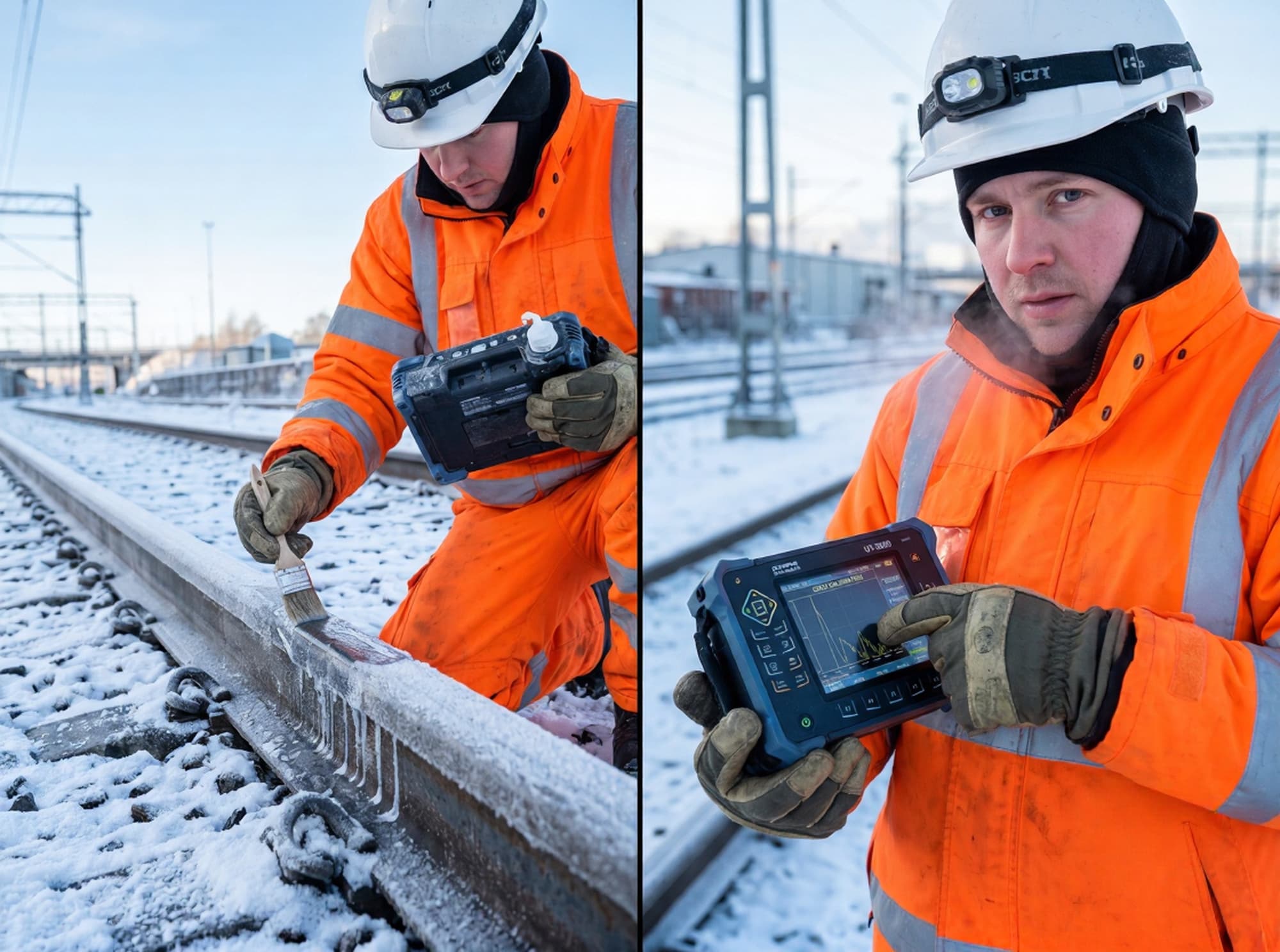
Cold Weather UT Testing: Seasonal Challenges in Temperature, Moisture & Environment
Cold Weather UT Testing faces challenges from freezing temperatures, moisture, frost, and equipment drift that impact inspection accuracy.
Insights
271 articlesPage 7 of 28
Cold Weather UT Testing faces challenges from freezing temperatures, moisture, frost, and equipment drift that impact inspection accuracy.
Rail inspection RFP clauses for ultrasonic testing: cite 49 CFR 213.237, 213.238, 213.241 and 213.113, set valid-search, verification and reporting terms.
How often must rail be tested? FRA rules set visual track inspections weekly to twice weekly and internal rail tests every 370 days or 30 MGT. Full schedule.
Learn how the Mobile Ultrasonic Rail Testing System helps railway operators detect hidden rail defects and reduce costly infrastructure failures.
Ultrasonic rail testing data interpretation: how bolt holes, welds, loss of bottom, 70° transverse defects and false calls look on a rail B-scan.
Rail profile types set the 0° base-echo time and 70° head coverage: 57.1 µs on 115RE vs 63.0 µs on 136RE. Worked examples for older, girder and worn rail.
Guided Wave vs Long Range Ultrasonic Testing explained with 9 facts. Learn differences in range, cost, speed, and applications for rail inspection.
Ultrasonic testing calibration for rail: IIW and V2 range checks, reference rail sensitivity, drift re-tests, 213.238 duties and what an RFP should require.
Flash butt weld inspection for rail: plant vs in-track welds, flat spots and trim cracks, AWS D15.2 and AREMA rules, UT probe angles, base limits, records.
Aluminothermic weld inspection step by step: visual and profile checks, hardness, a UT probe plan for head, web, base and fillets, and acceptance


